
Amper River Crossings and Southern Spearhead Operations
Fuel convoys strained under the weight of thousands of metal jerrycans as the 20th Armored Division prepared its mechanized forces for an unprecedented push across southern Bavaria. Division quartermasters had to deliver nearly forty thousand gallons of fuel each day to keep hundreds of medium tanks, half-tracks, and artillery trucks moving across cratered asphalt and muddy farm lanes. Officers formed Task Force 20 from selected armored and infantry elements of the 20th Armored Division under Combat Command B to solve this logistical problem by concentrating maximum striking power into a single mobile spearhead. Allied supreme headquarters tracked these supply calculations with intense urgency because political leaders in Washington and London worried that delays on the road would allow the Nazi regime to organize a fortified mountain redoubt in the Bavarian Alps. Mechanics worked through the night to replace stripped transmission gears and worn rubber track pads on the M4 Sherman tanks before supply officers waved the lead armored vehicles into their assembly areas.
Tanks of Task Force 20 roared out of these assembly positions on April 28, 1945, initiating a rapid forty-five-mile mechanized spearhead south of the Danube River. Tank commanders kept their vehicle hatches open to spot enemy roadblocks while half-track drivers pushed their heavy machines over back roads at top speed to keep the German defenders off balance. Drivers ignored overheating water pumps and blown tires, pausing only when scout cars reported snipers or abandoned German artillery pieces in the pine woods. Government officials in Allied capitals monitored the daily mileage of this southern drive on their war maps, knowing that a rapid military collapse in Bavaria would weaken German bargaining power in any surrender talks. Lead scouts from the cavalry reconnaissance troop pressed forward through small farming villages, bypassing isolated pockets of enemy infantry so the main column would not lose momentum.
Engineers closely followed these forward scouts toward the Amper River, scanning the riverbanks where German demolition squads were wiring explosive charges to every timber and concrete span. Task Force 20 attacked the crossing sites before the retreating German garrison could trigger their blasting caps, securing four critical bridges over the Amper River intact to enable the armored dash toward Munich. Gun crews on the leading tanks fired their high-explosive shells into nearby concrete pillboxes and machine-gun nests, covering infantrymen who sprinted across the spans to cut detonation wires with bayonets and wire cutters. Diplomatic cables carried word of these intact crossings back to Supreme Headquarters Allied Expeditionary Force, where generals and diplomats recognized that the capture of the river line removed the last natural barrier guarding the birthplace of the Nazi movement. Armored infantrymen established perimeter machine-gun posts on the southern banks of the river while tank retrieval crews dragged disabled scout vehicles out of the road lanes so the heavier armor could roll across without stopping.
Half-tracks and medium tanks rumbled over the wooden bridge decking in continuous files, turning their main gun turrets toward the northern suburbs of Munich just miles away. German commanders had planned to establish an artillery barrier along the Amper River to buy time for political leaders in Berlin, but the sudden bridge captures shattered their defensive line before rear-guard batteries could unlimber their guns. Allied high commissioners seized on this rapid breakthrough to prepare immediate governance decrees for southern Germany, recognizing that the imminent fall of Munich would foreclose any remaining German hopes of negotiating a split between western forces and Soviet armies. Battalion commanders ordered tank crews to refuel from trailing trucks along the roadside, replenish their thirty-caliber machine-gun belts, and form an assault line aimed directly at the fortified defensive ring around Neuherberg.
Tank Assaults on the Neuherberg Fortifications
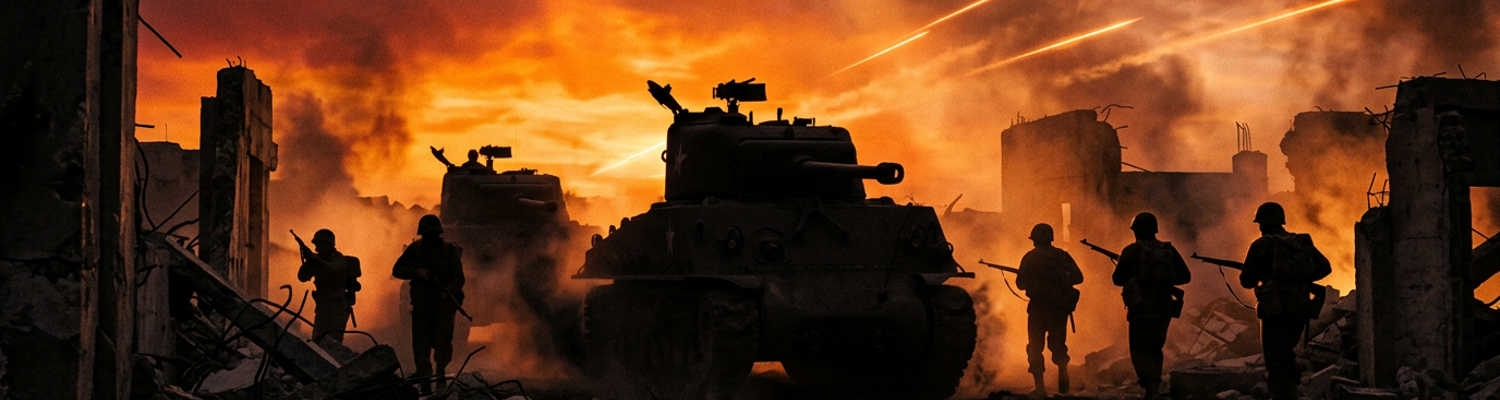
Sherman tanks surged across open farm fields to strike the fortified defensive ring on April 29, 1945, opening the mechanized engagement against the Neuherberg SS Training Center and Anti-Tank School. Gun crews fired high-explosive shells into reinforced concrete obstacles and perimeter guard towers, clearing avenues for trailing half-tracks loaded with armored infantrymen. SS instructors and advanced student gunners manned fortified earthworks and masonry barracks, deploying their school training weapons to block the northern approaches to Munich. Tank commanders maintained a steady combat pace under heavy mortar fire, knowing that political leaders in Washington and London were closely watching the clock to prevent German forces from consolidating a southern mountain bastion. Vehicle drivers crushed through outer wire entanglements and anti-tank ditches, forcing the defending SS detachments to withdraw into their secondary belt of concealed concrete pillboxes and heavy gun pits.
Artillerymen inside these fortified pits manned twelve entrenched 88-millimeter dual-purpose anti-tank guns to blast the approaching American armor with high-velocity direct fire. Armor-piercing shells slammed into the lead tanks, shearing off track links, puncturing road wheels, and pinning down the accompanying infantry squads in water-filled ditches. Task Force 20 responded by organizing rapid direct-fire suppression, directing tank main guns and heavy machine guns against each enemy gun position in sequenced volleys. Tank gunners fired smoke rounds to blind the German optical sights, followed immediately by high-explosive shells that shattered the steel gun shields and detonated stockpiles of German artillery ammunition. Allied high command received real-time radio updates of this duel, recognizing that breaking this heavy battery would eliminate the last operational artillery regiment protecting the Nazi administrative heartland. Combat engineers and tank crews completed the elimination of twelve entrenched 88-millimeter dual-purpose anti-tank guns before nightfall, crushing the disabled barrels under steel tracks to ensure the weapons could never fire again.
Infantrymen advanced past the crushed gun positions alongside the tanks on the morning of April 30 to begin the systematic clearance of fortified enemy dugouts and dense concealed Panzerfaust ambush positions. Coordinated armor and infantry teams moved through the dense pine stands and campus grounds, with foot soldiers scanning brush piles while vehicle machine gunners laid down grazing fire across open trenches. German tank-hunter squads waited in camouflaged spider holes and log-roofed bunkers, attempting to ambush the flanks of passing Shermans with short-range shaped-charge rockets. Riflemen countered these ambushes by establishing mutually supporting fire teams, throwing white phosphorus and fragmentation grenades into dugout ventilation shafts while tank main guns breached the fortified log roofs at point-blank range. American tank drivers pinned remaining enemy fighters inside collapsed shelters, neutralizing the anti-tank rocket threats and systematically securing the central courtyards of the school compound.
Officers inside the captured school compound seized operational map rooms and communication centers, discovering evidence of complete organizational collapse among the regional German defenses. Radio transmitters relayed news of the breakthrough directly to Supreme Headquarters Allied Expeditionary Force, where diplomats understood that the destruction of this SS stronghold left Munich entirely undefended. German regional commanders realized that their military leverage had vanished, prompting civilian leaders and military officers in the city to initiate surrender discussions with advancing American representatives. Allied planners in Washington and London adjusted their postwar military occupation boundaries accordingly, knowing that the swift elimination of this SS anti-tank school foreclosed any possibility of a Nazi redoubt in the Bavarian mountains. Task Force 20 refueled its tanks in the captured training facility, consolidated its prisoner collection points, and pivoted its mechanized column southward down the final paved highway toward the center of Munich.
Armor Penetration of Northern Munich Outer Defenses
Sherman tanks accelerated down the paved highway toward the fortified northern perimeter, overrunning concrete machine-gun bunkers and trench networks while inflicting hundreds of casualties on defending SS and Wehrmacht troops. Vehicle gunners blasted reinforced roadblocks with high-explosive shells, tearing through barbed wire entanglements and collapsing defensive earthworks before German artillery batteries could coordinate counter-battery fire. News of this sudden tactical breach reached the regional German command network within minutes, convincing senior military officials in Munich that their outer defensive belt had been permanently lost. Radio operators transmitted dispatches detailing the rapid disintegration of the perimeter directly to Supreme Headquarters Allied Expeditionary Force, where military leaders recognized that the northern approaches to the Nazi administrative capital lay completely open. Task Force 20 pressed its mechanized companies through the shattered perimeter, cutting off escape routes into the city center and surrounding clusters of bewildered German garrison troops.
Infantrymen from the disintegrating German garrisons threw down their rifles and emerged from concrete shelters, enabling the capture of eight hundred German prisoners following the rapid collapse of northern defensive strongpoints. Armored infantry squads and military police disarmed the captive soldiers, searching them for concealed hand grenades and separating field officers from enlisted recruits along the highway verges. Government officials in Washington and London evaluated this sudden influx of prisoners as tangible proof that organized German resistance in southern Bavaria had dissolved. Allied civil affairs administrators used the operational reports of these mass surrenders to expedite the implementation of military governance frameworks, ensuring that regional civilian infrastructure could be stabilized without protracted urban combat. Armored crews directed the long files of captured troops into secure rear-echelon collection yards, clearing the paved approaches so logistics trucks could deliver fresh ammunition and fuel to the front lines.
Trucks delivering these vital supplies rolled past the captured command sectors, allowing intelligence specialists to seize operational map tables, radio logs, and casualty reports abandoned by fleeing German headquarters staff. Analysts translated these captured documents on folding tables along the roadside, mapping how the sudden armored penetration had paralyzed the German regional communication net. Intelligence couriers forwarded carbon copies of these tactical evaluations directly to the State Department in Washington and the Foreign Office in London, where Allied diplomats used the collapse of Munich outer defenses to assert complete administrative authority over southern Germany. Allied diplomats presented these reports during discussions with Soviet representatives, pointing to the rapid capture of Bavaria as proof that Western armies had successfully eliminated all Nazi military resistance across the region. Field clerks stamped and packaged the original operation summaries, prisoner manifests, and casualty estimates into official divisional files for permanent transfer to military archives in the United States.
Couriers delivered these divisional records across the Atlantic to military authorities, who preserved the battle documents inside central War Department repositories. Officials completed the declassification and documentation of the assault records under War Department Adjutant General 370.24 unit citation reviews in October 1945, establishing an authoritative historical record of the armored breakthrough. War Department analysts reviewed the declassified operational files to study how the coordinated use of armor and mechanized infantry had dismantled prepared concrete fortifications in a matter of hours. Technical evaluators incorporated the combat data into postwar doctrine manuals, demonstrating to military planners how rapid tactical strikes could produce immediate strategic and geopolitical outcomes. Combat engineers in the field pushed disabled German anti-tank guns off the roadway and detached demolition cables from local bridges, opening the southern highway for following Allied infantry divisions to advance directly into the urban center of Munich.
Government Directives and Bavarian Surrender Negotiations
Allied assault forces surged down this cleared southern roadway directly into the municipal limits of Munich, shattering any remaining defensive cohesion among the garrison. Nazi party officials and local military commanders had planned to use the administrative capital as a formidable bargaining chip, threatening prolonged street fighting to extract conditional surrender terms from the Western allies. The rapid penetration of Munich outer works destroyed this leverage entirely, precluding local Nazi leaders from leveraging the city for negotiated concessions. German staff officers discovered that their defensive perimeter was irreparably fractured, leaving them without heavy artillery batteries, organized trench lines, or intact battalions to back up their political demands. American tanks and motorized columns fanned out across wide residential avenues, cutting off escape routes toward the Bavarian Alps and surrounding regional command centers before local authorities could dispatch surrender envoys. Panzerfaust teams scattered into side alleys as high-explosive tank shells smashed through barricades of overturned streetcars and felled trees, trapping senior Nazi administrators inside their fortified office complexes.
Rifle squads and armored vehicle crews pushed past these fortified office complexes into the central boulevards, colliding directly with the operational disruption of the anti-Nazi Freiheitsaktion Bayern uprising across multiple city blocks. Rebel soldiers belonging to this Bavarian resistance organization had seized local radio transmitters and government posts hours earlier to declare an end to Nazi rule, but fanatic SS units had launched brutal counterattacks to execute the mutineers and retake key facilities. The sudden appearance of American armor abruptly severed these street battles, catching both resistance fighters and diehard defenders in chaotic urban crossfire. Company commanders immediately deployed their infantrymen to protect municipal waterworks, restore electrical service, and disarm remaining SS snipers concealed in residential attics and church steeples. Civil affairs teams established strict curfews, confiscated small arms from irregular combatants, and implemented immediate military government stabilization efforts by securing city halls, banks, and food storehouses. Field officers appointed temporary civilian administrators to manage medical aid and bread supplies, while communications specialists seized local telephone exchanges to reestablish regional communication lines.
Signal officers tapped directly into these seized telephone lines and high-powered mobile transmitters to send operational updates across Europe, producing diplomatic shockwaves transmitted to Supreme Headquarters Allied Expeditionary Force concerning the sudden collapse of southern Germany. Allied supreme commanders and government leaders had long anticipated that Nazi forces would make a protracted, bloody last stand inside a fortified Alpine fortress. The complete disintegration of German resistance in Munich exposed this southern mountain redoubt as a logistical impossibility, demonstrating that the Nazi regime had neither the fuel, the ammunition, nor the organized troop formations needed to hold the Alps. Diplomatic delegations in London and Washington utilized these breakthrough reports to demand total German compliance on every front, denying regional commanders any opportunity to negotiate separate armistices or divide the Western allies from the Soviet Union. American corps commanders ordered fresh armored divisions to bypass the pacified city, driving eastward along the highway toward the Austrian frontier to complete the encirclement of remaining enemy field armies. Tank crews refueled their vehicles from mobile tanker trucks and loaded fresh crates of machine-gun ammunition, readying their weapons to push across the Inn River.
War Department Citation Reviews and Occupation Policy
Scout cars from the cavalry reconnaissance troop rolled down the gravel embankments of the Inn River to probe the far shore, encountering abandoned field guns and empty ammunition bunkers instead of fortified defense lines. Patrol drivers pushed their light armored vehicles across undamaged wooden bridges and shallow gravel fords into the southern valleys, where local townspeople hung white bedsheets from second-story windows to signal immediate surrender. Reconnaissance officers transmitted detailed terrain surveys showing that the German army had completely disintegrated across the Alpine approaches, initiating the strategic dismantling of high-level Allied anxieties regarding a coordinated German retreat into the Alpine National Redoubt. Supreme Allied Commander Dwight Eisenhower and joint intelligence staffs in London had spent months diverting entire field armies southward to prevent Nazi leaders from establishing a fortified mountain sanctuary. Tank crews from Combat Command A proved through their rapid southern dash that German logistics had totally collapsed, leaving enemy forces without the gasoline, spare engine parts, or organized infantry divisions needed to sustain mountain defense works. Corps commanders halted further heavy artillery bombardments along the river basin and dispatched specialized civil affairs units into the pacified cities.
Officers belonging to these newly arrived civil affairs units set up operational headquarters inside municipal buildings to oversee the establishment of initial American military governance structures across the municipal and regional authority sectors of Bavaria. Soldiers in steel helmets posted official bilingual military government proclamations on stone courthouse walls and town market squares, announcing strict nightly curfews, mandatory weapons surrenders, and immediate travel bans for all local residents. Civil affairs teams established regional supply points inside seized railway warehouses and grain depots, using captured German transport trucks to distribute flour, clean drinking water, and field medical dressings to thousands of displaced persons and townspeople. Field administrators took direct operational command of municipal police headquarters, electrical transformer yards, and telephone relay stations, posting armed sentries at power switches to safeguard public utilities from sabotage and prevent civil disorder. Counter-intelligence agents systematically screened German civil servants against captured Nazi Party membership rolls, arresting senior party functionaries while vetting essential civil engineers and sanitation workers to keep municipal water filtration plants, hospitals, and bakeries running. Administrative clerks bundled these daily governance summaries together with tactical combat dispatches, preparing the official paperwork for courier transport to senior military headquarters.
Couriers delivered these civil affairs reports and combat logs directly to the Pentagon for the formal review of Combat Command B operational performance documented in War Department Adjutant General 370.24 files. Analysts in the Adjutant General office examined battle logs, casualty tallies, and ammunition expenditures to evaluate how Task Force 20 had executed its synchronized assault against heavy concrete pillboxes and dual-purpose guns at Neuherberg. Evaluators noted that coordinating medium tank firepower with dismounted armored infantry sweeps had suppressed camouflaged anti-tank nests, shattered fortified road barriers, and prevented defending forces from blowing critical highway bridges over southern Bavarian rivers. Technical experts extracted practical combat data regarding tank fuel consumption rates, suspension wear on unpaved gravel roads, and vehicular radio performance under fire to update future tactical training doctrine for United States armored divisions. Senior military officials used these combat evaluations to demonstrate that rapid combined-arms mobility could shatter enemy field formations before they could reorganize, directly accelerating the transition from intense tactical warfare to stable territorial occupation. File clerks stamped the operational assessment binders with official War Department approval seals and transferred the complete documentation sets into permanent steel filing cabinets in the military records depository.