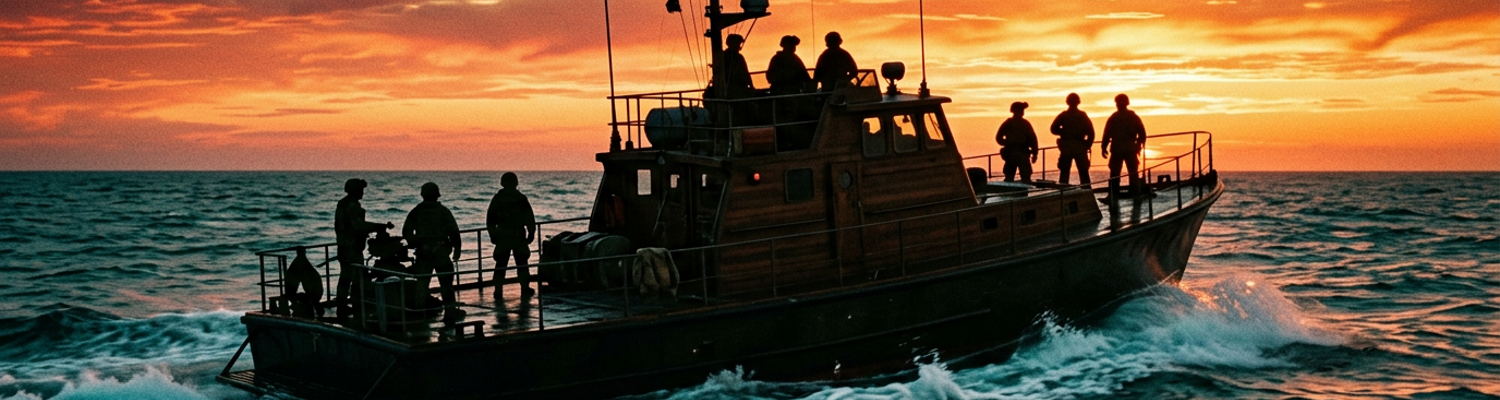

Maritime Boundary Enforcement Under USCAR Mandates
Soldiers scraped thick green mold from their canvas webbing while heavy diesel fumes hung over the sweltering patrol docks at Naha. Crews spent weeks surviving on stale canned rations and warm drinking water because military cargo freighters from Yokohama suffered constant mechanical breakdowns and delivery delays. Saltwater corroded the hulls of their wooden picket boats faster than maintenance depots could issue replacement zinc plates, fresh fuel filters, and new water pumps. Tropical storms battered the exposed harbor moorings throughout the summer months, tearing thick radar cables loose from shore masts and leaving lookouts completely blind along the outer barrier reefs. Army leaders openly blamed Navy supply officers for hoarding drummed aviation fuel and brass marine parts, creating bitter arguments between headquarters commands before patrol boats even slipped their mooring lines. Army staff officers responded to these mechanical failures by issuing rigid legal decrees to force rival Navy detachments and native maritime police units under joint military control.
USCAR Civil Administration Proclamation 27 and Ordinance 68 delineated strict maritime control zones across the Ryukyu Archipelago to turn those paper commands into enforceable borders. These security regulations barred native fishing junks, commercial freighters, and foreign trawlers from crossing designated perimeter lines without advance clearance pennants and military transit permits. Naval liaison officers argued furiously against the mandates because their small patrol detachments lacked the ships, fuel rations, and radar sets needed to cover thousands of square miles of rough ocean. Army administrators brushed these operational protests aside and insisted that Navy skippers board every unidentified craft found inside the boundary coordinates. Sailors repeatedly watched overloaded cargo luggers slip across shallow reef gaps where deep-draft Navy sub-chasers could not follow without ripping open their steel hulls on jagged coral heads.
Radar operators tracked the escaping luggers from hilltop bunker stations while the Office of the Civil Administrator established systematic coastal surveillance grids across the Nansei Shoto to halt smuggling and illicit transit. Spotters plotted geographic grid coordinates across grimy wall maps with grease pencils, attempting to steer unarmed Ryukyu Police patrol craft toward suspect vessels in the narrow channels between Okinawa and Miyako. Local police captains lacked compatible high-frequency radios to communicate directly with offshore American destroyers, forcing station lookouts to route urgent target coordinates through overburdened Army telephone switchboards. Static crackled through worn receiver headsets during tropical rain squalls, garbling vessel locations and delaying tactical interception orders by several critical hours. Contraband runners exploited these communication breakdowns by moving black-market sugar, commercial medicines, and undocumented passengers past unmonitored harbor checkpoints under the cover of darkness.
Troops intercepted a cluster of blacked-out wooden junks after frustrated Army commanders bypassed standard administrative channels to authorize direct midnight boardings. Armed soldiers and Ryukyu Police officers leaped onto slick cargo decks with drawn carbines, wrestling smugglers away from rumbling diesel throttles and confiscating forged vessel registries. Navy commanders lodged furious formal protests against Army jurisdiction early the following morning, arguing that ground force officers had broken maritime protocol by seizing ships outside designated harbor boundaries. Garrison commanders dismissed the naval paperwork without reading it and locked thirty tons of seized commercial contraband inside secure military warehouses along the Naha waterfront. Sentries bolted heavy iron padlocks onto the warehouse doors and established armed perimeter patrols to prevent naval personnel from inspecting the confiscated cargo.
Army Transportation Corps Patrol Boat Transfers
Army Transportation Corps mechanics hauled surplus military harbor patrol craft out of storage slips along the Naha waterfront to relieve ground garrisons of direct intercept duties. Welders cut away rust-rotted deck plating and overhauled worn marine diesel engines across the small fleet so the vessels could be transferred directly to the Government of the Ryukyu Islands Police. Civilian shipwrights worked under tropical heat alongside military technicians, stripping off delicate military electronics and replacing corroded seawater coolant lines with heavy galvanized steel pipe. Army staff officers intended these refitted wooden and steel hulls to take over regular boundary interdictions, allowing frontline troops to return to base perimeter security and cargo transport missions. Ryukyu police commanders boarded the freshly painted patrol boats for initial sea trials, only to discover that the stripped vessels carried neither marine radar nor mounted weapons to defend their crews against hostile offshore crews.
Machine guns remained strictly forbidden on the transferred craft because civil administrators feared political fallout and native protests over arming civilian maritime patrols. USCAR officials debated armaments authorizations for weeks with Army security officers, eventually allowing the police crews nothing heavier than standard service revolvers and a few surplus carbines. Naval liaison officers openly objected to this restriction, warning that lightly armed police boats could never intimidate large, reinforced foreign trawlers that operated without clearance along the outer reef borders. Smugglers frequently ignored warning shots from small-caliber rifles, using their heavy wooden bows to sideswipe the patrol craft and snap their steering rudders in rough water. Ryukyu police captains submitted urgent requisitions for armored gun shields and forward deck mounts, but garrison headquarters rejected each petition and locked all spare ordnance inside guarded harbor vaults.
Fuel drums stacked on the adjacent docks triggered an equally bitter inter-service clash over supply allocation protocols for the surviving patrol vessels. Navy supply officers controlled the primary marine fuel reserves at Buckner Bay and refused to release standard diesel quotas to the Government of the Ryukyu Islands Police without direct accounting reimbursements from Army budgets. Army administrators responded by ordering local police commanders to cut their patrol runs in half, which left large stretches of the Ryukyu frontier unguarded for days at a time. Strict vessel maintenance schedules collapsed under the same bureaucratic deadlock because civilian mechanics lacked access to military drydock facilities, specialized tools, and genuine engine replacement parts. Sand and salt crust clogged unprotected seawater intakes while engine blocks warped from constant overheating, leaving half of the newly transferred patrol boats dead in the water at their berths.
Mechanics cannibalized brass fittings, copper fuel lines, and rubber gaskets from junked utility barges along the Naha mudflats to bypass the stalled military supply pipeline. Ryukyu police officers worked by flashlight through humid nights reassembling diesel injectors by hand, determined to get their crippled vessels back into service before the next tidal influx of contraband traffic. Army Transportation Corps dispatchers monitored the improvised repairs and pushed two seaworthy craft directly into the choppy channels between Okinawa and the Kerama Islands. Patrol skippers immediately throttled back their engines to an economical crawl, carefully nursing their remaining fuel rations while shadowing darkened cargo luggers against the jagged barrier reefs.
Jurisdictional Disputes with Seventh Fleet Liaisons
Seventh Fleet liaison officers tracked those shadowed luggers on shipboard radar screens and ordered armed naval patrol craft into the same reef channels without notifying island administrators. US Army Civil Affairs officers clashed with US Seventh Fleet liaison officers over overlapping authority within coastal waters as soon as both services claimed the legal right to seize the vessels. Army administrators maintained that USCAR proclamations granted the civil government sole jurisdictional custody over all civilian craft operating within three miles of the Ryukyu coastline. Naval staff officers rejected that boundary entirely, arguing that Pacific Command directives tasked the Seventh Fleet with absolute defense of the outer island chains and supreme authority over all maritime traffic regardless of distance from shore. Heated telephone exchanges between headquarters bunkers in Naha and fleet offices at Buckner Bay erupted into administrative warfare before patrol craft even reached the outer reefs. Armed naval boarding crews pulled their motorized launches directly alongside the trapped civilian craft and ordered Ryukyu police officers to back away under threat of military impoundment.
Army administrators countered those threats by sending urgent field couriers to harbor docks, instructing police coxswains to maintain physical possession of every seized hull at all costs. Disputes between Army administrators and naval commands centered on boarding jurisdictions, vessel interception protocols, and restricted radio frequencies that left both branches competing for control on the open water. Interception protocols collapsed whenever an unidentified target appeared on radar, because Army standing orders mandated immediate pursuit by small harbor craft while Navy doctrine required offshore identification, searchlight illumination, and warning flares before any approach. Soldiers and sailors argued face to face across wet cargo decks over conflicting boarding jurisdictions, brandishing competing paperwork while suspect civilian crews quietly dumped sacks of untaxed goods into the sea behind them. Naval task unit commanders refused to transfer contraband seizures to USCAR court registries, choosing instead to tow captured luggers directly into naval anchorages and lock the cargoes inside naval warehouses.
Radio frequencies reserved exclusively for naval task forces prevented Army dispatchers from tracking those seized vessels or coordinating with offshore naval cutters during coastal operations. Seventh Fleet communications officers designated tactical fleet bands as restricted radio frequencies to protect offshore defense grids, refusing to issue clearance codes or crystal tuners to civil affairs personnel. Army radio operators at coastal listening posts had to transmit intercept coordinates over unencrypted commercial frequencies, broadcasting vessel locations across open airwaves where civilian contraband runners could easily hear every transmission. Static interference and rigid transmission silences frequently drowned out urgent navigation warnings, causing Ryukyu police boats and deep-draft naval destroyers to maneuver on dangerous collision courses inside narrow reef passages. Naval liaison officers dismissed Army complaints about missing targets and refused to alter their operational schedules to accommodate civilian administration patrols. Civil administrators responded by ordering Ryukyu police crews to shut down their shared transponders and execute independent midnight boardings along the contested reef lines.
Signal Breakdown in the Daisan Seitoku Maru Crisis
Police cutters operating with dark transponders vanished from Seventh Fleet radar consoles, creating wide surveillance gaps across the outer margins of the Nansei Shoto. Unmonitored civilian fishing craft drifted through these blind zones without air cover or naval protection while hunting for catches along the remote maritime frontier. In March 1955 the Okinawan fishing boat Daisan Seitoku Maru sailed directly into these exposed waters near the Senkaku islets to work the offshore reefs. Foreign armed junks suddenly emerged from the morning haze, surrounding the wooden fishing boat and raking its wheelhouse with automatic rifle fire. Hostile boarding parties clambered onto the bloodstained deck, fatally shooting crew members and forcing survivors into the water before the attackers abandoned the damaged vessel. Neighboring island fishermen witnessed the attack from distant rocky shoals and broadcast urgent distress calls on low-power commercial radios.
Army civil monitoring stations at Naha suffered severe radio isolation, preventing real-time coordination with offshore naval patrols when the emergency calls hit the airwaves. Commercial atmospheric interference and corroded copper antennas choked incoming signals down to broken bursts of static across Army receiver banks. Island listening posts operated on low-frequency voice bands, but Seventh Fleet destroyers and air squadrons monitored ultra-high-frequency tactical channels that civil administration personnel were legally barred from using. Army radio technicians twisted manual tuning dials on their switchboards for hours, unable to patch the civilian distress relays into naval operations centers across the island. Hand-delivered teletype messages finally reached naval watch officers at Buckner Bay after long transit delays over rutted dirt roads, but fleet dispatchers refused to launch sea planes without confirmed coordinates and formal service clearances.
Navy officers argued through the afternoon with Army staff over who held tactical jurisdiction in the Senkaku waters, leaving the surviving Okinawan crew with no armed support. Seventh Fleet liaison officers insisted that Pacific Command directives prioritized defense against hostile combat fleets rather than chasing unidentified pirate junks across remote islet shoals. Ryukyu police commanders in Naha attempted to fuel their own patched harbor boats to launch a civilian rescue mission, but Navy depot managers once again refused to release emergency diesel rations without cash payment. Coastal monitoring stations continued to log faint radio echoes from the Senkaku area as local fishing families gathered outside the harbor gates to demand information on the missing men. Frustrated Army civil administrators bypassed their locked teletype rooms and sent armed couriers directly to fleet headquarters with orders to demand immediate air reconnaissance.
Pilots from the Seventh Fleet finally flew over the Senkaku reefs late the following day, spotting only empty waters, drifting debris, and no trace of the attacking junks or the missing crewmen. Air crews dropped smoke markers over the reef passage before returning to Kadena Airfield without firing a shot or making contact with the foreign junks. Government of the Ryukyu Islands leaders lodged bitter formal protests with civil administrators in Naha, accusing the military government of leaving native mariners defenseless against armed raiders. Army colonels responded by padlocking their coastal monitoring shacks to naval liaison personnel and establishing independent emergency watch rosters along the Naha docks. Both military services began fortifying their separate communications networks, ensuring that neither command could track or question the other service patrol movements across the southern waters.
High Commissioner Reforms and Integrated Command Protocols
Teletype machines in Naha continued spewing uncoordinated patrol reports until the High Commissioner of the Ryukyu Islands intervened to break the bureaucratic stalemate between rival service headquarters. The High Commissioner restructured maritime operating procedures to eliminate inter-agency response delays that had crippled coastal interceptions during recent border crises. Staff directors ordered both Army logistics officers and Seventh Fleet commanders to submit their daily vessel positions, radar plots, and fuel allocations directly to a centralized civil-military watch center. Technicians from the signal corps immediately began tearing down the padlocked switchboards inside coastal observation huts and wiring the lines into a single combined operations room. Watch officers from the Army, Navy, and civilian administration now sat at the same plotting table, marking radar contacts on a shared maritime map as soon as sightings came across the wire.
Radio crystals and common tactical frequencies arrived at harbor docks next, replacing the mismatched voice radios that had kept civil and military crews deaf to one another. New directives unified communications channels and clarified boarding authorities between the Ryukyu Police and military authorities across all offshore intercept zones. Signalmen bolted standardized multi-channel transceivers directly into the wheelhouses of Ryukyu Police patrol craft, linking local coxswains with Navy destroyers and Army coastal radar posts on a single emergency frequency. These new command rules clearly designated civilian police officers as the primary boarding parties for any civilian fishing vessels or cargo luggers found inside island reef passages. Armed soldiers and sailors were barred from jumping onto civilian decks unless local police officers met armed resistance and requested immediate military firepower.
Ryukyu Police boarding details drilled alongside naval harbor boat teams along the Naha waterfront to practice the exact handoff sequence required by the new protocols. Officers rehearsed approaching suspect luggers with searchlights blazing while armed Navy launches hung back three hundred yards off the beam to provide heavy machine gun cover without violating civilian jurisdiction. Supply depots at Buckner Bay received binding orders to release drummed diesel fuel and spare marine engine parts to the civilian police fleet on an equal priority with military utility craft. Maintenance mechanics cleared away backlog work on drydocked police cutters within weeks, reinstalling overhauled injectors and bolting fresh zinc plates onto the exposed wooden hulls. Police dispatchers maintained steady radio contact with naval radar watchstanders throughout every drill, reporting engine status and vessel headings without experiencing the dropped signals of earlier seasons.
Lookouts stationed at coastal radar posts spotted their first real operational test when an unidentified flotilla of foreign cargo boats entered the shallow channels near the Kerama Islands under heavy rain. Centralized watch officers in Naha relayed the coordinates simultaneously to both a Seventh Fleet destroyer patrol and two Ryukyu Police cutters running on the common tactical frequency. Police coxswains accelerated into the reef passage, pulled alongside the lead cargo vessel, and secured the deck under the glare of their own spotlight without naval interference. Sailors aboard the trailing Navy launch held their station outside the breaker line, tracking the encounter through night-vision optics and maintaining an open radio guard until police officers confirmed the cargo was legitimate commercial trade. Army civil affairs dispatchers logged the completed inspection in the unified register within twenty minutes of the initial contact, filing the seizure reports into shared headquarters files without a single jurisdictional complaint.