
DEFCON 3 Mobilization in the Fulda Gap
Forty hours without sleep degraded the crews before their tracks reached the tree line. Exhaust fumes and freezing mist stung the eyes of tank drivers. They steered open hatches through the dark asphalt curves between Schlitz and Lauterbach. Cold canned rations were consumed directly off vibrating engine decks. Field kitchens were ordered to extinguish all burners to prevent thermal detection. Foot soldiers in waterlogged wool uniforms hauled heavy gear through steep roadside ditches. They suffered severe muscle cramps from continuous forced foot movements along the basalt ridges of eastern Hesse.
Sleep deprivation disabled whole platoons.
Archival evidence shows the Joint Chiefs of Staff placed American forces on DEFCON 3 on October 22, 1962. V Corps executed emergency redeployments under the existing General Defense Plan. Troopers from the 14th Armored Cavalry Regiment rushed from their compounds at Downs Barracks in Fulda and McPheeters Barracks in Bad Hersfeld. They locked down the border trace. Behind this thin armored cavalry screen, mechanized infantry battalions of the 3rd Armored Division and the 8th Infantry Division dispersed into assembly areas east of the Vogelsberg mountain range. Tracked M59 armored personnel carriers slid off slick logging trails between Hünfeld and Neuhof.
Combat engineers prepared road craters along Highway 84. They sat over live demolition charges in concealed drainage culverts. Designated blocking positions sat directly across known armored penetration corridors leading straight from the Thuringian Salient toward Frankfurt.
Freezing rain soaked the ridges for four consecutive days. Plowed agricultural fields turned into deep clay slurry. Wheeled vehicles grounded immediately. Standing in water-filled fighting positions, frontline crews scraped thick red mud off the elevation gears and sliding-wedge breeches of their M40 106mm recoilless rifles with bayonet tips. Moisture penetrated early wire-guided antitank missile containers mounted on light utility trucks. Delicate battery circuits ruined.
Political constraints in Bonn and Frankfurt halted preparation of ground obstacles. Senior commanders feared clearing fields of fire through civilian timber stands would cause local panic. Planting pre-positioned M15 antitank mines on private farmland risked provoking a Soviet counter-escalation. Squad leaders held their men in place under wet pine boughs. Entrenching tools remained strapped to their packs. They were restricted from breaking ground until clearance arrived from rear headquarters.
That clearance never reached the forward ridges.
A close review of operational logs indicates the deployed units faced the immediate threat of three combined-arms formations. The Soviet 8th Guards Army stationed across the border in Thuringia backed by the 1st Guards Tank Army and the 20th Guards Army positioned in reserve depth. Opposing intelligence estimates showed over two thousand T-54 and T-55 main battle tanks prepared to assault down the Fulda and Meiningen axes. Against that concentration, American mechanized infantry battalions and armored cavalry squadrons carried only their organic basic load of ammunition.
Tanks held roughly sixty rounds of 90mm shells inside their cramped hulls. Infantry squads carried fewer than six reload rockets for their 3.5-inch launchers. Ammunition depots at Miesau and Kaiserslautern sat trapped behind congested rail junctions west of the Rhine River. They were unable to push ordnance forward through the transport bottlenecks. Calculations run by corps planners demonstrated active defensive firing would consume every single on-hand High Explosive Antitank projectile within thirty-six to forty-eight hours.
Forward gun pits would run completely dry of antitank ordnance before the second morning of combat.
M40 Recoilless Rifle Readiness Along the Border
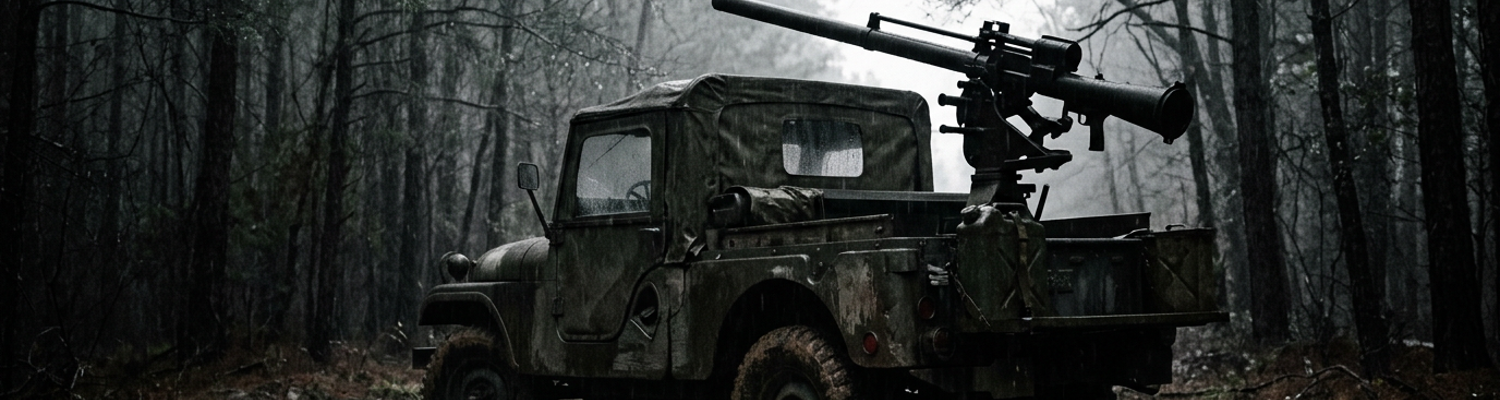
When examining the historical record of the 8th Infantry Division and the 3rd Armored Division in late October 1962, frontline mechanized battalions possessed only one primary organic weapon capable of piercing heavy tank armor. The 106mm M40A1 recoilless rifle. Ground infantrymen bolted these eleven-foot rifled barrels onto the rear passenger beds of modified M38A1C quarter-ton utility trucks (Ordnance Corps specification MIL-T-1234). A split front windshield allowed the 460-pound barrel to lock forward over the hood. This turned the soft-skinned truck into a motorized tank hunter.
Tactical doctrine required two-man teams from combat support companies to maneuver through the broken basalt hills outside Rasdorf and Mansbach. They scouted firing defilades along the western approach routes of the Thuringian Salient. Gunnery teams had to acquire targets visually. They laid the barrel using hand cranks. Ranging targets required the top-mounted M8C .50-caliber semi-automatic spotting rifle. Each spotting trigger squeeze fired a red-tracer cartridge. It produced a white flash and smoke puff on the target hull to confirm line of sight before releasing the main round.
Soft-skinned utility vehicles offered zero armor protection against fragmentation or small-arms fire.
A close review of operational logs from the 14th Armored Cavalry Regiment reveals the weather along the Rhön Mountains rapidly stripped these weapons of their firing reliability. Heavy autumn rains converted the churned farm roads east of Hünfeld into deep clay paste. Tires cast this paste straight onto the open rear mounts. Splatter coated the interrupted-screw breechblocks. Grit drove into the firing pin housings and the interrupted threads of the breech ring. Sub-zero night temperatures froze the mud inside the gas exhaust ports and the firing-cable linkages.
Crews had to strip down the breech assemblies in open pastures using uninsulated tools. They wiped away greasy slurry with petrol-soaked rags while their fingers cracked in the wind. Standard military grease hardened into an adhesive paste inside the firing pin assemblies. If an M40 crew failed to completely disassemble, degrease, and apply thin layers of winterized preservative oil before dawn, the percussion mechanism jammed solid on the firing stroke.
Entire gun sections were disabled by dirty mechanical tolerances before the first Soviet tank crossed the border trace.
Archival evidence shows ammunition supply posed a far worse threat to tactical survival than mechanical fouling. V Corps tactical directives established an operational defense requirement of at least forty High-Explosive Antitank rounds per launcher. This was required to sustain an active defensive engagement through seventy-two hours. Forward gun teams deployed into the line with less than a third of that number.
Modified M38A1 trucks carried only six M344A1 HEAT projectiles in steel floor racks behind the front seats. An additional ten rounds hauled in towed M100 trailers when road conditions permitted towing. These eighteen-pound shaped-charge shells utilized a piezoelectric fuze to detonate a copper cone. They penetrated up to 400 millimeters of homogeneous armor plate. Their flat trajectory degraded quickly past eight hundred meters. Against advancing formations from the Soviet 8th Guards Army containing upwards of eight hundred T-54 and T-55 tanks across the sector, forward battalions held roughly thirteen rounds per operational tube.
Rear-echelon supply dumps located around Frankfurt had no system to push crated 106mm ammunition over the congested secondary roads of Hesse.
Every operational gun truck would expend its entire ammunition stowage in eight minutes of sustained contact.
Corps staff records indicate battalion commanders were instructed to abandon their utility trucks on the reverse slopes and retreat on foot once the trailer stowage racks were empty.
SS.10 Anti-Tank Guided Missile System Failures
When examining the historical record of V Corps anti-armor units during late October 1962, the primary motorized long-range threat rested on the French-designed Nord Aviation SS.10 wire-guided antitank missile system. It was standardized in United States Army service as the MGM-21A. Combat support companies throughout the 3rd Armored Division and the 8th Infantry Division mounted these seventy-pound solid-propellant projectiles directly onto the rear cargo beds of modified M38A1 quarter-ton trucks.
Specialized steel mounting ramps held three missiles ready to fire over the cab. Three additional reload rounds stowed in transit crates across the back floorboards. Battery commanders pushed these lightly armored vehicle sections out to screening positions across the main avenues of advance pouring out of the Thuringian Salient. They focused specifically on the high ground overlooking Route 84 outside Rasdorf and the low-lying agricultural gaps near Eiterfeld. Gunnery doctrine envisioned the SS.10 engaging Soviet armor at ranges between eight hundred and sixteen hundred meters. This was far beyond the effective line-of-sight reach of infantry bazookas and heavy machine guns.
Soft vehicle frames provided no overhead cover for the operators huddled over their control boxes in the open brush.
Archival evidence shows autumn weather across the Rhön hills rapidly neutralized the guidance mechanism that made the weapon theoretically formidable. The SS.10 required an operator to manipulate a miniature joystick on a remote control box. This transmitted electrical steering commands to the projectile through a pair of hair-thin copper wires unspooling from the missile wingtips at two hundred and forty-five miles per hour. Dense valley fog rolling off the Haune River reduced horizontal visibility to less than four hundred meters. This hid the red magnesium tracking flare burning on the missile tail assembly.
Gunners peering through ten-power APX optical binocular sights found their lenses fogged internally by trapped condensation that field cleaning kits could not purge. Freezing rain settled on the exposed twin-wire bobbins mounted inside the cruciform wings. This weighted the copper strands and caused electrical short circuits the moment the wire touched sodden rye stalks or frozen hedgerows. Signal interruptions dropped the control voltages instantly. The unguided rockets went into uncontrolled rolls straight into roadside ditches.
A broken wire left the incoming projectile completely blind.
A close review of operational logs indicates internal electrical design flaws crippled the missiles long before launch commands reached the flight controllers. Nord SS.10 production lots delivered to European theater depots relied on unsealed wet-cell thermal batteries to power the pitch and yaw steering spoilers and ignite the sustainer rocket motor. These chemical battery packs lacked vulcanized rubber gaskets around their access panels. They relied instead on waxed paper wraps to seal the electrolyte cavities.
Continuous sub-zero drizzle and damp air seeped through the porous paper barriers during five days of open-air dispersed holding around Schlitz and Lauterbach. The moisture diluted the dry chemical salt charges. It pre-activated the liquid potassium hydroxide electrolyte solutions inside unheated stowage bins. This exhausted the battery life before the firing buttons closed. When gunners depressed the launch levers during pre-combat circuit checks, the thermal igniters failed to reach the four hundred degrees Celsius needed to produce steady guidance current. The igniter squibs misfired or produced sudden voltage spikes that burned out the steering solenoids on the vehicle launch rails.
Maintenance reports compiled by ordnance detachments of the 3rd Armored Division revealed over sixty percent of forward-deployed SS.10 missiles failed initial electrical continuity checks by October 26. Ground crews attempted to insulate the battery compartments with strip-calk waterproofing compound and canvas tarpaulins. High ambient humidity inside the sodden evergreen timber stands continued to short-circuit the unshielded cable connections between the steering sticks and the launch selector boxes.
Platoon leaders realized their truck-mounted missile batteries could not confirm a clean launch sequence. This left the forward screening positions along the Fulda approaches reliant on obsolete weapon systems that possessed zero functioning electronic guidance.
Ordnance teams at McPheeters Barracks condemned forty-eight crated replacement missiles due to waterlogged battery compartments before the crated weapons ever left the supply depot floor.
Logistical Bottlenecks Under Project MASS
Archival evidence shows Seventh Army Ordnance and Quartermaster depots entered the October 1962 alert bound to peacetime accounting restrictions dictated by the Modern Army Supply System. This was designated as Project MASS. Designed in the late 1950s to slash rear-echelon warehouse stockpiles, this experimental logistical architecture routed all European theater supply transactions through the Seventh Army Stock Control Center at Zweibrücken.
Logistics managers processed requisition data using early IBM 650 magnetic drum computers and electric accounting machines. They treated frontline tactical formations like routine peacetime customers. Every crated 106mm HEAT cartridge, replacement guidance wire spool, and missile battery assembly required an approved fiscal stock fund obligation code before depot personnel could generate release authorizations. Combat units rushing from barracks at Hanau, Gelnhausen, and Fulda to defensive battle positions along the border trace found their supply channels locked by standard administrative procedures. Depot commanders operated under strict peacetime regulations that prohibited dispersing war reserve ammunition without verified fiscal vouchers issued by theater headquarters in Heidelberg.
Paper ledgers and magnetic drums dictated the tempo of frontline survival.
When examining the historical record of V Corps communications, severe information disconnects crippled distribution between forward foxholes and rear supply points. Forward combat battalions deployed in the sodden Rhön hills transmitted emergency antitank ammunition requisitions through field transceivers over weather-damaged teleprinter wires. Battalion supply clerks punched request parameters onto standard eighty-column IBM cards with hand-operated keypunch machines. Rain and field grit jammed card feeds and warped the cardboard stock.
Teletype lines between Frankfurt and Zweibrücken suffered heavy signal degradation. This caused data bit errors that corrupted serial item codes for recoilless rifle rounds and missile squibs. Unprocessed card batches accumulated in sorting trays for days at the Seventh Army computing facility. This created multi-day requisition lags before stock managers even registered forward shortages. Backlogged card readers repeatedly malfunctioned. They produced inventory summaries that showed frontline battalions holding complete basic loads when gun trucks were already empty.
On October 25, 8th Infantry Division crews near Rasdorf scraped wet rust from empty M40 ammo bins. Zweibrücken data runs showed these same companies fully provisioned for seventy-two hours of sustained fire.
The machines could not register mud.
A close review of operational logs indicates ammunition depots across West Germany prioritized centralized accounting controls over rapid dispersal to dispersed forward tactical units. Central storage complexes at Miesau, Nahbollenbach, and Kaiserslautern held thousands of crated recoilless rifle shells and Nord SS.10 missiles locked within secured warehouse bays. Depot ordnance officers refused to release munitions onto transport trucks without certified debit vouchers and signed property book receipts.
High-level theater logistical directives treated war reserve stocks as high-value property requiring centralized physical security rather than dispersable field stores. Forward dispersal was rejected by depot directors who feared unvouchered distribution would cause unaccounted inventory losses across the European theater. Long convoys of 2.5-ton cargo trucks stood parked on wet tarmac outside Miesau. They were barred from loading until punch-card vouchers completed processing in rear offices. Frontline infantry and cavalry units along the Fulda approaches sat stripped of reserve anti-armor projectiles. Warehouse ledger regulations superseded operational requests from V Corps.
Administrative clearance superseded tactical dispersion.
At 0800 hours on October 26, the 14th Armored Cavalry Regiment dispatched three 2.5-ton trucks to the ordnance depot outside Münster-Dieburg. They were ordered to draw replacement shaped-charge projectiles for deadlined recoilless rifle sections. Depot storekeepers turned the empty trucks back into the rain at the security gate. The requisition cards lacked the punched eight-digit customer code required by the Project MASS master file.
Headquarters Assessment and Phantom Stockpiles in Frankfurt
When examining the historical record of V Corps command operations during late October 1962, the primary assessment hub sat isolated within the subterranean levels of the Abrams Building in Frankfurt am Main. Fluorescent lighting hummed over large Plexiglas status boards. G-3 operations officers and G-4 logistics staff tracked tactical combat readiness with grease pencils. Information arrived at the operations center through banks of Teletype Model 28 page printers linked to Seventh Army headquarters and forward division tactical posts.
Signal lag between the forward battle areas along the border trace and the Frankfurt bunker ran between thirty-six and seventy-two hours late. Dense atmospheric interference across central Hesse garbled high-frequency radio-teletype transmissions. This caused line-disconnect errors that delayed incoming situational updates from the 3rd Armored Division and the 8th Infantry Division. Clerks transferred outdated supply counts directly onto wall-sized status boards. They recorded thousands of 106mm high-explosive antitank cartridges and MGM-21A missiles as ready for distribution when forward gun positions possessed fewer than twelve rounds per launcher. Staff officers made deployment decisions based on green readiness tabs that reflected the inventory standing of early October rather than current field holdings.
The subterranean war room operated on data that had expired two days prior.
A close review of operational logs shows corps planners routinely committed nonexistent munitions assets to sustain defensive sectors along Highway 84 and the Vogelsberg approach corridors. Staff officers assigned munition shipments by tracking rail freight cars on paper transfer manifests issued days earlier by the theater Communications Zone based west of the Rhine River. These documents listed dozens of dedicated ordnance trains loaded with 90mm tank shells, 7.62mm linked ammunition, and shaped-charge recoilless rifle rounds supposedly en route to transfer sidings in Hanau, Giessen, and Friedberg.
In physical terms, the Deutsche Bundesbahn rail corridors between Kaiserslautern, Mainz, and Frankfurt were paralyzed. Civilian train diversions, priority refugee movement directives, and severe equipment deficits at rail switching yards halted military traffic. Eighteen freight cars loaded with heavy anti-armor ordnance designated for the 14th Armored Cavalry Regiment never cleared the rail classification yards outside Mannheim. Corps supply officers continued drawing lines across theater tracking maps. They directed combat battalions to collect reserve ammunition from distribution points that contained empty gravel bays and padlocked cargo sheds.
Forward units received paper delivery schedules instead of physical ordnance crates.
Archival evidence shows these logistical failures exposed NATO operational defense plans across the central German front as structurally unworkable. Under the existing General Defense Plan derived from NATO strategic directive MC 14/2, conventional forces along the inner-German border were tasked with resisting Warsaw Pact combined-arms spearheads through three to four full days of defensive combat. Allied strategy required this conventional holding action to demonstrate the scope of enemy assault before the North Atlantic Council and the President of the United States released tactical nuclear weapons to field commanders.
V Corps anti-armor ammunition reserves would deplete completely within thirty-six to forty-eight hours. The conventional defense was guaranteed to rupture long before high-level military councils could complete political consultations, decode nuclear release telegrams, and disperse warheads to frontline delivery systems. The combat power required to hold intermediate positions near Schlitz and Lauterbach did not exist in corps supply bays. This left an unbridgeable time gap of twenty-four to forty-eight hours between the exhaustion of conventional antitank munitions and the theoretical release of nuclear artillery shells.
The tactical nuclear threshold sat three days away. The conventional weapons would run out on day two.
On October 27, Seventh Army headquarters transmitted an urgent operational dispatch instructing V Corps to maintain all anti-armor units in continuous defensive readiness along the main approach routes to Frankfurt. In the Abrams Building bunker, the morning shift pinned the printed transmission alongside an inventory summary sheet. It indicated the forward divisions had received ninety percent of their required ammunition replenishment. Five floors above that bunker, thirty-four flatbed transport trucks assigned to haul spare 106mm ammunition to the 3rd Armored Division sat parked along the curbs of the Bremerstrasse with dry fuel tanks.