
The machinery of modern war depends on a hidden architecture of logistics and technology. In the critical years from the late 1920s through World War II, the United States Army Air Corps, and later the Army Air Forces, relied on just such a system: a continent-spanning network of radio lighthouses. Officially the Low-Frequency Radio Range, this system formed the invisible highways in the sky that guided a generation of aviators, enabled the unprecedented expansion of American air power, and proved fundamental to mobilizing for global conflict. Its development, a story of military foresight and dogged technical innovation, was a foundational element of American aviation dominance.
Signal Corps Forges the Beam
The concept of guiding aircraft with radio signals was not new. German experiments before World War I demonstrated the principle of using overlapping signals to define a course. It was the U.S. Army Signal Corps, however, operating in the austere but innovative environment of the 1920s, that drove the technology from a theoretical curiosity to a practical tool. The Engineering Division at McCook Field in Dayton, Ohio, became the nerve center for this work. The Signal Corps, tasked with all forms of military communication, recognized the profound implications of reliable, all-weather navigation for the nascent air arm.
Working with the National Bureau of Standards under scientists like Dr. J.H. Dellinger, Army engineers tackled the fundamental challenge of creating a directional radio beam a pilot could easily follow. The breakthrough was the A-N system. This involved two crossed loop antennas transmitting distinct, interlocking signals in the 200 to 415 kHz band. One antenna broadcast the Morse code for the letter 'A' (dit-dah), while the second transmitted the letter 'N' (dah-dit). The radiation patterns were shaped like figure-eights and positioned so they overlapped. In the four narrow zones where the signal strength from both antennas was equal, the 'A' and 'N' signals merged into a steady, continuous tone. This tone created four distinct beams, or courses, radiating from the station. If a pilot strayed to one side, the 'A' signal would become dominant. Stray to the other, and the 'N' would take over. The only equipment an aircraft needed was a simple low-frequency receiver and a headset. The pilot literally flew the sound.
Key personnel from the Army Air Corps, like Captain Albert F. Hegenberger, championed these developments. Hegenberger, an aeronautical engineer and pioneering pilot, was chief of the Instrument Branch at McCook Field. His work on blind flying systems, culminating in the first-ever solo flight from takeoff to landing purely on instruments in 1932, demonstrated the immense potential of radio navigation. His advocacy and successful demonstrations provided powerful justification for expanding the radio range network. Parallel commercial efforts, notably by the Ford Motor Company which installed its own prototype ranges in 1926 to support its air freight operations, created a fertile ground for rapid advancement. Ford's engineer Eugene S. Donovan patented a four-course range in 1928, marking a convergence of military experimentation, government science, and commercial interest.
Building the Federal Airways
While the Army provided the initial impetus and technical validation, the large-scale deployment of the radio range network fell to a civilian authority. The Air Commerce Act of 1926 empowered the Department of Commerce to establish and maintain federal airways, including navigational aids. This led to the creation of the Bureau of Lighthouses' Aeronautics Branch, a precursor to the Civil Aeronautics Administration (CAA) and modern FAA. The first official federal radio range station, transferred from the National Bureau of Standards, began operations at Bellefonte, Pennsylvania, in 1928.
This transition to civilian control was pragmatic. The network’s primary initial user was the burgeoning airmail service. The Department of Commerce had the mandate and, eventually, the budget to undertake a national infrastructure project that the Army, facing severe post-WWI budget cuts, could not finance. The Army Air Corps remained deeply involved. It provided continuous technical input, ensuring the network’s design met military requirements for accuracy and reliability. Army planners understood that in a future conflict, these civilian airways would become vital military logistical arteries. The Navy, while pursuing its own ship-based beacon systems, also recognized the utility of the growing terrestrial network for its own transport and patrol aircraft operating over the continental U.S., leading to de facto standardization.
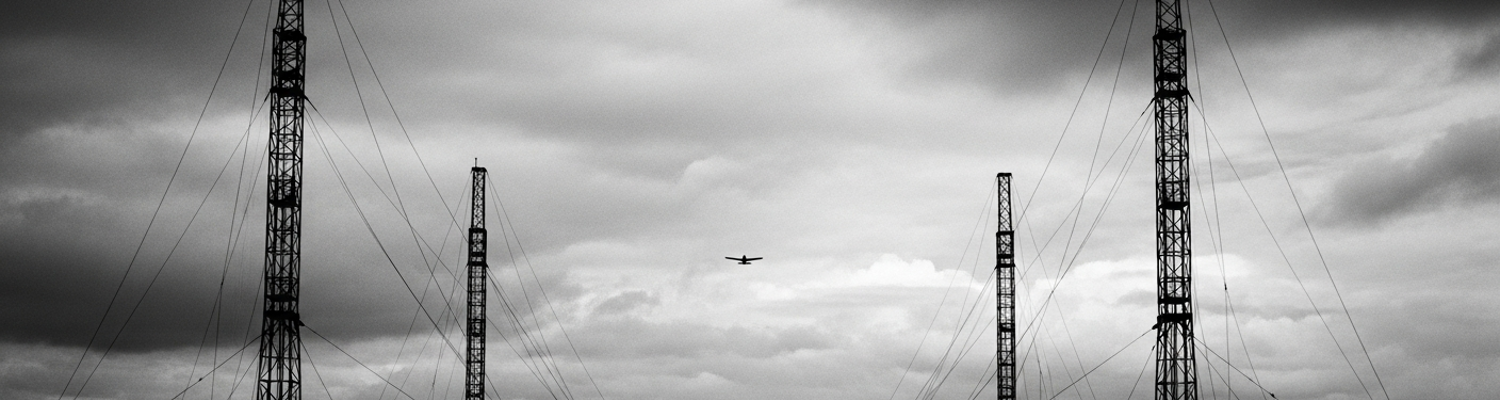
The initial loop antenna stations had a significant flaw known as 'night effect.' At night, low-frequency radio waves reflecting off the ionosphere arrived at the aircraft’s receiver out of phase with the ground wave. This could cause the beams to appear to bend, fade, or create false signals, a terrifying prospect for a pilot flying blind. The solution was the Adcock antenna array. Instead of loops, the Adcock system used four vertical antenna towers, typically around 130 feet tall, arranged in a square. These vertical antennas were far less susceptible to the horizontally polarized skywaves that caused the night effect. Starting in 1932, the Department of Commerce, with the Army’s strong encouragement, began replacing the loop systems with Adcock arrays. By 1933, radio range construction took precedence over the older visual airway beacon lights. The network expanded at a formidable pace. By the late 1930s, a web of over 90 stations marked out 18,000 miles of American airways, a unique and powerful piece of national infrastructure built with military needs in mind.
The Mobilization Grid
The true value of the Army's long-term investment became starkly apparent during the pre-war mobilization. As the nation prepared for conflict, the Army Air Forces underwent explosive expansion. Factories began churning out thousands of aircraft. These machines had to be moved from manufacturing plants in California and Michigan to training centers in Texas and then to coastal ports for shipment overseas. This massive logistical undertaking fell to the newly formed Air Corps Ferrying Command, later the Air Transport Command (ATC).
The Four-Course Radio Range was the backbone of ATC operations within the United States. A young pilot, fresh from flight school, would clamp on a headset in the cockpit of a new P-38 Lightning at Burbank. His mission was to deliver it to a staging field on the East Coast. For hours, his world would shrink to the instruments before him and the sound in his ears. Over the desolate plains, he would listen for the steady hum that told him he was on the beam from the station at Kansas City, identified by its Morse code 'KC' broadcast every thirty seconds. The process was demanding, requiring constant attention to the faint tone amidst a hiss of static. Over the station itself, there was a 'cone of silence,' a brief null in the signal that told the pilot he had arrived, a critical waypoint on his journey before he tuned his receiver to the next station down the line.
This network enabled a scale of aircraft movement previously impossible. It allowed for continuous, 24-hour operations, freeing ferrying flights from the constraints of daylight and good weather. A B-24 Liberator built at Willow Run could be flown via the ranges to a modification center in Dallas, then to a deployment base in Florida, all with a reliability that astounded the world. This rapid movement was essential for the AAF’s training pipeline. Squadrons could form up, receive new aircraft, and deploy in a fraction of the time it would have taken otherwise. The system was not perfect. Severe weather static could drown out the signal, and mountainous terrain could cause beams to bend, creating dangerous false courses. The mental fatigue of 'flying the beam' for hours on end was immense. Yet, it worked.
The network’s contribution extended beyond ferrying. It was an integral part of advanced pilot training, teaching thousands of new aviators the unforgiving skills of instrument flight. Navigators learned to use radio triangulation with the ranges to fix their position, a foundational skill for the long overwater flights they would soon face. The existence of this robust, ground-based navigation system allowed the AAF to focus its limited resources on developing critical offensive technologies like airborne radar. The Army's Radio Lighthouse network was a quiet enabler. It was not a weapon system, but its impact was as profound as any bomber. By championing the initial research, providing critical technical guidance, and leveraging it for massive mobilization, the U.S. Army built the invisible infrastructure that allowed its air power to dominate every theater of World War II.