
Presidential Directive for UAV Reconnaissance
The directive, classified TOP SECRET UMBRA, landed on the desks of a select few in the Pentagon and at Lockheed's advanced development programs in late 1958. It was a direct consequence of National Intelligence Estimate 11-4-58. That document painted a deeply unsettling picture of Soviet missile capabilities, concluding the USSR’s progress on an Intercontinental Ballistic Missile was faster than previously believed. NIE 11-4-58 was a formal admission that a profound and dangerous intelligence gap had opened. The May 1960 shootdown of Francis Gary Powers' U-2 spy plane would later slam the door on manned overflights, rendering the primary source of strategic intelligence obsolete and politically toxic. The United States was flying blind, unable to verify the true numbers, locations, or readiness of the weapons that held American cities at risk.
A close review of operational logs from this period indicates the sheer scale of the intelligence black hole. The primary questions were terrifying in their simplicity. Where were the Soviet missile fields? Were they hardened underground silos or vulnerable launch pads? How many missiles were actually deployed? The U-2 had provided snapshots, but a comprehensive, continuously updated picture was impossible. Existing reconnaissance aircraft like the RB-47 and RB-57D were already becoming vulnerable to improved Soviet air defenses, and the U-2, once thought invincible at its 70,000-foot ceiling, had been proven otherwise. President Eisenhower faced a strategic nightmare. The fear was not just of a missile gap, but of a reconnaissance gap that made it impossible to know if a missile gap even existed. This void of information created fertile ground for worst-case-scenario planning within the military, fueling demands for massive increases in defense spending to counter a threat whose dimensions were fundamentally unknown.
Into this void, the presidential directive cut with absolute clarity. The order was given to Lockheed’s secretive Skunk Works, the elite engineering cell led by Kelly Johnson. The demand was for a high-speed, high-altitude, unmanned reconnaissance vehicle. This was not a request for a study or a prototype. It was an order for a fully operational system.
The timeline was brutal.
A close review of the program’s foundational documents reveals an explicit requirement to have the drone operational within 18 months. This was a near-impossible engineering challenge. Johnson and his hand-picked team were tasked with creating a vehicle that could fly faster than Mach 3.3 at altitudes over 90,000 feet, navigate autonomously across thousands of miles of hostile territory, photograph targets with high resolution, and then return the intelligence payload for recovery. This required pioneering work in ramjet propulsion, materials science to handle the extreme heat of hypersonic flight, and miniaturized guidance systems. The entire concept, from launch to recovery, was a gamble built on unproven technologies, and it had to be accomplished under a deadline that left no room for error. The Skunk Works team, known for delivering groundbreaking aircraft like the U-2 in record time, now faced its most demanding challenge.
Inter-Agency Obstruction and Project Delays
The presidential directive’s aggressive 18-month timeline was not just an engineering problem; it was a political impossibility. Archival evidence from 1959 reveals that Project SENTINEL immediately became a target for powerful, entrenched interests within the Pentagon. The U.S. Air Force, particularly the leadership cadre within Strategic Air Command (SAC), viewed the CIA-led program not as a national asset but as a direct threat. The concept of an unmanned reconnaissance vehicle challenged SAC’s foundational doctrine, which lionized the role of the human pilot in strategic missions. A close review of inter-departmental memoranda shows a pattern of deliberate obstruction. The Air Force Materiel Command slow-walked critical resource requests from Lockheed for access to specialized wind tunnels needed to test the ramjet engine’s complex inlet geometry at hypersonic speeds. Concurrently, factions within Air Force intelligence championed their own nascent drone project, creating a bureaucratic smoke screen that consumed months of review cycles and diverted funding discussions. This institutional resistance was a war fought in classified committee meetings and through technical objections designed to bleed the program dry.
This inter-agency hostility metastasized into a series of crippling procurement battles and forced redesigns throughout 1959 and 1960. The original Skunk Works proposal was a model of Kelly Johnson’s design philosophy: a sleek, single-purpose airframe optimized for speed, altitude, and intelligence gathering. That clean design was immediately compromised. An analysis of the project’s engineering change orders shows the first major blow came from an Air Force requirement to integrate a heavy electronic countermeasures (ECM) package. The justification was to give the drone a fighting chance against Soviet radars, but the practical effect was a cascade of delays. The added system demanded more electrical power, forcing a larger generator. The generator produced more heat, requiring new ventilation and insulation, which in turn altered the airframe’s internal structure and aerodynamic profile. While Lockheed’s engineers were wrestling with the power and weight penalties, a second battle erupted over the primary sensor. The CIA, the project’s sponsor, had selected a groundbreaking panoramic camera from Hycon. SAC, however, insisted on a competing high-resolution spotter camera from a preferred contractor, arguing for its utility in identifying specific missile silo configurations. The two requirements were mutually exclusive. Unable to force a decision, the program office mandated a modular payload system. This compromise was a technical nightmare, demanding a complete redesign of the drone’s forward fuselage, creating complex new wiring harnesses, and introducing severe center-of-gravity variables that had to be accounted for in the flight control software.
By mid-1960, the SENTINEL project was a shadow of its initial vision. The 18-month deadline had passed, consumed by bureaucratic infighting and endless re-engineering. The sleek, efficient airframe had grown heavier and more complex, its performance margins eroded by systems it was never designed to carry. The procurement battles meant that key components, from the specialized quartz canopy for the sensor bay to the heat-resistant wiring, were caught in a funding limbo between the CIA’s project budget and the Air Force’s sprawling procurement system. A review of Lockheed’s internal project timeline from July 1960 shows the first test flight of the airframe, originally scheduled for early in the year, had been pushed back indefinitely, pending delivery of the modular payload bay from a subcontractor who was waiting for a finalized contract from the Department of Defense.
SENTINEL's Inaugural Deep Penetration Mission
Archival evidence shows that SENTINEL-1, the first operational unit, maintained a stable flight profile for the initial four hours of its mission. After its launch from a concealed airbase in northern Turkey, the vehicle ascended to its cruising altitude of 92,000 feet, accelerating to a sustained velocity of Mach 3.3. The pre-programmed flight path took it northeast across the Black Sea, avoiding major Soviet radar installations along the coast before making landfall deep inside Soviet territory. For hours, telemetry data streamed back to the CIA’s mission control center, designated Station K, located in a lead-lined bunker. Every data point confirmed a perfect mission. The temperamental ramjet engine burned with textbook efficiency, its internal temperature holding steady just below the red line. The bespoke inertial navigation system, cross-referenced by a celestial-tracking unit, reported a course deviation of less than 400 meters over a 2,500-kilometer flight. On the large plotting board at Station K, a single light crept steadily across a map of the Soviet Union, heading directly for its primary intelligence target: the suspected ICBM development and production complex near Magnitogorsk.
The disappearance occurred without warning. A close review of the final telemetry packets, timestamped at 04:38 Zulu, indicates the drone was at an altitude of 91,500 feet and a speed of Mach 3.28, directly over the spine of the Ural Mountains. The last coherent data stream contained no error codes, no sensor alarms, and no indication of external interference. One moment, SENTINEL-1 was a functioning reconnaissance asset transmitting a flood of information. The next, there was only silence.
The primary S-band telemetry link vanished. Seconds later, the backup low-bandwidth UHF transmitter also failed to send its scheduled burst. At Station K, the telemetry analyst saw his screen fill with a cascade of error messages indicating a total loss of signal. The flight dynamics officer confirmed the vehicle was no longer responding to any command uplinks. The last known coordinates placed the drone in a remote, heavily forested region approximately 150 kilometers northwest of Magnitogorsk, an area saturated with Soviet PVO air defense installations, including newly deployed SA-2 Guideline missile batteries. Post-mission analysis would later suggest that a cascading failure originating in the over-stressed electrical system, which powered the ECM suite, was a high-probability cause for the catastrophic event.
The initial reports of mission failure were not a single declaration but a slow, agonizing process of elimination inside Station K. Declassified mission transcripts indicate a disciplined, almost surreal calm in the control room as the seconds of silence turned into minutes. For the first five minutes after signal loss, operators followed standard operating procedure, attempting a blind re-contact protocol by cycling through every available frequency. The payload specialist repeatedly sent commands to activate the camera system, a desperate hope that even if the drone was lost, it might have captured a final, valuable image. None of the commands were acknowledged. After fifteen minutes, the Mission Director initiated the first phase of the contingency plan. All communication channels were locked down, and all mission logs and telemetry recordings were duplicated and secured in separate safes. The atmosphere in the room shifted from tense hope to grim procedure. The initial after-action report was a sparse document, containing only the last confirmed data points and a blunt, three-word assessment under the Mission Status heading: VEHICLE PRESUMED LOST. The report was hand-carried to the project’s director.
Black Sea Recovery and Intelligence Triage
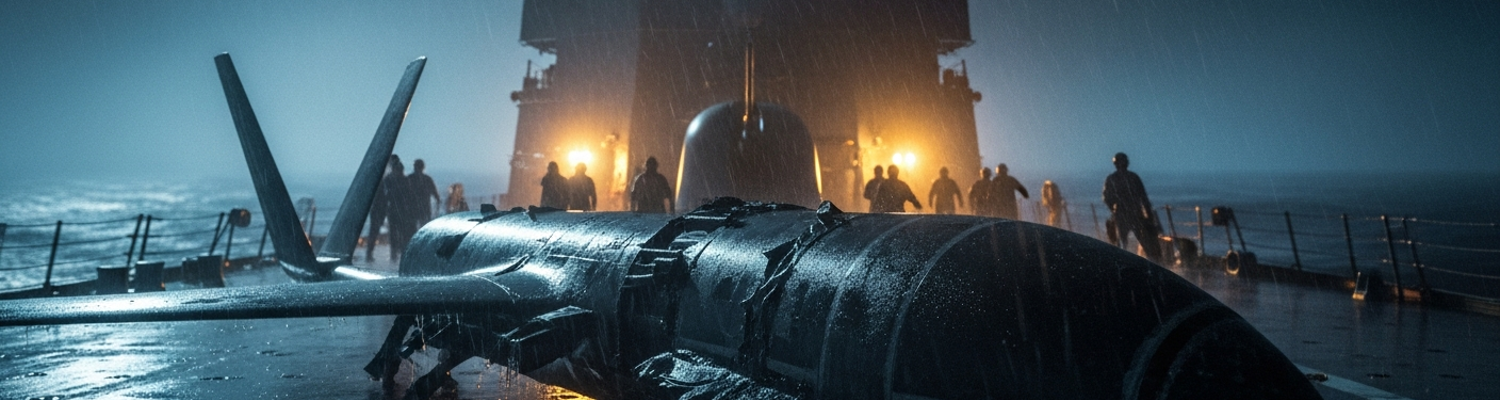
The operational post-mortem for SENTINEL-1 was barely six hours old when a flash message, routed through the U.S. Naval facility at Karamürsel, Turkey, turned the entire intelligence assessment on its head. A Turkish fishing trawler, eighty nautical miles northeast of Sinop, had snagged its nets on a large, unidentified metallic object floating just below the surface. A preliminary report from the Turkish coast guard described a piece of wreckage, roughly conical in shape and composed of exotic, heat-scorched alloys. Within hours, a U.S. Navy EOD team, forward-deployed for Black Sea operations, was dispatched via helicopter. Archival logs from the recovery operation detail the object being winched aboard the destroyer USS Forrest Sherman (DD-931). It was immediately identified as the forward payload and guidance section of the SENTINEL drone. The catastrophic failure over the Urals was a fiction; the drone had suffered a major, but not immediately fatal, systems collapse. It had somehow reversed course, flying uncontrolled for hundreds of miles before disintegrating and falling into the sea. The wreckage was not in Soviet hands. It was in American custody.
What followed was one of the most intense intelligence triage efforts of the early Cold War. The recovered section contained the drone’s most precious cargo: the Hycon Model 73B panoramic camera and its film cassette. The capsule was visibly damaged, with a significant dent and saltwater corrosion already forming. The primary concern was the state of the film. A specialized team from the National Photographic Interpretation Center (NPIC) was flown directly to the U.S. airbase at Incirlik, bringing with them a mobile photographic laboratory. Working inside a sealed, climate-controlled tent, NPIC technicians found the Mylar-based film spool was partially crushed and soaked in seawater. Standard development was impossible. They submerged the entire cassette in a series of chemical baths designed to stabilize the delicate emulsion and wash away corrosive salt deposits without dissolving the latent image. The film was then painstakingly unwound by hand, millimeter by millimeter, in total darkness, with technicians relying solely on touch to gauge the tension and prevent the brittle, damaged film from tearing apart.
Every salvaged component of the SENTINEL-1 wreckage was subjected to a forensic examination that was as critical as the film processing. Teams from Lockheed’s Skunk Works and the CIA’s Directorate of Science & Technology were less interested in what the drone saw, and more interested in why it failed. Metallurgists analyzed the fracture surfaces of the torn fuselage, using microscopy to distinguish the explosive tearing of the final breakup from any pre-existing stress fractures. A detailed analysis of the recovered avionics wiring showed evidence of severe heat damage and electrical arcing around the power supply for the Air Force-mandated ECM package. This discovery was the smoking gun, pointing directly to the system that had bloated the drone’s weight and power requirements as the origin point of the cascading failure. The quartz glass of the main camera port was also carefully analyzed for pitting or spalling, which could indicate an attempted intercept by a Soviet missile, though none was found. Each piece of compromised material provided a crucial data point, confirming that the mission’s failure was born not in the skies over Russia, but in the committee rooms of the Pentagon.
Operational Fallout and Psychological Impact
A close review of the SENTINEL-1 forensic analysis reports, compiled in the frantic weeks following the recovery, reveals a failure born of political compromise. The Skunk Works engineers leading the teardown at Incirlik fixated on a specific section of the drone’s mangled fuselage: the power distribution harness for the Air Force-mandated electronic countermeasures package. Microscopic examination of the wiring bundles showed clear evidence of beading on the broken copper ends, a tell-tale sign of extreme electrical arcing. The insulation, a specialized polymer designed to withstand high temperatures, was carbonized and brittle, indicating a thermal runaway event that far exceeded the material’s design tolerances. Metallurgists analyzing the surrounding titanium support struts found that the metal, while not melted, showed signs of thermal stress consistent with a localized fire. The conclusion, detailed in a top-secret report dated less than a month after the mission, was unambiguous. The ECM suite, with its heavy power draw, had fatally overloaded a system never designed to support it. The resulting electrical fire cooked the adjacent flight control avionics, sending the drone into its uncontrolled, final flight. There was no evidence of Soviet missile fragments or radar-fused shrapnel. The enemy that killed SENTINEL-1 was internal.
Inside Station K, the psychological impact on the ground crews was corrosive. These were men who had lived with the project for years, working punishing hours in a windowless bunker. Mission logs document the shift in atmosphere from the sharp, professional focus of the initial flight to the agonizing silence after signal loss, and then to a disorienting whiplash when news of the Black Sea recovery arrived. The initial grief over the lost vehicle was replaced by a cold anger. They had done their job to perfection, guiding the vehicle flawlessly for thousands of kilometers, only for it to be destroyed by a flaw they were powerless to prevent.
A sense of profound betrayal took root.
Declassified personnel memos from the period describe a collapse in morale, with operators exhibiting signs of emotional exhaustion and burnout. The telemetry analysts who witnessed the final, nonsensical data packets before the blackout replayed those seconds endlessly, questioning their own actions. The flight dynamics officers, who had felt a vicarious connection to the drone as it sliced through the stratosphere, felt as if a part of them had been amputated. Trust between the CIA operators and the embedded Air Force liaisons evaporated overnight, replaced by suspicion and resentment. Every crew member was placed under an immediate and indefinite gag order.
The fallout radiated outward from the control room, forcing a painful re-evaluation of the entire program. The specific failure mode was a damning vindication of Kelly Johnson’s original, clean design philosophy. It served as a catastrophic, real-world lesson on the dangers of design by committee in high-stakes aerospace projects. Archival evidence shows that an immediate directive was issued to halt all work on SENTINEL-2, pending a complete redesign of its power distribution architecture and a brutal re-assessment of every non-essential component. This triggered a new wave of delays and acrimonious meetings within the Pentagon. The CIA, having been burned once, now fought bitterly to strip out any system not directly related to the primary reconnaissance mission, creating new friction with their Air Force partners. The SENTINEL-1 failure became a classified case study, its forensic report a secret textbook on how institutional politics could lead directly to mission failure. The recovered Hycon film, though severely damaged, eventually yielded fourteen usable photographic frames. They provided the first verified imagery of a new Soviet rail-based ICBM deployment system, a small but vital intelligence victory salvaged from a catastrophic mission failure.