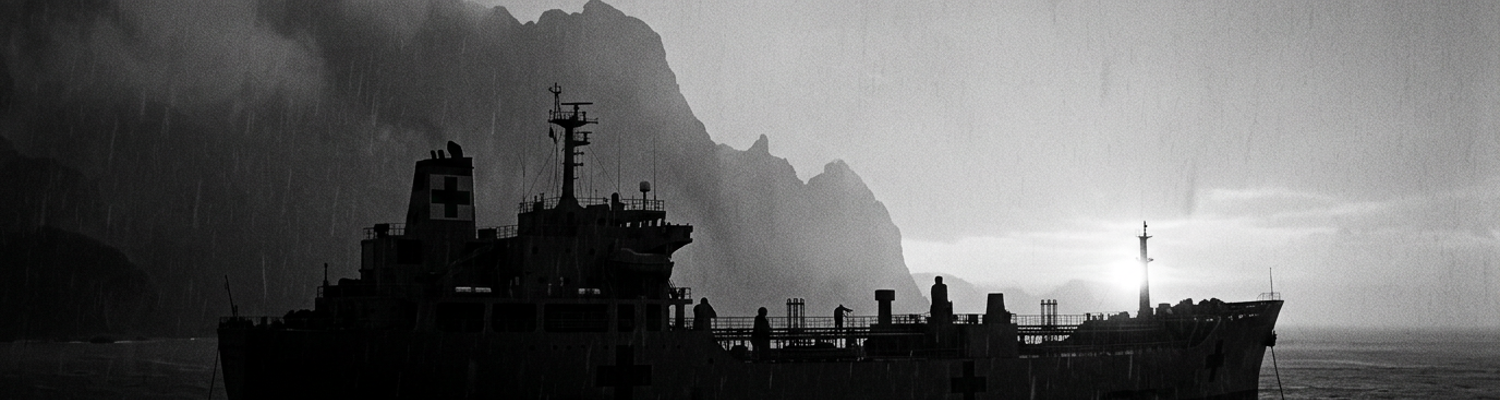

Hospital Ship Protocols and Coastal Artillery Threats
Archival evidence (NARA Record Group 313) shows Task Force 77 planners gave the bridge officers of USS Repose (AH-16) less than forty-eight hours to transition from deep-water transit to a static anchorage. This anchorage sat directly inside the coastal weapon engagement zone of Military Region 1. The clock ran out before damage control parties finished inspecting the emergency bilge pumping manifolds. On the morning of deployment, casualty reports from the Third Marine Division at Dong Ha indicated hundreds of incoming litter cases requiring immediate neurosurgery and blood transfusions. Command directives (BuMed Instruction 3120.1) required the converted Haven-class vessel to anchor six miles off the coast between the Cua Viet River and Da Nang without dedicated destroyer escort screens. Flight deck crews worked against the ticking countdown. They secured heavy chain tie-downs as the first twin-turbine UH-34D helicopters powered by Wright R-1820-84 radial engines crossed the shoreline.
The ship was ordered to drop anchor in plain view of hostile spotters.
When examining the historical record of naval medical operations in Southeast Asia, treaty obligations strictly dictated the exterior configuration of the vessel. Article 22 of the Second Geneva Convention of 1949 established that military hospital ships must display exterior paint work consisting entirely of white hull coatings. Large dark red crosses interrupted this white paint across both the port and starboard sides. Horizontal surfaces visible from the air required identical markings. International maritime law prohibited these vessels from camouflaging their positions. They could not screen their lights at sea. Night operations required the crew to activate high-output floodlight banks. These banks bathed the white superstructure in thousands of watts of continuous incandescent glare. Special neon tube arrays outlined the hull crosses. Surface ships and aircraft could verify non-combatant status from beyond five nautical miles. These protocols assumed opposing militaries possessed coordinated radar nets and professional command loops.
That legal assumption failed against North Vietnamese littoral tactics.
A close review of operational logs indicates North Vietnamese Army coastal artillery units systematically targeted shallow draft shipping throughout the littoral waters of I Corps. Soviet-manufactured 130mm M-46 towed field guns possessed an effective range exceeding twenty-seven kilometers. These weapons fired thirty-three-kilogram high-explosive fragmentation shells. Gun crews concealed these batteries in reinforced limestone caves near Cap Lay and the southern bank of the Ben Hai River. Long-range battery crews did not rely on complex radar tracking. They used visual triangulation against fixed navigational markers and surface contacts illuminated against the dark sea. Elements of the North Vietnamese 126th Naval Sapper Regiment operated along the mouth of the Cua Viet River using swimmer-reconnaissance cells. Combat swimmers equipped with oxygen-rebreathing diving gear and Soviet-designed magnetic limpet mines infiltrated shallow anchorages under cover of darkness. They targeted cargo hulls and support craft. Moving watercraft could defeat swimmer-sapper tracking through unpredictable maneuvers and screw wash. A stationary target anchored in shallow waters offered continuous firing solutions for shore gunners and subsurface saboteurs.
Naval doctrine provided no defensive armaments for the AH-16. The ship carried no deck-mounted five-inch guns. It lacked rapid-fire anti-aircraft mounts. Engineers installed no active sonar suites to detect underwater saboteurs approaching the rudder posts. Operating fully illuminated under Article 22 turned the fifteen-thousand-ton displacement vessel into a high-contrast target against the Gulf of Tonkin. Enemy forward observers on the dunes could see the ship from twelve miles away. Captains faced severe military court penalties if they darkened ship in violation of Geneva protocols. Maintaining full exterior lighting directly exposed five hundred hospital beds, six operating suites, and twelve hundred crew members to fragmentation and hull breach. An incoming 130mm high-explosive round striking the unarmored oxygen generation compartments or avgas fuel stores on the forward deck would cause secondary explosions. These blasts would instantly compromise the medical wards below the waterline.
Command Decision to Extinguish Illumination Arrays
The order to pull the circuit breakers went down to the main engineering station at 2140 hours.
Archival evidence shows three high-explosive artillery geysers erupted eight hundred yards off the port beam. Command personnel bypassed standard Seventh Fleet communication channels to initiate an immediate blackout. Chief electricians manually opened the knife switches and branch circuit breakers on the primary 450-volt distribution switchboards. This action severed power to forty-eight external 500-watt incandescent floodlights mounted along the deck perimeter. High-voltage step-up transformers feeding the red neon tube arrays framing the twenty-foot hull crosses went cold six seconds later. Ship doctrine held that extinguishing these specific identification arrays constituted an open violation of Article 22. Bridge officers faced general court-martial review under the Uniform Code of Military Justice. Senior officers accepted this legal liability. Shore batteries near Cap Lay were walking their fire out across the roadstead. They used the bright white hull paint and illuminated crosses as point-detonation aiming references. Cutting the circuits instantly eliminated the high-contrast optical silhouette. North Vietnamese spotters lost the visual reference required to align their stereoscopic rangefinders.
International maritime law provided zero protection against incoming high-explosive ordnance.
When examining the historical record of deck operations, medical staff confronted an extreme technical hazard inside the six second-deck surgical suites. Surgeons were performing delicate vascular reconstructions and emergency craniotomies on seventy-two critical Marine casualties. These procedures depended entirely on overhead lamps and electric suction units. Volatile medical gasses risked immediate detonation if shrapnel penetrated the 0.375-inch exterior steel hull plating. These gasses included stored nitrous oxide cylinders and high-pressure oxygen distribution lines running through unarmored interior bulkheads. Deck hands dogged shut every watertight battle port. They secured heavy rubber-lined canvas blackout covers over the ventilation cowls and air intakes servicing the hospital wards. Air conditioning compressors struggled under the trapped heat loads. Ambient ward temperatures pushed past ninety-five degrees Fahrenheit inside the active operating spaces. Command weighed the immediate hazard of heat exhaustion and surgical disruption against the certain catastrophic loss of five hundred patients if a 130mm shell pierced the unshielded deckhouse. Violating international convention carried diplomatic penalties. Keeping the lighting arrays active invited incoming shellfire straight into the triage spaces.
A close review of operational logs indicates the fifteen-thousand-ton vessel slipped its starboard anchor chain. The ship shifted into an evasive running profile off the Demilitarized Zone. Watch officers kept the bridge in complete red-lens darkness. They tracked nearby traffic through the AN/SPS-10 surface search radar console. Engineers brought the twin Foster Wheeler boilers up to fifteen knots. They directed superheated steam to the geared DeLaval turbines while maintaining strict forced-draft controls to eliminate smoke and stack sparking. Steaming without red and green running lights or standard white masthead lamps through congested littoral waters violated international collision regulations. This generated a severe risk of ramming friendly coastal craft. Fast patrol boats from Coastal Division 12 were patrolling the exact same sector off the mouth of the Cua Viet at high speed. Combat Information Center personnel calculated target bearings manually on grease-pencil plotting boards. They issued micro-rudder corrections to clear shallow sandbars along the ten-fathom curve without using visual reference lights.
Cryptographic Delays and Garbled Fleet Dispatches
Radio transmissions began at 2210 hours.
Archival evidence shows radio operators inside the Repose communications central attempted to broadcast the emergency repositioning data. They directed this transmission to Commander Seventh Fleet using the specialized SAX fleet broadcast network. SAX operated as a high-frequency, multi-channel radio teletype net reserved for urgent surface movement orders, tactical routing, and strike coordination across the Tonkin Gulf. Radiomen fed punched five-level paper tape containing revised holding coordinates into teletype transmitters. They attempted to flash the new station box to fleet headquarters in Danang and the flagship USS Oklahoma City. This new box centered sixteen nautical miles east-southeast of the Cua Viet River mouth. Operating on designated high frequencies between 4 and 18 megahertz using frequency-shift keying, the transmitters had to contend with severe atmospheric static along the littoral coast. Tropical rain squalls and constant ground-wave interference from inland terrain degraded the signal. Watchstanders set the message precedence to Operational Immediate. The emergency transmission warned fleet controllers that the darkened hospital ship was abandoning its fixed anchor point at 16 degrees 55 minutes North, 107 degrees 15 minutes East. The vessel pushed into deeper water along the ten-fathom curve without running lights to evade coastal artillery salvos.
Radio silence had failed to protect the ship.
A close review of operational logs indicates the outbound transmission encountered severe cryptographic processing bottlenecks. Physical routing backlogs across primary Seventh Fleet relay hubs compounded the delay. Incoming teletype traffic converged on Naval Communications Station Philippines at San Miguel and the regional naval communications center at Cam Ranh Bay. Message handling centers at these locations processed up to thirty thousand tactical messages daily. Communications centers routed traffic through TSEC/KW-26 ROMULUS electronic encryption systems. These machines relied on mechanical paper tape readers and synchronized rotor systems. Electrical surges caused frequent stepping errors in the rotors. Message centers operated on torn-tape relay principles. Radiomen physically carried strips of punched teletype paper between decrypting units and transmitters. They stacked low-precedence and operational dispatches into physical sorting trays. Decryption queues for traffic backlogged by four to six hours. Synchronization failures on automated cryptographic decoders forced communications technicians to manually reset cipher keys. This stalled the retransmission of revised movement coordinates. Combat command stations ashore handled hundreds of urgent gunfire support requests during this exact window.
The fleet command net was functionally blind.
When examining the historical record of littoral warfare off the Demilitarized Zone, this communications delay created an operational blind spot for Task Force 115. Operating under Operation Market Time, Task Force 115 maintained coastal surveillance zones. These zones were designed to intercept North Vietnamese maritime infiltration trawlers and clandestine supply sampans along the shoreline of Military Region 1. Fast patrol craft from Coastal Division 12 patrolled the shallow surf breaks off Cap Lay alongside 82-foot Coast Guard Point-class cutters. The Navy deployed fifty-foot aluminum-hulled Swift boats armed with over-and-under .50 caliber machine guns and 81mm mortar mounts for these patrols. None of these patrol units received notification of the darkened status of the hospital ship. Task Force 115 tactical operating centers in Da Nang had not cleared the unlit transit through the inner patrol track. The SAX broadcast decrypt sat buried in a decoding queue at Cam Ranh Bay. Swift boat radar operators scanned the dark water with low-definition AN/SPS-53 radars. They tracked a fifteen-thousand-ton displacement surface contact bearing down on their sector without running lights, identification transponders, or illuminated hull crosses. Crews closed to battle stations. They trained their forward twin .50 caliber mounts directly onto the darkened bridge wings.
Picket Destroyer Surface Intercept and Fire Preparation
An unlit surface contact crossed the restricted perimeter at 2228 hours.
Archival evidence shows watchstanders aboard the screen destroyer USS Mansfield (DD-728) logged an anomalous surface return on their AN/SPS-10 radar suite. The destroyer was patrolling the outer cordon of the Northern Search and Rescue station eleven miles northeast of Cap Lay. The surface-search transceiver swept at twenty revolutions per minute across the C-band spectrum. It detected a solid, non-transponding target. This target tracked southeast through the declared coastal exclusion zone at 17 degrees 04 minutes North, 107 degrees 22 minutes East. Electronics technicians engaged the Mark X IFF interrogator. They queried the blip across Mode 1 tactical and Mode 3 civilian transponder bands. The target returned zero electronic reply. Radar operators tracked the echo pushing a consistent fifteen-knot wake through restricted waters. Seventh Fleet rules of engagement required all allied traffic in this sector to broadcast active electronic beacons and display full navigation running lights. Rain squalls off the DMZ caused momentary sea clutter. The return sharpened every three seconds into a firm trace tracking past the ten-fathom curve. Bridge lookouts trained their twenty-power big-eye binoculars into the squall line. They spotted no green starboard running lights, masthead lamps, or illuminated deck structures across the dark horizon.
The ship ran blind toward the gunline.
A close review of operational logs indicates the tactical action officer aboard the Mansfield ordered the ship to General Quarters at 2231 hours. Continuous alarm bells sounded through the interior 1MC circuits. Damage control parties dog-latched watertight hatches across main deck passageways. Bridge personnel rang up full speed on the engine order telegraph. They swung the twin rudders eight degrees right to bring the forward battery to bear. Below decks in plotting rooms, fire control technicians brought the Mark 56 Gun Fire Control System online. They slaved its Mark 35 X-band tracking radar directly to the AN/SPS-10 surface coordinates. Amplidyne drive motors whined under sixty cycles of electrical load. Mount 51 and Mount 52 mechanically slewed forty-five degrees to starboard. These mounts housed the twin five-inch/38-caliber dual-purpose gun assemblies of the ship. Gun crews inside the armored gunhouses stripped protective canvas muzzles and slammed eighty-round ready racks open. Hydraulic hoist cylinders drove fifty-four-pound Mark 49 point-detonating high-explosive projectiles alongside brass propellant charges into the dual loading trays. The fire control computer fed continuous stabilized lead angles, wind corrections, and target range rates into the mount servos. Both barrels locked onto the exact coordinates of the darkened target at twelve thousand yards.
Every gun mount stood cocked on full automatic control.
When examining the historical record of naval interception operations off Military Region 1, intelligence watch officers classified the incoming blip as an armed infiltration vessel. They assumed it was operated by the North Vietnamese 125th Naval Transport Regiment. Known across Seventh Fleet tactical plots as the Group 759 sea infiltration unit, these covert maritime forces ran steel-hulled blockade runners southward along maritime supply routes into I Corps. These runners were primarily SL-4 and SL-6 class trawlers displacing four hundred tons. Operational intelligence distributed across Task Force 70 and Task Force 115 explicitly cautioned screen commanders about these tactics. Hanoi was attempting to breach the blockade during monsoonal squalls using large, darkened merchant hulls. These hulls were packed with heavy mortars, recoilless rifles, and dozens of tons of Chinese-manufactured ammunition for local Viet Cong units. Radar cross-section evaluations generated by the plotting team indicated a target return far larger than common fishing junks or wooden sampans. The displacement signature was consistent with an ocean-going blockade runner using the protective range of the North Vietnamese artillery batteries at Cap Lay to slip past the picket lines. The steady bearing and non-divergent vector of the target pointed directly toward the shallow unloading zones along the mouth of the Cua Viet. This fitted every tactical criterion of a hostile supply vessel preparing to beach its cargo under the cover of night.
The gun director crew held the firing key down against the contact point.
Visual Signal Recognition and Operational Repercussions
A close review of operational logs indicates the gun captain in Mount 51 aboard USS Mansfield took up the mechanical trigger slack. Six miles of open water separated the hulls. Target tracking data fed from the Mark 35 radar had converged on a firing solution. This solution positioned fifty-four-pound high-explosive shells right across the forward deckhouse of the Repose. On the darkened starboard bridge wing of the hospital ship, a signalman first class unlatched the weather cover of an eight-inch directional Aldis signaling lamp. He trained its narrow, focused incandescent beam directly into the wheelhouse windows of the destroyer. The watchstander depressed the mechanical shutter lever in frantic bursts. He transmitted standard flashing light challenges. He followed this with the unencrypted hull classification ALFA HOTEL ONE SIX. Bridge lookouts stationed above the open flying bridge of the destroyer shouted the visual sighting down the voice tube. The fire-control director completed the firing circuit at that exact second. The tactical action officer slapped the emergency weapon-inhibit switch on the Mark 56 console. He cut electrical firing current to the mount solenoids two seconds before primer ignition. The twin five-inch barrels of Mount 51 elevated into safe traverse angles. They shed their radar lock as the gun director spun off target.
A five-inch naval salvo was averted by a hand-squeezed brass shutter.
Archival evidence shows dawn brought immediate administrative retribution from Commander Seventh Fleet rather than commendation. Naval legal authorities convened a preliminary board of inquiry aboard the repair ship USS Hector at Subic Bay. They investigated unauthorized deviations from international maritime law. Staff judge advocates scrutinized the bridge logs of the Repose. They isolated the exact 2140 log entry recording the de-energizing of the hull floodlight circuits. Under Article 22 and Article 43 of the Second Geneva Convention, military hospital ships surrender their absolute immunity if they extinguish identification lighting, mask their movements, or act as navigational hazards to surface combatants. Board interrogators grilled the commanding officer and chief engineer of the vessel. They demanded to know why alternative evasive maneuvers within declared safety channels were abandoned in favor of a total running blackout. Senior operational commanders argued that intentional compliance with treaty lighting provisions while under targeted artillery fire from Cap Lay constituted reckless endangerment of five hundred wounded Marines. Fleet legal counsel drafted formal investigative briefs. They assessed whether criminal negligence or willful disobedience charges applied under Articles 92 and 99 of the Uniform Code of Military Justice.
International treaties provided no defensive countermeasures against 130mm coastal artillery.
When examining the historical record of littoral operations, Seventh Fleet headquarters issued comprehensive operational doctrine revisions within seventy-two hours of the near-miss off Cap Lay. Operational order revisions severed hospital ships from standard torn-tape teletype routing nets at Cam Ranh Bay. They established dedicated, point-to-point tactical circuits connecting hospital platforms directly to Task Force 70 command centers. Radio transmitters aboard the Repose and her sister vessel USS Sanctuary (AH-17) were assigned exclusive, clear-voice ultra-high-frequency guard channels. These channels patched straight into coastal surveillance sectors. Task Force 115 patrol craft received updated operational standing orders. These orders mandated positive visual recognition checks before slewing heavy weapons toward darkened surface radar returns. Fleet commanders established a continuous five-nautical-mile acoustic and visual identification buffer zone along the I Corps littoral shelf. This required Coastal Division 12 patrol craft to establish voice communication via 243.0 megahertz prior to closing within weapons range of unlit contacts. Destroyer picket crews received upgraded electronic interrogation instructions. They linked Mark X IFF Mode 2 military transponder settings directly to local surface-tracking computers in the Combat Information Center.
The updated tactical routing doctrine (CINCPACFLT MSG DTG 172210Z OCT 67) took effect across Task Force 77 on October 18, 1967.