
In the sweltering heat of July 1945, Admiral William F. Halsey's Third Fleet prowled the waters off the Japanese home islands. Its fast carriers, a fist of steel and fury, launched wave after wave of aircraft against naval bases and industrial targets, a relentless, sustained assault deep inside enemy territory. To outside observers, it appeared the fleet was defying the fundamental laws of naval warfare. Fleets needed ports. They needed to refit, rearm, and refuel. Yet Halsey’s armada remained on station, a persistent, lethal presence that refused to withdraw. The secret to this unprecedented operational endurance was not a new weapon, but a revolutionary approach to warfighting, a floating logistical backbone that had transformed the vast Pacific from a barrier into a highway for American naval power. Operating just over the horizon, a ghost fleet of auxiliaries kept the tip of the spear sharp.
The Great Western Base Takes to the Sea
This capability did not emerge overnight. It was forged in the crucible of early war defeats and the hard-won experience of the long island-hopping campaign. The initial American thrust across the Pacific was a painful lesson in logistics. Ships could only operate as far as their bunkers and magazines would allow, tethered to fixed, vulnerable bases like Pearl Harbor or even more distant West Coast ports. To solve this, Admiral Chester Nimitz, Commander in Chief, Pacific Ocean Areas, championed a new vision. Instead of bringing the fleet back to the base, the base would go to the fleet. This concept culminated in the formation of Service Squadron Ten on January 15, 1944, under the command of Commodore Donald B. Beary. ServRon 10 was a mobile naval base in its entirety. Its nerve center became the massive fleet anchorage at Ulithi Atoll in the Caroline Islands. This captured and rapidly developed lagoon, once a quiet backwater, was transformed into the busiest naval port in the world, capable of holding over seven hundred vessels. From this forward position, ServRon 10’s assets could meet the fighting fleet near the combat zone. The squadron’s growth was exponential. From an initial complement of just thirteen ships, it swelled by the war’s end to over 600 vessels, a navy unto itself. Its composition was a menagerie of specialized ships. Fleet oilers of the Cimarron and Suamico classes, the workhorses of the fleet, carried millions of gallons of fuel oil and aviation gasoline. Ammunition ships like the USS Shasta were floating arsenals, their holds packed with bombs, torpedoes, and shells of every caliber. Repair was a central function. Vulcan-class repair ships, such as the USS Hector, contained foundries, optical shops, and machine shops with skilled artisans capable of everything from welding cracked hulls to rebuilding destroyed flight decks. In February 1945, squadron repair ships rebuilt sixty feet of the carrier USS Randolph’s flight deck in just eighteen days following a kamikaze strike. Massive floating drydocks, submersible structures like the ARD-19, could lift even battleships and carriers out of the water for hull work, saving a crippled ship a perilous thousand-mile journey back to a shore-based yard. The logistical train included distilling ships producing fresh water, provision ships with refrigerated holds, and even specialized barges that produced ice cream, a simple but powerful morale booster for sailors who had been at sea for weeks. Tenders for destroyers and submarines, hospital ships, and floating barracks rounded out this armada. By early 1945, ServRon 10 possessed hundreds of floating facilities, a direct reflection of the industrial might and organizational genius driving the Pacific offensive.
The Dangerous Dance of Replenishment at Sea
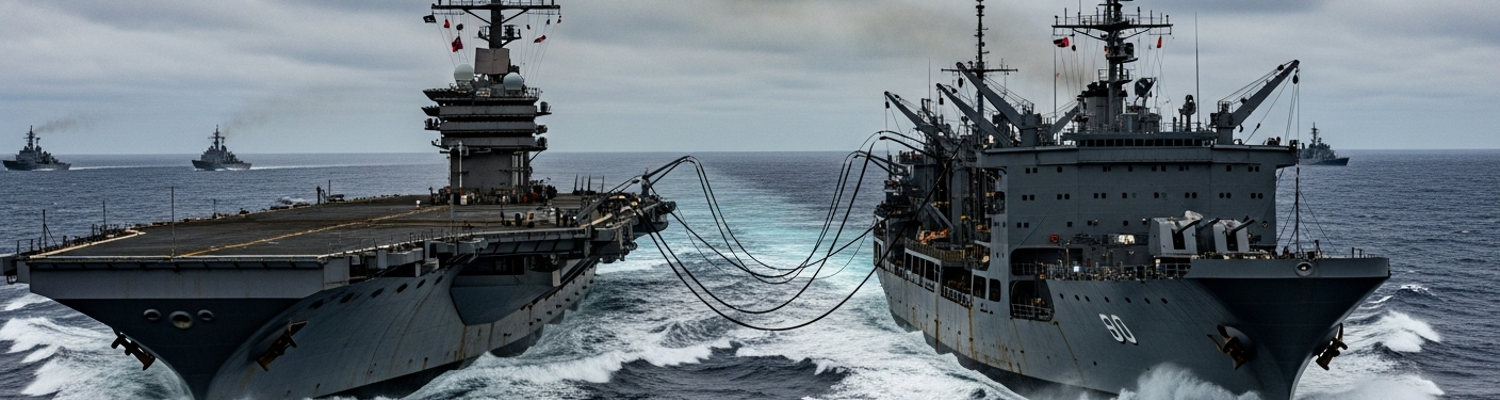
Having a mobile base was one thing; transferring its contents to a combat fleet steaming in open, often hostile, waters was another. The art and science of Underway Replenishment, or UNREP, was the tactical key that unlocked the strategic potential of ServRon 10. While early experiments had been conducted between the wars, the scale and sophistication achieved by 1945 were revolutionary. A replenishment day was a marvel of seamanship and coordination. The combat task force would rendezvous with the oilers and supply ships at a predetermined point. Warships would pull alongside the auxiliaries, maintaining a frighteningly close distance of sixty to eighty feet while steaming at speeds up to fifteen knots. A line-throwing gun would fire a light line across the gap, which sailors would use to haul across heavier messenger lines, and finally, the thick, greasy fuel hoses. A Cimarron-class oiler could pump thousands of gallons of fuel per hour through these connections, often refueling ships on both its port and starboard sides simultaneously. The constant threat of collision in a rolling sea, parting lines that could whip across decks with lethal force, and enemy submarine attack made every UNREP a high-stakes operation. The entire formation was at its most vulnerable during these hours. Transferring solids like ammunition and stores presented an even greater challenge. The solution was the Burton method, a technique using a series of booms and winches on both the supply and receiving ships. A tensioned wire, or highline, was run between the two vessels. Cargo nets filled with bombs, crates of K-rations, or mailbags were hooked to a trolley that rode the highline. Winch operators on both ships had to work in perfect concert, managing the tension and movement to swing the load from one deck to the other without dropping it into the churning sea below. Manhandling 500 and 1,000-pound bombs across a heaving, pitching steel deck was treacherous work, demanding immense strength and focus from the deck crews. Between March and June 1945 alone, this method allowed for the transfer of over 16,000 tons of ordnance to Task Force 58, keeping its air groups armed for the relentless strikes on Okinawa and the Japanese mainland.
Redefining Power and Forging Rivalries
The strategic impact of this logistical self-sufficiency was profound. It directly enabled the operational tempo that broke the back of the Japanese war machine. The fast carrier task forces could remain at sea for weeks, even months, at a time. A typical cycle involved several days of launching strikes against Japan, followed by a brief withdrawal to a rendezvous point for a day of replenishment, before returning to the fight. This continuous pressure gave the enemy no time to rest, repair, or regroup. The U.S. Navy had effectively cut the anchor chain that had tethered fleets to land bases for centuries, creating a new paradigm of global naval power projection. This newfound capability also shifted dynamics within the U.S. military command structure. The Pacific theater was famously divided into two major commands: Admiral Nimitz’s Pacific Ocean Areas and General Douglas MacArthur’s Southwest Pacific Area. This division was a source of significant inter-service rivalry over strategy and resources. The Army, reliant on capturing territory to build airfields for its long-range bombers, often viewed the Navy’s Central Pacific drive with skepticism. The Navy's ability to sustain itself indefinitely at sea, however, gave it immense strategic flexibility and leverage. It could project power where it chose, independent of the Army’s slower, more ground-based advance. This created a dynamic where naval objectives could be pursued without direct reliance on Army ground forces to secure logistical bases, a point of friction in joint planning. Lt. Gen. Brehon B. Somervell, commander of the Army Service Forces, was famously distrustful of the Navy’s logistical organization, which he saw as decentralized and inefficient compared to the Army’s preferred centralized model. He failed to grasp that the Navy's fluid, mobile system was a direct response to its operational environment. Even within the Navy, tensions existed. Aggressive combat commanders like Halsey, focused on the fight, had to coordinate with logistical commanders like Beary, who were focused on the painstaking work of sustainment. The relationship was symbiotic, but the priorities were not always aligned. A combat commander’s desire for one more strike had to be weighed against fuel states and ammunition levels. Yet, leaders like Admiral Raymond Spruance, Halsey’s more methodical counterpart, deeply understood that logistics determined what was operationally possible. Spruance, who had studied logistics at the Naval War College, later established its first formal Logistics Department, ensuring the hard-won lessons of the Pacific campaign were not forgotten.
The story of Service Squadron Ten is the story of how the United States won the war in the Pacific. While the carriers and battleships delivered the decisive blows, they were enabled by a vast, unglamorous, and absolutely essential fleet of auxiliaries. This floating backbone did more than just sustain the Third Fleet; it demonstrated a new model of sea power, one where operational reach was limited only by industrial capacity and human ingenuity. It was a gritty, dirty, and dangerous business, but it was the foundation upon which modern American naval dominance was built.