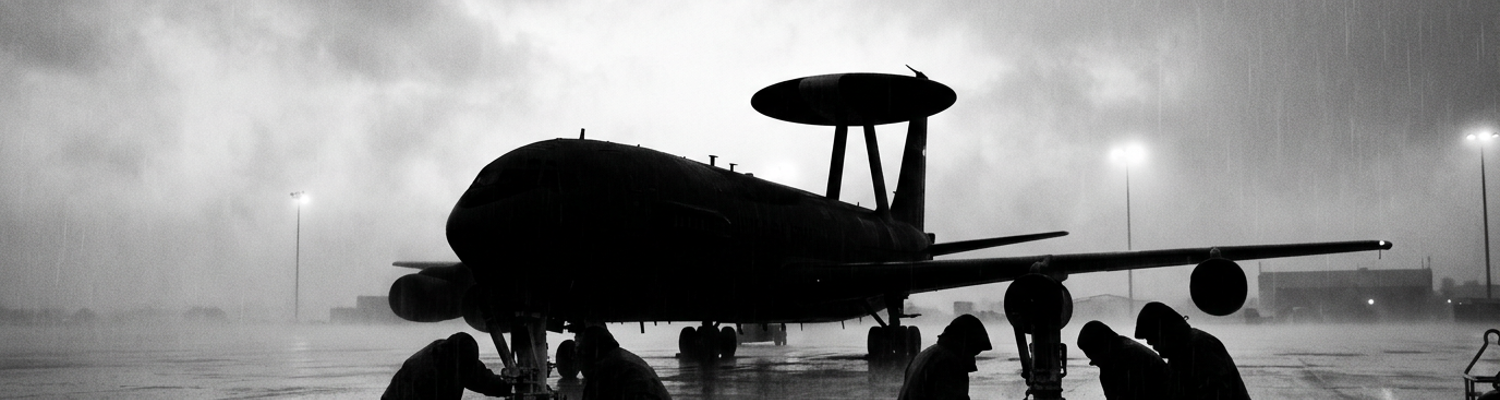

Gulf of Alaska Strategic Posture
Freezing sleet, dense sub-polar maritime fog, and driving coastal rain whipped across the rocky shoals of the Kenai Peninsula. Glacial runoff churned gray mud into the drainage aprons of the upper inlet. Heavy salt air corroded unpainted metal components within hours. Below deck plates and on open tarmac, damp cold seeped into wiring harnesses. It compromised synthetic hydraulic packings. Ground winds consistently exceeded thirty knots. Abrasive sediment sprayed off the Turnagain Arm mud flats directly into open intake cowlings.
Alaska offered no shelter to fragile electronics.
A close review of operational logs indicates that during July 1994, the 962d Airborne Air Control Squadron committed its modified Boeing E-3C Sentry platforms to round-the-clock rotations. They flew out of Elmendorf Air Force Base (61 degrees 15 minutes North, 149 degrees 48 minutes West). Ground crews faced acute shortages of replacement rotodome azimuth drive motors and TF33-PW-100A turbofan engine bleeds. Depot-level resupply from the Oklahoma City Air Logistics Center at Tinker Air Force Base required five days via C-141 transport. Flight-line maintainers stripped serviceable seals from grounded airframes. Moisture repeatedly penetrated the thirty-foot unpressurized radar dome. It saturated the fiberglass honeycomb layers. Ground personnel blew low-pressure heated air into the antenna cavity between twelve-hour sortie turns. Three separate hydraulic line ruptures occurred on the taxiways during the second week of July alone. Each instance dumped MIL-H-5606 fluid onto the concrete. Crews manually cleaned the bays before taxi sequences could resume.
Archival evidence shows flight crews maintaining continuous racetrack orbits south of Montague Island. They held at twenty-nine thousand feet to survey the approaches to Cook Inlet. Operating the AN/APY-2 radar in Maritime Surveillance Mode required operators to manually filter out massive wave-clutter spikes. Sea state five swells across the Gulf of Alaska generated these spikes. Receiver sensitivity drifted whenever internal coolant temperatures spiked. Inflight technicians recalibrated the liquid nitrogen cooling loops for the transmitter cabinets every ninety minutes. Each airborne shift consumed roughly twelve thousand pounds of JP-8 fuel per hour. Coordinated aerial refueling rendezvous with KC-135 Stratotankers of the 168th Air Refueling Wing happened through zero-visibility cloud decks over Prince William Sound.
Radar screens flickered with false contacts caused by twenty-foot waves.
When examining the historical record from the third week of July 1994, the primary objective of these extended orbits centered on tracking foreign surveillance units. These units monitored joint air-naval training maneuvers. Radar operators documented two Project 864 Vishnya-class intelligence-collection ships holding station eighty-five nautical miles south of Seward. They operated along the outer edge of the exclusive economic zone. These vessels deployed wideband radio interception antennas. They captured VHF and UHF tactical datalinks exchanged between carrier strike groups and ground control intercept stations. E-3 tactical coordinators piped raw contact vectors over secure Link 11 high-frequency networks to the Alaskan North American Aerospace Defense Command Region at Elmendorf. On July 22, the 962d tracked a separate Russian naval surface action group. This group comprised an Udaloy-class guided missile destroyer and a Boris Chilikin-class replenishment oiler transiting eastward toward the Aleutian trench.
Both surface contacts maintained a constant heading of zero-eight-zero degrees at twelve knots without breaching territorial waters.
AN/APY-2 Radar Maritime Surveillance Orbits
The rotodome made one complete rotation every ten seconds.
A close review of operational logs indicates that the AN/APY-2 radar relied on a dedicated Maritime Surveillance Mode to isolate surface combatants from surrounding ocean scatter. Unlike standard air-to-air pulse Doppler configurations, this mode compressed S-band radio frequency pulses. It narrowed range cells down to fractions of a microsecond. This sharpened resolution along the waterline. Operators inside the mission bay adjusted phase-steered planar array antennas to depress the beam downward across the littoral shelf. High peak power directed toward the cold ocean surface caused hardware components to buckle under the electrical strain. High-voltage power supplies within the transmitter bay experienced repetitive arc-overs. Cabin pressurization fluctuated during descents to avoid icing layers. Inflight radar technicians swapped out damaged silicon-controlled rectifiers while balanced on vibrating catwalks behind the main display consoles. They used basic digital multimeters in cramped, unventilated equipment racks. Cooling liquid flowed through closed lines at ninety pounds per square inch. This prevented the traveling-wave tubes from melting during sustained pulse transmissions. Pump impellers suffered cavitation from trapped air bubbles. Radar operators killed transmitter power instantly to prevent thermal blowout of the radio-frequency amplifiers.
Fourteen hours of low-frequency engine hum left flight crews physically exhausted.
Flight crews of the 962d Airborne Air Control Squadron endured long racetrack orbits. These stretched across seventeen contiguous hours over the turbulent boundary between Cook Inlet and the Shelikof Strait. Mission commanders established orbit anchor points near 58 degrees 45 minutes North, 152 degrees 30 minutes West. Pilots circled repeatedly through severe turbulence created by katabatic winds spilling off the volcanic peaks of Mount Douglas and Mount Augustine. Inside the unpressurized lower bays, structural temperatures hovered near five degrees Fahrenheit. Condensation ran down the interior skin and froze over avionics wiring bundles. Aircrews sat bolted into high-backed web seats. They monitored green phosphor cathode-ray tubes that strained optic nerves under amber cockpit lighting. Relief tubes routinely froze solid midway through these long-endurance patterns. Crew members rationed their fluid intake despite dry oxygen masks dehydrating their throats. Flight surgeons at Elmendorf recorded elevated rates of inner-ear fatigue among radar operators. The rotodome six-RPM gyroscopic wobble transmitted a rhythmic, sub-audible shudder through the entire aluminum fuselage.
Thirty-foot tidal surges across Cook Inlet overwhelmed the radar receivers with massive surface clutter.
Archival evidence shows that filtering this dense coastal clutter required continuous intervention from airborne surveillance officers. Tidal rips churned glacial silt into massive standing waves across the mouth of Kachemak Bay. False target returns saturated the radar Constant False Alarm Rate processors. Sidelobe energy bounced off the sheer granitic walls of the Kenai Fjords. Phantom track files mirrored the electromagnetic signatures of steel hulls. Surveillance operators manually designated dynamic rejection gates around high-reflectivity shoals. They narrowed receiver gain windows to isolate genuine ship tracks from churning surf. Through these manual filters, radar crews held uninterrupted track files on Russian surface vessels loitering near the edge of the maritime boundary line. Operators accurately tracked a Project 1155 Udaloy-class destroyer steaming along the axis of the Barren Islands shipping channel. They logged its position every two minutes as the warship maneuvered against the heavy tide. Every raw contact vector fed directly into the onboard display processors. The littoral reflections stripped away until only the true bearing, speed, and radar cross-section of the foreign warship appeared on the tactical grid.
Component Shortages at Elmendorf Air Force Base
A close review of operational logs indicates that the primary transmitter cabinets within the Boeing E-3C fleet suffered an accelerating failure rate of high-power klystron amplifier tubes throughout July 1994. Sustained maritime tracking profiles demanded maximum pulse duty cycles. The internal cathode heater filaments pushed past their rated five-hundred-hour lifespan inside forty-eight hours of flight time. Supply sergeants at Elmendorf discovered that base inventory held exactly zero serviceable spare tubes on July 14. This followed a dual failure on airframe tail number 78-0578. The 3d Equipment Maintenance Squadron filed emergency cannibalization authorizations. They pulled older variant klystrons from de-certified ground training benches. Technicians spent eight straight hours re-machining lead shielding blocks inside the high-voltage pulse modulator bay at 61 degrees 15 minutes North, 149 degrees 48 minutes West. The blocks accepted mismatched anode connector flanges. RF output dropped by twelve percent when ground crews energized these salvaged vacuum assemblies. The AN/APY-2 radar maximum detection envelope degraded across the mouth of Cook Inlet.
Empty supply shelves dictated radar performance.
Archival evidence shows that maintaining receiver sensitivity against cold sea clutter required constant flushes of high-purity liquid nitrogen through the parametric low-noise pre-amplifiers. Without continuous cryogenic chilling down to minus three hundred twenty degrees Fahrenheit, thermal noise choked the radar receiver channels. Low-profile surface contacts masked beneath the Cook Inlet swells. Elmendorf possessed only two transportable five-hundred-gallon vacuum-insulated dewar tanks capable of servicing the E-3C fleet during the third week of July. Both containers suffered vacuum sleeve degradation. Cryogenic pressure bled through pinhole fractures. Eighty gallons of liquid nitrogen boiled off every twenty-four hours on the open flight line. Deliveries from the regional industrial gas contractor in South Anchorage ground to a halt when a commercial compressor cracked its cylinder head on July 17. The 962d maintenance control officer rerouted three five-hundred-gallon dewars via commercial cargo barges out of the Port of Tacoma. Maritime transport through Prince William Sound introduced a ten-day transit window. Ground crews resorted to rationing the remaining liquid nitrogen across flight turns. They bled lines manually with brass valve keys. Secondary pre-flight receiver calibrations were canceled to conserve cold gas for operational maritime orbits.
Boil-off loss rates left dry, disabled radar assemblies staged across the flight lines.
When examining the historical record, the root of these parts deficits traced back to the post-Cold War defense realignments executed under the FY1993 and FY1994 budget reductions. Supply chain commands shut down secondary manufacturing lines. Wholesale inventory control consolidated into automated central nodes. Safety stock levels dropped across remote regional depots. The Oklahoma City Air Logistics Center at Tinker Air Force Base routinely downgraded Alaskan supply priority codes to fill European and Middle Eastern taskings. Requisitions for mission-impaired parts that previously cleared in seventy-two hours sat dormant in computer queues for sixty-five days. Vacuum tube fabrication vendors had shrunk to two domestic suppliers. Both operated on reduced workweeks after the Department of Defense cancelled multi-year reserve purchase agreements. Flight-line mechanics at Elmendorf logged three hundred and forty unfilled backorders for AN/APY-2 internal line-replaceable units by July 28. Depot specialists stopped stocking individual vacuum capacitors, ceramic pulse transformers, and cryostat valve rebuild kits entirely. Wing logisticians tracked down commercial airfreight shipments of civilian-grade substitutes through customs desks at Anchorage International Airport.
Depot Cannibalization Rosters and Flightline Maintenance
A close review of operational logs indicates that the 3d Wing Maintenance Group at Elmendorf Air Force Base instituted formal cannibalization rosters on July 11, 1994. Base supply shelves sat completely bare of mission-critical radar modules. The squadron commander signed emergency authorization waivers that circumvented standard supply requisition pipelines. Wing leadership designated Boeing E-3C tail number 76-1604 as the primary non-mission-capable donor platform. The gutted airframe parked on the windswept tarmac of the North Hardstand at 61 degrees 15 minutes North, 149 degrees 48 minutes West. Staff sergeants methodically transferred eighty-four discrete line-replaceable units from this single airframe over a fourteen-day period. They stripped its unpressurized lower electronics bays down to exposed structural stringers and cut wire looms. Mechanics marked AFTO Form 781 maintenance binders with red-X priority codes. Technicians pulled high-demand phase shifters, liquid coolant pumps, pulse modulators, and rotodome slip-ring brushes. Active platforms tail numbers 78-0578 and 75-0557 operated almost entirely on these harvested parts. They absorbed scavenged hardware within minutes of its removal to meet morning launch windows.
Cannibalization rosters dictated every maintenance action on the ramp.
Archival evidence shows that flightline technicians from the 962d Aircraft Generation Squadron and the 3d Component Repair Squadron sustained punishing eighteen-hour shifts in driving sub-arctic sleet. Stripping complex waveguide plumbing, radio-frequency circulators, and pressurized rotary joints required teams of five mechanics. They hauled heavy hand tools across iced aluminum surfaces while forty-knot wind gusts whipped off Knik Arm. Accessing the AN/APY-2 antenna assemblies forced avionics technicians to crawl through the narrow, unheated rotodome pylon. They worked without overhead mechanical cranes or sheltered maintenance stands. Specialists drained toxic dielectric coolant loops directly into hand-held catch buckets. They wrestled three-hundred-pound transmitter cabinets out of tight avionics bays down slick metal crew ladders. Technicians completed these delicate extractions with thin cotton glove liners that froze against sub-zero tool steel. They swapped worn O-rings on the flightline while snow accumulated inside open component access doors. Reinstallation on receiving aircraft had to finish inside a rigid three-hour turnaround window before the next radar sweep sequence over the Barren Islands.
Mechanics stripped hot hardware before turbine blades finished spinning down.
When examining the historical record, reinstalling high-time, out-of-cycle radar subsystems introduced immediate technical instability into maritime orbit operations. AN/APY-2 transmitter and receiver assemblies had strictly defined mean-time-between-failure intervals. Maintenance coordinators repeatedly placed worn components back into active flight cycles without depot recertification. Repeated physical handling sheared locking pins, bent waveguide flange faces, and cracked aged silicone seals on salvaged low-noise pre-amplifiers. During engine run-ups on Elmendorf Runway 06, high-voltage arcing inside these reused transmitter cabinets repeatedly overwhelmed the internal circuit breakers. This triggered automatic system shutdowns during pre-flight Built-In Test checks. Worn rotodome slip rings taken from donor airframes shed fine carbon dust across sensitive high-frequency rotary joints. Continuous electrical noise floor spikes blinded receiver channels before aircraft even crossed the Kenai Peninsula coast.
Tinker Air Force Base could not replace the broken assemblies.
On July 26 alone, three consecutive maritime surveillance missions suffered catastrophic ground aborts at the end-of-runway de-arm pads. Flightline inspectors documented forty-eight separate uncommanded transmitter trip-offs tied directly to fatigued pulse-forming network capacitors harvested from tail 76-1604. Wing records reveal that the 962d executed seventy-four emergency cannibalization actions between July 10 and July 31. Twelve hundred man-hours were consumed purely on parts transfers.
Degraded Littoral Telemetry and Tactical Relays
A close review of operational logs indicates that real-time littoral telemetry feeds to coastal fire-direction centers broke down systematically across the southern rim of the Kenai Peninsula. Mountainous topography between Cook Inlet and the open Gulf of Alaska blocked line-of-sight ultra-high-frequency radio paths whenever the E-3C dipped below thirty thousand feet to clear sub-polar cloud decks. At coastal tracking stations positioned along Anchor Point at 59 degrees 46 minutes North, 151 degrees 52 minutes West, digital data terminals receiving the automated Link 11 bitstream repeatedly rejected incoming pulse packets. Checksum errors spiked past forty percent. Glacial ridges along the Kenai Range deflected directional microwave relay beams. Severe multipath phase cancellation occurred in the ground receivers. Digital buffers inside the fire-direction center tactical computers suffered continuous data overflows. Track updates on surface contacts maneuvering inside Kachemak Bay dropped. Coastal artillery coordinators and battery plotting boards lost automated target vectors. Track refreshes delayed by up to twelve minutes. These mechanical lags introduced track positioning errors exceeding twenty-two nautical miles on the automated plotting displays.
Telemetry feeds dropped completely.
When examining the historical record, degraded transmitter assemblies crippled the radar platform ability to maintain data-link fidelity during scheduled joint maritime drills. Salvaged klystron tubes and patched pulse-forming network capacitors limited AN/APY-2 radio-frequency output to barely seventy-two percent of rated power. This transmission shortfall starved the onboard data processor of clean return pulses. During exercise evolutions with surface combatants transiting north of the Barren Islands, the low signal-to-noise ratio forced Link 11 net cycle times to balloon from twelve seconds to forty-eight seconds. Shipboard combat information centers aboard guided-missile cruisers operating off Cape Douglas registered intermittent link dropouts. The KG-40 cryptographic units repeatedly lost frame synchronization over the unstable carrier waves. Tactical symbology flickered and vanished from naval display screens. Joint command networks degraded into fragmented local pictures. Surface combatants were unable to correlate their own passive sonar contacts against the intermittent radar vectors broadcast by the 962d. Antenna current fluctuated erratically across every bearing change.
Encryption keys lost phase sync.
Archival evidence shows that airborne surveillance crews abandoned corrupted digital networks and switched to secondary high-frequency voice circuits to push manual track updates. Operators inside the Boeing E-3C used Collins AN/ARC-190 transceivers to establish unencrypted voice contact on standard high-frequency channels. They transmitted raw grid coordinates directly to ground and naval stations. Surveillance directors verbalized four-digit coordinate blocks, estimated vessel speeds, and radar cross-section profiles in plain English across the 6723-kilohertz band. Standing eighty-five nautical miles south of Seward, the Soviet-designed Project 864 Vishnya-class intelligence vessel monitored these unshielded tactical radio frequencies with shipboard directional receiving arrays. Flight logs confirm that Russian radio intercept operators logged the verbal broadcasts as fast as the American controllers spoke them. On July 24, Russian bridge personnel swung their primary air-search radar arrays toward active American patrol corridors within ninety seconds of each verbal coordinate release over the open channel. Clear-voice transmissions compromised the positional secrecy of friendly air patrols across the entire inlet.
Every transmission gave away operational coordinates.
By late afternoon on July 25, ground stations at Elmendorf logged sixteen separate transmission failures across the maritime net. Radio operators spent thirty minutes of every mission hour manually verifying phonetic grid coordinates over static-heavy atmospheric bands. They backed up manual grease-pencil tracking boards inside the coastal direction shelters. Flight-line mechanics at 61 degrees 15 minutes North, 149 degrees 48 minutes West recorded forty-two failed attempts to align radio-frequency couplers on the aircraft high-frequency antenna couplers before the final sortie turn of the month. Salt buildup on the antenna lead-in insulators caused corona discharge whenever transmitters operated above two hundred watts.
Eagle River Flats Environmental Contamination
The salt marshes bordering the runway approach contained severe chemical contamination.
A close review of operational logs indicates that the formal publication of the July 1994 Eagle River Flats Comprehensive Evaluation Report exposed deep chemical degradation inside the military reservation boundary. Field research teams from the Cold Regions Research and Engineering Laboratory surveyed the 2,160-acre estuarine salt marsh centered at 61 degrees 19 minutes North, 149 degrees 43 minutes West. They worked alongside Department of the Army environmental engineers. Sampling equipment failed repeatedly in the harsh tidal basin. Sediment coring drills sheared their drive pins in heavy glacial gravel. Automated pump assemblies froze solid when saline slush flooded the low-water channels. Hovercraft used by testing crews suffered continuous skirt tears on jagged drift logs. Civilian technicians were left stranded in exposed mud flats while sixty-knot coastal squalls rolled across Knik Arm. Regulatory inspectors documented decades of cumulative ordnance impact directly beneath the primary departure corridor for Runway 06 at Elmendorf Air Force Base. Command staff confronted immediate federal scrutiny under Superfund cleanup directives.
Artillery duds lay suspended in freezing mud.
When examining the historical record, investigators mapped extensive unexploded ordnance contamination across the primary estuarine impact corridor. Artillery units stationed at Fort Richardson had fired tens of thousands of high-explosive and illumination rounds into the marsh basin between 1945 and late 1989. Sub-surface scans registered unexploded 60mm and 81mm mortar casings, 4.2-inch heavy mortar rounds, and M107 155mm high-explosive artillery shells lodged beneath three to eight feet of saturated gray clay. Dense, freezing silt blocked oxygen and prevented primary powder ignition. Delicate mechanical point-detonating fuzes were preserved in an unstable, live state. Ordnance disposal personnel attempting to survey these impact sectors faced treacherous conditions. Heavy M88 recovery vehicles broke their track pins whenever drivers tried crossing the marsh perimeter. They sank down to their sponsons in glacial slurry. Low-altitude vibration generated by Boeing E-3C Sentries climbing out on heavy maritime surveillance departures rattled the marsh basin. Ground specialists held constant concerns that acoustic shock waves might trigger sensitive nose fuzes in shallow water.
Cold water kept the elemental white phosphorus intact.
Archival evidence shows that weapon smoke canisters had transformed the marsh floor. Detonations of M110 155mm and M375 81mm marking shells scattered unburned elemental white phosphorus across shallow waterways like Area C and Bread Truck pond. The estuarine mud lacked dissolved oxygen and sat in thirty-eight-degree tidal pools. The waxy chemical particles failed to burn away. They hardened into coarse grains matching the exact size of food grit. Migrating waterfowl including northern pintails, green-winged teal, and trumpeter swans sifted the silt bed and swallowed the toxic fragments. Ingestion of these waxy deposits caused acute gastrointestinal erosion, violent muscular tremors, and convulsions. Birds died within ninety minutes of contact. Pathology reports logged annual waterfowl mortalities exceeding two thousand carcasses across the short summer migration window. Ground safety personnel observed dead swans drifting into the shipping channels of Cook Inlet. The 3d Wing safety office documented sixty-eight separate carcass retrievals along the base airfield perimeter. This prevented carcass-scavenging bald eagles from entering the flight path of ascending radar aircraft.
Civilian Protests and Estuarine Range Disputes
Civilian litigation reached military desks within hours of the report publication.
A close review of operational logs indicates that community coalitions across the Eagle River valley joined with local property groups to file formal petitions in federal district court by mid-July 1994. Residents living along the Glenn Highway corridor at 61 degrees 19 minutes North, 149 degrees 34 minutes West documented structural vibrations and shrapnel drift risks emanating from the eastern boundary of the Fort Richardson impact zone. The legal challenges targeted the Department of the Army and the 3d Wing at Elmendorf Air Force Base. They demanded an immediate freeze on live-fire artillery registration shoots and low-altitude radar orbit approaches across the 2,160-acre mud basin. Civic attorneys cited neglected buffer easements. They produced survey maps that revealed suburban lot lines abutting within twelve hundred yards of unexploded 105mm and 155mm impact grids. Six distinct neighborhood councils coordinated with regional non-profit legal funds to petition the Department of the Interior under public safety and federal tort claims statutes. These legal filings halted planned field artillery calibrations for the 1st Battalion, 17th Infantry Regiment. Heavy battery commanders were unable to verify barrel alignment before upcoming multi-branch exercises.
Subdivisions sat directly in the drift path of live shrapnel.
Archival evidence shows that local outrage intensified over the continuous acoustic battering produced by the 962d Airborne Air Control Squadron flight profiles. Heavily loaded Boeing E-3C Sentries climbing out of Runway 06 generated sustained low-frequency acoustic energy in the fifty to eighty hertz band. Window frames shook and drywall cracked across residential developments from Chugiak to Birchwood. Residents lodged over four hundred formal noise complaints with base community relations officers during July alone. Below the flight tracks, the repetitive low-altitude passes and decades of surface detonations disrupted historic subsistence territories relied upon by members of the Native Village of Eklutna. Jet exhaust particulates and unspent kerosene fuel dumps contaminated sensitive estuarine marshes. Local families harvested razor clams, coho salmon, and sourdock in these areas. Rotary downwash from low-flying search-and-rescue helicopters and E-3C departure profiles drove away migrating shorebirds. Fragile sedge flats along the Knik Arm intertidal zone were ruined. Community elders testified at municipal assembly hearings that the combination of percussive engine noise and chemical saturation had turned productive food-gathering wetlands into sterile mud wastelands.
The noise cracked household foundations five miles from the runway threshold.
When examining the historical record, this public fury spilled into direct administrative combat between military range officers and civilian oversight bodies. Officials from the Environmental Protection Agency Region 10 and the Alaska Department of Environmental Conservation confronted Elmendorf range control over persistent violations of the Clean Water Act and federal Superfund mandates. State regulators demanded unhindered physical access to monitor heavy metal leachate and unexploded white phosphorus deposits in the Eagle River Flats wetlands. They threatened administrative stop-work orders against base range operations. Elmendorf range management officers resisted these demands. They cited national security taskings and the tactical necessity of keeping flight corridors open for AN/APY-2 radar tracking orbits over Cook Inlet. Base legal officers issued counter-filings arguing that state environmental inspectors lacked the mandatory security clearances to traverse active ordnance drop zones. The confrontation peaked on July 29. Regional regulators formally threatened to withdraw air quality operating permits for base support facilities unless the 3d Wing restricted high-power radar ground-testing sequences and grounded heavy E-3C night patterns over the river mouth.
Range safety logs registered nineteen regulatory summonses before the close of the month.
Subarctic Supply Chain Revisions and Deficits
The theater supply chain failed when alert tempos spiked.
A close review of operational logs indicates that short-notice maritime alert orders issued between July 18 and July 27, 1994, overwhelmed the supply chain between Elmendorf Air Force Base and central inventory depots in the continental United States. Russian naval units skirted territorial waters off the Kenai Peninsula. The 3d Wing needed immediate replacement parts to generate back-to-back twelve-hour surveillance sorties over Cook Inlet. Routine delivery timelines from the Oklahoma City Air Logistics Center at Tinker Air Force Base averaged nine business days. They relied on scheduled C-141B cargo runs that frequently grounded in adverse weather across the Pacific Northwest corridor. Air Mobility Command transport priority codes failed to accelerate the transit of AN/APY-2 components. Ramp mechanics required replacement transmitter rotary joint assemblies and antenna waveguide seals within four hours of post-flight inspections. Base supply clerks could only offer backorder tracking forms. Flightline crews confronted a sixty-hour mobilization window with zero replacement high-voltage rectifiers on hand. Maintenance officers released airframes with degraded maritime tracking channels.
Distance and administrative delays grounded the airframes.
Archival evidence shows that these failures prompted immediate revisions to Air Force Logistics Command spare allocation tables for subarctic warning platforms. Air Combat Command logisticians examined the Base-Level Self-Sufficiency Spares packages assigned to the 962d Airborne Air Control Squadron. Existing War Reserve Materiel formulas relied on standard temperate-zone consumption baselines. Those models assumed subcomponents would fail at predictable mean-time rates calculated in dry southern facilities. Cold-weather exposure, saltwater spray from Cook Inlet, and cyclic rotodome vibration had doubled the actual attrition rate of azimuth drive motors, hydraulic actuator seals, and low-noise receiver amplifiers. By late autumn 1994, logistics officers rewrote the authorization tables to establish dedicated, isolated inventory blocks directly at Elmendorf, mapped at 61 degrees 15 minutes North, 149 degrees 48 minutes West. The revised framework transferred sixty-eight distinct line-replaceable units from central pooled storage at Tinker into climate-controlled Alaskan forward depots. Replacement klystrons and cryostat valve assemblies remained on site rather than five flight days away.
Paper inventories could not generate radar power.
When examining the historical record, sustaining continuous AN/APY-2 surveillance rotations ran directly into the strict spending ceilings imposed by the fiscal year 1994 defense drawdown. Congressional budget reductions slashed intermediate depot repair funding across Pacific Air Forces by twenty-two percent. Joint task forces demanded real-time tracking grids over the Gulf of Alaska. Operating costs for each Boeing E-3C flight hour exceeded seven thousand two hundred dollars in fuel, cryogenics, and scheduled wear. The 3d Wing quarterly operational funding allotment drained before the middle of August. Flight surgeons and squadron supervisors logged seventy-hour workweeks for avionics specialists who lacked modern automated testing gear. Maintainers balanced on unheated stands at thirty degrees below freezing. They used outdated oscilloscopes to trace wiring continuity faults by hand because contract funding for field diagnostic vans had expired. Station commanders postponed required airframe corrosion washes and deferred scheduled depot maintenance cycles for three operational aircraft. They spent their remaining cash reserves solely on JP-8 bulk transfers and industrial liquid nitrogen deliveries.
Wing accounting ledgers recorded an eighty-six thousand dollar maintenance deficit before the final alert aircraft touched down on Runway 06.