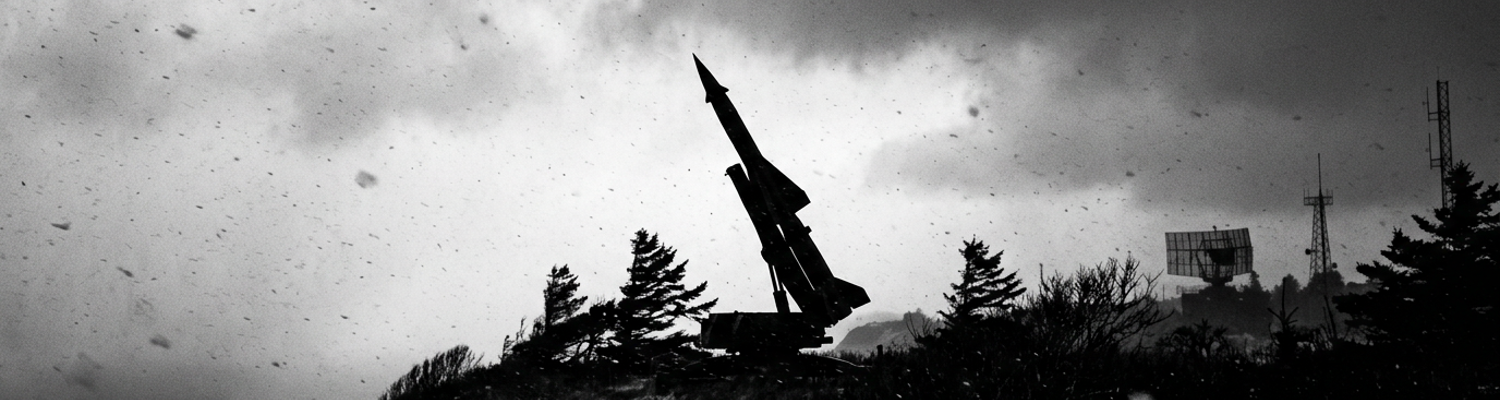

Cold War Origins of Site Point Hercules Batteries
Pentagon target vulnerability studies calculated a specific kill ratio for northern defense sectors. An unhindered Soviet air strike on south-central Alaska would kill 78 percent of the Anchorage civilian population. It would reduce Elmendorf Air Force Base to unusable rubble within twelve minutes. The burden of preventing that destruction fell upon the MIM-14 Nike Hercules. A 41-foot interceptor engineered by Western Electric and Douglas Aircraft. Conceived to replace the short-ranged Nike Ajax, the weapon suffered through protracted propulsion problems during its mid-1950s test cycle at White Sands Proving Ground (NARA Record Group 338). Engineers struggled to synchronize the solid-propellant blast of four clustered M5E1 booster rockets. These rockets repeatedly threatened to tear the airframe apart at liftoff. The missile could reach Mach 3.65 and climb past 100,000 feet when mated to an internal Thiokol M30 sustainer motor. Its complex analog vacuum-tube computers proved exceptionally vulnerable to sub-zero shock. Technicians rebuilt internal electronic circuits. They reinforced hydraulic rudder actuators to withstand intense g-forces during extreme high-altitude maneuvers.
A fractured solder joint inside a guidance chassis grounded the interceptor completely.
Archival evidence shows that the United States Army deployed this weapon system to Site Point in 1959. The installation sat along the coastal bluffs of Point Campbell. It directly fronted Cook Inlet at 61 degrees 09 minutes North, 150 degrees 01 minutes West. Assigned to the 4th Missile Battalion, 43rd Artillery under the command of the 87th Artillery Group, the battery occupied a dual-configuration site. This site contained two distinct firing lines and twenty-eight live missiles. Standard continental batteries kept missiles hidden in underground elevators. Sub-Arctic conditions along Cook Inlet made excavation impossible. Glacial silt, permafrost, and tidal marshes forced engineers to place the launch facilities entirely above ground. Four concrete-and-timber revetments shielded the launchers from horizontal winds and incoming weapon fragmentation. Cold salt air constantly assaulted the mechanical components. Technicians struggled with rapid condensation that degraded radar seals. Frozen hydraulic fluids locked the launcher elevation mechanisms at negative thirty degrees Fahrenheit. Daily maintenance logs recorded that ground crews frequently ran heated alcohol baths through mechanical linkages. They did this to keep the launching shoes from freezing to the steel guide rails.
Strategic defense mandates assigned Site Point a specific geographic purpose. It secured the airspace surrounding Elmendorf Air Force Base and the port of Anchorage against incoming Soviet strategic bombers. Elmendorf served as the northern headquarters of American air defense. It housed command elements and frontline F-102 interceptors that patrolled air corridors over the Arctic. Bombers of the Long-Range Aviation branch would push across the Bering Strait from bases in the Chukotka Peninsula if the Soviet Union initiated a general nuclear exchange. Soviet flight routes channeled Tupolev Tu-95 Bear and Tu-16 Badger bombers along the Cook Inlet maritime trench. This route bypassed interior radar detection networks. These aircraft carried multi-megaton gravity bombs and Raduga Kh-20 standoff missiles. Those weapons could level southern Alaska before striking deeper into the continental United States. Site Point formed the terminal surface-to-air barrier designed to destroy those bombers before their payloads detonated over the regional command center.
Interception windows left zero room for mechanical hesitation.
A close review of operational directives required the 4th Missile Battalion, 43rd Artillery to preserve continuous readiness under severe alert parameters. One launcher section at Site Point stayed permanently on fifteen-minute launch notice. Another maintained a thirty-minute posture twenty-four hours a day. Battery personnel shared targeting coordinates with the Air Defense Command radar outpost at Fire Island Air Force Station. They received early tracking data over high-frequency radio links. The missile guidance computer plotted an intercept course for the MIM-14 once target acquisition radars locked onto an enemy flight path. Fire-control doctrine authorized the battery to arm its interceptors with W31 nuclear warheads. These warheads delivered yields between twenty and forty kilotons. A high-altitude nuclear detonation eliminated the requirement for a direct physical impact. It created an atmospheric blast radius that could destroy an entire incoming bomber formation at ranges exceeding seventy-five miles. Battery launch officers had strict standing instructions in the event of system saturation or communications failure. They were to acquire targets locally through the Low-Power Acquisition Radar, compute firing solutions on site, and expend every armed missile on the pad.
Sub-Arctic Metallurgy and Hydraulic Fluid Crystallization
Operational logs from the sub-zero winter cycles between 1960 and 1963 detail severe mechanical failures. The M47 launcher elevation mechanisms at Site Point repeatedly seized under extreme thermal stress. Standard Army operational doctrine prescribed MIL-H-5606 red petroleum-based hydraulic fluid across all MIM-14 launch platforms. That chemical formulation was rated for fluid movement down to negative sixty-five degrees Fahrenheit under controlled laboratory conditions. Sustained temperatures of negative thirty-five degrees Fahrenheit combined with maritime moisture to produce wax fractionation in the open revetments along Point Campbell. Heavy paraffin chains separated from the base stock. Crystallization jammed the internal spool valves inside the exposed fluid lines. It clogged the twenty-micron wire-mesh filters of the main elevation pump. Pressure within the 3000-pound-per-square-inch hydraulic circuit spiked violently whenever technicians engaged the elevation controls. Ruptured seals sprayed freezing hydraulic oil across the concrete aprons. The dual-stage elevating cylinders failed completely. They were unable to raise the 10,000-pound missile assembly from its horizontal maintenance cradle into the eighty-five-degree firing position.
Frozen elevation pistons turned active interceptors into dead weight.
The 4th Missile Battalion, 43rd Artillery improvised aggressive mechanical countermeasures to keep launcher rails functional. Maintenance crews under the 87th Artillery Group wired electrical resistance strip heaters directly around the hydraulic reservoirs. They wrapped primary feed manifolds in thick layers of asbestos insulation. Battery technicians established a mandatory cycling schedule. They forced operators to elevate and depress every launcher through its complete arc once every fifteen minutes throughout twenty-four-hour alert shifts. This continuous mechanical churning generated friction heat within the fluid chambers. It prevented crystalline wax structures from binding the pump rotors. Ground personnel ran portable gasoline-powered Herman Nelson heaters directly into the launcher bases when ambient temperatures plummeted past negative forty degrees during Arctic gales. They channeled flexible canvas ducting into the enclosed cylinder housings. Ordnance officers submitted urgent deficiency reports to the Army Missile Command at Redstone Arsenal. They demanded immediate delivery of synthetic, low-temperature hydraulic fluid blends. Those chemical alternatives arrived slowly through the military sea transport chain into the Port of Anchorage.
Winds off Cook Inlet brought an even more dangerous structural hazard.
Metallurgical inspections conducted in early 1964 exposed critical brittle fracture vulnerabilities across the low-alloy structural steel guide rails of the Site Point launchers. Douglas Aircraft had fabricated the standard M47 launcher assemblies using structural carbon steel with low nickel content. This was a metallurgical choice suited for temperate continental installations. Unrelenting sub-zero gales carrying salty sea spray battered the exposed launching shoes and structural base beams at Site Point. That unshielded metal dropped well below its ductile-to-brittle transition temperature. It lost its capacity to absorb mechanical shock. The extreme weight of the MIM-14 interceptor and its clustered M5E1 booster array exerted massive static shear loads on the guide flanges during simulated alert sequences. Dynamic load calculations conducted by Army Ordnance teams revealed that the steel rails had become as fragile as cast iron.
Mobile nondestructive testing teams dispatched from Elmendorf Air Force Base applied liquid dye penetrant and magnetic particle checks to every launcher bed on the firing line. Technicians identified hairline stress fractures propagating through the fillet welds of the guide rails and the primary hinge pins of the truss assemblies. The four clustered booster motors generated 175,000 pounds of instantaneous thrust. They would shear the fractured guide rails apart if a battery commander fired an interceptor while structural steel resided in this brittle state. This would destabilize the missile before it cleared the pad. Battery officers immediately placed structural loading limits on all above-ground revetments. Welding teams reinforced identified fracture points with heavy gusset plates. Engineers constructed timber wind deflectors along the northern perimeter bluffs to shield the launch rails from coastal gusts. Operational directives subsequently forbade raising any missile to the vertical launch position during gale-force winds exceeding forty knots. They mandated waiting until pad heaters had elevated the core steel temperature above zero degrees Fahrenheit.
National Engineers Register and Cold Weather Retrofits
The Army Materiel Command faced an acute engineering bottleneck in January 1964. Military technicians could not solve the problem locally. The Pentagon activated emergency search protocols through the 1964 National Engineers Register. This specialized talent roster was maintained by the Engineers Joint Council for the federal government. Search parameters filtered for civilian specialists with documented research in low-temperature fracture mechanics, ductile-to-brittle transition phenomena, and cryogenic metallurgy. Defense liaisons contacted ten civilian metallurgical engineers from industrial research laboratories and academic institutions within forty-eight hours. They requisitioned their services under direct Department of the Army technical contracts. Transport planes flew these civilian specialists into Elmendorf Air Force Base. Convoy trucks ferried them southwest along the coastal ice roads to Site Point at Point Campbell. Stationed alongside the 4th Missile Battalion, 43rd Artillery, these engineers conducted Charpy V-notch impact tests. They performed ultrasonic inspections inside unheated revetments at negative thirty-five degrees Fahrenheit. Their diagnostic data revealed that the structural carbon steel frames had lost over eighty percent of their dynamic impact resistance. This required immediate metallurgical intervention.
Civilian specialists stripped the missile pads down to bare metal.
The metallurgical team immediately ordered the replacement of the launcher blast deflectors beneath the M5E1 booster cluster. Standard launch pads utilized low-carbon mild steel deflectors to channel the booster flame away from the elevation rails. The thermal shock of 175,000 pounds of thrust striking frozen carbon plates at negative forty degrees cracked the deflector plating during ground engine runs at Site Point. Engineers specified custom blast deflectors fabricated from ASTM A353 nine-percent nickel alloy steel to arrest this failure mode. This material was engineered to maintain crystalline ductility down to negative three hundred twenty degrees Fahrenheit. Douglas Aircraft machinists cut and formed the new nickel plates at continental manufacturing plants. They airlifted them directly to the Anchorage depot. Army Ordnance welders worked inside temporary canvas enclosures warmed by kerosene blowers. They bolted and welded these heavy nickel-alloy deflectors directly to the M47 launcher sub-bases. Each deflector plate received additional gusset reinforcement along the trailing blast edge. This absorbed the mechanical expansion of booster ignition without transmitting torsional loads back into the primary launcher truss.
Hydraulic fluid crystallization threatened the remaining launch assemblies.
Chemical engineers identified that the standard MIL-H-5606 hydraulic oil inside the M47 elevation cylinders had separated into heavy paraffin gels. These gels completely obstructed the two-inch high-pressure return lines. The civilian task force directed the 4th Missile Battalion to drain every elevation reservoir across the revetments. They flushed the valves with heated trichloroethylene solvent. Technicians then pumped in a newly formulated low-viscosity synthetic fluid blend, MIL-H-27601. This was combined with specialized anti-wear additives designed for deep sub-zero operating thresholds. This synthetic formulation maintained a stable kinematic viscosity of less than two thousand centistokes at negative sixty-five degrees Fahrenheit. It prevented the pressure spikes that had ruptured the elevation pump seals. Maintenance crews adjusted the relief valves on the main hydraulic manifolds from 3000 to 3400 pounds per square inch. This compensated for cold-weather shear resistance in the actuator cylinders. Launcher crews successfully executed fifteen consecutive elevation cycles at negative forty-two degrees Fahrenheit by late February 1964. They did this without a single mechanical jam or fluid line rupture. Site Point logged thirty operational minutes per rail retrofit before returning the batteries to thirty-minute combat alert.
The 1964 Good Friday Quake and Bluff Liquefaction
At 1736 local time on March 27, 1964, a magnitude 9.2 megathrust earthquake ruptured south-central Alaska. This event triggered catastrophic ground failures across the coastal bluffs flanking Knik Arm. Saturated deposits of Bootlegger Cove clay underwent rapid cyclic loading. This unstable, glaciomarine sediment underlay the Anchorage lowlands. Horizontal ground accelerations exceeded 0.30g for nearly five unbroken minutes. Water pressure inside the pore spaces skyrocketed. This pressure destroyed the shear strength of the subsoil. Whole sections of coastal promontories collapsed. They slid downward along low-angle shear planes directly into the inlet mudflats. Point Campbell sat at the geographic intersection of Knik Arm and Turnagain Arm. The bluffs fractured into deep grabens and stepped terraces. Unconsolidated glacial fill supporting the military installations lost all bearing capacity. The terrain turned into a churning slurry.
Saturated silt liquefied beneath forty tons of live ordnance.
This sudden loss of structural support wreaked direct physical damage on the concrete launcher aprons and dual-rail mounts at Site Point. Douglas Aircraft engineers had configured the above-ground revetments for static surface loads. They anchored each M47 launcher to ten-inch-thick reinforced concrete slabs with heavy high-tensile steel foundation bolts. Differential settlement tore these slabs apart across expansion joints when the underlying silt beds gave way. Pads Alpha and Bravo tilted violently. The northern revetment floor dropped seventeen inches relative to the perimeter blast walls. Torsional forces sheared off two-inch steel anchor studs at baseplate corners. Dual-rail launching tracks twisted along their longitudinal axes. These tracks were engineered to hold the 10,000-pound MIM-14 interceptor at rigid alignment tolerances during pre-fire checks. Hydraulic elevation pistons bound completely within their trunnion mounts. They froze the missile cradles in asymmetrical, semi-elevated attitudes.
Misalignment exceeded maximum fire-control tolerances within ninety seconds.
Battery personnel faced total loss of commercial utility power as the primary grid collapsed across the Anchorage bowl. Auxiliary diesel generators inside the underground power building automatically cranked and took over the electrical load. Physical devastation on the aprons prevented standard automated functions. Technicians armed with optical collimators, leveling transits, and flashlights conducted emergency structural surveys. Violent aftershocks shook Point Campbell every twenty minutes. Field measurements indicated that launcher rail azimuths had drifted more than five degrees out of plumb with the tracking radar antennas on the ridge. That physical drift invalidated every ballistic firing solution stored in the analog computers of the battery control area. Umbilical cables connecting the missile guidance sections to ground test panels were pinched flat beneath shifted steel outriggers. This severed continuity to the internal guidance packages. Ordnance specialists found the primary locking pins of three clustered M5E1 solid-propellant booster assemblies bent by lateral shear. This threatened immediate structural breakup if crews attempted ignition.
Ruptured communication cables severed the hardline link to the Fire Island Air Force Station radar outpost.
Ordnance teams immediately scrambled to prevent physical tipping of the nuclear-armed interceptors. Ground crews rigged heavy hemp hawsers and steel winch cables around the main launcher booms. They tied the shuddering assemblies back to heavy tracked bulldozers brought up from the battalion motor pool. Maintenance mechanics hand-pumped hydraulic fluid through auxiliary bypass valves. They attempted to bleed off trapped pressure in the jammed elevation cylinders and drop the missiles back onto horizontal maintenance dollies. Two W31 warhead sections exhibited cracked structural skin around their forward warhead adapter rings. Shifting launcher shoes had slammed against the launch rail stops. Battalion commanders placed six of the battery frontline launchers on out-of-action status by midnight. This left only two partially operational rails to defend the entire northern Cook Inlet air corridor.
Telemetry Disruption and Simultaneous North Pacific Alert
Beneath six feet of frozen muskeg and gravel overburden, the subsurface ground displacement severed the control pathways of Site Point. Heavy multiconductor control lines and RG-17/U hardened coaxial telemetry cables ran through pressurized transite conduits. These conduits connected the radar tracking vans on Point Campbell ridge to the launch revetments on the lower apron. The cables carried pulse signals from the Target Tracking Radar and Missile Tracking Radar trailers directly to the launcher guidance computers. They also fed the internal gyroscopes of the erect MIM-14 interceptors. Horizontal soil slip along the Bootlegger Cove clay layer pushed the launcher revetments twelve feet westward toward Cook Inlet. The rigid transite ducts snapped. Concrete pull boxes anchored along the utility trench tore free from their foundations. Tensile forces exceeded four thousand pounds per linear inch across the junction boxes. This force cleanly severed the heavy lead-sheathed bundles of RG-17/U coaxial line. It crushed the eighty-pair command firing circuits. Technicians inside the battery control trailer watched the launch board lights go dark. Analog voltmeters registered open circuits across all external test loops.
Copper conductors snapped inside buried trenches across a three-hundred-yard span.
The physical shearing of these subterranean telemetry paths wiped out the battery capability to transmit fire-control commands to the eight launchers on the pad. The analog computers inside the battery control console required uninterrupted, millisecond-by-millisecond phase tracking between the AN/MPQ-14 acquisition radar and the internal steering package of the missile. The radar vans could not transmit pitch and yaw commands to the hydraulic fins of the Thiokol M30 sustainer motor without electrical continuity across the sheared coaxial cables. They could not receive positional verification pulses from the internal missile beacon. Launcher crews attempting to re-establish wire links discovered that the terminal junction blocks at Launcher Section Alpha had been pulled out through the reinforced conduit walls. This stripped sixty-four distinct pin connectors down to frayed copper threads. Technicians had to deploy spools of unshielded field telephone wire across the torn ground in an attempt to re-establish manual launch overrides.
Loss of signal synchronicity reduced the armed interceptors to inert steel towers.
This localized mechanical breakdown coincided directly with a major strategic escalation across the Alaskan North Pacific air defense sector. The NORAD Alaskan Region Command Post at Elmendorf Air Force Base declared a Class-One Air Defense Alert at 1749 local time. This occurred thirteen minutes after the initial shock wave flattened coastal radar towers. High-frequency radar antennas operated by the 5070th Air Defense Wing at King Salmon and Sparrevohn detected a cluster of ambiguous, high-speed radar tracks. These tracks pushed southeast from the Bering Sea across the Gulf of Alaska. Radar operators contended with atmospheric ionization and anomalous propagation caused by earthquake-induced ionospheric disruption. They could not verify whether the blips were atmospheric artifacts or a coordinated low-level strike by Soviet Tu-95 bombers exploiting the communication blackout. Elmendorf scrambled four F-102 Delta Daggers from the 317th Fighter Interceptor Squadron into the sub-zero storm over Cook Inlet.
Interceptors scrambled blindly into an unmonitored defensive sector.
Regional air defense networks issued an urgent red fire-control readiness order to Site Point at the exact moment the battery commander had zero firing circuits remaining. Alaskan NORAD Headquarters could not raise the Fire Island Air Force Station radar site. Commercial line failure and antenna platform tilt had silenced the AN/FPS-27 search radar there. Radio operators on Point Campbell tried to relay voice coordinates to Elmendorf over battery-operated AN/PRC-25 tactical radios. Atmospheric interference from severe aurora activity degraded VHF transmissions to unintelligible static. Ordnance specialists worked beneath emergency floodlights powered by a sputtering 5-kilowatt gasoline generator inside revetment Bravo. They manually inspected the sheared control boxes of Launcher Four to ascertain whether a missile armed with a W31 warhead could be fired via manual jump-wire relays. That field improvised circuit failed ground continuity tests at 1812 local time. This left the Cook Inlet approach vector completely unprotected while the radar blips tracked fifty miles southwest of Kenai Peninsula.
Emergency Field Leveling and Launcher Calibration
Battery A ordnance personnel faced eight unaligned M47 launcher beds by 1830 local time. These beds were thrown out of tolerance along the cracked Point Campbell pad. Launch doctrine for the MIM-14 Hercules dictated a maximum foundation tilt limit of three-tenths of a single mil. This strict limit ensured the internal stable platform resolved pitch commands accurately during the booster separation phase. Differential soil compaction had canted Launcher Rail Two by twenty-seven mils along its transverse axis. Master sergeants from the 4th Missile Battalion, 43rd Artillery dragged commercial twenty-ton hydraulic bottle jacks out of the motor pool. They slid them beneath the distorted steel outriggers. Gunners set up K and E optical surveyor transits directly on the fractured concrete revetment aprons. They took reference shots against fixed geodetic benchmarks established along the intact eastern blast wall. Mechanics hand-pumped the hydraulic jacks in uneven five-millimeter increments. Junior technicians shoved high-carbon steel shims, chopped railroad ties, and grader blade fragments under the lifted sub-frame beams. Freezing coastal winds reached thirty knots. The wind vibrated the leveling transit bubbles. Battery survey crews had to take duplicate sight readings across three separate azimuth lines before bolting the baseplates down.
Three mils of tilt meant complete flight path failure.
The physical destruction of the subterranean conduit runs required a complete bypass of the buried RG-17/U coaxial network. Communication teams stripped spools of standard WD-1/TT two-conductor field wire from the battery supply depot. They dragged coils across the fissured tundra on aluminum pack frames. Technicians tied lines into elevated scrub spruce branches. They anchored the wire along timber revetment edges to stop surface movements from snapping the copper-clad steel strands during recurring magnitude 6.0 earth aftershocks. Field mechanics bypassed the crushed subterranean pull box at Launcher Four by splicing WD-1 lines straight into the twenty-four-pin cannon plugs of the launcher control trailer. Solder joints had to be completed using gasoline blowtorches shielded inside canvas utility jackets. Signalmen ran twelve discrete pairs of wire across four hundred yards of torn glacial silt between the launch revetments and the radar tracking vans perched on the bluff crest. Ground tremors ripped two newly routed lines apart at 1915. Wiremen retraced the frozen path on foot with battery-powered test lanterns and re-spliced the circuit under falling sleet.
Analog fire-control loops required unbroken electrical impedance to function.
Battery electronics technicians re-established continuous circuit loops between the AN/MPQ-14 acquisition radar and the launcher elevation resolver circuits at 1942. Fire-control specialists balanced line resistance across the makeshift wire runs by wiring variable carbon rheostats directly into the terminal junction boards. Ordnance crews then turned to the mechanical elevation linkages on Rail Three. These had bound tight after the foundation dropped seventeen inches. Mechanics engaged the manual crank drive on the hydraulic elevation manifold. They used four-foot lengths of steel pipe slipped over the hand cranks to force the frozen pistons past sheared hydraulic bypass valves. Crewmen adjusted the elevation stops until the launcher rail sat precisely at eighty-five degrees. They checked the rail angle with a mechanical gunner quadrant placed against the missile guide flange. Launcher Section Alpha completed an emergency simulated firing run by 2010 local time. The system read zero error on the launcher azimuth sync indicators and twelve ohms across the ignition squib test circuit.
CONARC Interagency Debates and Final Obsolescence
Damage reports from Point Campbell landed directly in the middle of a jurisdictional fight inside the Pentagon by May 1964. Continental Army Command insisted on an immediate eighty-five-million-dollar emergency appropriation. This money would rebuild the shattered revetments of the 4th Missile Battalion, 43rd Artillery. Plans called for deep-driven steel H-piles anchored into bedded shale beneath the Bootlegger Cove clay (Project File 64-A-112). North American Air Defense Command supported the Army position. They warned that any gap in the Cook Inlet missile ring invited low-altitude Soviet bomber penetration from Siberian airfields. Alain Enthoven Systems Analysis office within the Office of the Secretary of Defense blocked the funding request. Civilian analysts calculated that spending millions to re-anchor stationary surface-to-air missile pads in an active sub-Arctic fault zone produced diminishing defensive returns. Robert McNamara budget team argued that the physical vulnerability of fixed surface installations along coastal mudflats outweighed their utility against an increasingly modernized adversary.
Accountants in Washington cancelled the reconstruction contracts before concrete trucks ever left the depot.
The technical disputes centered on the sheer mechanical difficulty of stabilizing heavy, fixed missile hardware against recurring ground displacement. Army Corps of Engineers assessments revealed that preventing future launcher bed tilt required driving vertical friction piles two hundred feet into glaciomarine silt. It required surrounding each M47 launcher with shock-isolated hydrostatic sub-frames. It also required substituting brittle carbon-steel piping with flexible stainless steel braided joints capable of withstanding six feet of lateral ground displacement. NORAD commanders demanded that these facilities maintain instant reaction times through continuous subterranean power cables and vacuum-tube computer racks protected by pneumatic dampening springs. Systems analysts counter-argued that hardening a fixed battery against recurring tectonic shifts cost nearly four times the original installation price of the MIM-14 batteries. Technical evaluations demonstrated that even if the launchers survived earth tremors intact, coastal bluff liquefaction would repeatedly pull the antenna masts out of alignment. This would sever microwave links to the battery control trailers.
A static weapon could not adapt to shifting mud.
A broader strategic reorientation was already stripping the MIM-14 of its original mission. Soviet rocketry bureaus had shifted mass production from long-range Tupolev bombers to intercontinental ballistic missiles like the R-16 and early R-36. This rendered terminal high-altitude bomber interceptors strategically redundant along the sub-Arctic perimeter. Pentagon planners redirected capital into satellite early warning constellations. They transitioned from the experimental Missile Defense Alarm System to operational infrared surveillance platforms designed to catch ballistic plumes thousands of miles before they crossed the pole. Air defense doctrine rapidly pivoted toward mobile, decentralized surface-to-air systems such as the tracked MIM-23 Hawk. This system could displace across broken ground on short notice without concrete revetments or vulnerable underground wiring trunks. NORAD planners concluded that mobile batteries and orbiting heat-seeking sensors provided superior flexibility across sub-Arctic terrain compared to multi-ton fixed interceptors sitting on sinking coastal bluffs.
Army leadership fought to retain the northern batteries through the late 1960s. The technological momentum against the weapon proved unstoppable. The Department of Defense issued directives accelerating the phased deactivation of sub-Arctic Nike Hercules batteries across Alaska. This began with the permanent reduction of frontline alert posture at Site Point. Ordnance teams dismantled the W31 nuclear warhead packages. They packed the fissile components into armored transport containers bound for the Pantex storage plant in Texas. Maintenance crews cut the hydraulic elevation lines. They drained the low-temperature synthetic oils from the M47 launcher pistons. They unbolted the nine-percent nickel steel blast deflectors from the cracked foundation pads. The Army officially struck the Point Campbell installation from active service rolls. The 4th Missile Battalion, 43rd Artillery surrendered its firing lines, leaving hollow concrete revetments and rusted guide rails overlooking the waters of Cook Inlet.
Depleted launch crews loaded the last stripped MIM-14 airframe onto a flatbed truck bound for the Fort Richardson salvage yard on July 18, 1979.