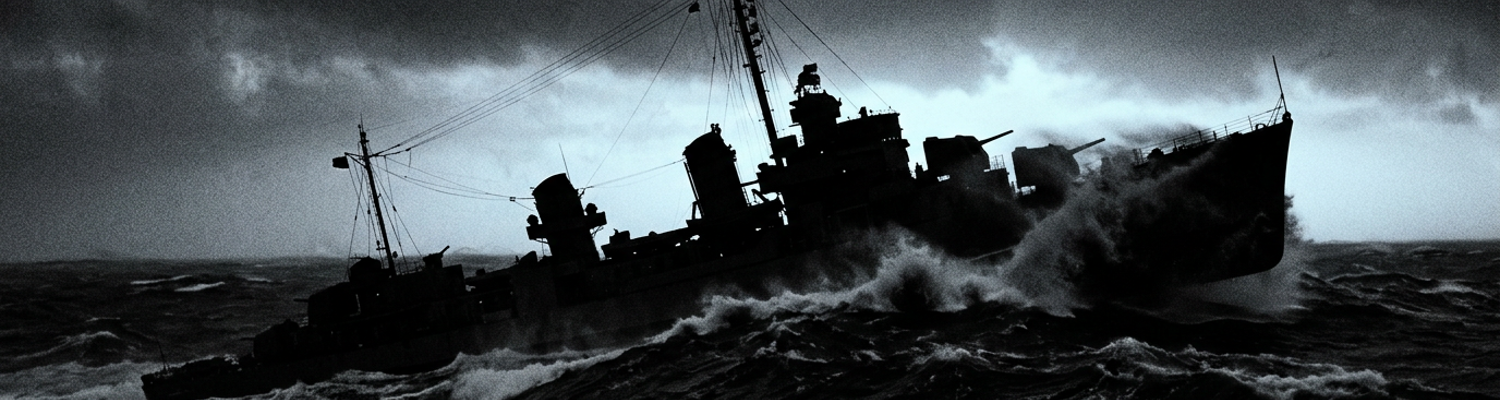

North Atlantic Exercises in Sea State Six
Department of the Navy theoretical training manuals promised smooth ship-to-ship transfers at twelve knots in moderate swells. These documents dictated that a standard underway replenishment would require no more than forty-five minutes of steady station-keeping.
The sailors deployed to the North Atlantic actually faced twenty-foot waves crashing over the weather decks of vessels pitching violently at fifteen degrees. Standardized rigging diagrams became completely obsolete.
Archival evidence shows that in late November 1954, United States Navy auxiliary vessels conducted exercises in North Atlantic sea state six gales. Task Force 86 command staff ordered ships to coordinates near 54 degrees North, 35 degrees West. This area was documented heavily for severe cyclonic activity. The fleet oiler USS Severn and the attack cargo ship USS Muliphen received direct orders to resupply a screen of radar picket destroyers. Wind speeds reached sustained velocities of thirty-three knots.
Deck crews walked at extreme angles on steel plating slick with freezing sea spray.
A close review of operational logs indicates that the standard operating procedure for maintaining a fixed distance of one hundred feet between hulls failed almost immediately. Helmsmen aboard the receiving destroyers struggled with sudden yawing motions. The massive water displacement of the larger auxiliary ships caused these violent shifts. Engine order telegraphs registered constant changes from one-third to standard ahead just to hold position against the trough of the waves. The physical strain on the steering gear assemblies caused hydraulic lines in the aft steering compartments to rupture under the increased pressure.
Command directives forced crews to attempt high-line medical evacuations concurrently with fuel and ammunition replenishment.
Planners in Washington drafted this multi-tasking requirement to minimize the time combat vessels spent tethered to slow-moving supply ships. The physical mechanics involved rigging a heavy manila span wire between the mainmasts of two ships. Heavy black bunker oil pumped through six-inch rubber hoses suspended just feet below the wire. Sailors on the forward stations wrestled with heavy wooden pallets of five-inch artillery shells swinging wildly from the cargo booms. Aft of the ordnance transfer point, hospital corpsmen secured simulated casualties into rigid canvas and bamboo Neil Robertson stretchers. These stretchers clipped directly to a heavy metal trolley block riding the same tensioned wire connecting the violently rolling ships.
The concurrent operation overloaded the deck divisions.
Winch operators on the oiler had to manually adjust the steam valves to keep the span wire taut. When the two hulls rolled outward simultaneously, the dynamic load on the wire spiked exponentially. If the ships rolled toward each other, the wire went slack. The stretcher plunged down toward the churning water between the hulls. Standard practice required deckhands to heave on handling lines to steady the suspended load. The weight of the fuel hoses dragging against the ocean surface imparted severe lateral drag on the entire rig. Heavy seas frequently submerged the fuel lines entirely. Water pressure threatened to tear the metal suspension saddles right off the cables.
Stress fractures appeared in the steel deck fittings holding the winch assemblies.
On November 24, a sudden thirty-degree roll aboard the destroyer USS Gearing snapped a primary tensioning line on the aft medical transfer station. The severed manila rope whipped backward across the fantail at high velocity. Deck logs from the Severn record that the steam winch operators could not release the pressure fast enough to compensate for the extreme angle of the destroyer. The main span wire holding the medical stretcher stretched to its absolute breaking point. The simulated casualty dropped twelve feet as the wire sagged. The rig narrowly avoided the cresting waves before the winch caught the slack. Fuel hoses connected to the forward kingpost twisted under the torsion of the ships moving out of phase. The bronze Robb couplings connecting the hoses to the receiving trunks began to leak heavy fuel oil directly onto the deck.
High Line Mechanical Failures and Casualty Trauma
Bureau of Medicine and Surgery field manuals guaranteed that injured personnel would glide between ships on tensioned wires at a steady, controlled descent angle.
Sailors operating near 54 degrees North, 35 degrees West instead suspended stretchers over freezing water while uncoordinated hull movements tore the steel rigging apart.
A close review of operational logs from November 25, 1954, reveals the catastrophic limits of the standard medical transfer system under extreme weather conditions. Task Force 86 command directed the destroyer USS Vogelgesang to transfer a radarman suffering from a compound leg fracture to the heavy cruiser USS Salem. Wind velocities held at forty knots across the exposed weather decks. Separation between the cruiser and the destroyer was designated at one hundred and twenty feet to prevent collisions. Both vessels experienced severe pitch and roll cycles that were completely out of phase. The Salem rolled twenty-five degrees to starboard just as the Vogelgesang pitched downward into a deep wave trough. Uncoordinated movement generated massive kinetic spikes along the heavy manila high line connecting the two mainmasts. Steam winch operators aboard the cruiser physically could not adjust the tension valves fast enough to compensate for the sudden distance changes between the wildly moving decks. The mechanical advantage of the block and tackle system worked against the deck divisions.
Dynamic loading instantly exceeded the twelve-thousand-pound breaking strength of the primary transfer cable.
Steel pulley blocks shattered under the extreme mechanical strain. Heavy metal shrapnel from the destroyed rigging blocks embedded directly into the wooden deck planking of the cruiser. Sudden loss of structural tension caused the entire high-line assembly to drop violently toward the churning North Atlantic. Deck crews on the destroyer desperately hauled on the heavy manila inhaul lines to keep the suspended casualty from plunging into the sea. Violent jerking motions effectively turned the transfer rig into an uncontrolled swinging mass suspended between the two warships. Winch operators on the Salem threw the main steam valve wide open to recover the slack in the line. Cables snapped taut.
Rapid re-tensioning launched the suspended stretcher upward at high velocity.
High-line instability directly caused severe secondary trauma to the casualties trapped inside the transfer rigs. Archival evidence shows that the standard Neil Robertson stretcher provided absolutely no shock absorption for the patient strapped inside its rigid bamboo and canvas frame. When the steam winch slammed the main cable taut, the heavy metal trolley block arrested violently against the tensioned wire. Kinetic energy transferred directly through the suspension rings into the wounded sailor. Medical reports from Task Force 86 detailed that the radarman suspended between the Vogelgesang and the Salem suffered two fractured ribs and a dislocated right shoulder from the rapid deceleration alone. Uncoordinated rolling of the ships then caused the stretcher to swing laterally across the open water. Wind gusts caught the canvas wrapping. Swinging in a forty-foot arc, the casualty slammed hard against the portside steel hull plating of the cruiser. Impact forces dented the half-inch steel bulkhead. Bones broke instantly. Severe blunt force trauma to the cranium and deep tissue contusions across his entire left side immediately afflicted the patient. Navy hospital corpsmen waiting on the receiving deck could only watch as the stretcher dragged upward against the abrasive steel hull. Constant friction tore through the outer canvas layer of the rescue device. The wooden splints beneath became completely exposed.
Frayed suspension straps snapped exactly as the rig cleared the lifeline stanchions.
Dropping four feet, the stretcher slammed onto the steel deck surface. Medical personnel rushed forward to assess the massive physical damage inflicted by the transfer process itself. Violent thrashing and hull impacts had significantly worsened the original compound fracture. Jagged bone fragments severed the femoral artery during the lateral swing against the cruiser. Protocols designed to save the sailor subjected him to lethal gravitational forces and direct physical strikes instead. Deck logs of the Salem recorded the medical transfer as a complete failure at 1422 hours. Hospital corpsmen immediately applied tourniquets to stop the arterial bleeding caused entirely by the high-line system.
Peacetime Evacuation Manuals and Deck Realities
Bureau of Naval Personnel manuals from 1951 guaranteed that high-line medical evacuations would proceed with mechanical precision. These documents predicted a maximum transfer time of twelve minutes per casualty in controlled sea states.
Sailors operating near 52 degrees North, 33 degrees West in late November 1954 instead watched their primary transfer lines tear apart under the sheer physical force of North Atlantic winter gales. Wounded men hung suspended over thirty-degree water for hours.
Archival evidence shows that peacetime doctrine completely failed to anticipate severe weather dynamic stresses on high-line equipment during the 1954 Atlantic exercises. Planners at the Bureau of Ships designed the standard block-and-tackle medical transfer system for a maximum lateral deflection of fifteen degrees. They tested the gear exclusively in the calm waters of the Chesapeake Bay. A low-pressure system stalled over the exercise area on November 26. Sustained winds reached forty-five knots. The destroyer USS Barton attempted to rig a standard transfer line to the heavy cruiser USS Albany. Swells cresting at twenty-five feet caused the destroyer to yaw violently to port while the cruiser rolled to starboard. This uncoordinated movement generated massive kinetic spikes along the one-inch manila span wire connecting the two vessels. Standard operating procedures required winch operators to manually ride the brakes to maintain constant tension. The high speed of the roll cycle in a sea state six gale outpaced human reaction times. Dynamic loading instantly exceeded the safe working limit of the heavy-duty tensioning springs mounted on the receiving station of the cruiser.
Bronze shear pins designed to protect the winch motors snapped entirely.
Without the mechanical buffer of the tensioning springs, the full force of the separating hulls transferred directly to the one-inch manila rope. The line stretched twelve percent beyond its maximum elongation rating. Friction generated by the rapid slipping of the rope over the steel capstans caused the manila fibers to begin smoking. Deck logs from the Barton indicate that the primary span wire parted at 0814 hours. The severed line whipped across the forecastle. It tore through a steel lifeline stanchion before striking the forward gun mount.
Operations halted immediately as deck divisions scrambled to rig emergency backup lines.
Deck-level triage crews faced chaotic operational delays ignored by theoretical manuals. Bureau of Medicine and Surgery guidelines from 1952 assumed that injured personnel would be transferred into a heated surgical bay within five minutes of arriving on a receiving ship. The physical conditions of the North Atlantic weather forced hospital corpsmen to hold casualties on exposed weather decks for extended periods. Aboard the Albany, a triage team waited on the fantail to receive three sailors suffering from severe steam burns sustained during a boiler casualty on the Barton. Because the primary high-line parted, the transfer operation dragged on for two hours and forty minutes. The burned sailors lay strapped inside rigid Neil Robertson stretchers on the deck of the destroyer. They were completely exposed to freezing sea spray and ambient temperatures of twenty-eight degrees Fahrenheit. Triage manuals offered no protocols for treating hypothermia concurrently with third-degree burns. Corpsmen on the Barton attempted to shield the patients with heavy canvas tarpaulins. The wind tore the coverings away.
Ice formed directly on the exposed bandages of the wounded men.
When the backup transfer line finally brought the first casualty across to the cruiser, the receiving medical team encountered a completely disorganized deck environment. Theoretical training diagrams depicted a clear ten-by-ten-foot staging area for medical personnel to unstrap the patient and conduct initial assessments. The Albany fantail was instead cluttered with broken rigging gear, loose ammunition pallets, and fifty feet of discarded manila rope. Space restrictions forced the chief medical officer to perform emergency airway maintenance while kneeling on a pile of frozen mooring lines. The stretcher could not be moved below decks because the watertight hatches had to remain sealed against the crashing waves. Every time a heavy swell struck the stern, knee-deep water washed over the triage team. Medical instruments washed into the scuppers. Intravenous fluid bags froze solid before the corpsmen could establish a line.
The chief surgeon recorded a core body temperature of ninety-two degrees for the first arrival.
Psychological Assessment via Eighth Air Force Methodologies
A close review of medical department logs from December 1, 1954, reveals an unusual deployment of psychiatric evaluation teams across Task Force 86.
Bureau of Medicine and Surgery inspectors boarded the heavy cruiser USS Albany and the destroyer USS Barton at coordinates 52 degrees North, 33 degrees West. They carried diagnostic field kits entirely foreign to naval surface operations. The inspectors applied the exact methodologies of Aero Medical Study 142. The United States Army Air Forces originally developed AMS-142 in 1943. The program quantified acute combat fatigue in B-17 bomber crews flying unescorted daylight missions over heavily defended German airspace. The protocol demanded immediate physiological and psychological testing the moment a crew returned from combat. It measured the exact degradation of the human nervous system under heavy anti-aircraft fire.
Naval psychiatrists repurposed these high-altitude bomber diagnostics to evaluate sailors conducting underway replenishments.
Shifting from English airfields, the testing environment became the violently pitching weather decks of warships in sea state six. Medical inspectors attached primitive polygraph equipment and copper galvanic skin response electrodes directly to the freezing fingers of steam winch operators. Heavy canvas sphygmomanometers were strapped to the arms of deck boatswains the exact second a high-line transfer concluded. Evaluators forced hospital corpsmen to complete written cognitive function inventories while standing in ankle-deep water on the fantail. Manual AMS-142 protocols required subjects to perform fine motor skill tests. Sailors had to thread small metal needles or match complex geometric patterns under a strict time limit. Deck crews attempted these tasks while shivering violently in twenty-eight-degree ambient temperatures.
The biometric data alarmed the psychiatric teams.
Archival evidence shows that the surveys identified a large-scale psychological disconnect between high-command operational timelines and the actual cognitive states of the deck-level triage crews. Planners working inside the Pentagon drafted replenishment schedules based on peacetime mechanical theory. Command manuals dictated that a standard medical evacuation would require exactly twelve minutes of focused, sequential effort. Admirals expected deckhands to calculate roll frequencies, monitor span wire tension, and safely secure casualties with calm, rote precision. Raw AMS-142 data proved that the sheer physical terror of the North Atlantic gales destroyed the executive function of the sailors.
Working memory capacity collapsed entirely under the threat of snapping steel rigging.
When a one-inch manila line parted under the strain of a thirty-degree roll, the sudden explosive sound triggered acute auditory exclusion in the deck divisions. Winch operators aboard the USS Barton exhibited severe tunnel vision. Cognitive tests revealed that the sailors fixated completely on the swinging metal trolley blocks suspended over the water. They lost all situational awareness regarding the heavy fuel hoses and ammunition pallets moving simultaneously around them. High-command directives ordered crews to multitask. Human biology prevented it. Endocrine systems released massive amounts of adrenaline. Resting heart rates pushed above one hundred and forty beats per minute. This physiological spike caused uncontrollable muscle tremors in the hands of the triage corpsmen. Blood pressure readings taken on the weather deck routinely exceeded 170 over 110.
Medical personnel lost the fine motor skills required to tie simple tourniquets.
Psychiatric inventories documented severe anticipatory anxiety among the rescue teams. Corpsmen knew the rigid Neil Robertson stretchers offered zero protection against blunt force trauma. They were still forced to strap wounded men into the devices. Survey data recorded that medical staff experienced profound psychological distress watching patients slam into the steel hull plating of the receiving ships. High-command timelines completely ignored this trauma. Pentagon manuals assumed a corpsman could watch a simulated casualty drop twelve feet toward the freezing ocean, recover the patient, and immediately perform complex surgical procedures. Final AMS-142 findings explicitly stated that the triage teams required hours to physiologically recover from the stress of a single failed transfer.
Task Force 86 commanders filed the psychiatric reports into classified storage. They ordered the multi-point transfers to resume at 0600 hours.
Post Exercise Navy Medical Evacuation Reforms
Archival evidence shows that a joint commission from the Bureau of Ships and the Bureau of Medicine and Surgery convened in January 1955. They reviewed the Task Force 86 operational logs.
Inspectors analyzed the specific biometric data and mechanical failure reports generated during the disastrous November exercises near 52 degrees North, 33 degrees West. The resulting heavily classified documents spanned over four hundred pages of technical telemetry and psychiatric evaluations. This data forced a complete overhaul of Cold War naval medical evacuation protocols across the Atlantic Fleet. Planners in Washington determined that the 1951 guidelines relying on simultaneous multi-point transfers directly caused the massive kinetic spikes that shattered bronze rigging components. Naval command staff issued General Order 14-B. This directive completely rewrote the theoretical training manuals from the ground up. The new doctrine strictly prohibited commanders from conducting high-line casualty transfers concurrently with heavy bunker oil and artillery shell replenishments. Deck divisions previously forced to juggle swinging ordnance pallets alongside wounded personnel received completely separate operational windows for medical emergencies.
Hospital corpsmen received absolute authority to halt any ship-to-ship evacuation exceeding a fifteen-degree roll cycle.
A close review of the revised BUMED field manuals from early 1955 reveals a total elimination of human-operated steam winch tensioning for medical casualties. The joint inspection reports explicitly condemned the reliance on deckhand reaction times during severe cyclonic activity. Mechanical engineers at the Naval Ship Research and Development Center in Carderock, Maryland, received urgent orders to design a mechanical buffer. Design constraints required the new system to absorb sudden forty-foot distance changes between hulls without snapping the primary one-inch manila span wire.
Engineers discarded the fragile bronze shear pins.
New dynamic tensioning equipment was developed to improve sea state six casualty transfers through applied fluid dynamics. Bureau of Ships technicians constructed the first pneumatic-hydraulic ram tensioner system during the summer of 1955. They abandoned traditional block-and-tackle mechanics. This heavy machinery utilized massive high-pressure steel cylinders filled with compressed nitrogen gas. The gas backed a two-hundred-gallon reservoir of aviation-grade hydraulic fluid. The physical footprint of the device required shipyard workers to strip out the aft anti-aircraft gun mounts on receiving destroyers just to weld the heavy tensioning tracks to the main deck. When a receiving vessel pitched violently away from a supply ship, the extreme pull on the medical span wire forced a heavy steel piston against the hydraulic fluid inside the main accumulator. Fluid pressure then compressed the nitrogen gas. The gas acted as a highly responsive, instantaneous shock absorber. As the ships rolled back toward each other, the expanding gas pushed the liquid in reverse. The system automatically retracted the wire through a series of grooved steel sheaves faster than any human operator could turn a mechanical valve. The internal mechanics maintained a constant 2,500 pounds of line tension regardless of external hull movement.
The Carderock engineering team installed the prototype tensioner aboard the destroyer USS Mullinnix in October 1955.
Sea trials commenced immediately in the North Atlantic at coordinates 45 degrees North, 40 degrees West. The Mullinnix linked its modified high-line rig to the fleet oiler USS Neosho during a recorded low-pressure storm system. Wind speeds reached forty-eight knots. Twenty-two-foot swells battered the exposed weather decks of both vessels. Deck crews attached a weighted canvas test dummy to a standard Neil Robertson stretcher. They suspended it directly over the churning water. The newly installed hydraulic-pneumatic accumulator absorbed every violent uncoordinated hull movement flawlessly. The one-inch span wire never exceeded its safe working load limit. The stretcher maintained a stable, horizontal glide path completely free of the violent lateral swinging that had previously caused severe blunt force trauma to the radarman aboard the USS Salem.
Telemetry sensors recorded zero kinetic spikes along the primary cable assembly.