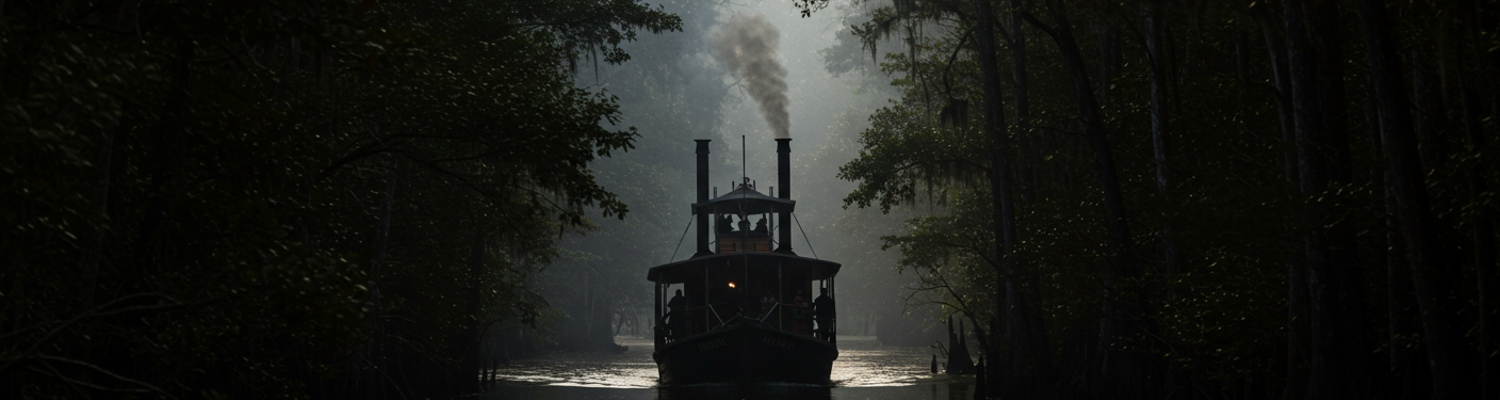

The Second Seminole War confounded the United States Army. Beginning in 1835, conventional tactics failed against Seminole warriors waging a masterful guerrilla campaign from the sanctuary of Florida’s unmapped wilderness. The Army, organized for set-piece battles, found itself paralyzed by an environment where swamps, dense hammocks, and winding, shallow rivers were primary combatants. This terrain neutralized the Army's advantages in numbers and firepower. Facing a strategic impasse, Army leadership turned to a new technology forged in the industrial age: the steamboat. The decision to procure, adapt, and deploy steam-powered vessels for riverine operations would fundamentally alter the logistical landscape of the conflict, providing the essential means to sustain a brutal war of attrition.
Forging a Riverine Weapon
Initial attempts to navigate Florida’s interior waterways with conventional craft ended in failure. The territory’s lack of roads made water transport vital, but its shallow, snag-filled rivers demanded a vessel of unique design. Early in the war, the Army chartered commercial steamboats, a costly and inefficient stopgap. These boats, built for the deeper channels of the Mississippi or Hudson, were ill-suited for the specific challenges of the Florida theater. They frequently ran aground, were too large to navigate twisting tributaries, and required extensive modifications for military use.
The strategic shift began with Major General Thomas Sidney Jesup. Taking command in Florida in late 1836, Jesup applied a new vision focused on grinding down the Seminoles’ ability to resist rather than seeking a single, decisive engagement. His prior experience as the Army's Quartermaster General gave him a profound understanding of military logistics. He correctly identified the Army's inability to sustain deep-woods operations as its central weakness. His solution was to establish a network of forts supplied by a reliable riverine transport system. This led to a pivotal command decision: the development of steamboats purpose-built for the war.
The most significant result of this decision was the U.S. Army steamer Poinsett, an iron-hulled sidewheel vessel named for Secretary of War Joel Poinsett. Constructed in 1837 at the Pusey and Jones shipyard in Wilmington, Delaware, its design was a direct response to the hard lessons of the war's early years. The 93-foot-long boat featured an exceptionally shallow draft, reportedly as little as 18 inches when lightly loaded. This allowed it to penetrate far up rivers like the St. Johns, the Withlacoochee, and their tributaries, areas previously inaccessible to Army supply craft. The use of an iron hull, a relatively new innovation, offered superior durability against the constant threat of submerged cypress logs and abrasive sandbars that quickly destroyed wooden vessels. Its engine and machinery were placed on the main deck to maximize cargo space and maintain stability in the shallows. Jesup’s direct influence on the Quartermaster’s Department ensured that the Poinsett and similar vessels were not just procured but integrated into a coherent operational plan.
The Steam-Powered Supply Chain
The primary function of the Army's new steamboat flotilla was to extend its logistical spine deep into hostile territory. The entire war effort rested on a chain of isolated forts and outposts that were untenable without consistent resupply. Steamboats became the workhorses, pushing upriver with ammunition, rations, medical supplies, and forage for the Army's horses and mules. They formed a moving supply chain that kept the war machine running.
Operational records show their profound impact. Steamers like the Poinsett, New-York, and Camden regularly navigated the St. Johns River, the main artery into the interior, to supply Fort Mellon on Lake Monroe and other key posts. From these forward depots, commanders could launch sustained campaigns. General Zachary Taylor’s 1837 expedition, which culminated in the Battle of Lake Okeechobee, depended entirely on supplies stockpiled at forward bases serviced by river transport. The ability to move troops rapidly was another key advantage. An infantry company could be transported hundreds of river miles in days, a journey that would take weeks of punishing overland marching. This mobility allowed commanders to concentrate forces and react to Seminole movements with unprecedented speed.
Beyond combat logistics, the steamboats performed the critical function of medical evacuation. Florida’s environment was a breeding ground for malaria and yellow fever, which inflicted far more casualties than combat. A soldier wounded in a skirmish or struck down by disease faced a grim fate in a primitive forward camp. Steamboats served as rudimentary hospital ships, enabling the swift transport of the sick and wounded from interior posts like Fort King to better-equipped hospitals at coastal bases such as St. Augustine and Savannah. This capability preserved manpower and bolstered the morale of soldiers who knew that injury or illness did not guarantee death in the swamps. In a darker capacity, these same vessels, including the Grey Cloud and Quapaw, were later used for the forced removal of captured and surrendered Seminoles to the West, their logistical efficiency applied to the government's policy of relocation.
Navigating a Gauntlet of Fire and Fever
Steamboat operations were exceptionally dangerous. The same rivers that served as Army highways provided perfect ambush sites for Seminole warriors. Concealed in the dense vegetation of the riverbanks, they could deliver accurate rifle fire onto the exposed decks of the slow-moving vessels. A steamboat navigating a narrow channel was a predictable, vulnerable target. These attacks became a constant threat, forcing the Army to adapt. Sharpshooters were posted on the upper decks, and some vessels were armed with small-caliber cannons to provide suppressive fire. To protect pilots and helmsmen, pilothouses were reinforced with iron plating. Supplies like cotton bales or sacks of grain were often stacked along the railings to create temporary bulwarks.
Mechanical failure was a relentless problem. Florida's rivers, with their shifting sandbars, submerged cypress stumps, and floating debris, were brutal on the machinery. Engines were strained to their limits, boilers were a constant risk for explosion, and hulls were frequently damaged. A steamboat grounded on a sandbar became a stationary target, its crew forced to work frantically to free the vessel while exposed to potential attack. The operational tempo demanded by commanders often meant skipping necessary maintenance, leading to a high attrition rate for the boats themselves. Field repairs were difficult, and a disabled steamer could block a critical supply line for days.
An invisible enemy, disease, was even more lethal. The swampy, stagnant waters of the riverine environment were ideal breeding grounds for mosquitoes carrying malaria and yellow fever. The cramped quarters aboard the steamboats facilitated the rapid spread of illness. During the humid summer months, it was common for a large portion of a boat’s crew and embarked troops to be incapacitated by fever. This directly impacted strategy, reducing the availability of the boats and the combat effectiveness of the soldiers they carried. Army commanders learned through bitter experience that summer campaigns were often a losing proposition, defeated not by the Seminole but by a biological onslaught that their technology could not overcome.
Jesup's Gamble: Steam as Strategy
The decision by Army leadership, specifically General Jesup, to invest in a specialized fleet of shallow-draft steamboats was a defining moment of the Second Seminole War. His strategic insight, born from his logistical background, correctly identified that victory in Florida depended on sustaining a permanent presence in the interior. His strategy of creating a web of river-supplied forts was a direct counter to the Seminoles’ guerrilla tactics. It shifted the conflict to a war of endurance that the U.S. Army, with its industrial backing, was equipped to win.
Subsequent commanders, including Zachary Taylor and Walker Keith Armistead, built upon this logistical foundation. They integrated riverine assets into their campaigns, using the forward positioning of supplies to launch deeper and more sustained patrols. The establishment of a major depot at Garey’s Ferry on Black Creek, a tributary of the St. Johns, became the logistical heart of the entire war effort. The steamboats did not provide a simple path to victory. The war remained a brutal, costly affair that dragged on until 1842. However, the command decision to embrace and adapt steam power was instrumental in preventing a strategic defeat. The swamp engines enabled the U.S. Army to overcome the tyranny of Florida's terrain, deny the Seminoles permanent sanctuary, and slowly grind down their capacity to resist. They were the essential tool that made the Army's attritional strategy possible.