
Operation Blacklist and Initial Landings at Atsugi
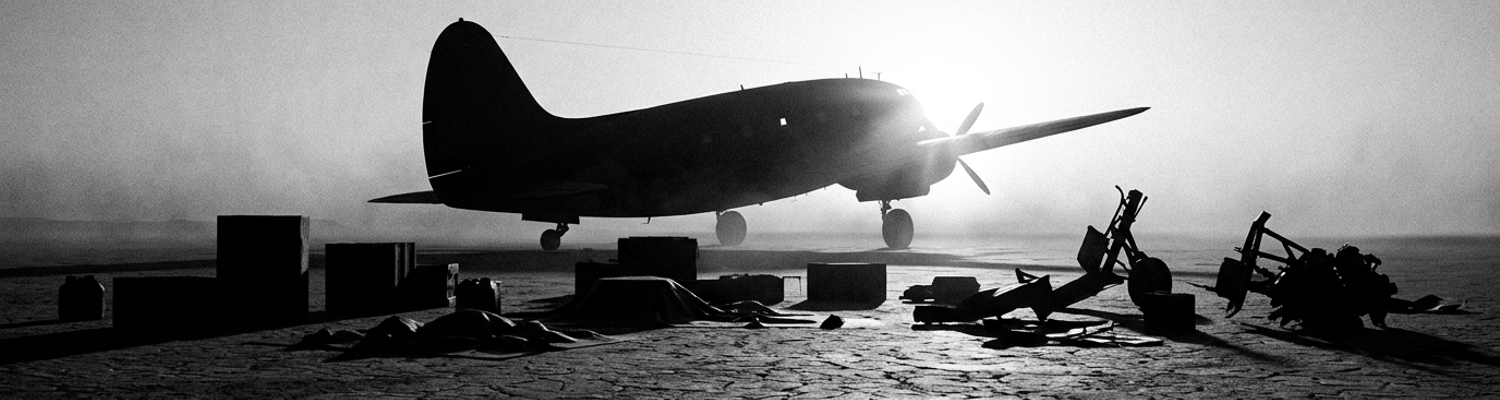
Inside the port landing gear bay of Curtiss C-46D (serial number 44-77512) three gallons of hydraulic fluid vaporized. The liquid turned into an atomized mist across the red-hot brake assembly. Fluid pressure inside the stainless steel lines plunged from twelve hundred pounds per square inch to zero in under four seconds. Neoprene synthetic packing rings had degraded. A rear depot supply point had substituted mineral-base hydraulic oil. This oil turned the rings to sticky black sludge within the wheel calipers during the flight north. Internal seals designed to withstand natural castor-oil mixtures dissolved under the petroleum wash. They blew out through the bleeder valves with an audible hiss. The pilot depressed the rudder pedals on touchdown. The expander tubes failed to retract. Steel brake discs ground directly against cast-iron drums at one hundred miles per hour. This emitted a high-pitched screech of tearing metal. Expanding heat quickly fused friction pads to the rotor plates. The port wheel locked solid. It gouged a deep scar of vaporized rubber across Atsugi's cracked runway.
The transport skidded sideways through the morning heat haze.
Archival evidence shows that this mechanical breakdown had its origins hundreds of miles south across the Ryukyu Islands. Directives for Operation Blacklist issued by General Douglas MacArthur's General Headquarters in Manila dictated a specific timeline. The occupation vanguard had to secure air terminals in Kanagawa Prefecture before the surrender ceremony in Tokyo Bay. Staging operations concentrated at Kadena, Yontan, and Ie Shima on Okinawa. Flight lines there held over two hundred Curtiss C-46 Commandos assigned to the 54th Troop Carrier Wing. These aircraft were drawn primarily from the 317th and 375th Troop Carrier Groups. Ground personnel worked around the clock in tropical squalls and corrosive salt air. They loaded infantry equipment into cargo holds. They tuned overworked Pratt and Whitney R-2800 engines. Supply personnel struggled with local shortages of specification AN-VV-O-366 hydraulic fluid. They accepted unapproved petroleum-based fluids. These fluids steadily corroded synthetic Buna-N seals throughout the hydraulic sub-assemblies. Depot personnel across the Marianas and Ryukyus had stamped the altered drums with general maintenance codes. This masked the chemical incompatibility from flight line mechanics. The mechanics poured the dark liquid straight into the hydraulic reservoirs. Flight plans required each twin-engine transport to haul twenty-seven combat-ready soldiers. Some carried four tons of field gear. They flew across eight hundred miles of open water directly into unmapped Japanese airspace.
Every operational airframe on Okinawa was committed to the flight schedule.
A close review of operational logs indicates that the airlift into Atsugi Airfield began at dawn on August 28, 1945. Colonel Charles Tench led the advance party down onto runway concrete surrounded by disabled Mitsubishi J2M interceptors. This marked the first foreign military landing on mainland Japanese soil. Major General Joseph M. Swing followed shortly behind with the main body of the 11th Airborne Division. He air-landed the 187th and 188th Glider Infantry Regiments along with forward echelons of the 511th Parachute Infantry Regiment. Transports touched down at three-minute intervals. They threw up grit that settled on Japanese ground crews standing by the dispersals. Flight crews carried sidearms while taxiing past rows of camouflaged hangars. They were unsure whether Japanese personnel would respect the imperial cease-fire order. Ambient temperatures on the Kanto Plain pushed past ninety degrees Fahrenheit by mid-morning. This baked the concrete surface. The heat superheated the wheel hubs of incoming aircraft. Mechanics on the ramp used hand-pumped carbon dioxide extinguishers to chill blistering brake drums. Aircrews could then taxi clear of the single operational landing strip.
Seventy-four aircraft rolled to a stop at Atsugi before noon.
Ambient Heat and C-46 Commando Vapor Hazards
A close review of operational logs indicates that the transit flight path from Okinawa to Honshu transformed the transport holds into volatile spaces. This happened before the aircraft ever sighted the Japanese coastline. Heavily laden C-46 Commandos departed Kadena and Yontan at gross weights often exceeding fifty-two thousand pounds. Pilots had to cruise at low altitudes between two thousand and four thousand feet across the warm waters of the Kuroshio Current. High outside air temperatures combined with heavy engine workloads. This pushed fuel temperatures inside the internal wing cells past ninety degrees Fahrenheit. Under these conditions the Reid vapor pressure of military-specification 100/130 grade aviation gasoline caused rapid fuel vaporization within the fourteen-hundred-gallon center-section tanks. Curtiss-Wright had designed venting lines to dump pressure through outlets near the wing trailing edges. Deteriorated rubber check valves and misrouted balance pipes allowed atomized vapors to backflow into the enclosed lower cargo compartments. Gasoline fumes seeped upward through unsealed plywood decking. They saturated the cabin air breathed by infantrymen of the 187th Glider Infantry Regiment. Aircraft systems lacked bilge exhaust fans to purge these enclosed spaces. Flight crews faced constant ignition risks from open-contact starter solenoids. DC generator relays and command radio sets operated along the lower fuselage structure.
One stray electrical arc would detonate the airframe.
Archival evidence shows that atmospheric conditions across Kanagawa Prefecture aggravated these mechanical hazards. This occurred the moment the 54th Troop Carrier Wing crossed Sagami Bay. A stagnant summer high-pressure system held over the Kanto Plain during the final days of August 1945. Midday air temperatures pushed past ninety-eight degrees Fahrenheit. Atsugi Airfield (located at coordinates 35 degrees 27 minutes North and 139 degrees 27 minutes East) occupied an unshaded flat basin. Solar radiation baked the dark repair patches covering damaged runway slabs. Black bituminous asphalt and fractured concrete absorbed the heat without respite. Runway surface temperatures pushed past one hundred and forty degrees Fahrenheit by midday. Convective heat currents rising from the runway disrupted low-altitude approach airflows. This denied incoming transports effective cooling as landing gear extended into the thermal boundary layer. Superheated surface air flooded the landing gear wells. The cooling rate of brake drums dropped to zero. These drums had just absorbed heavy kinetic friction during touchdown. Wheel hub assemblies remained at temperatures exceeding four hundred degrees Fahrenheit. They steadily transmitted heat into brake calipers. This softened the already compromised hydraulic seals.
Runway concrete stored and released this thermal energy continuously.
When examining the historical record of ground handling at Atsugi ramp personnel faced immediate operational delays around the parking dispersals. Taxiing aircraft trapped volatile fuel vapors directly above the baking asphalt. Pools of flammable gas settled underneath engine nacelles and unpressurized belly compartments. Maintenance officers from the 375th Troop Carrier Group ordered all gasoline-powered auxiliary power units shut down. This prevented ground fires along the flight line. Cockpit ventilation scoops ingested engine exhaust and superheated tarmac air instead of fresh oxygen. Cargo compartment temperatures drove past one hundred and twenty degrees Fahrenheit. Soldiers dropped from the side doors drenched in sweat. They were incapacitated by avgas vapors that had accumulated during the four-hour flight from Okinawa. Flight line crews used hand fans and wooden chocks. They prohibited steel tools near the wheels to avoid friction sparks. Ground crews measured hub temperatures of three hundred and ninety degrees on thirty-four separate C-46 transports. Maintenance stands could not safely approach the landing gear assemblies until they cooled.
Quartermaster Hydraulic Substitutions and Packing Failures
When examining the historical record of Far East Air Forces supply lines the breakdown at Atsugi began with clerical adjustments inside rear supply depots. This happened months before the first transport touched Japanese soil.
Archival evidence shows that supply personnel at the 21st Air Depot on Biak and the 5th Air Force Base Command at Leyte faced widespread shortages of Buna-N nitrile elastomer O-rings by June 1945. Quartermaster requisition forms specifically demanded Army-Navy standard AN-6227 and AN-6230 packing rings. These were designed to withstand mineral-base hydraulic fluids under pressure. Frontline supply units possessed empty bins. Rear-echelon depot managers authorized the substitution of older synthetic and natural rubber seals pulled from Class 04-B inventory reserves. They did this rather than ground the transport squadrons during the final offensive. These emergency issue rings were compounded under obsolete specification AC 3580. They were manufactured strictly for vegetable-base castor oil mixtures rather than modern petroleum distillates. Depot technicians repacked bulk crates with hand-lettered labels marked for universal utility. This hid the material incompatibility from ground crews. Service echelons transferred over forty thousand of these unapproved seals to the 301st Depot Wing on Ie Shima and Kadena. Flight mechanics of the 54th Troop Carrier Wing worked double shifts to prep C-46D transports for Operation Blacklist. They installed these rubber rings directly into brake master cylinders. They also packed them into landing gear oleo struts and hydraulic selector valves.
Mineral-based AN-VV-O-366 hydraulic fluid began dissolving the interior surfaces of those seals the instant mechanics pressurized the lines.
A close review of operational logs indicates that the synthetic rubber seals suffered acute chemical breakdown during the four-hour flights north across the Philippine Sea. Hydrocarbon molecules inside the mineral-base fluid extracted plasticizers from the Buna-S and natural rubber compounds. The elastomeric matrix softened and disintegrated. It swelled by up to sixty percent beyond engineered clearances. This chemical softening became catastrophic when the landing gear encountered the extreme thermal conditions of the Kanto Plain. Touchdown at Atsugi required pilots to arrest fifty-two thousand pounds of aircraft momentum on a single short runway. Internal brake hub temperatures pushed past four hundred degrees Fahrenheit. Convective ground heat exceeding one hundred and forty degrees prevented radiant cooling. Thermal energy transferred through the caliper housings. The saturated rubber baked into a tacky swollen sludge. The deformed packings mushroomed against the steel cylinder walls. They blocked the internal bleeder ports. Hydraulic fluid could not return to the reservoirs when pilots eased off the pedals.
Trapped fluid held expander tubes permanently inflated against the brake blocks. Three hundred pounds per square inch of residual line pressure was unable to escape. The segmented bronze-and-steel brake shoes stayed locked against the rotating wheel drums during high-speed rollout. Friction tore the disintegrating rubber rings apart. Shredded polymer debris forced its way through hydraulic lines and wedged the shuttle valves shut. Ground mechanics inspecting the disabled transports of the 317th Troop Carrier Group found brake caliper assemblies welded together by friction heat. Liquefied rubber bubbled out around the wheel axle seals. Repair crews had no operational replacement rings on Honshu. They had no means of freeing the seized wheels without draining the entire hydraulic circuit onto the concrete.
Maintenance records from the 375th Troop Carrier Group documented forty-two total landing gear seizures before evening fell.
Brake Seizures and Airhead Gridlock at Atsugi
A close review of operational logs indicates that the afternoon landing sequence collapsed into structural destruction along Atsugi's primary five-thousand-foot runway. Tire blowouts cascaded across the 317th Troop Carrier Group. Pilots fighting thermal crosswinds touched down with swollen packing seals already pinching their brake expander tubes. C-46D transports hit the rough concrete at ninety-five knots. Internal wheel assembly temperatures instantly exceeded four hundred and fifty degrees. Synthetic rubber tires could not rotate against the fused bronze-and-steel brake discs. They dragged across the aggregate. Friction sliced deep flat spots through the eight-ply cord casing. Within six hundred feet of rollout internal air pressure inside forty-seven-inch main tires spiked beyond eighty pounds per square inch. The outer casings detonated with concussive bangs. Shredded vulcanized rubber threw itself into the wing flaps. Cast-magnesium wheel hubs slammed directly onto the unyielding runway slab. They ground down at eighty miles per hour. Side loads generated by asymmetric brake resistance ripped the lower trunnion pins clean out of the oleo shock struts. Transports spun violently off their centerlines. Their steel gear legs folded backward into the wheel wells. They gouged trenches through the centerline pavement.
Four transports collapsed onto their bellies within twelve minutes.
Archival evidence shows that the resulting airframe pileup completely shut down Atsugi's single usable strip before two in the afternoon. Serial number 44-77839 lost both port tires upon contact. Its left gear cylinder snapped. The aircraft spun ninety degrees across the concrete threshold before grinding to a halt on its port wingtip and fuselage belly. Two hundred yards behind it an incoming Commando piloted by Captain Robert V. Vandegrift from the 39th Troop Carrier Squadron attempted ground looping to avoid the collision. Locked right-side calipers dug a six-inch furrow into the runway margin. The right oleo strut snapped. The transport listed across the centerline. Thick black smoke from burning magnesium and smoldering tires drifted across the approach path. Broken steel brake shoes and splintered aluminum skin littered an eight-hundred-foot section of the landing area. Severed hydraulic lines leaked fluid across the asphalt. The tarmac became impassable for any tricycle-gear transport.
Runway clearance operations stalled immediately.
When examining the historical record of Base Command resources the occupation vanguard lacked the heavy engineering plant needed to clear twenty-ton wrecks off an active strip. Priority manifests drawn up in Manila had dedicated every cubic foot of transport cargo space to infantry platoons of the 187th Glider Infantry Regiment. They also carried light communications jeeps and small-arms ammunition. Earthmoving machinery sat tied down to open loading ramps back at Kadena and Yontan. This included Caterpillar D7 bulldozers and heavy wrecking cranes from the 822nd Engineer Aviation Battalion. Ground personnel at Atsugi had only two Dodge weapons carriers. They possessed hand-cranked cable winches intended for utility maintenance. Mechanics looped five-eighths-inch steel wire cables around the tail gear of the disabled C-46s. They attempted to drag them using three-quarter-ton trucks. The cables snapped under the deadweight of fifty-thousand-pound airframes resting directly on their aluminum bellies. Japanese ground personnel supplied two farm tractors and heavy manila ropes. The tractors lacked the traction to move the buckled airframes across the uneven asphalt.
Obstructions completely choked the strip.
Flight echelons already en route from the Ryukyus had nowhere to set down. Fifty-eight Curtiss C-46s belonging to the 375th Troop Carrier Group were stacked in holding patterns between three thousand and nine thousand feet over Sagami Bay. They burned forty-five gallons of aviation fuel per engine every hour. Zero alternate airfields were available within range. Pilots had departed Okinawa with minimum fuel reserves to maximize infantry passenger capacity. They had less than forty minutes of reserve fuel in their center tanks when Atsugi closed. Air traffic controllers operated from an open jeep mounted with a SCR-522 VHF radio set near the Japanese hangars. They ordered inbound transports to throttle back to minimum clean airspeed. Ground crews used cutting torches to slice off broken landing gear assemblies. Maintenance personnel eventually poured two hundred gallons of motor pool oil beneath the aluminum hulls. They dragged the wrecks sideways onto the grassy overrun.
Total airhead closure lasted four hours and twenty-two minutes.
Kanto Plain Infrastructure Collapse and Rail Destruction
Archival evidence shows that field survey teams compiling Far East Air Forces Damage Assessment Reports 3-a(16) Takasaki through 3-a(20) Tokyo found the rail network across eastern Honshu shattered beyond functional utility. During the final months of B-29 precision strikes and naval air sweeps by Task Force 38 heavy bombardment had systematically targeted the double-track arteries. These arteries funneled resources down from Niigata and Gunma toward the capital. Report 3-a(16) detailed the complete severing of the Takasaki junction. Five hundred-pound general-purpose bombs had cratered the main marshalling yards. Three overhead signal towers collapsed. The Shinetsu and Joetsu trunk lines were cut. Consecutive reports 3-a(17) through 3-a(19) logged crater patterns across Omiya, Utsunomiya, and Hachioji. They noted sheared rail beds and wrecked locomotive roundhouses. The final survey in the sequence (Report 3-a(20) Tokyo) documented an urban terminal network rendered completely inoperative. Over sixty percent of the switch tracks and inter-terminal transfers between Ueno, Shinjuku, and Tokyo Station were obliterated by incendiary firestorms and explosive impacts. Track ballast had been displaced down to raw subsoil. Twisted steel rails were torn away from burnt cross-ties.
Cross-country rail transit had ceased to function.
A close review of operational logs indicates that this physical ruin triggered an immediate breakdown of regional rolling stock. The Japanese Home Ministry could not move basic food supplies into the Kanto Plain. Out of nearly two thousand steam locomotives nominally registered to the Tokyo Railway Bureau fewer than two hundred and fifty possessed boiler pressure or coal reserves to pull freight. Hundreds of wooden boxcars sat stranded in burned-out sidings from Kumagaya to Tachikawa. Their running gear seized from ash contamination. Wheels were stripped of lubricating grease. Japanese municipal authorities could not transport harvest reserves of sweet potatoes, barley, and rice. These reserves were stored in the agricultural basins of northern Honshu. They could not reach the starvation zones of urban Tokyo and Kanagawa. Civilian daily rations fell below eight hundred calories per person by late August. Starving urban populations began walking outward into the rural prefectures along shattered rail rights-of-way. They searched for scraps.
Civilian survival hinged on military supplies.
When examining the historical record of Eighth Army supply lines this complete collapse of civil transport dumped the burden of feeding both the occupation force and adjacent municipal centers directly onto Atsugi Airfield. Supreme Commander for the Allied Powers directives had assumed Japanese state railways would move division field rations. They expected trains to transport water purification units and medical stores from the Kanagawa coast into the interior. Eighth Army quartermasters found themselves facing an emergency request instead. They had to distribute tens of thousands of Ten-in-One ration packs and flour sacks straight from the airfield perimeter to prevent civil riots. The grounded Curtiss C-46 Commandos of the 54th Troop Carrier Wing could neither clear the taxiways nor fly supply shuttles back to Kadena. Major General Swing ordered division motor pools to deploy two-and-a-half-ton GMC CCKW trucks across damaged local dirt roads. They delivered bulk rations directly to Japanese relief committees in Machida and Yokohama. This consumed the division's finite eighty-octane motor gasoline reserves at twenty times the planned rate.
Every gallon burned in a truck reduced fuel for the grounded transports.
Operational records from Eighth Army advance headquarters indicate that by August 30 Japanese railway officials reported zero freight car arrivals at the Atsugi municipal spur for six consecutive days. Ground crews at the airfield found their dispersal areas swarmed by municipal delegates and local police. They requested emergency distributions of C-rations, dried beans, and medical plasma. They needed these items to treat dysentery outbreaks among displaced refugees. Maintenance battalions lacked the transport tonnage to satisfy local civilian demand. They were simultaneously servicing sixty-two immobilized transport airframes scattered along the tarmac. Quartermaster distribution logs recorded that the 11th Airborne Division transferred thirty-two thousand pounds of field rations to civil authorities in Fujisawa on August 31. The occupation force was left with four days of rations remaining on site.
Civilian Refugee Influx and Airhead Administrative Crisis
A close review of operational logs indicates that the physical breakdown of the Kanto rail corridor pushed thousands of displaced civilians straight toward Atsugi Airfield by dawn on August 31, 1945. Starving residents of Tokyo, Kawasaki, and Yokohama were burned out by summer air raids. They were cut off from regional rice shipments. They followed the crushed ballast of the Odakyu and Sotetsu rail tracks westward across the Sagami River basin. Word had traveled through shattered municipal wards that American aircraft were offloading mountains of dry provisions on the coastal plain. Forward observation posts manned by Company A of the 188th Glider Infantry Regiment counted over three thousand people moving across unpaved farm lanes toward the outer barbed-wire barriers by nine in the morning. Many suffered from open burn lesions. Others showed advanced malnutrition and acute bacillary dysentery contracted in bombed transit shelters. Japanese municipal police officers from Yamato and Ayase were stripped of sidearms and authority under surrender protocols. They could neither halt the mass movement nor feed the crowds.
Hungry crowds pressed directly against the northern perimeter wire.
Archival evidence shows that civilian numbers surrounding the airfield boundaries climbed past twelve thousand within thirty-six hours. Displaced families dug open latrines into the irrigation ditches flanking Prefectural Road 45. They set up makeshift scrap-wood lean-tos within ten yards of American weapons emplacements. Paratroopers of the 511th Parachute Infantry Regiment manned machine gun tripods behind sandbag bastions. They faced dense rows of weeping parents holding out empty tin pans and porcelain bowls. Heat on the unshaded approaches reached ninety-four degrees Fahrenheit by midday. Dozens of collapsed refugees fell directly into perimeter drainage culverts. Division surgeons reported an immediate threat of epidemic typhus and waterborne disease spreading from the refugee encampment into the frontline American bivouacs. Sentries had standing instructions to deny civilian entry. Unarmed crowds surged forward whenever supply trucks rolled through the security barriers.
The perimeter had transformed into an unmanaged refugee camp.
When examining the historical record of Base Command resources this gathering human crisis triggered immediate operational disorder inside the advance occupation headquarters. Major General Joseph M. Swing and Colonel Charles Tench had landed with transport manifests engineered strictly for combat operations. They carried fourteen days of combat rations per soldier and zero civil relief tonnage. Fifty-four C-46 transports sat disabled across the runways with seized brakes and blown tires. Scheduled replenishment shuttles from Kadena Airfield could not touch down. Division quartermasters calculated that feeding even a fraction of the surrounding Japanese population would wipe out unit supplies in under seventy-two hours. An emergency conference inside a damaged Kawanishi assembly hangar descended into sharp arguments over security protocols versus humanitarian disaster. Staff officers chose to breach standard distribution directives. They ordered field kitchens from the 187th Glider Infantry Regiment to uncrate Ten-in-One ration packs. Cooks mixed large quantities of hot oatmeal and soluble coffee for distribution at perimeter checkpoints.
Forward warehouses ran out of field rations within forty-eight hours.
Operational supply sheets confirm that Base Command authorized the emergency transfer of forty-eight thousand individual K-ration units and seven tons of dry navy beans directly to Japanese municipal delegates between August 31 and September 2. This unauthorized drain depleted the 11th Airborne Division's emergency war reserve down to an estimated forty-eight-hour margin for its own airborne infantrymen. Division quartermasters were forced to place all American military personnel on a strict two-meal daily restriction. They cut caloric intake to eighteen hundred calories per man while flight lines stayed paralyzed. Armed details took up positions around the remaining C-ration stores inside Hangar 3. They deterred break-ins from both starving locals and desperate occupation troops. By the evening of September 2 the Atsugi garrison retained only thirteen thousand individual food units. Four thousand four hundred soldiers were stranded on the Kanto Plain.