Hagaru-ri Runway Aftermath and Evacuation
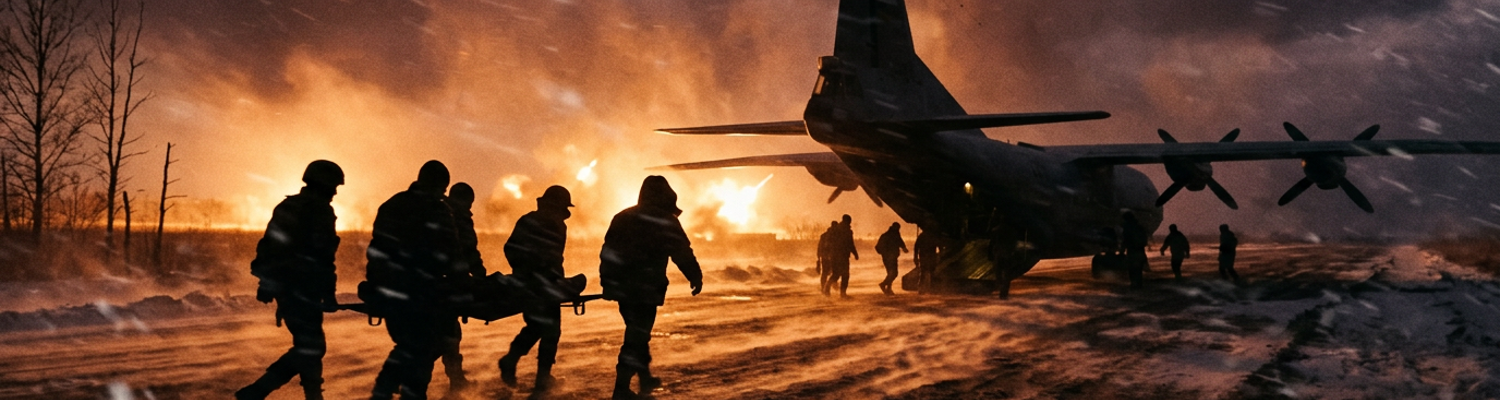
Permafrost, narrow mountain roads, and subzero gales battered the 1st Marine Division long before the perimeter defense consolidated around the frozen reservoir. Temperatures plunged below minus thirty degrees Fahrenheit across the jagged ridgelines of the Chosin Reservoir, freezing engine lubricants into thick sludge and cracking rubber vehicle tires as troops carved defensive works out of the mountain stone. Engineers detonated dynamite charges to shatter the frozen ground and scraped together a makeshift runway across the narrow valley floor while infantrymen traded fire with encircling forces. Twin propellers pulled the overloaded Douglas R4D transport into the overcast sky on December 6, 1950, blowing loose ice crystals across the clearing as the final aircraft departed the crude 2900 foot airstrip at Hagaru-ri.
Ice crystals stung the faces of Navy hospital corpsmen and medical teams who remained on the debris strewn perimeter under sniper and artillery fire. Corpsmen wrapped surviving patients in multiple wool blankets and loaded the nonambulatory wounded onto heavy weapons trucks because no more transport planes could land on the cratered runway. Chinese mortar rounds burst along the rocky slopes, showering rock fragments and snow across the medical staging stations. Medics held glass morphine syrettes inside their mouths to keep the pain medicine thawed while rubber blood plasma tubing cracked and failed whenever it touched the freezing air. Stretcher bearers hauled the last litters onto open truck beds and lashed heavy canvas covers over the casualties as vehicle engines idled in the falling snow.
Vehicle engines shuddered as tire chains gripped the packed ice, exposing the deep administrative breakdowns that had plagued the evacuation from its first hours. Casualty accounting broke down almost immediately because paper identification tags blew away in the wind or became unreadable when blood froze across the cardboard. Clerks tried to maintain unit logs, but standard ink solidified inside pen barrels, forcing battalion staff to track names on scrap cardboard or rely on memory alone. Surgeons wrote triage priorities directly onto the skin of wounded soldiers with wax grease pencils so receiving field hospitals could rapidly identify internal injuries.
Grease pencil marks and field dressings could not overcome the failure of vital medical and operational hardware in the extreme arctic environment. Equipment durability reached a critical breaking point when hydraulic fluid thickened inside aircraft landing gear struts, truck axles snapped under standard weight loads, and suction pumps for chest wounds froze solid during operations. Cross service communication collapsed with equal severity between Marine air controllers on the ground and Air Force transport pilots in the sky. Radio batteries lost their electrical charge within twenty minutes of exposure to the freezing wind, and quartz frequency crystals cracked inside transmitter units when radios moved between heated tents and the freezing runway. Marine radio operators swapped dead batteries into their undershirts to warm them with body heat while convoy commanders waved the first armored vehicles down the mountain road toward Koto-ri.
Communications Relays and Tactical Isolation
Tanks and armored vehicles driving down the mountain road left the signalmen inside the Hagaru-ri perimeter cranking field generators and adjusting long wire antennas. Chinese Peoples Volunteer Army encirclement operations had severed tactical wire lines and high frequency mountain radio relays between the 1st Marine Division and X Corps. Enemy infantry units infiltrated the rocky heights surrounding the reservoir on the night of November 27, cutting overhead telephone cables and overrunning high altitude relay posts stationed on isolated peaks. Jagged granite cliffs blocked direct line of sight signals to division elements fighting at Yudam-ni and Sinhung-ni. Heavy snowfall and atmospheric interference degraded tactical voice channels until transmitters emitted nothing more than faint carrier hums. Staff officers sent couriers in armored scout cars, but ambushes along the frozen road quickly turned every messenger run into a bloody firefight.
Firefights along the frozen road trapped the couriers and forced the 1st Medical Battalion to establish an autonomous triage station on an unfinished dirt strip without operational directives from higher headquarters. Navy surgeons and battalion corpsmen set up canvas hospital tents on the frozen soil of the valley floor, heating the interior spaces with noisy kerosene stoves that could barely keep water from freezing. Medical officers sorted arriving casualties without knowing whether external supply convoys or airborne resupply drops would ever reach the garrison. Corpsmen unpacked wooden medical chests, organized litters into rows across frozen straw, and used flashlights to inspect bullet wounds when lantern fuel ran dangerously low. Every passing hour brought hundreds of frostbitten and bleeding Marines from the perimeter foxholes into the drafty tents, filling the dirt floor from wall to wall.
Dirt floors inside the packed medical tents could no longer hold the incoming wounded, forcing engineers from the 1st Engineer Battalion to operate earthmoving equipment under persistent hostile fire to clear the frozen perimeter strip. Heavy Caterpillar D7 bulldozers scraped bladefuls of iron hard soil while Chinese snipers on East Hill fired armor piercing bullets through unarmored engine hoods. Equipment operators sat exposed on high steel seats without windshields or protective plating, steering heavy crawler treads through mortar craters as shrapnel dented the steel blades. Demolition teams detonated shaped dynamite charges in hand drilled holes to pulverize granite boulders that threatened to shear off aircraft landing gears. Mechanics crouched in the snow with blowtorches to thaw frozen fuel lines and hydraulic valves every time an engine choked on slushy diesel.
Diesel fuel and frozen hydraulic valves yielded to the blowtorches, allowing bulldozer blades to finally clear a rough twenty nine hundred foot runway. Ground crews coordinated landing operations without radio links to coastal airfields. Marine air controllers stood on frozen dirt berms, scanning gray cloud decks through binoculars and signaling inbound Air Force and Marine transport planes with red handheld flags. Pilots from transport squadrons dropped out of the overcast sky on steep gliding approaches, dodging machine gun tracer fire from the ridgelines to slam their heavy landing gear onto the icy gravel. Navy corpsmen carried stretchers out to the runway edge the moment transport tires stopped rolling, loading litters four high into cargo bays without waiting for formal passenger manifests. Ground crews wrestled frozen cargo doors shut against the wind, sending the overloaded aircraft back into the sky while their engines remained running to keep lubricating oil from solidifying.
Material Failures and Subzero Medical Complications
Oil solidified rapidly in auxiliary power units and aircraft radio batteries, severely impeding flight line coordination as ground mechanics attempted to keep transport turnarounds moving without shutting down idling engines. Flight line crews depended on mobile power carts to maintain vital radio contacts with incoming aircraft, but the auxiliary units died from frozen carburetors and dead storage cells within minutes of exposure to the airstrip. Air Force and Marine pilots circling Hagaru-ri could not receive landing clearance or wind warnings from the runway controllers, forcing each transport crew to commit to steep visual approaches through sniper fire on East Hill. Ground guides waved red signal flags and directed taxiing planes by hand across the rutted snow, shouting above the roar of twin engines to guide litter bearers through propeller wash and exhaust smoke. Stretcher teams hurried past the flight line toward the hospital complex, carrying hundreds of shivering casualties away from the exposed strip and into the overcrowded canvas triage tents.
Canvas triage tents offered almost no warmth for these incoming casualties, causing whole blood and plasma containers to shatter from freezing. Rubber intravenous tubing stiffened and fractured in unheated triage tents. Navy doctors discovered that glass bottles of whole blood cracked as the liquid expanded into solid blocks of ice, ruining precious supply stocks that had arrived on previous airdrops. Corpsmen placed surviving fluid containers against their own bodies under layers of heavy wool clothing or held them over soot belching oil stoves to melt the frozen plasma back into usable liquid. Brittle intravenous hoses snapped in half whenever assistants attempted to bend them toward a patients arm, forcing medical teams to thaw the rubber under their armpits before puncturing collapsed veins. Surgeons operated with numbed fingers inside these frigid spaces, using scalpel blades that stuck to cold flesh as they worked by the flickering yellow light of kerosene lanterns.
Kerosene lanterns illuminated rows of screaming men whose agony mounted as temperatures plummeted to minus thirty degrees Fahrenheit. The extreme cold froze morphine syrettes, compelling corpsmen to thaw them in their mouths before field administration. Corpsmen held the small collapsible metal tubes between their cheeks and gums for minutes at a time, softening the narcotic solution with body saliva so the plunger could push the fluid through the needle. Needles bent against frozen clothing and rigid skin when corpsmen attempted injections, requiring medics to cut away multiple layers of stiff canvas and wool with heavy shears to find softer flesh on a patients chest or abdomen. Tourniquets turned into hard bands that froze directly to mangled extremities, completely halting peripheral circulation and accelerating the onset of severe frostbite in already damaged limbs. Battalion doctors prioritized patients based on respiratory stability and chest trauma rather than limb viability, marking each mans forehead with grease pencil numbers to establish evacuation priority.
Grease pencil priorities guided the stretcher bearers who lifted casualties and carried them back into the blizzard toward the idling transports. Frozen canvas on litter frames split under the weight of heavily clothed casualties, forcing corpsmen to lash splints and wooden boards across the steel poles to prevent men from dropping into the snow. Ground crews loaded four tiers of stretchers into the bare aluminum fuselages of each transport, stacking the dying closest to the small cockpit heaters while frostbite victims filled the unheated cargo bays. Corpsmen checked pulse points with bare hands because thick mittens deadened tactile sensation, their skin tearing away on frozen metal buckles whenever they fastened safety straps across the litters. Pilots engaged full throttle against the icy runway as the final cargo door latched, accelerating down the strip into heavy cloud cover while fresh waves of wounded arrived at the perimeter line.
Airfield Triage and Interservice Transport Friction
Perimeter lines received fresh waves of wounded delivered directly from cut off outposts by Marine Observation Squadron 6. The squadron utilized Stinson OY-1 aircraft and Sikorsky HO3S-1 helicopters for frontline casualty evacuation into the Hagaru-ri pocket. Aviators landed their fragile single engine observation planes on narrow stretches of snow covered roadway and frozen riverbeds, braving small arms fire to pull isolated casualties from surrounded infantry pockets. Mechanics had modified these light planes by fitting metal litter racks over the rear fuselage, which allowed them to carry a single prone patient inside or lashed across the deck. Sikorsky HO3S-1 helicopters flew continuous rescue missions into rocky ravines that fixed wing planes could not reach, landing inside perimeter clearings with casualties strapped into external litter capsules mounted directly onto the landing gear. Navy corpsmen ran through swirling rotor wash to pull freezing men from these unheated capsules and carried them into the battalion hospital tents, where space had run out entirely.
Hospital tents lacked adequate casualty tracking systems, creating conflicting loading priorities between ambulatory frostbite victims and critical surgical patients inside the packed shelters. Walking wounded suffering from advanced frostbite crowded around the entryways, begging for air transport before their blackened feet and hands developed gangrene. Medical officers wanted these walking cases evacuated immediately because exposure to the subzero winds guaranteed permanent tissue death and limb loss. Stretcher bearers pushed forward with unconscious casualties who were suffering from penetrating chest wounds, shrapnel trauma, and head injuries that required immediate operating rooms in rear field hospitals. Flight line personnel possessed no master casualty list or functional communication channel to confirm priority clearance, leading to chaotic jams around the tent exits. Medical officers struggled to maintain order as competing litter teams converged on the flight line to wait for the next transport aircraft.
Transport planes belonging to Combat Cargo Command landed directly into the triage jams, sparking severe jurisdictional clashes between ground triage officers and C-47 aircrews over aircraft payload limits and patient manifests. Air Force transport pilots operated under strict peacetime safety regulations that limited standard C-47 loads to roughly twenty four litter casualties, and they insisted on verified paperwork before loading began. Pilots argued that the rough twenty nine hundred foot frozen airstrip and thin arctic air severely restricted their takeoff performance, warning that an overloaded plane could easily fail to clear the surrounding mountain ridges. Marine triage doctors considered strict flight rules ridiculous while hundreds of wounded men lay freezing on the icy gravel without shelter. Navy surgeons and Marine officers boarded the parked aircraft, shouting down the protests of transport pilots and demanding that aircrews fill every square foot of cargo floor with casualties.
Casualties filled the cargo floors as flight engineers adjusted tie downs and drained excess fuel to compensate for the overloaded cabins. Medical teams stacked litters four tiers high against the aluminum interior walls, wedging extra stretchers across the center aisle and resting litter handles on ammunition boxes. Ambulatory frostbite casualties sat pressed shoulder to shoulder along the metal side benches, holding suspended plasma and blood bottles upright for the litter patients who could not move their hands. Aircrews slammed the heavy cargo doors shut as soon as the final walking patients squeezed into the cabin doorway. Pilots pushed their twin throttles forward against locked brakes, checked their flight controls, and released their landing gear to race down the icy strip toward the surrounding hills where enemy artillery batteries waited.
Battlefield Triage Protocol and Cold-Injury Classification
Artillery batteries echoed from the hills as propeller wash churned loose ice across the runway gravel. Navy surgeons inside the battalion aid station confronted hundreds of fresh casualties arriving from perimeter firefights. Surgeons instituted emergency triage categories prioritizing salvageable life and limb while treating severe frostbite concurrent with penetrating ballistic trauma. Medical officers divided the incoming wounded into immediate surgical cases, delayed casualties, and expectant men whose wounds were judged fatal, writing priority numbers with colored grease pencils across frozen foreheads. Infantrymen frequently arrived with shattered bones from machine gun fire while their boots encased pale, necrotic feet that had frozen solid during days of static defense in perimeter foxholes. Doctors cut through stiffened canvas boots and rigid wool trousers to determine whether peripheral blood circulation survived before committing scarce surgical supplies and wooden splints to compound bone fractures.
Bone fractures and severe ballistic wounds masked lethal trauma beneath rigid, bloodless skin as arteries throughout these frozen bodies constricted into narrow channels. Extreme hypothermia and cold induced shock concealed internal hemorrhaging, leading to rapid deterioration during aeromedical transit. Core body temperatures dropped far below normal levels, slowing cardiac output and depressing blood pressure until ruptured abdominal vessels and torn thoracic organs stopped leaking fluid into body cavities. Medical corpsmen evaluating litter patients in the dim aid tents found faint pulses, cold extremities, and clean field dressings that suggested stability rather than catastrophic vascular damage. Triage personnel cleared these quiet casualties for immediate air evacuation, unaware that the subzero temperatures were artificially keeping the men alive by halting internal blood loss.
Blood loss resumed violently the moment aeromedical evacuation flights climbed away from the Chosin Reservoir and cabin heaters aboard the twin engine Douglas transports disrupted this temporary circulatory state. Aluminum cargo fuselages warmed under hot engine bleed air, raising ambient cabin temperatures and causing constricted peripheral blood vessels to dilate rapidly. Rebounding blood pressure forced thawed blood through torn mesenteric arteries and ruptured lung tissue, dislodging the fragile clots that had formed in the freezing ground environment. Casualties who had rested motionless on their canvas litters at Hagaru-ri slipped into violent circulatory collapse at altitude as massive internal hemorrhages drained their vital organs. Flight nurses and aeromedical technicians struggled to administer whole blood through stiff rubber intravenous sets inside the bouncing cargo bays, but dozens of patients expired minutes before the transports touched down on coastal runways.
Runways along the coast remained out of reach for the remaining wounded when mortar rounds from Chinese positions on East Hill detonated across the frozen airstrip. A sudden blizzard dropped ceiling heights and visibility to zero, halting flight operations on the gravel strip. Ground medical officers faced difficult triage decisions when deteriorating weather and enemy fire abruptly halted inbound transport aircraft. Air Force transport pilots circling the cloud deck received radio orders to divert back to coastal airfields, leaving hundreds of freshly sorted litter cases stranded along the snow swept gravel. Doctors rushed outside through the gale to inspect the rows of stretchers, stripping blankets and morphine syrettes from dying expectant casualties to warm conscious riflemen who possessed viable chances of survival through the night. Corpsmen hoisted salvageable surgical patients on split litter poles and hauled them back inside crowded canvas tents, wedging stretchers across wooden ammunition crates to keep bleeding men off the bare frozen earth while perimeter defenses traded rifle fire through the storm.
Inquest Boards and Joint Medical Doctrine
Rifle fire echoed outside the canvas tents while surgeons stacking casualties on those ammunition crates kept hurried triage logs that soon reached division headquarters. Legal officers and staff analysts dissected the operational and logistical failures at the airstrip, reviewing these records alongside analyses noted in contemporary legal reviews to understand why the medical evacuation had created severe interservice friction. Investigators scrutinized files documenting how transport planes took off without accurate passenger rosters while hundreds of freezing wounded remained stranded on the runway. Marine officers and Navy physicians submitted formal statements detailing the severe breakdowns in communications gear, the freezing of medical tools, and the jurisdictional fights over cargo limits that had threatened patient survival. Inquest boards reviewed these operational debriefs alongside Air Force flight records to trace the exact administrative command structure that had fractured during the perimeter defense.
Perimeter defense operations and transport flights left behind logbooks that proved neither Navy medical officers on the ground nor Air Force pilots in the air possessed clear legal authority to decide final patient loads. Inquest findings catalyzed revised Department of Defense guidelines governing joint service casualty custody and aeromedical transport command authority across all branches of the armed forces. New directives established that medical personnel held ultimate responsibility for patient welfare and priority ranking until casualties crossed into the cargo bay, where the aircraft commander assumed operational custody of the flight. Staff planners eliminated chaotic runway arguments by requiring standardized joint casualty tags and uniform manifests that both flight crews and ground corpsmen were legally bound to honor. Joint commands received explicit instructions establishing a single unified officer to run evacuation airfields, ensuring that forward medical units and transport squadrons operated under one clear authority regarding ammunition and cargo.
Ammunition crates rode aboard inbound transports before crews loaded litters on outbound runs, complicating the legal classification of combat transport versus protected medical evacuation. Enemy mortar batteries had shelled the runway continuously because the transport aircraft displayed standard tactical camouflage and lacked dedicated hospital markings, making them legitimate targets for artillery spotters on the surrounding ridges. Military jurists and doctrine writers reexamined the Geneva Conventions in light of these events, and the operational breakdown established updated standards regarding medical transport neutrality and protection within actively contested airspace. Negotiators and military authorities determined that aeromedical flights required clearer protocols for identification, communication, and cargo restrictions if they were to claim protected status near active front lines. Armed services adopted strict operational rules separating combat resupply missions from designated casualty evacuation flights, ordering forward airfields to designate specific staging zones and flight windows for planes carrying wounded personnel through contested airspace.
Airspace standards and staging zones provided engineers and flight surgeons at military transport bases the framework to overhaul the physical equipment carried aboard evacuation aircraft. Technicians discarded fragile rubber intravenous tubing in favor of cold resistant synthetic lines and fitted field suction units with insulated thermal sleeves to prevent mechanical freeze ups during winter operations. Ground mechanics reconfigured transport cargo bays with standardized aluminum litter brackets and added heavy duty electrical outlets to run heated blankets during high altitude flights. Training centers across the armed services drilled flight nurses and ground corpsmen in joint loading protocols, forcing crews to practice rapid casualty handoffs under simulated artillery fire and subzero wind chills. Marine Corps and Air Force commanders signed formal interservice agreements that bound both branches to common aeromedical rules, establishing clear jurisdiction over every stretcher from forward aid stations to rear hospitals.