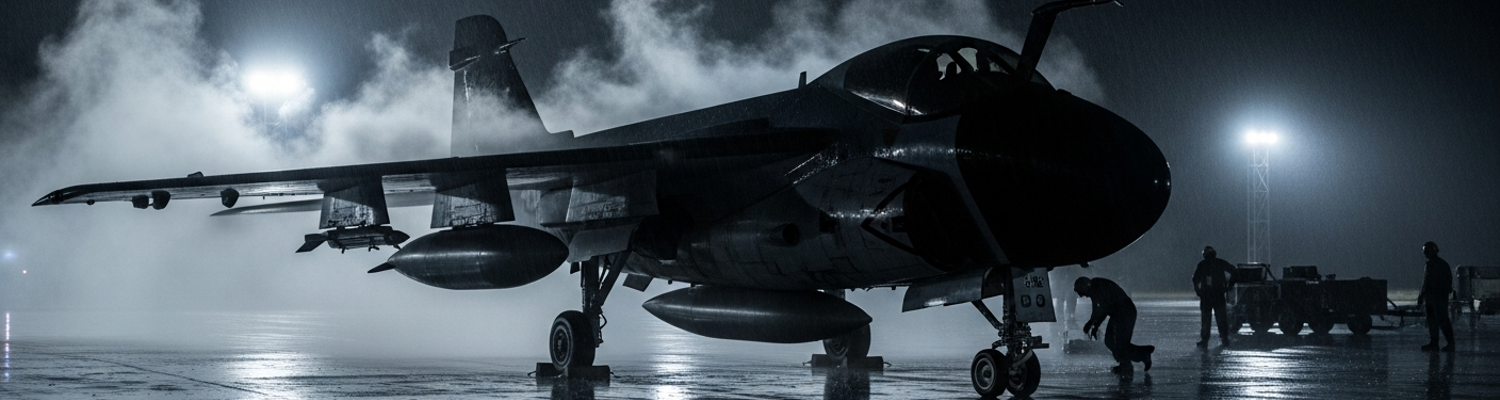

Late 1966. Marine All-Weather Attack Squadron 242, the “Bats,” arrived at Da Nang Air Base. There was no gradual ramp-up. Operational logs indicate they were expected to be fully combat-operational almost immediately. It was a baptism by fire. The operational environment at Da Nang was a physical and mechanical grinder, a sprawling, chaotic hub crowded with aircraft from multiple services and under constant threat. The first use of 140mm rockets in the war occurred against the Da Nang complex on February 27, 1967, forcing a rapid expansion of the security perimeter. These standoff attacks became a persistent feature of life. A particularly damaging raid on July 15, 1967, destroyed or damaged dozens of aircraft and resulted in nearly 200 casualties. The climate itself was an adversary. Intense humidity, monsoon rains, and salt-laden air were corrosive, attacking the sensitive and unproven electronics of their new aircraft.
This was a new kind of war, and the A-6A Intruder was a new kind of weapon.
The A-6A was the Marine Corps’ strategic answer to a difficult problem: how to strike an enemy moving under the cover of darkness and monsoon clouds. It was the first true all-weather attack aircraft in the U.S. inventory, designed for long-range interdiction missions far beyond any visible front line. Its core was the revolutionary but temperamental Digital Integrated Attack and Navigation Equipment (DIANE) system. This collection of computers, radars, and navigation aids allowed a two-man crew, a pilot and a bombardier/navigator (B/N), to fly at low altitude in zero visibility and theoretically place an 18,000-pound payload with high precision. While other aircraft were grounded by weather or darkness, the A-6 was expected to be in the air, hunting targets along the Ho Chi Minh Trail or striking assets deep in North Vietnam. This unique capability placed VMA(AW)-242 at the forefront of the air war, tasked with missions deemed too dangerous for other platforms. The side-by-side cockpit arrangement fostered an intense dependency between the pilot and B/N, their survival entirely dependent on the complex and often-faulty electronics entrusted to them.
The early months of 1967 were a period of sharp escalation. For VMA(AW)-242, this translated into a punishing operational tempo. The squadron’s all-weather capability meant it was in constant demand from the 1st Marine Aircraft Wing. There was no respite. When storms rolled in, the A-6s were ordered into the air. When night fell, the Intruders were sent deep into heavily defended enemy territory. Operational records from this period show a relentless cycle of missions targeting truck parks, supply depots, bridges, and anti-aircraft artillery sites in Route Package I and the maze of supply routes in Laos. In the first three months of 1967 alone, the 1st Marine Division, which the wing supported, conducted over 36,000 company-sized operations, creating an insatiable demand for air support. Crews often flew single-plane night missions where the risk of being shot down was exceptionally high. The vulnerability of the low-level flight profiles necessary for the DIANE system to work meant that between 1965 and 1973, eighty-four A-6 Intruders would be lost to all causes.
The early A-6A Intruder was a contradiction forged in steel and vacuum tubes. It was designed to be the most advanced all-weather attack aircraft in the world, yet it was constructed using a delicate and unproven combination of early solid-state transistors. The heart of the aircraft was its DIANE system. A review of its components reveals an ambitious level of complexity. The DIANE suite integrated a Norden AN/APQ-92 search radar, an AN/APG-46 tracking radar, an AN/ASN-31 inertial navigation system, and a Litton AN/ASQ-61 digital ballistics computer. This system-of-systems was intended to allow the crew to navigate at low level and attack targets with precision in weather that grounded every other aircraft. The teething problems were extensive. The individual components, packed densely into unsealed avionics bays, generated enormous heat. This required intricate cooling systems that became another point of failure. The DIANE system was so new that its reliability had not been established when it was deployed, leading to what was described in official reports as a greater degree of aircraft unserviceability than normal for an attack squadron.
This system was a product of a laboratory, not a jungle.
Archival evidence shows that Vietnam’s tropical climate was a relentless adversary to the Intruder’s sensitive electronics. The combination of extreme heat and near-total humidity on the airfields at Da Nang and Chu Lai proved catastrophic. Temperatures inside a metallic fuselage baking in the sun could surpass 150 degrees Fahrenheit, pushing electronic components beyond their thermal limits, weakening solder joints, and warping early circuit boards. The primary enemy, however, was moisture. When an A-6 took off from the sweltering flight line and climbed to freezing temperatures at altitude, then descended back into the jungle atmosphere, massive amounts of condensation would immediately form inside the avionics bays. This water pooled directly on high-voltage circuitry, causing shorts and intermittent failures that were nearly impossible for ground crews to diagnose. The salt-laden air of coastal bases accelerated corrosion on connectors and wiring harnesses. Tropical fungi were found to grow on and consume wire insulation, exposing live wires. This environmental assault was not limited to the avionics; it also degraded the airframe, causing hydraulic seals to fail and flight control systems to become sluggish.
The direct operational result of this technological fragility was a high rate of mission aborts. A review of operational logs from 1967 reveals that missions were constantly scrubbed. A single failure in one of DIANE’s many subsystems could render the aircraft combat ineffective. An inertial navigation system that would not align, a radar display that refused to energize, or a ballistics computer that failed to accept its Mylar mission tape were all common occurrences. One VA-85 mission in the spring of 1967 saw an eight-plane strike force reduced to four before even crossing the coast due to weapon system problems. Another of the remaining aircraft suffered a radar failure while maneuvering through mountains at night. This left a single jet to press on to a heavily defended target. These failures placed commanders in an impossible position: launch a partially capable aircraft, increasing the risk to the crew, or abort the mission entirely. Maintenance crews worked in a perpetual state of crisis, cannibalizing parts from damaged airframes just to get a single Intruder into the air, a practice that ensured the squadron’s long-term maintenance posture would only worsen.
The maintenance bays for VMA(AW)-242 at Da Nang Air Base became a static display of grounded airframes. For every A-6A Intruder taxiing out for a mission, another two were often down for repairs, creating a debilitating backlog of maintenance tasks. The squadron’s maintenance control officers faced an impossible equation. A high operational tempo demanded a steady flow of mission-ready aircraft, but the unreliable nature of the A-6A’s avionics guaranteed a steady flow of breakages. The DIANE system was the primary culprit. Failures in the Norden AN/APQ-92 search radar, the AN/ASQ-61 ballistics computer, or the Litton inertial navigation unit were constant. Ground crews, working in oppressive heat and humidity, were forced to become experts in diagnosing faults in systems that were barely understood by their designers. Each failure required hours of troubleshooting, swapping out delicate, heat-sensitive black boxes that were often in short supply. The result was a maintenance backlog measured not in days, but in weeks, with aircraft availability rates plummeting.
The problem was not a lack of effort. It was a lack of parts.
The root of VMA(AW)-242’s maintenance crisis was a bureaucratic and unresponsive logistical pipeline stretching 8,000 miles back to the continental United States. The supply system in 1967 was not built for the needs of a high-technology air war. When a critical component like a radar display unit failed, a multi-stage requisition process began. The request traveled from the squadron through Marine Aircraft Group 11 (MAG-11) headquarters, then to the Force Logistic Command (FLC) at Da Nang, which was established in April 1967 to manage support for all Marines in the I Corps Tactical Zone. From there, the request was transmitted to Naval Air Systems Command (NAVAIR) or a Naval Supply Center in Oakland, California. Each step introduced delays. The system was overwhelmed. In 1967, the FLC processed over 63,000 requisitions a month. High-priority “Red Ball” requests designed to expedite critical items often got lost in the sheer volume of paperwork and shipping containers, arriving weeks or months late, if at all.
This systemic failure in the supply chain directly fueled the pervasive mechanical failures. With new parts unavailable, VMA(AW)-242 was forced into a cycle of cannibalization. Aircraft already grounded for extensive repairs were designated as “parts birds.” Maintenance crews would systematically strip them of functioning components to get other Intruders back into the air. A working radar from one jet would be pulled to fix another slated for a night mission. A functional hydraulic pump would be swapped from a plane awaiting an engine change. While this practice produced a handful of mission-capable aircraft in the short term, it was catastrophic for long-term readiness. Analysis of military maintenance practices shows that cannibalization dramatically increases the workload on mechanics, who have to perform two removal and two installation jobs for every one part. It also increases the risk of collateral damage to wires, connectors, and adjacent components, introducing new, unpredictable failures into the fleet. For VMA(AW)-242, the number of fully operational aircraft dwindled, while the number of stripped, unflyable airframes in their revetments grew steadily.
Operational logs for February 1967 reveal a squadron consumed by a singular, grinding task: interdiction. The North Vietnamese Army was masters of nocturnal logistics. VMA(AW)-242’s primary mission was to hunt and destroy enemy supply lines and vehicle convoys moving under the cover of darkness and monsoon weather. Crews were tasked with severing the logistical arteries of the NVA 324B Division as it massed for attacks south of the Demilitarized Zone (DMZ). Flying single-plane or two-ship missions deep into the complex terrain of Route Package I and the Laotian border regions, the Intruders used their radar systems to find targets that were invisible to other aircraft. The North Vietnamese moved supplies almost exclusively at night, turning the Ho Chi Minh Trail and its feeder routes into a conveyor belt of men and materiel. A typical mission involved a low-level ingress at 500 feet or less to remain below enemy radar detection, followed by a pop-up maneuver to acquire the target and release ordnance. Loads often consisted of Snakeye retarded bombs and cluster bomb units, ideal for area targets like truck parks. These missions were a high-stakes duel between the A-6's technology and the enemy's dense anti-aircraft artillery (AAA) defenses. The DIANE system’s moving target indicator was crucial for identifying convoys, but the low-level flight profiles made the Intruders exceptionally vulnerable to ground fire.
The squadron was fighting a war on two fronts.
While designed for deep strike, the urgent needs of the ground war in I Corps forced VMA(AW)-242 into a secondary role: close air support (CAS). Throughout early 1967, the 3rd Marine Division was heavily engaged in a series of brutal fights south of the DMZ, most notably Operation Prairie II, which ran from February 1st to March 18th. This operation sought to find and destroy NVA units infiltrating into Quang Tri Province. When Marine infantry battalions from units like the 1st Battalion, 9th Marines made contact with entrenched NVA forces, the demand for immediate air power was absolute. The A-6, with its massive payload, was a powerful tool for this task, but it was not a nimble dive-bomber. Providing CAS required A-6 crews to adapt their sophisticated avionics to a chaotic, close-quarters fight, often in daylight, which negated their primary all-weather advantage and exposed them to heavy concentrations of enemy fire. Coordination between the aircrews and the Forward Air Controllers (FACs) on the ground was everything. In the violent struggles for positions like Con Thien and Gio Linh, Marine ground forces were frequently subjected to intense NVA artillery bombardments, and responsive air strikes from the A-6s were often the deciding factor in breaking up enemy assaults.
The ferocity of the fighting in I Corps had a profound effect on the civilian population. To deny the Viet Cong and NVA access to food and shelter, military strategy in the region relied on the creation of vast free-fire zones. U.S. Marine Corps operational directives from the period show this policy involved the forced relocation of entire village populations into centralized, guarded hamlets. This created a massive civilian displacement crisis and turned huge swaths of the coastal plains into a desolate landscape where anything that moved was considered hostile. Aircrews from VMA(AW)-242 flew their missions over this scarred and emptied terrain. During interdiction strikes, the distinction between a military truck and a civilian vehicle at night, through the grainy resolution of a radar scope, was a constant source of pressure. For the ground units they supported, the campaign was a mix of large-scale sweeps and thousands of small-unit patrols aimed at protecting the remaining population centers. In the first three months of 1967 alone, the 1st Marine Division conducted over 36,000 such small-unit operations, each one a potential trigger for a major firefight that would require the A-6s to deliver ordnance into a complex environment.
Directives from the 1st Marine Aircraft Wing during 1967 reveal an insatiable demand for the A-6 Intruder. VMA(AW)-242’s ability to strike targets at night and in monsoon conditions meant its crews bore a disproportionate weight of the air war. While other squadrons were grounded, the “Bats” were ordered into the sky. Command pressure to generate a high sortie rate was unrelenting, driven by major ground operations like Prairie II and the constant need to interdict supplies. Mission logs show a grueling cycle: single-plane missions flown at low level, deep into the heavily defended Route Package I sector. Crews were often flying multiple high-stakes sorties in a 24-hour period, a tempo that far exceeded sustainable levels. The expectation was simple: if an A-6 was flyable, it needed to be in the air.
The crews began to break.
Severe combat fatigue manifested in specific, dangerous ways within the A-6’s cockpit. For pilots, the strain eroded the fine motor skills and instantaneous reflexes required to manually fly the aircraft at 500 feet over jagged terrain with no visibility beyond the green glow of their radar displays. The bombardier/navigators, meanwhile, faced a different kind of exhaustion. Their job required intense, unbroken concentration on the unreliable DIANE system. Mission reports from this period indicate a rise in navigational errors and aborted attack runs directly attributable to crew exhaustion. A B/N, dulled by sleep deprivation, might misinterpret a radar return or struggle with the DIANE’s complex procedures, placing the aircraft in immediate peril. This exhaustion was compounded by the physical toll of the missions themselves, long hours strapped into an ejection seat, the constant vibration of the airframe, and the perpetual tension of flying within range of enemy guns. The two-man crew dynamic meant that one man’s fatigue became a direct threat to the other.
Survival became a matter of dwindling probabilities.
The psychological erosion experienced by VMA(AW)-242’s aircrews was a direct result of their missions. Intruder teams faced the distinct stress of placing their lives entirely in the hands of unproven electronics. They were flying at night, in weather, navigating by a temperamental radar system through unseen mountains, stalked by an enemy they could not see. The fear was not just of being shot down, a risk common to all combat pilots, but of a catastrophic system failure at a critical moment. A flicker of the screen or a sudden failure of the inertial navigation system could leave a crew utterly lost and blind at low altitude in hostile territory. This constant technological anxiety, layered on top of combat stress and physical exhaustion, created a corrosive psychological burden. The A-6 community suffered some of the highest loss rates of the war, a fact not lost on the men flying night after night into North Vietnam’s air defense network.
Post-mission documentation from VMA(AW)-242 in 1967 reveals a squadron slowly being fractured by the psychological weight of its mission. The operational tempo, combined with the A-6A’s unreliability, created a climate of deep-seated frustration. Morale was not collapsing in a single event, but eroding mission by mission. Aircrews grew increasingly distrustful of their machines. The high rate of DIANE system failures meant that a significant number of sorties were either aborted mid-flight or pressed forward with degraded capabilities, increasing the risk. This created a corrosive friction between the aircrews and the squadron’s overworked maintenance department. Pilots and B/Ns, exhausted from flying high-risk night missions, would report aircraft as “down” for intermittent avionics faults. Maintenance chiefs, facing an impossible backlog and a broken supply chain, struggled to differentiate between legitimate failures and what they sometimes perceived as crew fatigue manifesting as equipment write-ups. The men were being worn down, and their confidence in their equipment was deteriorating.
The breaking point was a slow, grinding process.
For the aircrews, sustained operational stress manifested as a grim, mathematical view of survival. Debriefing reports from the period document a rise in crew-reported spatial disorientation and an acute sensitivity to any anomaly in the aircraft’s complex systems. The constant dread of a DIANE failure during a low-level night run through unseen karst valleys was a unique psychological burden. This anxiety was compounded by the intense dependency of the two-man crew. The pilot’s survival depended entirely on the bombardier/navigator’s ability to interpret the flickering green radar display, and the B/N’s survival depended on the pilot’s skill in flying the aircraft mere feet above the terrain based on those electronic cues. A historical analysis of military psychiatric data from the period shows a direct correlation between the intensity of combat exposure and the incidence of long-term psychological distress, a pattern VMA(AW)-242’s crews were living in real time.
This psychological toll is evident in the dry language of official reports. Debriefing summaries and flight surgeon’s notes from 1967 point to a clear pattern of combat fatigue. Reports detail an increase in sleep disturbances, irritability, and what was then termed “flying stress.” Crews returning from missions deep in Route Package I described a heightened state of anxiety that did not dissipate upon return to Da Nang. The requirement to place total faith in a complex and frequently malfunctioning electronic system, while being hunted by anti-aircraft artillery, was a specific stressor unique to the A-6 community. This was not the conventional fear of being shot down, but a deeper anxiety rooted in technological fragility. The squadron’s flight surgeons noted a rise in vague physical complaints and a general decline in crew endurance. While the term “Post-Traumatic Stress Disorder” was not yet in the medical lexicon, the symptoms documented in these reports were its clear precursors.