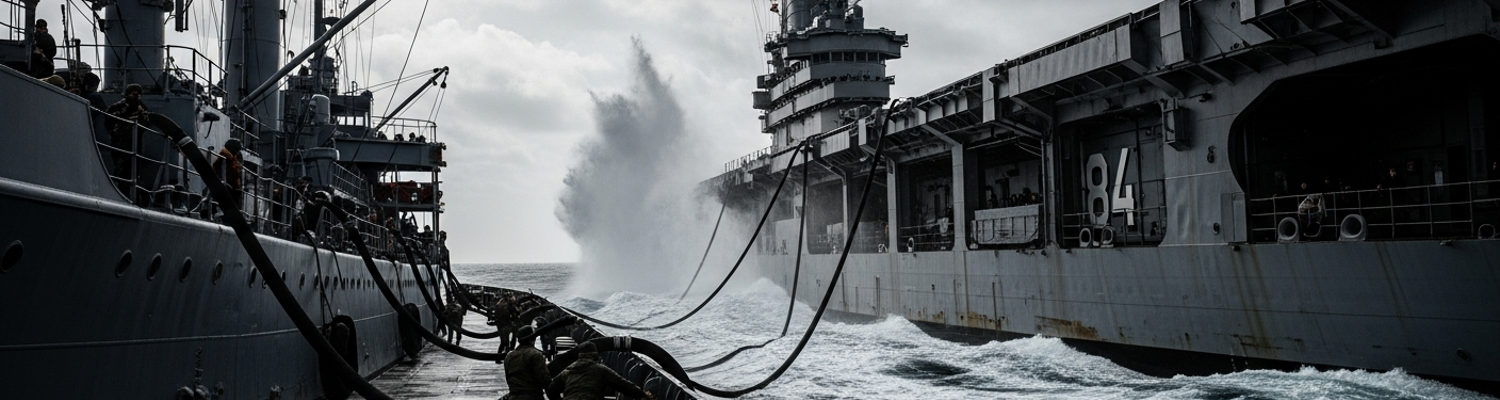

Pacific Logistical Tempo
By the spring of 1945, the war in the Pacific had become a contest of supply. Victory hinged not on tactical brilliance alone, but on the unending and perilous work of keeping the fleet armed, fed, and fueled.
A review of operational logs from the Okinawa campaign reveals a demand for fuel without precedent. Between April and June 1945, the U.S. Pacific Fleet consumed an average of 4.5 million barrels of Navy Special Fuel Oil and other petroleum products monthly. This torrent of black oil was the lifeblood of Task Force 58. Its carriers and fast battleships could burn through their fuel reserves in days. To meet this demand, a mobile logistics force, Service Squadron 10, functioned as a floating pipeline. Dozens of T2-SE-A1 tankers and other fleet oilers (AOs) steamed in continuous rotation from the anchorages at Ulithi and Kerama Retto to designated rendezvous points at sea, often just over the horizon from the fighting.
The process of underway replenishment, or UNREP, was a high-risk evolution. Two ships, the oiler and the warship, had to maintain a precise course and speed, often just 60 to 80 feet apart, while heavy, oil-filled hoses were passed between them. Hydrodynamic forces created by the ships' passage through the water generated a constant suction, threatening to pull the vessels into a collision. All this was done while exposed to enemy attack, with lookouts scanning the skies for the glint of a kamikaze.
The fleet did not run on fuel alone.
During that same three-month window, the fleet also consumed an average of 15,000 tons of provisions every month. This figure encompassed everything required to sustain hundreds of thousands of personnel in continuous combat. It was more than bulk items like flour and potatoes; it included refrigerated meats, medical supplies, mailbags by the tens of thousands, and replacement parts, from tiny vacuum tubes to 20-ton propeller shafts. Specialized stores ships (AFs) and even concrete barges converted into floating warehouses were packed with these goods. Transferring them at sea involved a different but equally dangerous process. Instead of hoses, men used cargo nets and highlines strung between ships to move pallets weighing hundreds of pounds. A snapped line or a sudden lurch from the ship could send tons of supplies plunging into the Pacific.
On the receiving ship, hundreds of men would form long lines, passing boxes and crates by hand down to the storage decks. It was a physically exhausting process that had to be completed as quickly as possible to minimize the ship’s vulnerable time alongside the unarmored supply vessel.
These fuel and supply transfers were not isolated events. Archival evidence shows that to sustain this operational tempo, the Pacific Fleet conducted over 800 individual underway replenishment operations each month during the Okinawa campaign. A single operation could range from a lone destroyer pulling alongside an oiler for a quick top-off to a complex, multi-ship ballet that tested the limits of seamanship. It was not uncommon for a large aircraft carrier to be replenishing fuel from an oiler on its starboard side while simultaneously taking on bombs and rockets from an ammunition ship (AE) on its port beam. Meanwhile, destroyers from the anti-submarine screen would dart in, one by one, for their own fuel and stores. These evolutions were conducted under the constant threat of massed kamikaze attacks, known as kikusui, which specifically targeted the vulnerable replenishment groups. The entire logistical system, from the supply depots at Guam to the helmsman on the destroyer, was strained to its absolute limit.
Bureaucratic Oversight and Field Decisions
Between April 25 and June 26, 1945, while the US Navy was engaged in the deadliest naval battle in its history off Okinawa, delegates from fifty nations met in San Francisco. Their purpose was to draft the Charter of the United Nations, a framework intended to prevent future global conflict. The contrast was absolute. In the polished halls of the San Francisco Opera House, diplomats debated the structure of the Security Council. Simultaneously, in the waters of the Ryukyu Islands, destroyers on picket stations fought for their lives against waves of kamikaze attacks. The conference in California represented a large-scale investment in a future, theoretical peace. The battle raging in the Pacific represented a desperate, immediate struggle where survival was measured in minutes.
This was war on an industrial scale.
The size of the Pacific campaign necessitated new layers of administration. A massive shore-based establishment had grown in places like Pearl Harbor and Guam, staffed by thousands of personnel and governed by Commander, Service Force, Pacific Fleet (COMMSERVFORPAC). This organization was designed to bring order to the chaos, attempting to forecast the fleet’s needs and rationalize the flow of everything from 5-inch shells to replacement radar tubes. An explosion of paperwork and formalized requisition procedures followed, a system intended to prevent waste and ensure the right supplies reached the right task group. The system, however, was slow. A request for a non-standard part from a battle-damaged cruiser off Okinawa might have to travel up a long chain of command and be processed by a logistics officer hundreds of miles from the combat zone. The time between a request being filed and the item arriving could stretch for weeks, a period during which a warship could be rendered partially ineffective.
This friction was something junior officers learned to circumvent. A close review of operational logs and after-action reports reveals a persistent pattern of on-the-fly, unauthorized logistics. Lieutenants and ensigns, often serving as Officer of the Deck on destroyers or as division officers on larger ships, frequently made immediate decisions to keep their vessels in the fight. A destroyer running low on fragmentation shells for its 5-inch guns after fending off an air attack might learn via signal lamp that a nearby ammunition ship had a surplus. Official procedure required a formal request routed through multiple command echelons. Instead, a 24-year-old lieutenant would maneuver his ship alongside the AE in heaving seas, pass a highline, and trade a spare fuel pump for several pallets of the needed ammunition. These actions were not without high risk. They violated standing orders, risked collision, and exposed two ships to enemy submarine or air attack. A snapped line could send tons of ordnance plunging into the sea. Yet these localized, granular decisions happened constantly, driven by the immediate need to be ready for the next kikusui attack.
Underway Replenishment Techniques
The physical act of alongside connected replenishment, or CONREP, was a study in controlled violence. A close examination of after-action reports from 1945 breaks down the complex sequence. The process began with the warship approaching the slower supply ship from its quarter, carefully matching course and speed. A line-throwing gun, often a modified M1 Garand rifle, would fire a light projectile carrying a thin messenger line across the churning gap of water. Deck crews would then use this initial line to haul across progressively heavier ropes until a stout wire highline was secured between a kingpost on the supply ship and a reinforced strong point on the receiving warship. For transferring dry goods and ammunition, this highline served as a roadway. Using a system of winches and tackle known as a Burton rig, cargo nets laden with pallets were hoisted from the deck of the supply ship, pulled across the highline, and lowered to the deck of the warship. Each load could weigh hundreds of pounds.
Fueling at sea, or FAS, required a different and more hazardous setup. A specialized spanwire rig supported the weight of multiple heavy, rubber fuel hoses. The workhorses of this operation were the fleet oilers, designated AO. Many of these were T2-SE-A1 type tankers, commercial designs rapidly adapted for military service. A typical T2 oiler was over 520 feet long, displaced nearly 22,000 tons when fully loaded, and could carry almost 6 million gallons of liquid cargo. This cargo was not just a single type of fuel; archival records show their tanks were segregated to carry Navy Special Fuel Oil for capital ships, diesel fuel for smaller escorts, and high-octane aviation gasoline for carrier air groups. Their pump rooms were a maze of pipes and valves, allowing for the simultaneous transfer of different fuel types to multiple receiving points. On deck, raised platforms and extended kingposts were retrofitted to support the fueling rigs. These ships were, in effect, floating gas stations operating on the front lines, unarmored and filled with highly flammable liquids.
Every replenishment evolution was governed by physics. As two ships steamed on a parallel course, the water flowing through the narrow channel between their hulls accelerated. This increased water velocity created a zone of lower pressure, a suction that constantly threatened to pull the two ships into a catastrophic collision. Counteracting this required exceptional seamanship and intense focus from the bridge crews. The Officer of the Deck and the helmsman had to make constant, minute adjustments to rudder angle and engine revolutions to maintain a precise distance. A marked distance line, strung between the two ships, provided a visual reference. Any deviation caused by a large wave or a lapse in concentration could cause the ships to surge apart, parting the transfer lines, or to be sucked together, resulting in a collision. This balancing act had to be maintained for hours, often in rough seas and under the constant threat of an imminent enemy attack.
The Okinawa Replenishment Environment
Operational logs from the Okinawa campaign show that the U.S. Fifth Fleet’s mobile replenishment groups operated in a designated, shifting sea lane approximately 300 miles east of the island. This was not a random position. It was a deliberately calculated risk, a balancing act between tactical necessity and survival. To operate any closer would place the slow, unarmored fleet oilers and ammunition ships within the effective combat radius of land-based Japanese aircraft operating from Kyushu. To operate any farther away would drastically increase the transit time for the combat task forces, pulling them off the front line for longer periods. Even at this 300-mile distance, safety was an illusion. Japanese long-range reconnaissance aircraft actively hunted for these logistics groups. Intelligence intercepts from the period (NARA Record Group 457) reveal that Japanese pilots would search on a line about 200 miles east of the islands, using radar to find the clustered ships. Once located, the coordinates could be relayed to submarines or used to vector in a long-range kikusui suicide attack.
This operational area was a nautical box.
Vice Admiral Marc Mitscher’s Task Force 58 was tasked with providing a continuous blanket of airpower over and around Okinawa. Its carrier air groups had three overlapping objectives: maintain air superiority over the island, provide direct, on-call air support for the Army and Marine divisions, and fly long-range sweeps to neutralize Japanese airfields on Kyushu. Task Force 58 typically operated in a 60-mile square area east of Okinawa. From March to late May 1945, the force was in continuous action. A schedule from this period shows that task groups rotated on a cycle that allowed them to refuel and rearm roughly every four days. At any given time, at least one or two of the carrier groups were off the line and steaming east to that 300-mile replenishment zone.
Fuel was the ultimate arbiter of the campaign’s tempo. Without a constant influx of Navy Special Fuel Oil for the ships and high-octane avgas for the aircraft, Task Force 58 would cease to function. A single T2-SE-A1 type fleet oiler carried a capacity of around 140,000 barrels. The thirst of the fast carriers and their screening battleships and destroyers was so great that a task group could drain an oiler in short order. An Essex-class carrier conducting high-speed flight operations burned through its own reserves in a matter of days. As fuel levels dropped, a commander’s options narrowed. A carrier low on fuel had to reduce speed, making it unable to generate the necessary wind over the flight deck to launch its heaviest aircraft, such as a fully armed TBM Avenger. It also made the ship a slower, less maneuverable target. The entire operational cycle of strike, retire, replenish, and return was dictated by the rate of fuel consumption. Any delay in this cycle had a direct and immediate impact on the number of sorties flown.
A Representative Crisis: May 17, 1945
The date was May 17, 1945. In the designated replenishment area east of Okinawa, the war had settled into a rhythm of exhaustion. For the carriers of Task Force 58, the cycle was unforgiving: days of high-speed flight operations, followed by a brief, vulnerable window to refuel and rearm. The presence of the fleet was non-negotiable. On this day, the Cimarron-class fleet oiler USS Kaskaskia (AO-27) was performing its core function, steaming on a parallel course with a veteran fast carrier. The carrier, having just survived another series of kamikaze alerts, was dangerously low on fuel. The sea was agitated, forcing the helmsmen on both ships into a state of heightened concentration as they fought the hydrodynamic suction pulling the two hulls together.
This was the fleet’s lifeline.
A review of operational logs from the period reveals the strain placed on the machinery of underway replenishment. The USS Kaskaskia, a vessel designed for this task, had been in continuous service in the Pacific. Her deck was a web of heavy-duty kingposts, booms, and spanwires, all designed to support the weight of rubber hoses carrying a torrent of Navy Special Fuel Oil. As the oiler came alongside the carrier, line-throwing guns fired, and soon the six-inch fueling hose was hauled across and bolted to the carrier’s intake manifold. Deep within the Kaskaskia’s pump room, powerful machinery whirred to life, pushing thousands of gallons of black oil per minute through the system. On the decks of both ships, fueling teams stood ready.
The entire system depended on a network of small mechanical components. One of the most critical was a series of pressure relief valves integrated into the oiler’s pumping lines. A pressure relief valve's sole function is to automatically open and bleed off pressure if it exceeds a preset limit, ensuring a smooth flow and preventing the system from exceeding its structural tolerances. After months of non-stop operations, however, metal fatigue and the corrosive sea environment took their toll. A close examination of similar mechanical failures shows that such valves were a known point of weakness. A spring could weaken, a pilot line could clog, or the valve seat itself could become jammed.
And then the system failed.
A pressure relief valve in the Kaskaskia’s forward pump assembly stuck shut. Unseen by the operators, the pressure in the line connected to the carrier began to surge. The pumps continued to force oil into the hose with no safety bleed-off. On deck, the effect was immediate. The thick rubber hose began to swell and stiffen, vibrating violently as the pressure inside spiked. Sailors on both ships saw the danger, shouting warnings lost in the noise of wind and machinery. Before the pump operators could react to frantic telephone calls from the bridge, the hose ruptured. It exploded, tearing open and releasing a high-pressure spray of black oil that coated a wide section of the carrier’s hangar bay and flight deck. The flank of the warship was drenched in thousands of gallons of flammable liquid, creating the conditions for a fire that could gut the ship. The immediate response was a testament to drilling. On the Kaskaskia, an officer slammed the emergency stop button for the forward pump group. Simultaneously on the carrier, damage control teams sprang into action, fire hoses instantly spraying down the oil-soaked bulkheads to wash the fuel overboard before a spark could ignite the vapor. The five-minute window that followed was a frantic effort to sever the remaining connections and get the ships apart, a localized crisis that was contained by the swift actions of the deck crews.
The Five-Minute Override
Deep inside the steel hull of a ship like the USS Kaskaskia, hundreds of pumps, valves, and gauges worked under continuous strain. The core of the fueling operation was the pump room, a noisy, hot space manned by Machinist’s Mates. Their job was to ensure a steady flow of thousands of gallons of fuel per minute through heavy rubber hoses slung between two ships.
This entire process was guarded by a spring-loaded pressure relief valve.
The valve’s function was to automatically vent any excess pressure in the line. On this day, it failed. Months of non-stop use had caused the mechanism to seize. Salt corrosion, vibration, and metal fatigue were common culprits. The pressure in the fuel line, designed to operate at a steady 100 pounds per square inch, began to climb. On the oiler’s pump room control panel, the needle on the pressure gauge for the number two transfer line trembled past 150 psi, then 200, creeping into the red.
A rupture was seconds away.
In the pump room, a Machinist’s Mate First Class felt the high-frequency shudder through the deck plates. He saw the gauge pegged at its maximum reading. Official procedure called for an immediate call to the bridge to request an emergency pump shutdown. There was no time. The sailor, whose identity is lost to history but whose actions are representative of countless others, made a decision. He grabbed a thirty-six-inch valve wrench from its bulkhead rack. Directly in front of the overheating pump was a large, manually operated gate valve, the master cutoff for that specific line. A small brass pin was in place, a safety lock to prevent its closure while the pump was engaged. This was the unauthorized override. He sheared the pin with a sharp blow from the wrench, then fitted the tool onto the large valve wheel. He threw his entire body weight against it, forcing the heavy gate valve to screw shut against the back-pressure from the pump.
The violent shaking in the fuel hose on deck instantly ceased.
The action was a direct violation of established procedure, but it was decisive. A full-bore rupture would have sprayed thousands of gallons of highly flammable Navy Special Fuel Oil across the hot steel decks of both the destroyer and the oiler. The loss of a fleet oiler and a front-line destroyer would have been a tactical blow. The entire replenishment group would have been forced to scatter and cease operations. Other warships in the task group, low on fuel, would have had their replenishment cycle broken, forcing the entire combat unit to withdraw from its station off Okinawa. This would have created a dangerous gap in the anti-kamikaze screen and reduced air support for the ground troops. The quick, unauthorized action of one enlisted man in the belly of the ship prevented a localized mechanical failure from spiraling into a significant disruption of the campaign’s operational tempo.
Legacy of Tactical Logistics
After-action reports from the Pacific theater reveal a consistent pattern: the strategic success of the fleet was directly tied to the outcome of thousands of small, unrecorded crises on the decks of ships engaged in replenishment. The near-disaster aboard the USS Kaskaskia was a representative example of the constant risk inherent in the system. The split-second decision of one enlisted sailor to override procedure had an effect that rippled far beyond the two ships involved. A catastrophic fire would have removed not just a fleet oiler but a front-line combatant from the order of battle. This would have forced the entire replenishment group to scatter, breaking the logistics cycle for every other warship waiting for fuel. For a carrier task group operating on a four-day combat-and-supply rhythm, such a disruption meant a premature withdrawal from the waters off Okinawa. A single failed valve could have led to American soldiers on the ground being denied air cover during a critical Japanese counterattack.
This environment reinforced the necessity of flexible, decentralized decision-making. The formal logistics chain, stretching from supply depots in the United States to fleet headquarters in Guam, was designed for the predictable consumption of a large force, but it could not react to the immediate demands of combat. An official request for a non-standard electronics tube could take weeks to process. A destroyer captain who had just fought off a kamikaze attack did not have weeks. He had hours. Operational logs and personal accounts from the period are filled with instances of junior officers and senior enlisted men circumventing the official system. A signal lamp flashing between two destroyers could result in an unauthorized, high-risk transfer of depth charges in exchange for spare radar parts. These actions were direct violations of standing orders, yet they were a constant feature of life on the front line. The command structure tacitly accepted this reality. A successful, unauthorized transfer that brought a ship back to full fighting strength was often overlooked, while a failure that resulted in collision would mean a court-martial. This unofficial doctrine placed responsibility on individuals, proving that empowering those at the tactical edge to solve their own problems was faster and more effective than relying on a slow, distant bureaucracy.
The high-risk improvisations of 1945 directly contributed to the evolution of post-war naval underway replenishment protocols. The near-constant equipment failures and jury-rigged solutions of the Pacific War provided a brutal but effective dataset for naval engineers. Wartime rigs, often adapted from normal deck gear, were difficult to use and prone to failure. After the war, the Navy systematically analyzed these shortcomings to create a safer, more efficient system. This effort led directly to the development in the 1950s and 1960s of the Standard Tensioned Replenishment Alongside Method, or STREAM. The STREAM rig replaced the comparatively primitive wartime setups with a system using ram tensioners that kept the highline between ships under constant pressure, automatically compensating for the roll and pitch of the vessels. This allowed for smoother, faster transfers and permitted a greater, safer separation distance between ships. Innovations like the probe fueling coupling, with a latching mechanism to secure it in the receiver, were direct answers to the problem of hose ruptures. Entire ship classes were designed around these new methods, like the multi-product Sacramento-class fast combat support ships (AOE), which could deliver fuel, ammunition, and stores from a single hull. The hard-won lessons learned by sailors on the decks of ships like the Kaskaskia were codified into new technology and doctrine.