
Army Logistical Overstretch and Urban Ration Collapse
Army field manuals promised that liberated populations would feed themselves through intact local distribution networks. Allied soldiers crossing the Belgian border found wrecked rail yards, demolished bridges, and hollow municipal storehouses instead. Armies advancing toward the German border outran their supply lines between September and November 1944, causing civilian flour rations in Belgian cities to plunge below 1,000 calories daily. Bread vanished from store shelves in Brussels, Liege, and Charleroi. Thousands of cold and hungry residents waited for hours outside locked bakeries. Belgian municipal leaders reported that regional grain bins held only a few days of wheat. Mayors pleaded directly with nearby military garrisons to share emergency field rations to prevent violent street unrest.
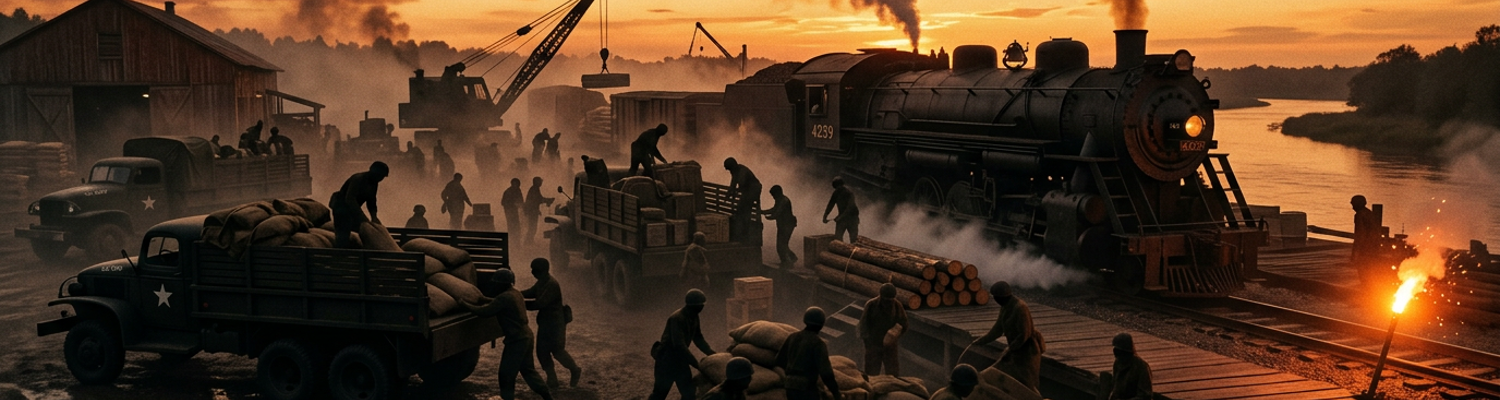
SHAEF G5 Civil Affairs detachments diverted tactical cargo trucks from forward ammunition dumps to municipal food depots to answer these local pleas. Officers assigned to these civil relief units commandeered fleets of heavy cargo trucks initially reserved for combat corps. Drivers hauled heavy burlap sacks of flour, dried peas, and powdered milk across rain soaked roads. Supply columns bypassed frontline staging areas to reach city distribution points. Mechanics worked around the clock to change blown tires, flush flooded carburetors, and patch cracked leaf springs to keep these heavily loaded supply vehicles moving. Civilian dockworkers unloaded the grain bags onto distribution platforms in Liege and Brussels, allowing urban bakers to restart their ovens.
Truck convoys diverted away from combat zones generated friction between frontline tactical commanders seeking operational tempo and Civil Affairs officers tasked with civilian survival. Combat division leaders argued that every vehicle loaded with civilian flour meant tons of artillery shells and drums of gasoline withheld from units attacking the German frontier. Tactical officers repeatedly tried to halt relief columns at major road junctions. Military police received orders to turn supply trucks toward corps ammunition dumps. Civil Affairs officers refused to surrender their vehicles, producing written authorizations from Supreme Headquarters. Relief coordinators argued that civilian starvation would spark strikes that could paralyze military rail lines. Disputes between combat commanders and civil affairs teams intensified over every available transport company.
Ministers in the Belgian government entered this logistical battle, warning Allied high command that bread shortages were inflaming political unrest and destabilizing the newly liberated nation. Prime Minister Hubert Pierlot sent urgent messages to London and Washington, declaring that his cabinet would collapse if Allied authorities prioritized artillery stockpiles over civilian survival. Supreme Allied Commander Dwight D Eisenhower recognized that political chaos in the rear posed a massive threat to the western offensive. Eisenhower intervened by formally authorizing the emergency allocation of army transport to the relief mission. Supply teams promptly drove lines of loaded cargo haulers into central Belgian plazas, unloading stacks of wheat flour directly into civilian custody.
Transport Requisitions and Belgian Bottlenecks
Flour sacks stacked across central Belgian plazas provided instant food to starving neighborhoods, but these emergency truck runs could not replace the heavy rail transport required to distribute bulk coal and grain across the country. Allied military requisitioning of coal hauling rolling stock and locomotives paralyzed domestic bulk transport across the Belgian national railway network. Army logistics officers commandeered every operable railcar for frontline ammunition and gasoline. Army transport detachments seized hundreds of Belgian steam engines and thousands of freight wagons to haul military supplies toward forward corps near Aachen. Belgian rail authorities reported that fewer than twenty percent of their pre war freight cars remained available for civilian traffic. Coal extraction in the mining valleys of Charleroi and Mons halted as pithead storage bins overflowed with fuel that nobody could move. Steam engines bearing Allied military markings rolled past stranded domestic trains, leaving municipal power plants and water systems without the fuel needed to generate electricity.
Officers in Civil Affairs detachments documented this spreading domestic breakdown in weekly SHAEF field summaries that recorded sharp logistical friction between military lines of communication and civilian transport necessities. These weekly reports emphasized that military demands for track space and freight cars were cutting off provincial towns from their basic fuel and grain supplies. Civil Affairs officers noted that municipal bakeries could not fire their ovens to bake the flour that trucks had just delivered without coal. Urban water pumps stopped working during hard freezes as power grids failed. Belgian government ministers sent written warnings to Allied headquarters, declaring that cold and darkness in major cities were breeding anti Allied strikes among rail workers and factory laborers. Tactical lines of communication commanders disregarded these civilian complaints, arguing that combat units preparing to assault the Siegfried Line had absolute priority over every locomotive and rail line in the country.
Cargo cranes at the newly opened port of Antwerp operated under identical restrictions, as clearance priorities favored tactical military tonnage and severely restricted the intake of vital civilian relief imports. Port operating battalions reserved deep water berths and quayside gantry cranes exclusively for vessels carrying ammunition, gasoline, and replacement armor. Civilian relief ships carrying Canadian wheat and British medical parcels dropped anchor in the Scheldt estuary, unable to secure berthing permits or labor details to unload their cargo holds. Belgian dock workers unloaded thousands of tons of high explosive artillery shells onto waiting flatcars under armed military police guard. Empty flour bins sat neglected along nearby municipal wharves. Allied logistical officers refused to clear dockside warehouse space for civilian goods, fearing that any delay in staging combat supplies would stall forward army corps.
Barges moored along the Antwerp waterfront became the next target of Allied transport officers, who commandeered civilian river craft to haul tank ammunition toward inland supply bases. Belgian barge skippers protested by tying up their vessels along the Scheldt and Meuse waterways. River captains refused to surrender their boats without fuel guarantees and replacement parts for their diesel engines. Civil Affairs detachments stepped in to broker emergency agreements, offering army fuel drums and mechanical repairs to bargemen who agreed to transport relief flour alongside combat supplies. Military rail directors reluctantly released a handful of damaged freight cars and shunting locomotives back to the Belgian railway administration for emergency repair in Brussels rail shops. Mechanics worked through the night in freezing roundhouses, welding cracked boiler plates and rebuilding brake lines to assemble makeshift relief trains before winter blizzards shut down the tracks entirely.
Walloon Basin Fuel Deficits and Industrial Stoppages
Locomotives backed long strings of empty hopper cars into Walloon mine sidings, but extraction crews had nothing to load into them. Belgian colliers faced critical shortages of pit timber required to shore up extraction shafts, causing regional coal extraction to collapse. Fighting in the Ardennes and across eastern France had severed the normal supply routes for pine logs, leaving lumber yards across the Borinage and Liege basins completely bare. Heavy earth pressure deep underground cracked the old, rotted wooden props that supported the extraction galleries, filling the narrow tunnels with falling slate and rock dust. Mine engineers warned that sending workers into unsupported seams risked catastrophic cave ins that could trap entire shifts hundreds of meters below the surface. Safety inspectors red tagged hundreds of unbraced tunnel headings and ordered work crews to haul their tools back up the mine cages.
Steel hoisting cages sat motionless at the surface while a severe solid fuel famine paralyzed municipal utilities and domestic heating across the mining basins of Charleroi and Liege. Temperatures plunged toward freezing during November, rapidly exhausting the final stockpiles of coking coal at city gasworks in Liege. Municipal gas lines shut down, leaving entire city wards unable to cook or boil water. Families burned scrap furniture, floorboards, and garden fences in iron stoves to survive the damp cold. Hospital wards wrapped patients in army blankets to keep them warm. Water utility pumps throughout Charleroi ground to a halt as boiler fires died, causing municipal pipes to freeze and burst under expanding ice. Depleted coal bunkers at regional power plants forced station engineers to pull main circuit breakers, cutting streetcar lines and plunging working class neighborhoods into freezing darkness.
Miners refused to report for underground shifts in these dark and freezing districts, sparking widespread labor unrest and strikes across the Walloon coalfields. Thousands of colliers walked away from the pitheads in Charleroi, Mons, and Liege, furious that their families were freezing and surviving on starvation bread rations while Allied armies took their coal. Steel mills and chemical plants across the Meuse valley banked their blast furnaces and shut down machinery because electrical generators lacked the fuel needed to run industrial dynamos. Train dispatchers warned that the regional electrical collapse was threatening military rail lines that hauled Allied artillery shells toward the front lines around Aachen. Union representatives delivered formal strike ultimatums to regional governors, vowing that not a single ton of fuel would leave the pits until the government restored civilian flour rations and trucked food into the mining communes.
Hubert Pierlot forwarded these strike ultimatums directly to Supreme Headquarters, warning Allied leadership that the Walloon coal crisis would shatter his fragile government. Pierlot cautioned Allied commanders that communist and socialist factions were organizing mass protest marches across Wallonia. General Dwight D Eisenhower understood that an industrial paralysis across Belgium would cut electrical power to Allied supply bases and choke military transport lines just as Allied corps prepared to assault the Roer River. Supreme Allied Headquarters ordered Civil Affairs officers and military logistics units to treat coal extraction as an urgent military priority rather than a secondary civilian issue. Army engineers diverted fleets of heavy military trucks to haul emergency lumber shipments from French forests to Walloon pitheads. Supply officers released thousands of canned rations to mining canteens to persuade the striking colliers to pick up their tools.
Government Administration and Internal Political Instability
Truck convoys unloading rations and timber at Walloon pitheads could not resolve the broader political crisis in Brussels, where food and fuel supply failures threatened the collapse of Prime Minister Hubert Pierlot and his returned provisional government. Citizens across the capital faced empty markets and unheated homes, directing their bitter frustration at ministers who had spent the war years in London exile. Belgian families burned broken furniture in iron stoves and stood in long lines for microscopic bread rations while government officials struggled to establish functional price controls or food collections. Hubert Pierlot faced furious shouting matches inside the Belgian parliament, where legislators accused his administration of bowing to Allied military commands while leaving Belgian citizens to freeze. Regional governors warned the prime minister that municipal authorities could no longer enforce civil obedience, leaving government ministries isolated against rising public fury.
Ministers representing the Communist Party deepened that isolation by resigning from the cabinet alongside left wing resistance factions, turning civilian deprivation into a challenge to national authority. Resistance organizations had spent four years fighting German occupation forces and now refused to obey government decrees demanding that partisans surrender their weapons. Armed resistance fighters staged angry mass marches across Brussels, carrying banners that linked urban starvation directly to Pierlot failing to secure food and fuel supplies. Left wing commanders ordered their underground detachments to retain their hidden rifles and submachine guns, warning that workers would defend their rights against a government that could not provide bread. Demonstrators filled the squares outside government offices, surrounding the parliament and clashing violently with municipal police units who fired into crowd lines to protect ministerial buildings.
Officers in Civil Affairs detachments warned that these violent clashes and administrative collapse in Brussels would imperil rear area security along Allied combat supply corridors. Major General George W Erskine, chief of the SHAEF Mission to Belgium, monitored the expanding street violence and sent urgent operational assessments directly to Supreme Headquarters. Erskine cautioned that an armed overthrow of Pierlot and his government would immediately sever communication wires, block rail dispatchers, and paralyze the highway corridors that carried supplies from Antwerp to the frontline fighting in Germany. Allied army groups depended entirely on Belgian rail networks and paved roads through Brussels and Namur to move thousands of tons of artillery ammunition, fuel cans, and medical stores to forward corps. Tactical commanders recognized that an active insurrection or general strike in Brussels would force Allied leaders to divert front line combat divisions away from the German border to police the Belgian interior.
Dwight D Eisenhower ordered British and American forces to prevent that diversion by backing Pierlot and his provisional government with combat troops and armored vehicles posted around key Brussels infrastructure. British armored cars rolled into central city plazas, setting up fixed machine gun positions and barbed wire checkpoints around government ministries, telegraph exchanges, and railway stations. Military authorities prohibited armed resistance assemblies in the streets, informing partisan leaders that Allied units would shoot anyone attempting to seize public administrative centers by force. Supply officers simultaneously released emergency stockpiles of army coal and flour to civilian bakeries to ease the immediate pressure on urban bread supplies. Allied patrols took up defensive positions along the main supply arteries leading eastward toward Aachen, keeping the supply roads open for military convoys under the protection of armored vehicles.
Commander George Erskine and Anglo American Intervention
General George Erskine stepped directly past those armored vehicle cordons to confront the political unraveling inside the government palace in Brussels. Prime Minister Hubert Pierlot sat across from furious socialist and communist ministers who threatened an immediate walkout over urban starvation, unheated homes, and the forced disarmament of resistance fighters. Erskine intervened directly with the Pierlot cabinet and dissenting ministers to stabilize civil order, speaking plainly to the assembled politicians about the operational stakes of their internal feud. The British general made it clear that Allied combat divisions would not stand by and watch street battles or cabinet collapses sever the vital supply arteries feeding the frontline armies. Dissenting ministers accused the Allies of prioritizing military logistics over civilian survival, but Erskine held firm, warning that any attempt by armed partisans to seize state power would trigger an immediate military response. Cabinet leaders agreed to keep the provisional government intact for the moment, but they informed Erskine that civil peace remained impossible unless the colliers in Wallonia received the supplies required to safely harvest coal.
Pit timber stored in army engineer yards gave Erskine the material needed to break that industrial paralysis and reopen the coalfields. Erskine negotiated emergency allocations of army controlled pit timber with reluctant supply commanders, diverting heavy pine logs away from combat pontoon units and forward trench networks directly to the mining basins of Charleroi and Mons. Freight cars loaded with fresh timber arrived at the railheads, allowing mine carpenters to shore up crumbling slate roofs and reopen extraction galleries that safety inspectors had shut down weeks earlier. Erskine deployed Allied military forces to secure vulnerable pitheads across the Walloon valleys alongside the lumber shipments, dispatching British infantry squads and American military police to establish fixed defensive perimeters around the mines. Allied soldiers placed machine guns around the hoisting towers, boiler rooms, and ventilation shafts to protect returning miners from militant pickets and prevent partisan sabotage against the surface works. Working shifts entered the elevator cages under armed guard, raising hundreds of tons of fuel each day while foreign combat uniforms lined the fences of Belgian industrial property.
Diplomats in Belgian national ministries immediately challenged the visible presence of foreign soldiers around domestic industrial assets and the heavy handed pressure applied to civilian ministers. The intervention provoked high level diplomatic disputes between SCAEF headquarters, the British War Office, and Belgian national ministries over military control versus sovereign governance. Officials in the Belgian Ministry of Foreign Affairs delivered sharp protests to Allied embassies, declaring that an independent government returning from London exile could not function if British commanders treated national territory as occupied ground. Representatives inside the British War Office shared those anxieties, sending urgent telegrams to Supreme Headquarters questioning whether Erskine had overstepped his authority by acting as an unappointed governor in a sovereign Allied nation. Field commanders at SCAEF headquarters answered that battlefield survival around Aachen outweighed legal sensitivities in Brussels, insisting that Allied armies could not permit political paralysis to choke the western campaign. Erskine retained his troops at the mine complexes and kept his seat at the cabinet table, maintaining direct oversight of fuel shipments while diplomats continued their arguments in London and Brussels.