
The Ambush of Lima Company
Operational records from July 1966 document the movement of Lima Company, 3rd Battalion, 4th Marines, into the contested area south of the Demilitarized Zone. The company was a component of Operation Hastings, a large-scale offensive against the infiltration of the People’s Army of Vietnam (PAVN) 324B Division into Quang Tri Province. On July 15, Lima Company and its battalion were inserted by helicopter into Landing Zone Crow, deep within a region soon known as Helicopter Valley. The insertion was flawed from the start. The LZ was too small, and a mid-air collision between two CH-46 helicopters, followed by a third striking a tree, caused two Marine deaths and seven injuries before any enemy contact.
The mission was to establish a blocking force. Other Marine units would sweep toward them, intending to trap and destroy PAVN elements.
Marine intelligence had severely underestimated the enemy’s disposition. While the presence of the PAVN 324B Division was known, the scale of its concentration was not appreciated. Captured PAVN soldiers identified their unit as the 812th Regiment, but the tactical weight of that information was not yet understood. As Lima Company advanced, it moved directly into a prepared ambush laid by what was later estimated to be two full battalions of the PAVN 324B Division. These were not local insurgents. They were well-trained, disciplined regular soldiers occupying fortified positions. The enemy initiated a devastating and coordinated attack with mortars, machine guns, and small arms. The volume of fire from a concealed enemy of this strength immediately overwhelmed the lead elements of the Marine company.
The battlefield was dissolving under a torrential monsoon. The timing of Operation Hastings coincided with the start of the rainy season, a factor the PAVN used to its advantage. Constant, driving rain turned the ground into a thick, impassable morass of mud that exhausted the Marines and bogged down any potential support. The mud infiltrated every piece of equipment, causing widespread weapon malfunctions at the worst possible moments. Early model M-16 rifles were particularly susceptible to jamming under such conditions. Visibility was reduced to mere meters by the combination of rain and thick jungle canopy, making it nearly impossible to identify enemy positions or coordinate movement. The weather severely hampered the Marines' greatest advantages: air support and medical evacuation. A low, thick cloud ceiling and violent squalls grounded many helicopter missions and made fixed-wing air support treacherous and inaccurate. Radio communications, the lifeline of a unit in contact, became unreliable due to extreme humidity and physical damage.
The initial moments of the ambush inflicted heavy casualties among Lima Company’s leadership. The company commander and several non-commissioned officers were hit, creating a vacuum in command. Pinned down and fragmented, the Marines struggled to form a coherent defensive perimeter. The enemy’s numbers and prepared positions allowed them to press the attack from multiple directions. Calls for reinforcements and artillery support were hindered by failing radios and the same monsoon conditions that prevented air cover. Supporting artillery from distant firebases did provide some fire, its effectiveness limited without clear targets. The engagement devolved into a desperate, close-quarters fight for survival, with Marines defending their positions with grenades and small arms against repeated assaults.
The fight continued in isolation for hours. Kilo Company, dispatched from the same battalion to relieve the besieged unit, was itself pinned down by heavy enemy resistance just a few hundred yards from Lima’s position. The inability of the relief force to break through underscored the strength and tactical positioning of the PAVN forces. Only under the cover of slightly improving weather, which allowed for more effective air and artillery strikes, did the pressure on the ambushed Marines begin to lessen. The extraction of the wounded and the dead was a harrowing process, conducted under sporadic fire and in appalling conditions. By the time the engagement concluded, Lima Company was rendered combat-ineffective. The overall Operation Hastings would claim 126 Marine lives.
The Mandate of MASS-2
Archival records (NARA Record Group 127) show the doctrinal purpose of Marine Air Support Squadron 2 (MASS-2) was to serve as the principal aviation command and control unit for directing air operations in direct support of ground forces. The squadron was not an attack element. It possessed no offensive aircraft. Its function was procedural control, acting as the critical node through which requests for airpower were processed, approved, and assigned. During operations in Vietnam in 1966, MASS-2's primary responsibility was to establish and operate the Direct Air Support Center, or DASC. This center, callsign Landshark, was the operational heart of the Marine Corps' close air support system in the I Corps Tactical Zone. From locations like Da Nang and a forward DASC at Dong Ha, MASS-2 controllers managed the airspace where ground troops and aircraft operated in close proximity. Their mandate was to receive immediate requests for air support, coordinate the employment of aircraft with other fire support assets, and manage the pilots and terminal controllers who would execute the final strikes.
The squadron was a self-contained entity, equipped with the radios, radar, and personnel needed to create an air support hub from nothing. This included the AN/TSQ-12 air support control central, a system of shelters and equipment that provided the electronic means for communication and tracking. MASS-2 also deployed smaller, mobile Air Support Radar Teams (ASRTs) equipped with the AN/TPQ-10 radar, which could be set up at forward positions to guide aircraft onto targets in poor weather or at night through ground-directed bombing runs.
The entire system was dependent on clear radio communications.
Operational logs from the period detail the rigid procedures for requesting fire support. A Marine company taking fire would initiate the process through its Forward Air Controller (FAC). The FAC would transmit an immediate request over the radio to the battalion’s Fire Support Coordination Center (FSCC). This request followed a strict format, detailing the target’s location, the desired ordnance, and the location of friendly forces. From the battalion FSCC, the request for air support was sent up the chain to the DASC over the Tactical Air Request Net (TARN). At the DASC, air support officers, all experienced pilots, would receive the request. Their first action was to determine which assets were available. They could divert an aircraft already in the air (a divert) or request a new launch from an airbase (a scramble). Response time was a key metric. Diverts were expected to be on station within 20 minutes; scrambles could take 40 minutes or more.
Once an aircraft was assigned, the DASC controller would brief the pilot on the mission, providing target data and the radio frequency for the FAC on the ground. The DASC’s job was not finished until the aircraft was handed off to the FAC, who would then take terminal control, marking the target with smoke rockets and guiding the pilot’s attack run. For missions where a ground or airborne FAC could not see the target due to weather or darkness, the DASC could utilize one of its AN/TPQ-10 radar teams to direct the pilot, telling him the precise heading and moment to release his bombs. Every step of this sequence was a potential point of failure, from a jammed radio signal to a misread map coordinate.
The most complex function of the DASC was the integration of air and artillery fire. Marine Corps doctrine demanded the synchronized application of all available supporting arms, a concept known as combined arms. In practice, this meant that the air support officers at the DASC had to deconflict their aircraft from the thousands of artillery rounds being fired. When a fire mission request arrived, DASC operators had to immediately coordinate with the artillery’s Fire Direction Center (FDC), often co-located within the same tactical headquarters. They checked flight paths against artillery trajectories to ensure an aircraft would not fly through a salvo of outgoing shells. To manage this three-dimensional problem, planners used Fire Support Coordination Lines (FSCLs) drawn on operational maps. Beyond the FSCL, aircraft could operate with more freedom, but inside the line, where most close air support occurred, every mission required specific clearance from the ground commander’s fire support coordinators. The monsoon conditions prevalent during Operation Hastings made this coordination even more difficult, forcing aircraft into unpredictable flight paths at low altitudes and affecting the known ballistics of artillery shells.
Vulnerabilities of Field Radio Systems
Operational logs from Operation Hastings reveal a systemic breakdown in tactical communications. The American operational concept, from the platoon level to the DASC, depended on functioning radio links. For units like Lima Company, pinned down in the monsoon-soaked jungles, the radio was the only conduit to survival. It was the sole means to request artillery, direct air strikes, or call for medical evacuation. When these links failed, companies were condemned to fight in isolation. The command and control architecture was designed for responsiveness, but it was brittle. The failure of a single radio operator’s equipment on the ground could sever an entire infantry company from the firepower waiting on standby.
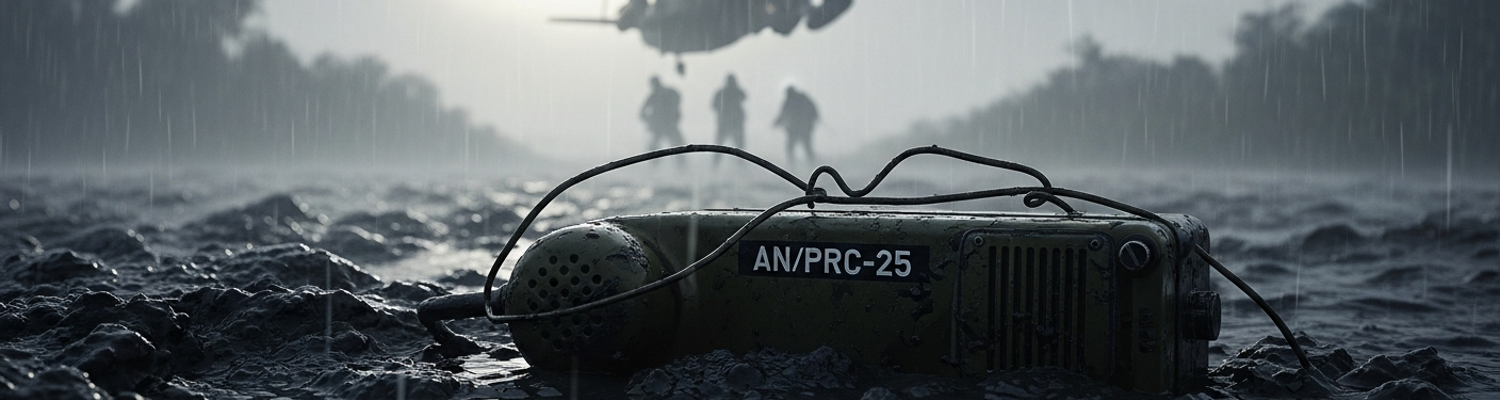
The monsoon environment was uniquely hostile to the electronics of the era. By 1966, the Marine Corps was in a transitional phase with its field radios. The older AN/PRC-10, a vacuum-tube set from the Korean War, was still in service alongside its intended replacement, the solid-state AN/PRC-25. While the AN/PRC-10 was obsolescent, its vacuum tubes generated heat, which offered a marginal benefit of helping to dry out internal moisture. It was also heavy, power-hungry, and its open-contact relays were highly susceptible to corrosion. The AN/PRC-25 was lighter and built with modern solid-state circuitry, making it theoretically more rugged. It was designed to be water-resistant, capable of surviving brief submersion. The pervasive humidity of the Vietnamese jungle presented a different challenge. Moisture did not just splash onto the radio; it seeped into every unsealed component. The most significant point of failure was the H-189/GR handset. This telephone-style component contained the push-to-talk switch and microphone elements, and it was not waterproof. Once moisture infiltrated the handset, it could short out the press-to-talk circuit, leaving a Marine unable to transmit. Radio operators developed field-expedient solutions, such as stretching the plastic bag from a new battery pack over the handset and securing it with a rubber band, but this was an imperfect defense.
The radio itself was only one part of a fragile system.
The performance of the radios was directly tied to their power sources, which were themselves vulnerable to the climate. Both the AN/PRC-10 and AN/PRC-25 relied on disposable dry-cell batteries, primarily the BA-279/U or the newer magnesium BA-4386/PRC-25. Archival records show that the constant humidity, combined with the heat, drastically reduced the operational lifespan of these batteries. A battery rated for 20 hours of use might fail in less than half that time, often without warning. For a radio telephone operator (RTO) carrying a 25-pound radio, the added weight of extra batteries was a significant burden. Moisture also attacked the physical connections. The metal antenna mounts and cable connectors would corrode, creating intermittent and unreliable links. A radio might receive clearly one moment and be filled with static the next, not because of enemy jamming or terrain, but because microscopic layers of oxidation were interfering with the electrical contacts. This unreliability forced ground units to make terrible choices, either broadcasting in the clear and risking interception or remaining silent and risking annihilation. For the men of Lima and Kilo companies during the intense fighting of July 1966, these technical failures had immediate and lethal consequences.
The Impact of the Monsoon Environment
The operational theater of Quang Tri Province was an environment actively hostile to military hardware. The southwest monsoon, arriving in July 1966, did not just bring rain; it unleashed a meteorological force that fundamentally altered the battlefield. It was a physical presence, a wall of water that fell in blinding sheets, turning the red clay of the region into a viscous, shoe-stealing mire that exhausted infantry formations before they made contact. The terrain, a rugged mix of sharp hills and triple-canopy jungle, became a labyrinth of mudslides and swollen streams. For the Marines of the 3rd Battalion, 4th Marines moving through the Song Ngan valley, every foot of ground was a battle against this mud. Movement rates slowed to a few hundred meters per hour, negating the doctrine of rapid, helicopter-borne assault. This physical struggle was compounded by the jungle’s effect on communications. The dense, water-saturated foliage absorbed and scattered radio waves, turning reliable VHF signals from AN/PRC-25 radios into unpredictable bursts of static. Signal propagation, already difficult in the jagged terrain, became nearly impossible, isolating platoons from their command elements.
Near-100 percent humidity was a corrosive agent. It attacked every piece of military equipment with a silent efficiency. The moisture was omnipresent, seeping into sealed components and accelerating decay. A review of after-action reports from Operation Hastings reveals a pattern of equipment failures directly attributable to the environment. The early-model M16 rifle, issued to Marines without adequate cleaning kits or chrome-lined chambers, proved catastrophically vulnerable. The combination of fine, abrasive mud and constant moisture worked its way into the direct-impingement gas system, creating a paste that fouled the bolt carrier group. This led to the most common malfunction: a failure to extract a spent cartridge case, which could not be cleared by simply pulling the charging handle. A Marine under fire would be forced to try and knock the stuck casing out with a cleaning rod. Beyond rifles, the dampness attacked everything. The fabric on web gear and rucksacks would rot. Hand grenades suffered from corroded fuses. Mortar crews found their baseplates sinking into the liquefied earth, making it impossible to provide stable and accurate fire. This systemic equipment degradation crippled the individual Marine’s ability to fight.
Aviation, the cornerstone of Marine strategy, was effectively neutered. The monsoon brought a consistently low, thick cloud ceiling that often hovered just a few hundred feet above the jungle canopy, accompanied by violent, unpredictable squalls. This made Visual Flight Rules (VFR) operations, the standard for most helicopter and attack jet missions, a suicidal proposition. For the CH-46 Sea Knight helicopters tasked with inserting and resupplying troops, the conditions were atrocious. Pilots were forced into low-level, terrain-hugging flights through valleys shrouded in mist, with visibility dropping to near zero in an instant. The initial insertion into LZ Crow on July 15 saw a mid-air collision between two CH-46s and a third striking a tree, a direct result of the chaotic, low-visibility conditions. Tactical air support from A-4 Skyhawks faced the same limitations. Pilots could not visually acquire targets marked by ground troops. Even the ground-directed bombing missions, relying on the AN/TPQ-10 radar operated by MASS-2, were severely hampered. The torrential rain created significant ground clutter on radar scopes, a phenomenon where the radar signal reflects off the dense sheets of water, making it difficult for operators to guide an aircraft to a precise release point without endangering friendly troops.
Improvised Field Repairs
The doctrinal system of military hardware maintenance was incompatible with the conditions of Operation Hastings. Marine Corps procedure was built on a tiered echelon system where unit-level operators performed only the most basic preventative checks. Any true technical failure was meant to be addressed by evacuating the equipment to rear areas, where specialized technicians with proper tools could perform component-level repairs. During the fighting in Helicopter Valley, this system collapsed. Cut off by weather and intense enemy fire, infantry companies like Lima and Kilo were on their own. There were no technicians, no oscilloscopes, and no spare circuit boards at the platoon level. The only tools available to an RTO were those he carried for daily survival: a bayonet or a P-38 can opener.
This disconnect forced Marines into desperate, damaging acts of field expediency. After-action trouble tickets and veteran accounts reveal a consistent pattern of well-intentioned repairs that permanently destroyed sophisticated electronics. The most common failure point, the AN/PRC-25 radio’s H-189/GR handset, was notoriously vulnerable to moisture. Once humidity seeped into the push-to-talk switch, it would short the connection or cause corrosion. An RTO, isolated and under fire, would attempt to fix it. He might pry open the plastic casing with a knife tip to wipe the contacts, an act that broke the water-resistant seal and guaranteed future failure. He might scrape at the metal contacts with his bayonet to remove visible corrosion, inadvertently scratching the plating and creating rough surfaces that would corrode even faster.
These ad-hoc repairs extended to the entire system. When the radio’s transceiver unit itself failed from moisture, some operators would pry open the main chassis, again breaking the factory seals and exposing the delicate solid-state circuit boards to the super-saturated jungle air. This was a catastrophic error. Others, suspecting a power issue, might try to manipulate the battery contacts, bending or scraping them in an attempt to get a better connection, which often led to intermittent power loss or destroyed the contact points altogether. Antennas were another point of failure. A bent three-foot tape antenna might be forcibly straightened by hand, but this created invisible micro-fractures in the metal that disrupted its electrical properties, degrading both transmission and reception quality. Every one of these actions, born of a desperate need to restore the platoon’s only link to the outside world, often had the opposite effect.
The Failure of Fire Support Coordination
Operational logs indicate the American fire support system, a structure built to synchronize artillery and air power, was paralyzed by friction and delay during the height of the crisis in Helicopter Valley. The doctrinal path for a fire mission was a multi-layered relay. A forward observer with a company under fire transmitted a request to their battalion’s Fire Support Coordination Center (FSCC). From there, the request was passed up the chain, either to an artillery Fire Direction Center (FDC) or, for air support, to the DASC run by MASS-2. This process, designed to prevent friendly fire by deconflicting aircraft from artillery trajectories, became a fatal bottleneck. With radio communications failing due to environmental damage and the sheer volume of simultaneous firefights overwhelming the nets, urgent requests from units like Lima Company entered a queue. The support system, despite having access to thousands of artillery rounds and hundreds of daily air sorties, was often unable to deliver that firepower to a specific map coordinate at the specific minute it was needed.
Artillery that did arrive was often ineffective or dangerously inaccurate. Forward observers with the Marine companies, pinned down under the triple-canopy jungle, could rarely see the impact of the shells they were calling for. The standard adjustment technique of walking shells onto a target by observing the explosions was impossible. They were firing blind. Gunners at firebases like the one at Cam Lo were lobbing thousands of shells based on map coordinates and desperate radio calls. The shells frequently detonated high in the thick canopy, creating tree bursts that rained shrapnel down but had little effect on the well-entrenched NVA soldiers in their bunkers. The chaos of battle led to catastrophic errors. Analysis of friendly fire incidents shows how an inexperienced observer, disoriented under fire, could give an incorrect directional command like Left 150 when they meant to add range with Add 150, shifting the point of impact into friendly lines. An FDC, having no way to know the observer had become confused, would process the correction as given. In other cases, a garbled target description could cause the FDC to misjudge the urgency and fire a mission without the normal safety protocols required for troops in close contact, resulting in friendly casualties.
This blindness extended to the air war. The Marine Corps' tactical air power was largely nullified. The monsoon ceiling was too low for A-4 Skyhawk pilots to see the ground, and Forward Air Controllers embedded with the infantry could not see the sky to guide them. This forced a reliance on the one system designed for exactly these conditions: ground-directed bombing using the AN/TPQ-10 radar. An Air Support Radar Team from MASS-2, positioned at a forward operating base, would guide an aircraft on a specific heading and altitude, telling the pilot the precise moment to release his bombs. The system was technically brilliant but had a critical environmental flaw. After-action analyses showed that the torrential rains of the monsoon created extreme ground clutter on radar scopes. The radar pulses were reflecting off the dense sheets of water in the air, creating a false and distorted image of the terrain. A radar operator attempting to guide a jet to a release point just a few hundred feet above the jungle floor was unable to distinguish the true ground level from the returns generated by the storm. The risk of directing a plane into a hillside or dropping bombs on the friendly positions they were trying to protect was unacceptably high.
The Discrepancy in Doctrine
A review of Marine Corps operational doctrine from 1966 shows a highly structured and theoretically seamless system for integrating air and artillery support. The architecture was designed for speed and precision, built around the DASC operated by squadrons like MASS-2. This command-and-control node was the central clearinghouse for all immediate air support requests. The process was rigid. A FAC with a company under fire would radio a request to the battalion’s FSCC, which would relay it to the DASC. DASC operators, co-located with the senior artillery command, were responsible for deconflicting aircraft flight paths from artillery trajectories. For conditions where a pilot could not see the ground, the doctrine provided a specific technological solution: the AN/TPQ-10 Course Directing Central. This ground-based radar system, operated by a forward-deployed ASRT, was designed to guide an aircraft on a precise heading and altitude, providing the pilot with an exact release point for his ordnance in any weather. On paper, it was the answer to fighting in zero-visibility conditions.
The operational environment of Quang Tri Province in July 1966 bore no resemblance to the conditions for which the system was designed. The southwest monsoon introduced meteorological factors that created a total operational paralysis. The consistently low cloud ceiling made visual bombing runs by A-4 Skyhawks impossible. This forced a complete reliance on the AN/TPQ-10, the designated all-weather tool. Post-action analysis, however, revealed a critical flaw. The torrential downpours generated extreme radar interference, or rain clutter, where the radar pulses reflected off the dense sheets of falling water. This effectively blinded the radar operators. On their scopes, the actual terrain was indistinguishable from the noise created by the storm. Guiding a fast-moving jet to a release point just above the jungle canopy became an act of sheer guesswork. The all-weather solution was defeated by the weather.
This doctrinal failure had lethal consequences. For units like Lima Company, the breakdown of the air support system was immediate. Radio calls for air support went unanswered not because aircraft were unavailable, but because the available aircraft were circling uselessly above the clouds, unable to see the battle. During Operation Hastings, Marine attack aircraft flew 1,677 sorties, with a significant number being radar-controlled missions, but their effectiveness was severely limited during the peak of the monsoon. Artillery was the only remaining option, but it too was hampered. Forward observers, unable to see more than a few meters through the rain and jungle, could not adjust fire by observing shell impacts. They were firing blind, directing over 34,000 rounds based on map coordinates and muffled sounds of enemy movement. This led to shells detonating high in the triple canopy, leaving the NVA soldiers in their well-dug earthworks largely unscathed.
Subsequent after-action reports were blunt. The findings identified a critical gap between the theoretical capabilities of the air support system and its performance in a monsoon environment. The core of the problem was that the doctrine presented a false choice: support was either visually directed or it was radar-directed. There was no redundancy or alternative method when both were negated simultaneously. The AN/TPQ-10 radar, the key to all-weather operations, was simply not designed to function in precipitation of such intensity. The established doctrine had not accounted for an environment that could neutralize both the human eye and the electronic one at the same time.
Analysis of Marine Casualties
An examination of after-action reports for Operation Hastings reveals a casualty rate that threatened the operational integrity of the engaged Marine battalions. Across the 19-day operation, total U.S. Marine losses were recorded as 126 killed and 448 wounded. These aggregate numbers obscure the concentrated violence that consumed the infantry companies cut off in Helicopter Valley. The 3rd Battalion, 4th Marines, suffered 14 killed and 49 wounded in a single engagement attempting to link its forces. For the companies fighting in complete isolation, the numbers were far worse. In one 24-hour period, Company I sustained 18 dead and 82 wounded while repelling repeated assaults. Kilo Company, in a separate but similar fight, took over 45 wounded and one killed. These loss ratios, approaching 50 percent of a company’s fighting strength in a single day, rendered these units combat-ineffective. They were losses inflicted because terrain, weather, and a prepared enemy force had turned blocking positions into besieged islands, with no possibility of timely reinforcement or medical evacuation.
The contribution of communication breakdowns to this high casualty count is undeniable. Archival analysis shows that NVA forces placed a high priority on targeting Marine radio telephone operators, understanding that eliminating the RTO severed the unit’s connection to artillery and air support. For a platoon pinned down by machine gun and mortar fire, the failure of an AN/PRC-25 radio, whether from a moisture-compromised H-189 handset or a battery drained by the humidity, was a death sentence. A request for an artillery fire mission to suppress an enemy mortar pit would die in a burst of static. A call for an A-4 Skyhawk to strike a machine gun bunker would never leave the valley. This forced delay, measured in minutes, gave PAVN assault elements the time needed to maneuver closer and overwhelm Marine positions with concentrated fire. The inability to communicate meant that the vast firepower of the U.S. military was rendered useless, leaving individual Marines to fight with only the weapons in their hands.
The operational post-mortem led to material and doctrinal shifts. The most immediate lessons concerned the individual Marine’s equipment. The M16 rifle’s performance during Hastings was catastrophic. Analysis revealed that a combination of factors, the switch to a dirtier-burning ball powder that was not part of the original design specification, a direct-impingement gas system prone to fouling, and the lack of issued cleaning kits, caused constant failures to extract spent cartridges. In response, the Marine Corps and Army rushed to field the M16A1 variant in 1967. The new model featured a chrome-lined chamber and bore to resist corrosion and ease cleaning, and a forward assist that allowed a Marine to manually force the bolt into battery if it was impeded by fouling. Simultaneously, cleaning kits were finally issued on a widespread basis, along with training that acknowledged the rifle required meticulous maintenance. Similar lessons were applied to radios, with the AN/PRC-25’s known vulnerabilities leading to the development of improved handsets and a focus on field-expedient waterproofing techniques that were incorporated into RTO training. The experience in Helicopter Valley served as a brutal lesson that equipment and doctrine designed in sterile conditions would fail unless they were rigorously tested against the specific environmental realities of the battlefield.