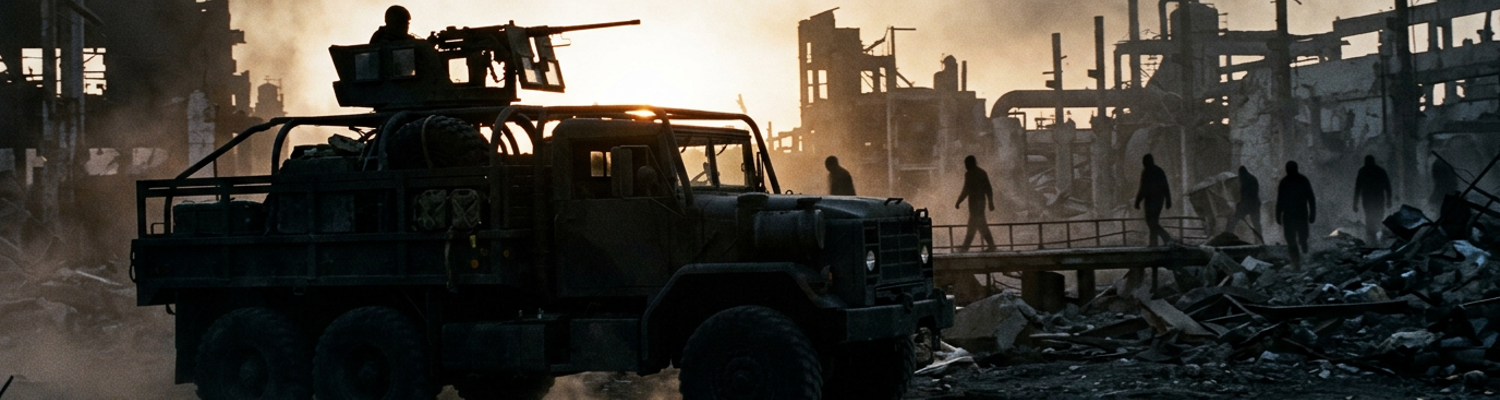

Prewar Military Police Doctrine and Manual Assumptions
Inside the transfer case of a quarter-ton Willys MB assigned to the 759th Military Police Battalion, the hardened spur teeth of the intermediate cluster gear chipped under shock load. Metal shavings dropped into the ninety-weight mineral oil. Friction escalated instantly. The front output shaft bearing seized. The drive selector lever jammed between high and low range. Twenty feet behind the scout car, an accompanying Dodge WC-51 three-quarter-ton truck experienced an immediate loss of hydraulic pressure. A rubber piston cup inside the left rear wheel cylinder ruptured under emergency braking. Brake fluid sprayed across the inner drum lining. The friction pads failed. The heavy utility truck skidded sideways into a jagged pile of masonry along the approach to a pulverized railway overpass south of Hagen.
Field service regulations never anticipated this type of operational environment.
Archival evidence shows that interwar training doctrine developed at Fort Custer prioritized administrative routine. Planners focused on orderly rear-echelon traffic management rather than high-intensity combat amid pulverized municipal infrastructure. Lesson plans developed throughout 1941 and 1942 treated circulation control as a mathematical exercise. These exercises were governed by time-distance tables, steady speeds of twenty miles per hour, and uniform intervals of fifty yards between trucks. Trainees learned point control using white gloves and batons. They directed vehicular flow along wide, undamaged two-lane highways during the Louisiana and Carolina maneuvers. Instruction centered on maintaining vehicle density along established lines of communication. Cadres taught soldiers to write minor disciplinary citations and guard rear supply depots far behind front-line infantry regiments. Nothing in the training syllabus prepared the four lettered companies of the 759th for the close-quarters fighting, blind intersections, and pulverized masonry of the industrial Ruhr basin.
In cities like Dortmund, Essen, and Hagen, multi-story brick tenements had collapsed directly into street beds.
These collapses blocked thoroughfares with impassable debris fields six feet deep. Downed overhead tram cables wrapped around vehicle axles. The cables severed fuel lines.
Theoretical route calculations failed the moment tires contacted pulverized masonry.
A close review of operational logs indicates that Field Manual 19-5 (Military Police) operated on the assumption of functional local civil administrations. The manual assumed intact transportation networks for orderly convoy routing. Doctrine dictated that advancing provost marshals would immediately interface with native municipal officials. They were expected to rely on resident burgomasters, water department engineers, and standing Schutzpolizei detachments to maintain public order. These local elements were supposed to preserve utility infrastructure and produce detailed street maps for supply divisions. Field manual guidelines instructed military police officers to establish command posts at local town halls. Officers were told to requisition existing civilian motor pools and utilize existing municipal telephone exchanges to coordinate traffic diversion routes.
In the Ruhr encirclement during early April 1945, these administrative mechanisms did not exist.
Allied aerial bombing and heavy artillery preparation had obliterated local municipal registries. The bombardments severed subterranean water mains and destroyed electric transformer substations across hundreds of square miles. Civilian administrators had abandoned their posts to join combat Volkssturm battalions. Others committed suicide in underground bunkers or fled east before the Ninth and First United States Armies closed the pocket.
The municipal structure had vanished.
Platoons from the 759th Military Police Battalion entered urban sectors without functional local guides. They lacked municipal route charts or civil law enforcement partners. In place of orderly transit networks, patrol details discovered that retreating Wehrmacht engineers from Army Group B had blown every major bridge across the Ruhr and Ennepe rivers. This forced supply columns into narrow, single-lane diversions through blasted industrial railyards. Without civilian police to enforce evening curfews or maintain municipal order, military police squads faced thousands of displaced persons. Freed foreign laborers scavenged food warehouses. German sniper fire harassed vehicle checkpoints at unmapped intersections. Doctrine offered no procedures for clearing steel girders or directing tanks through burning factory floors. There were no guidelines for securing intersections under direct small-arms fire.
Patrol commanders discarded their manual dispatch forms.
They operated instead from improvised vehicle-mounted SCR-508 radio sets. Drivers kept their M1 carbines unlatched across the dashboard. On April 5, 1945, near the outskirts of Iserlohn, third platoon reported expending 450 rounds of .30-caliber ammunition simply to establish a single operational checkpoint at a ruined crossroads.
Collapse and Encirclement of the Ruhr Pocket
At 1545 hours on April 1, 1945, motorized patrols from the Ninth and First United States Armies collided near the rail junction of Lippstadt.
When examining the historical record, this linkup completed the double envelopment of Field Marshal Walter Model and Army Group B. Spearheading from the north, Lieutenant General William Simpson directed the Ninth Army. He drove the 2nd Armored Division past the Lippe River. Lieutenant General Courtney Hodges commanded the First Army. He thrust the 3rd Armored Division northward through Paderborn after breaking out from the Remagen bridgehead. Trapped across four thousand square miles of industrial terrain, Model found two full field armies locked between the Rhine, Ruhr, and Sieg rivers. The Fifth Panzer Army and the Fifteenth Army were completely cut off.
German motorized columns ran dry.
Allied P-47 Thunderbolts bombed fuel reserves and strafed railway marshaling yards in Siegen and Hamm. Replacement tracks for disabled Panther tanks failed to arrive over severed rail spurs. Crews detonated their own hulls with demolition charges rather than abandon them intact. Field telephone networks collapsed after aerial barrages severed subterranean cables. Division commanders had to move along fractured rural roads without air cover or fuel reserves.
Army Group B was trapped inside an operational perimeter shrinking by five miles each day.
Archival evidence shows that Model attempted disjointed local counterattacks against the eastern front near Winterberg. He threw depleted elements of the 9th Panzer Division and the 116th Panzer Division against dug-in American infantry. Lacking artillery ammunition and synthetic gasoline, these assaults fractured against massed American 105-millimeter battery fire. By April 14, US XVIII Airborne Corps and III Corps split the pocket in two along the axis of the Ruhr River. This isolated German forces in the eastern Sauerland from the western industrial centers of Essen and Duisburg. Model rejected formal surrender demands. Subordinate commanders acknowledged that operational coherence had dissolved entirely. Local Wehrmacht officers managed units starved of field rations and small-arms cartridges. They ordered their men to discard rifles in roadside ditches and walk west toward advancing American vehicle columns.
Mass surrender overwhelmed frontline combat sectors.
Combat units transformed into improvised custodial details overnight. A close review of operational logs indicates that the rapid pocket collapse forced rear-echelon units to process over 317,000 surrendering Axis soldiers within a matter of days. Military police companies from the 759th and accompanying corps provost marshals found their intake schedules dismantled by the volume of personnel marching out of the ruins. In place of standard processing stations handling fifty prisoners an hour, single MP platoons encountered entire regiments. These units walked down the Autobahn under white sheets tied to broom handles.
Open agricultural pastures near Remagen, Wickrath, and Sinzig filled beyond physical capacity within forty-eight hours.
These temporary enclosures lacked latrines, water lines, or wire barriers. Guard details worked eighteen-hour shifts cataloging personnel records. They confiscated Mauser bolt-action rifles and stripped potato-masher hand grenades from men who stood packed shoulder to shoulder in ankle-deep mud. Logistical supply sections diverted ten-ton semitrailers originally loaded with combat rations. These trucks hauled sacks of flour, dry beans, and water purification tablets to the perimeter fences. Patrols from the 759th Battalion walked perimeter trenches with M1 carbines. They managed a demographic intake that contained teenage Volkssturm levies, foreign labor units, and veteran Waffen-SS grenadiers.
On April 21, Model walked into an oak wood south of Duisburg and fired a service pistol into his right temple.
Municipal Infrastructure Failure and Displaced Persons
Archival evidence shows that by April 8, 1945, the physical machinery supporting civil life across the central Ruhr urban corridor had stopped operating.
Bombing runs by RAF Bomber Command and the US Eighth Air Force had broken the forty-eight-inch cast-iron feeder conduits branching from the Mohne and Sorpe reservoirs. This depressurized the regional water network. Underground cisterns beneath Essen and Bochum drained into blast craters. High-voltage transformer substations stood ruined. Their copper windings warped and drained of insulating oil after artillery fragments punctured the steel cooling jackets. Without three-phase line voltage, heavy municipal pumps along the Ruhr River ceased forcing river water through sand filtration beds. This left dry pipes and backed-up raw effluent in basements across four administrative districts.
Fire stations had burned out along with their apparatus when municipal hydrants failed during late-March incendiary raids.
Platoon leaders from the 759th Military Police Battalion entered Dortmund to find zero operational telephone exchanges. They found zero functioning fire pumpers. There was no civil administration capable of burying bodies or extinguishing smoldering coal bunker fires.
Every municipal pipe had run dry.
Combat engineers from the 254th Engineer Combat Battalion and military police patrol details had to build survival infrastructure from scratch while maintaining perimeter security. Mobile water purification units equipped with sand filters and mechanical chlorinators broke down within three hours of deployment. Heavy coal slurry in the Ruhr canal intake basins jammed the impeller blades. Repair crews spent cold nights patching cracked five-hundred-gallon canvas storage basins in factory gravel yards. They applied vulcanizing cement over tears caused by masonry dust and jagged bomb shards.
Civilian surgical wings in Bochum had lost electric lighting.
US Army medical sections requisitioned 5-kilowatt gasoline-driven field generators from corps reserves to power operating tables in cellars. Military police patrol details functioned as makeshift municipal dispatchers. They used backpack-mounted SCR-300 radios to coordinate with engineer D7 armored bulldozers when fractured sewer mains spilled across key division avenues of approach.
When examining the historical record, this infrastructure collapse collided directly with the uncontrolled movement of over 350,000 liberated foreign forced laborers.
Soviet, Polish, French, and Italian workers walked out of barbed-wire barracks attached to Krupp armament works, Rheinmetall-Borsig facilities, and Ruhr coal pits the moment German factory guards abandoned their posts. Carrying makeshift packs of blankets and pulling two-wheeled wooden handcarts, these civilians walked directly onto supply arteries. They crowded Reichsstrasse 1 and the arterial routes running between Wuppertal and Hagen. They possessed no food rations, no clean drinking water, and no medical support.
Combat supply columns supporting the US First Army stalled twenty miles west of their planned staging lines.
Pedestrian traffic filled the macadam roadbeds from ditch to ditch. Rations vanished immediately. Hungry crowds broke through padlocks on freight boxcars at the Oberhausen rail yards. This immobilized dozens of two-and-a-half-ton supply trucks that could neither turn around in the rubble-choked canyons nor push through the thousands of people blocking the roadbed.
Circulation halted across the pocket.
Operational logs record that Company C of the 759th Military Police Battalion received emergency dispatch orders on April 9. They were tasked to clear the primary bypass artery running through Hattingen toward eastern supply depots. Captain Robert H. Vance positioned three-man patrol posts at fifty-yard intervals along the macadam shoulder to divide military convoys from pedestrian columns. His men erected holding pens inside abandoned synthetic rubber plants. They directed thousands of displaced civilians off the road surface while engineer kitchens ladled out boiled horsemeat and flour porridge prepared in five-gallon grease drums.
Military police drivers fitted steel bumper plates onto three-quarter-ton Dodge trucks.
They physically pushed disabled civilian wagons and abandoned Wehrmacht horse carts into bomb craters to establish a single ten-foot traffic lane for gasoline tankers. Near the blown bridge crossing at Steele on April 11, Company C rerouted a convoy of forty-two semi-trailers loaded with 105-millimeter artillery ammunition. They guided the trucks around a crowd of four thousand displaced persons assembled across the railway embankment.
Improvised Vehicle Modifications for Industrial Combat
A close review of operational logs indicates that by April 10, 1945, standard wheeled movement ground to a complete halt across the heavy industrial sectors of Hagen and Hohenlimburg.
Impassable debris fields filled municipal roadways with six-foot embankments of pulverized clinker, shattered refractory brick, and tangled pre-stressed steel rebar. Dodge WC-51 three-quarter-ton trucks bottomed out on sheared bridge spans and fallen smokestack masonry. This cracked cast-iron differential housings and spilled ninety-weight gear lubricant into the streetbed. Heavy-duty Goodyear tires blew their inner tubes after shredding against jagged slag heaps and razor-sharp bomb fragments.
Trapped against these artificial barriers, open-topped utility trucks entered narrow avenues bordered by the towering, skeletal frameworks of bombed Krupp and Hoesch fabrication plants.
These roofless steel skeletons exposed American personnel to plunging small-arms fire from concealed positions fifty to eighty feet above the pavement. Standard canvas truck tops offered zero ballistic protection against lead falling straight down.
Company B patrols operating along the Ennepe River encountered German marksmen positioned inside overhead gantry crane cabins and high catwalks spanning damaged blast furnaces.
Snipers armed with scoped Mauser Karabiner 98k rifles fired straight down through open truck cabs at near-vertical angles. Standard vehicular machine gun mounts failed completely in this environment. These mounts were designed for horizontal engagement across open fields. Drivers attempting to engage overhead targets discovered that the standard M31C pedestal mount allowed an elevation of only twenty-eight degrees. The gun cradle struck the dashboard rim or windshield frame at that angle. Soldiers had to roll out of their cabs and crawl beneath transfer cases and drive shafts for protection. They were pinned down on the asphalt while plunging fire punched holes through thin hood cowlings, seats, and unarmored floorboards.
Motor pool mechanics corrected the geometric failure with oxyacetylene cutting torches.
Archival evidence shows that maintenance personnel assigned to the 759th took over an abandoned metal fabrication workshop near Gevelsberg to modify Company B Dodge WC-52 utility trucks. Technicians scavenged structural channel steel from collapsed overhead crane tracks. They recovered salvageable four-inch seamless pipe from severed industrial gas conduits. Using welding rigs powered by mobile Hobart generator trailers, repair crews fabricated heavy-walled tubular pedestals measuring four feet in length.
Mechanics welded these pedestals directly through the truck beds to the main chassis cross-members.
This elevated scavenged M1919A4 .30-caliber and M2 .50-caliber Browning machine guns sixteen inches above the canvas roofline. This modification allowed gunners to train their barrels upward to an eighty-five-degree pitch. It provided full spherical fire across a three-hundred-and-sixty-degree arc. Four diagonal angle-iron braces were welded from the central pedestal collar to the cargo bed floor. These braces absorbed the violent vibration generated when firing continuous bursts into elevated catwalks.
Welding crews simultaneously fabricated specialized external hardware to knock out marksmen embedded behind reinforced masonry and thick industrial steel plating.
During sweeps of an overrun ammunition cache near Witten, military police detachments captured hundreds of German Panzerfaust 60 single-shot recoilless weapons. Technicians adapted these captured munitions by welding heavy angle-iron brackets onto the passenger-side running boards and front fender braces of the Dodge trucks. Each bracket secured two disposable launch tubes angled upward at forty-five degrees. They locked them into position with tension clamps fabricated from scrap leaf springs.
When an industrial sniper fired from an enclosed crane cab or brick ventilation shaft, the vehicle driver oriented the truck hood toward the target.
The passenger reached through the window frame to trip the launcher trigger mechanism with an insulated pull-cord. The fin-stabilized shaped charges detonated on impact. They pulverized brick lintels and dislodged sniper nests with high-explosive concussion that standard .30-caliber ball ammunition could not achieve. Near the Haspe rail yard on April 12, a modified Dodge truck from Company B unleashed three captured warheads into an overhead conveyor housing. This dropped the structure onto the tracks and neutralized an entire sniper detachment.
Clearance Operations Across Shattered Industrial Complexes
Concrete dust hung motionless inside the roofless shell of the Krupp cast steel works in western Essen.
Archival evidence shows that Company A of the 759th Military Police Battalion and attached demolition squads from the 254th Engineer Combat Battalion commenced tactical clearance of the Friedrich Krupp Gussstahlfabrik on April 12, 1945. Clearing operations across this sprawling industrial complex required sweeping multi-story fabrication plants. Structural floor plates had collapsed into tangled webs of hanging steel catwalks. Combat engineers deployed pneumatic rock drills and ten-pound satchel charges of Composition C-2. They breached fallen reinforced concrete slabs blocking access to the heavy artillery gun-finishing bays along Altendorfer Strasse.
Platoon leaders formed clearance stacks consisting of two military police riflemen armed with M1 Garands, a carbine-carrying squad leader, and an engineer carrying an M2A1-7 portable flamethrower.
Teams advanced along buckled steel gantries using hand signals. They stepped across severed high-pressure steam conduits and pulverized asbestos lagging that blanketed the floor in a gray powder. Unexploded ordnance complicated each forward movement. Delayed-action 500-pound aerial bombs dropped weeks earlier by British bombers remained pinned beneath sheared crane girders sixty feet above the concrete shop floor. Soldiers scrambled across fractured lathe beds and through drained transformer vaults. They checked high overhead crane cabs for enemy observers while cold drainage water pooled around rusted ingot molds.
Basement corridors dropped through three levels of unlit drainage pits.
A close review of operational logs indicates that rear-area detachments operating behind frontline elements of the 79th Infantry Division encountered sustained resistance from bypassed German combat groups. Volkssturm levies from local factory defense battalions and scattered Wehrmacht survivors from the 116th Panzer Division had barricaded themselves inside reinforced subterranean air-raid bunkers and utility conduits beneath the ruined blast furnaces. Deprived of central command and low on medical supplies, these defenders turned the deep basements into fortified pockets of resistance.
These isolated holdouts converted heavy debris piles, twisted crane assemblies, and iron slag mounds into fortified machine-gun nests guarding subterranean tunnel junctions.
German gunners set up an MG 42 light machine gun behind a steel fire door fifty yards south of Krupp Gate 4. They swept an underground power cable trench with sustained automatic fire when Company A attempted an initial sweep. Volkssturm fighters armed with single-shot Volkssturmgewehr rifles and Panzerfaust 60 anti-tank launchers ambushed follow-up patrols from air intake shafts and grease collection sumps. They fired through drainage grates before melting back into the unmapped utility corridors.
When examining the historical record, radio transmissions failed completely inside the three-foot-thick ferroconcrete walls and subterranean pipe galleries.
This cut squad leaders off from battalion communications. Backpack SCR-300 radios emitted only static once patrol scouts descended below the floor line of the mechanical press halls. Captain Donald Henderson directed his military police platoons to abandon conventional room-clearing doctrine in favor of direct bunker suppression. Heavy Browning M1919A4 machine guns pinned bunker firing embrasures from across open foundry floors. This allowed engineer teams to drop white phosphorus grenades and sulfur smoke pots down through exterior ventilation pipes.
Overpressure from five-pound tetrytol block charges blown against escape hatches collapsed structural entryways.
This deprived defenders of air and illumination. Engineers ended a three-hour standoff beneath the central rolling mill on April 14 by pouring twenty gallons of diesel fuel down a damaged air exhaust line to force thirty entrenched German soldiers into the courtyard.
Patrols hauled twenty-two wounded prisoners out of the Krupp heavy press basement at dusk on April 15.
Strategic Bombing Survey Assessments on Civil Disintegration
Archival evidence shows that field teams from the United States Strategic Bombing Survey Civilian Defense Division entered the perimeter of the collapsed pocket during the third week of April 1945.
Technical investigators, structural engineers, and fire protection specialists traveled in three-quarter-ton Dodge utility trucks across the fractured municipal districts of Essen, Dortmund, and Hagen. Civilian analysts worked alongside military officers to inspect subterranean command bunkers, municipal air-raid shelters, and gutted fire stations before debris-clearing bulldozers altered the physical terrain. Field teams retrieved operational registers from basement files. They evaluated blast craters near utility junctions and conducted technical interrogations of captured German civil defense personnel.
Their objective focused on analyzing the performance of theoretical passive defense organizations under sustained air assault.
They examined the physical structures erected by the Reichsluftschutzbund and the emergency response units of the Sicherheits- und Hilfsdienst. What they found among the slag heaps and collapsed brick tenements was an administrative void where every prewar response mechanism had shattered under shock waves and heat convection currents.
Theoretical blueprints for civilian survival had dissolved beneath millions of tons of pulverized masonry.
When examining the historical record, field investigation reports compiled by the survey confirmed that German civil protection apparatuses suffered catastrophic organizational disintegration weeks before ground troops encircled the basin. National air-raid doctrine had prescribed an integrated municipal network where Luftschutzpolizei detachments, mobile repair columns, and auxiliary medical units operated from reinforced subterranean bunkers to isolate industrial fires and redirect urban populations. Survey findings documented that this theoretical structure disintegrated completely once municipal utility trunks severed.
Without hydro-static water pressure in underground conduits, mobile fire pumpers equipped with five-hundred-gallon-per-minute centrifugal pumps proved useless against burning residential blocks.
Technical inspectors discovered that emergency water basins constructed inside city squares sat empty. They had drained dry through subterranean fissures opened by delayed-action high-explosive ordnance. In Dortmund, investigators recorded that forty-eight-inch cast-iron trunk lines lay shattered across eleven distinct pumping sectors. This confirmed earlier terrain assessments filed by the 254th Engineer Combat Battalion. Underground gas conduits had ruptured simultaneously. This blew cast-iron access covers into the air and filled subterranean shelter complexes with carbon monoxide that overwhelmed mechanical air-filtration canisters.
Centralized communication across the industrial corridor died when lead-sheathed trunk cables melted inside concrete floor chases.
A close review of operational logs indicates that the survey reports fully corroborated American combat engineer accounts detailing the absolute failure of local municipal systems. Administrative chains of command dissolved because district air-raid directors, municipal police chiefs, and technical service leaders routinely abandoned their operational posts as Allied artillery fire closed within direct range. Local Sicherheits- und Hilfsdienst personnel were conscripted directly into ad-hoc Volkssturm battalions by regional Nazi Party functionaries. This stripped cities of their remaining heavy equipment operators and salvage squads.
Survey analysts uncovered evidence that in districts where civil manuals required fifty functioning rescue trucks, zero were operational.
This was due to vulcanized rubber shortages, punctured oil pans, and cracked engine blocks caused by brick dust contamination. Fire defense leaders in Essen possessed no central telephone connectivity after April 6. Dispatchers deployed teenage runners on bicycles who were repeatedly cut down by fragmentation rounds along Krupp-Strasse. The civilian population had withdrawn into subterranean limestone caves, industrial railway tunnels, and deep brewery cellars without sanitation, central distribution of dry provisions, or municipal medical oversight.
On April 28, civilian defense field team number two cataloged eighty-seven unburied bodies lying inside a single unventilated coal bunker adjacent to the Hoesch steelworks in northern Dortmund.