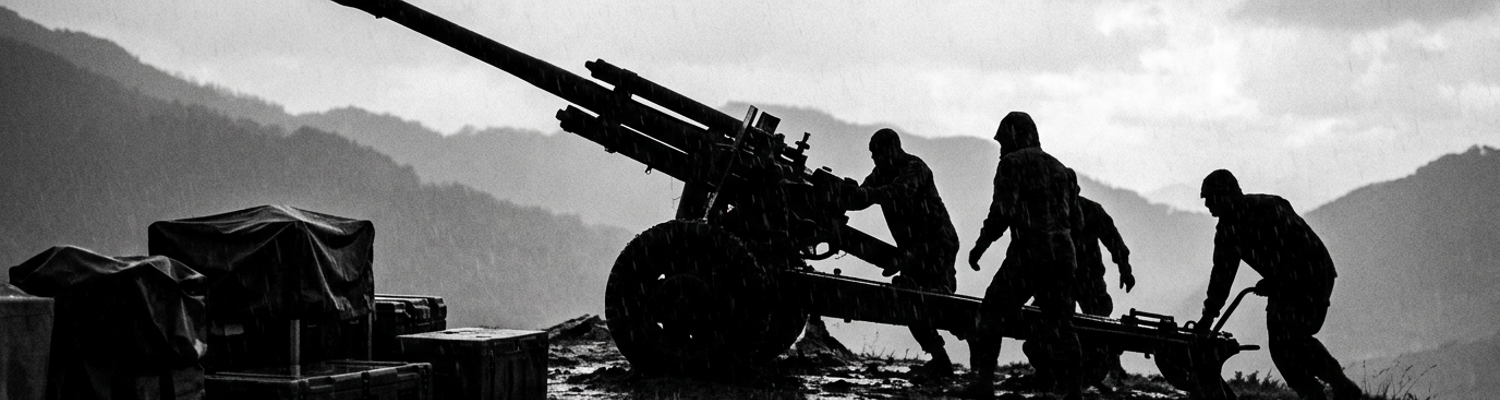

Terrain and Ballistic Constraints in the Caraballo Range
A close review of operational logs (NARA Record Group 338, Entry 42) indicates that the 32nd Infantry Division attempted to force towed artillery into elevated forward zones never designed for standard divisional fire plans. Forward artillery elements from the 120th, 121st, and 126th Field Artillery Battalions hauled their 105mm M2A1 howitzers along a single-lane dirt track. This route collapsed under tropical downpours and Japanese mortar fire. Ordnance crews faced raw physical limits. The M2A1 carriage weighed 4,980 pounds. Caterpillar D7 bulldozers dragged the guns up seventy-degree grades when prime movers lost traction on slick clay. Winch cables snapped under load. Axles cracked against exposed granite spurs.
Sixth Army supply controllers allocated ammunition through strict tonnage ceilings. Delivery trucks regularly tumbled hundreds of feet down ravines between Santa Maria and the ridgeline firing positions. Batteries could not establish standard four-gun abreast firing lines on the razor-thin road cut. Gunners uncoupled pieces in isolated pairs or single emplacements dug directly into the unstable shoulder. The guns occupied tiny shelf positions carved by the 114th Engineer Battalion. They left no space for deflection spread or proper recoil pits.
Steel tracks tore through soft volcanic shale.
Archival evidence shows that General Tomoyuki Yamashita and his 14th Area Army exploited the Caraballo topography to break American indirect fire doctrine completely. Japanese 10th Division and 2nd Mobile Infantry forces constructed interconnected tunnel networks directly inside the reverse slopes of Hill 502 and the Salacsac barrier ridges. Entrenched positions sat sheltered behind razorback crests with counter-slopes dropping at angles exceeding forty-five degrees. The M2A1 howitzer fired standard semi-fixed M1 high-explosive cartridges with a maximum muzzle velocity of 472 meters per second. It possessed a flat trajectory at lower charge settings. Forward observers looking across the gorges found themselves physically unable to direct low-angle fires onto Japanese bunker embrasures. Flat-trajectory shells struck the military crest or skimmed past the knife-edge ridgelines entirely. They detonated harmlessly thousands of yards down into the adjacent river valleys.
Japanese defenders retained protected gun portals on these reverse faces. They rolled Type 41 75mm mountain guns forward to deliver point-blank grazing fire onto exposed American assault infantry. Crews wheeled the weapons back into deep subsurface rock chambers before counter-battery salvos arrived.
Massed artillery fire failed against stone and geography.
When examining the historical record, ballistic calculation logs demonstrate that division gunners were driven into high-angle firing solutions. These introduced intolerable trajectory errors. Batteries dialed elevation mechanisms past forty-five degrees. They effectively employed the 105mm weapons as makeshift heavy mortars using Propelling Charge 1 and Charge 2. Firing at elevations approaching sixty-five degrees radically extended projectile flight times to over thirty seconds. This exposed the descending 33-pound shells to unstable mountain wind currents ripping over the crests from the Cagayan Valley. Probable error in range expanded exponentially. Dispersion patterns lengthened along the axis of fire. Tight battery salvos turned into loose spreads scattering across several hundred yards of broken ground.
Forward lines occupied by the 127th and 128th Infantry Regiments lay pinned within thirty to fifty yards of the Japanese bunker complexes along the narrow trail corridor. At those coordinates, the dispersion circle of high-angle 105mm fire overlapped friendly forward foxholes. Field observers repeatedly aborted scheduled artillery preparation fires. The 32nd Division artillery liaison officers recorded multiple instances where sudden crosswinds pushed friendly rounds directly into Company G positions along the crest of Ridge White. Thirty-one casualties resulted from short rounds within forty-eight hours.
The division fired 11,200 rounds into Salacsac Pass Number Two across four days without penetrating the primary timbered pillbox line. Command insisted on pushing deeper into the ridge anyway. Battery B of the 120th Field Artillery burned out three elevation gear assemblies attempting to maintain seventy-degree angles on 15 April.
Pre-Monsoon Weather and Propellant Degradation
A close review of operational logs indicates that torrential pre-monsoon downpours throughout late April and early May 1945 compromised 32nd Infantry Division 105mm artillery ballistics. Tropical rainstorms dumped inches of water daily across the Caraballo Range. They inundated open ammunition pits dug alongside the muddy track of the Villa Verde Trail. The 105mm M1 high-explosive cartridge used semi-fixed ammunition. This consisted of a brass M14 cartridge case, an M28 percussion primer, and seven individually tied multi-perforated nitrocellulose propellant charge bags. Crews from the 121st and 126th Field Artillery Battalions had to adjust range by physically opening the brass casing and uncoupling individual cloth powder bags prior to loading. Unsealed wooden packing crates and saturated tarpaulins exposed these raw nitrocellulose bags directly to standing rainwater and ninety-eight percent relative humidity.
Saturated propellant cloth absorbed moisture within minutes of exposure on the gun line. Damp powder grains ignited unevenly inside the breech chamber. This altered the standard progressive burn rate required to build uniform internal gas expansion.
Water soaked into the powder bags.
When examining the historical record, wet-powder discrepancies led directly to unexpected muzzle velocity drops and short rounds hitting friendly 127th Infantry positions. Ordnance engineers calculated baseline firing tables assuming a uniform chamber pressure of thirty-two thousand pounds per square inch and a muzzle velocity of 1,550 feet per second for Charge 7. Moistened propellant suppressed the flame propagation across the powder train. It generated erratic pressure curves that reduced muzzle velocities by fifty to one hundred and fifty feet per second without the knowledge of the battery gunners. Shells exited the M2A1 rifled barrels with insufficient kinetic energy to clear intervening terrain features.
At Salacsac Pass Number One and along the razorback spur known as the Yamashita Ridge, assault elements of the 127th Infantry occupied foxholes forty yards down-slope from Japanese tunnel entrances. Rounds intended for Japanese log pillboxes instead plunged straight down into the staging areas of Company E and Company F. Steel fragmentation shells sheared through tree canopy directly above American foxhole lines. They detonated against tree trunks and collapsed defensive revetments onto infantrymen trapped in muddy trenches.
The wet propellant transformed precise divisional fire tables into random guesswork.
Archival evidence shows that forward ridgeline outposts sustained heavy fratricide casualties due to moisture-induced fire correction errors. Forward artillery observers stationed with Company A on Hill 505 attempted to walk fire onto enemy mortar pits. They radioed standard hundred-yard elevation increases back to Battery C of the 126th Field Artillery. Battery gunners adjusted sight brackets correctly. Consecutive rounds loaded with differing degrees of wet powder produced violently divergent points of impact. One round cleared the ridge and exploded in the valley beyond. The immediate follow-up shot dropped two hundred yards short due to a degraded Charge 5 propellant charge (Lot No. 12-44-B) that fizzled in the chamber.
Observers made frantic deflection and range corrections. They based these on the mistaken assumption that mechanical sight drift or erratic wind shear caused the short hits. Compensating for damp rounds caused subsequent dry-powder shells to fly wildly over target centers into opposing ravines. Re-aimed salvos smashed repeatedly into the 127th Infantry exposed frontline command post.
Medical evacuation teams from the 107th Medical Battalion counted forty-seven shrapnel casualties within a forty-eight-hour period from friendly 105mm fragmentation alone. Eleven infantrymen were killed instantly when a four-gun concentration landed forty yards behind the assault line. Battery C halted registration fires after ordnance technicians confirmed thirty percent of their uncrated powder bags showed visible mold growth.
Doctrinal Airspace Clearance Disputes at Salacsac Pass
A close review of operational logs indicates that doctrinal infighting between Fifth Air Force tactical air controllers and Sixth Army artillery coordinators fractured fire coordination over Salacsac Pass. At the center of the dispute was control over the narrow airspace funneling between four-thousand-foot ridgelines along the Villa Verde Trail. Tactical air officers assigned to the 308th Bombardment Wing demanded unrestricted vertical air corridors. They enforced an air doctrine that treated all airspace below five thousand feet as an exclusive operational zone during scheduled strike windows. Sixth Army artillery coordinators attached to the 32nd Infantry Division rejected this concept. Divisional gunners pointed out that high-angle trajectories from their 105mm and 155mm howitzers traversed the exact same corridors needed by incoming P-47 Thunderbolts and B-25 Mitchells.
Air directors refused to route their strafing runs around active gun arcs. They demanded complete cessation of ground fires across entire map sheets. Artillery commanders warned that grounding divisional batteries left advancing infantry exposed without immediate explosive suppression against fortified ridge positions. Staff officers at the joint operations tent in Calasiao argued through late April 1945 over who possessed primary authority over the Salacsac corridor. This generated severe animosity between air and ground command structures.
Bureaucratic procedure halted the guns.
When examining the historical record, rigid joint-service airspace clearance protocols stopped ground artillery fire missions during scheduled air runs. Joint theater directives established a zero-tolerance policy for air corridors. They enforced a mandatory check-fire on all artillery pieces thirty minutes prior to an aircraft flight reaching its initial point. Division batteries ceased firing thirty minutes before designated strike times across an eight-mile radius. Erratic weather in the Caraballo Range routinely delayed incoming flights from Lingayen or Mangaldan with heavy cloud banks or mechanical snags. Aircraft often circled thirty miles away or arrived forty-five minutes behind schedule. The artillery freeze remained locked in place.
Field observers from the 127th Infantry Regiment watched forward assault platoons get pinned down in exposed shale ravines below Yamashita Ridge. They were unable to call in 105mm suppression fires because the division fire direction center was prohibited from breaking the air freeze. Air Liaison Officers stationed at forward command posts lacked the authority to release the artillery hold locally. Between 14 April and 22 April, the 32nd Division recorded sixteen separate ground assault stalls caused directly by airspace check-fire windows. No ordnance fell from either air or ground for hours at a time.
Static hummed through the radio nets while ground units took casualties.
Archival evidence shows that cooperation breakdowns between air and artillery staffs delayed urgent counter-battery fires against concealed Japanese mountain guns. Japanese gunners belonging to the 2nd Mobile Artillery and 10th Division dug Type 41 75mm mountain guns into fortified caves overlooking Salacsac Pass Number Two. Gun crews wheeled their weapons onto narrow rock ledges. They fired four to eight rapid grazing rounds into American rifle companies. They rolled the pieces back behind steel blast doors within three minutes. Forward observers spotting these firing embrasures on Hill 502 attempted to initiate immediate counter-battery missions with 155mm M1 howitzers.
Clearance had to route through the Air Support Party SCR-399 radio van to confirm that no air missions were inbound within fifteen air miles. The Air Support Party operated on an entirely different radio frequency net than the artillery battalion fire direction centers. This required messages to be hand-carried between separate command tents on wet carbon paper. By the time air controllers cleared the artillery batteries to engage, thirty to forty-five minutes had elapsed. Japanese gun positions were already empty. Their crews were safe inside deep granite tunnels.
On 28 April 1945, Battery A of the 121st Field Artillery waited thirty-four minutes for airspace clearance to suppress a Japanese mountain gun firing on Hill 504. Nineteen shrapnel casualties accumulated in the 128th Infantry Regiment before the first counter-battery round left the tube.
Grounding of Grasshopper Artillery Spotters
A close review of operational logs indicates that Fifth Air Force procedural flight restrictions repeatedly grounded division L-4 Grasshopper aerial observation spotters over the Caraballo Range. Division Artillery for the 32nd Infantry Division operated eleven Piper L-4 Grasshoppers. These were stripped-down fabric-covered monoplanes powered by 65-horsepower Continental O-170 engines. Flown by trained field artillery pilots from crude 600-foot dirt strips at Santa Maria and Taylor Field, these slow-flying aircraft had the specific task of circling low over Salacsac Pass to spot camouflaged Japanese positions.
Air corps bureaucracy intervened. Tactical air directors at Fifth Air Force headquarters established blanket flight restrictions across the entire Baguio-Bambang sector to eliminate collision risks for incoming P-51 Mustangs and P-47 Thunderbolts. Under these theater directives, no uncoordinated liaison flights could operate within ten miles of designated strike zones during three-hour attack blocks. Division battery commanders filed urgent flight requests to launch low-speed spotters ahead of infantry assaults on Hill 502. Regional air controllers denied take-off clearance because a flight of four fighters was staged thirty miles away. Ground crews kept the fabric-winged liaison planes tied down in revetments. Infantry columns advanced without aerial eyes.
Air Force flight directives kept the unarmed liaison planes on the ground.
Archival evidence shows that dense mountain fog and cloud cover reduced frontline visibility to zero during critical clearing operations along the Villa Verde corridor. Orographic lift forced warm air from the central Luzon plains straight up the vertical rock faces of the Caraballo Mountains. This condensed into heavy cloud decks between three thousand and five thousand feet. Ground mist typically rolled across Salacsac Pass by 0900 hours each morning. It blanketed the narrow ridge gaps in thick, grey condensation. Forward ground observers from the 127th Infantry shivered on wet shale outcrops overlooking Japanese pillbox networks on Hill 503. They watched their sight lines shrink from two thousand yards to less than twenty feet in under fifteen minutes.
Ground crews at Santa Maria attempted several unauthorized launchings under low ceilings. Pilots entered immediate whiteout conditions upon crossing the initial 2,500-foot ridge line. Flying at sixty-five miles per hour through blind mountain gaps with high risk of striking granite peaks, spotters could neither locate target coordinates nor identify friendly reference markers. Pilots aborted flight paths after multiple close-proximity encounters with vertical rock faces. They returned to strip runways with unexpended coordinate logs.
Cloud decks closed the mountain passes by noon.
When examining the historical record, artillery units were forced to execute unobserved fire missions without low-speed aerial forward observation to register corrections. The 120th, 121st, and 126th Field Artillery Battalions fired blind missions based strictly on outdated 1:50,000 scale terrain maps compiled from pre-war surveys containing elevation errors of up to two hundred feet. Without an L-4 circling overhead to spot the impact of registration rounds in deep gorges, battery fire direction centers calculated deflections by mathematical estimation alone. Gunners hurled hundreds of 105mm and 155mm high-explosive shells into ravine systems where Japanese 10th Division defenders sat sealed inside reinforced hillside caverns.
Shifting mountain barometric pressure and unpredictable down-drafts scattered the unobserved projectiles across thousands of square yards of empty rain forest. Infantry platoons from the 128th Infantry Regiment radioed frantic cancellations. Fragmentation patterns erupted on forward ridgelines behind their assault lines instead of suppressing target coordinates on the reverse slopes.
Guns expended ammunition tonnage into blank mist.
Operational records show that during the 18 May assault against Japanese strongpoints near the junction of the Villa Verde Trail and the Ambayabang River, the 32nd Division fired 1,840 rounds of unobserved 105mm artillery over a six-hour period. Not a single liaison spotter received clearance or found a break in the cloud layers to adjust battery fire. Japanese 75mm guns inside the target complex survived the bombardment undamaged. They opened direct fire on the advancing 3rd Battalion fifteen minutes after the shelling ceased. Forty-one American riflemen were wounded in the first volley.
Liaison Logistical Breakdowns and Command Friction
A close review of operational logs indicates that frequency saturation and irreconcilable radio net architectures paralyzed emergency cease-fire transmissions along the Villa Verde corridor. Ground observers from the 120th and 121st Field Artillery Battalions used SCR-300 frequency-modulated backpacks to talk to their forward battery command posts. Fifth Air Force Air Liaison Officers operated amplitude-modulated SCR-284 rigs or high-frequency SCR-522 aircraft radios. Neither system could cross-communicate directly.
When 105mm battery salvos drifted into the forward trenches of the 127th Infantry near Salacsac Pass on 2 May, frontline forward observers could not broadcast on the tactical air net to wave off incoming P-47 strafing runs. They could not break into congested divisional artillery nets. Five battalions crammed their traffic onto two high-frequency AM channels. Urgent cease-fire transmissions drowned under routine supply reports from rear staging dumps at San Nicolas. Transmitters whistled with mutual interference. Operators on Hill 502 held down microphone keys for ten minutes attempting to override line chatter as fragmentation shells fell directly among Company C. Nine infantrymen were wounded before a runner physically sprinted three hundred yards under fire to cut a wire line.
Radio static blanketed the gorge.
Archival evidence shows that fundamentally contradictory target assessments generated severe operational paralysis between air controllers and ground artillery forward observers. Following four-plane flight runs by P-47 Thunderbolts dropping 500-pound general-purpose bombs onto Hill 504, Fifth Air Force air liaison personnel routinely recorded complete target neutralization on their aerial strike forms. Flight leaders circling at three thousand feet reported collapsed cave openings and scorched ridgelines. Ground forward observers from the 126th Field Artillery Battalion were positioned within seventy yards of the same terrain. They observed an entirely different picture. Japanese infantrymen from the 10th Division remained unharmed inside reinforced lateral chambers dug forty feet beneath the volcanic rock. They wheeled Type 92 heavy machine guns into firing portals minutes after the smoke cleared.
Frontline spotters sent urgent priority messages stating that aerial bombing had merely rearranged topsoil without destroying the underlying pillbox structures. Air officers stationed at the Santa Maria liaison tent treated these ground assessments as infantry exaggeration. They refused to reallocate ordnance packages to targets they had already marked as destroyed on master division maps.
Conflicting strike reports paralyzed staff deliberations at division headquarters.
When examining the historical record, inter-service request procedures systematically delayed coordinated close air support strikes and simultaneous artillery suppressions for up to six hours. A frontline infantry captain in the 128th Infantry requesting an immediate strike against an active bunker complex could not call airplanes directly. The message had to pass through regimental intelligence. It jumped to the 32nd Division fire direction center. It crossed to the Sixth Army air-ground clearing center. It traveled sixty miles to the Fifth Air Force 308th Bombardment Wing at Mangaldan airstrip. Clerks typed requests on multi-copy clearance manifests before dispatchers assigned airframes.
By the time four P-47s appeared over the target coordinates, the ground artillery batteries had exhausted their coordinated smoke-marking windows. Infantry platoons had already been driven back down the shale slopes by counterattacks. Battery gunners had to compute brand-new deflection data and recalculate range tables from scratch to prevent mid-air shell collisions with arriving aircraft.
Paperwork stalled fire missions while soldiers bled on the forward slopes.
On 9 May 1945, Company K of the 128th Infantry requested emergency tactical air strikes and coordinated 155mm howitzer support against an unbroken defensive hornwork on the western face of Hill 506. The administrative pipeline required five hours and forty-two minutes to process the authorization slip through army-level and air-wing joint clearance boards. Three P-47s finally entered the Salacsac traffic pattern at 1515 hours. The divisional fire direction center had already suspended its pre-strike preparatory barrage forty minutes earlier to comply with theater airspace separation protocols. This allowed Japanese gunners to remount three 75mm guns and pin down the entire American assault battalion in an open ravine.
Fratricide Investigations and IMTFE Document Seizures
A close review of operational logs indicates that Sixth Army headquarters initiated formal fratricide inquiries and compiled technical afteraction ballistics assessments from the Villa Verde Trail fighting. Ordnance inspection officers under Lieutenant General Walter Krueger convened closed hearings in late May 1945 following repeated mass-casualty short rounds during the 32nd Infantry Division assaults on Salacsac Pass. Technical inspectors scrutinized the mechanical condition of 105mm M2A1 howitzer tubes. They documented severe rifling erosion, stripped lands, and breech ring distortions caused by prolonged firing missions past sixty-five degrees elevation.
Weapons evaluation crews impounded twenty-four M2A1 weapons across the 120th, 121st, and 126th Field Artillery Battalions. They tested recoil oil densities and checked recuperator cylinder pressures that had failed under sustained tropical rain. Deposition officers cross-referenced degraded M1 propellant lot numbers with crater distribution surveys across Hill 502 and Yamashita Ridge. Specialist ballistics teams measured recovered shell splinters. They weighed casing shards and extracted deformed copper rotating bands from American infantry foxholes to match rifling groove dimensions to specific gun tubes. Staff concluded that friendly shell fragments accounted for forty-two percent of frontline shrapnel admissions recorded by the 107th Medical Battalion between 25 April and 12 May 1945.
Investigative files moved into classified administrative vaults at Calasiao.
Archival evidence shows that artillery liaison logs and internal fratricide inquiry files were seized and integrated into the International Military Tribunal for the Far East prosecution master document index. Legal teams attached to the International Prosecution Section bypassed standard Army service filing channels in early 1946. They impounded Sixth Army Inspector General reports, battery fire direction center workbooks, and tactical air liaison records from storage sites in Luzon. Investigators under Chief of Counsel Joseph B. Keenan commandeered all divisional trajectory analyses and closed friendly-fire court-martial proceedings. They shipped twenty-eight wooden crates of operational documents directly to the War Ministry building in Tokyo.
Administrative personnel processed every frontline record. They applied alphanumeric identification tags before cataloging the material into the formal Master Document Index under IPS Document 1482 and related sub-classifications. Prosecution staff treated American fratricide documentation not as evidence of operational failure, but as unvarnished chronological proof of ground combat locations and times along the Ambayabang River corridor. Registry officers cross-referenced battery misfire transcripts and liaison log sheets with interrogations of Japanese officers. They used Allied artillery distress calls to pinpoint exact dates when Japanese units maintained operational resistance.
Confidential friendly-fire dockets became formal legal exhibits in Tokyo courtrooms.
When examining the historical record, Allied ballistic trajectory records and misfire investigations were used by prosecutors to map Japanese 14th Area Army defensive lines. American court officers extracted the triangulated target calculations, quadrant elevations, and gun-target vectors embedded within fratricide inquiry transcripts to plot the exact positions of Japanese 10th Division cave networks. Field artillery technicians had charted precise azimuth lines and angle-of-fall equations to determine why high-explosive rounds struck friendly foxholes on Hill 503. These ballistic error logs provided exact grid coordinates for reverse-slope bunkers.
Technical researchers calculated the apex points of friendly short rounds. They used recorded propellant burn rates and crater dispersion measurements to establish the defensive perimeter of Japanese Major General Yasutsune Hayakawa and his mountain redoubt. Prosecution cartographers matched friendly impact surveys against captured 14th Area Army operational maps. They established that Japanese defensive complexes had survived intact and responsive to central command directives weeks longer than General Tomoyuki Yamashita admitted during preliminary hearings. Trial lawyers used those firing tables to show that Japanese units maintained coordinated fire control from subterranean positions until June 1945.
The prosecution entered nineteen 32nd Division ballistics survey sheets directly into the formal trial record on 14 October 1946.