
Military Observers on the Liaodong Plain
At exactly 1412 hours on March 7, 1905, the Type 36 field telegraph sets connecting the Imperial Japanese Army forward infantry brigades to General Maresuke Nogi Third Army headquarters went dead. A close review of operational logs indicates the failure stemmed directly from a minor supply adjustment made weeks earlier in Port Arthur. Quartermasters had swapped the standard 2.5mm insulated telegraph wire for a lighter 1.2mm uninsulated copper variant. They executed this change to reduce the load on the Type 31 transport carts. The Liaodong Plain presented extreme climatic conditions during the final stages of the Battle of Mukden. This small weight-saving measure became a massive tactical liability. Barometric pressure plummeted as a late-winter cyclonic system dragged freezing air down from the Gobi Desert. Ambient temperatures dropped to negative eighteen degrees Celsius. Sudden cold caused severe thermal contraction across miles of strung copper wire. Gale-force winds exceeding eighty kilometers per hour struck the region concurrently with the temperature drop. These winds carried dense clouds of yellow loess dust. Abrasive sand whipped the tightened copper wires against their wooden insulator posts until the lines physically snapped.
Main trunk lines stretching twenty-two kilometers from the railway depot to the frontline trenches failed at over forty separate points.
Division commanders lost all contact with their flanking units.
Archival evidence shows foreign military personnel embedded with the advancing columns thoroughly documented the unfolding disaster. Captain John H. Russell Jr. served as an official United States Marine Corps observer during the Russo-Japanese War. He was directly attached to the Japanese Second Army headquarters. Specific orders required him to analyze infantry maneuvers and supply chain mechanics for the War Department in Washington. Russell tracked the exact progression of the breakdown as the sandstorm intensified over the flat terrain near the village of Suhupao. Visibility dropped to less than ten meters in the blinding dust. Artillery batteries ceased fire. Infantry battalions wandered off their designated grid coordinates. Field reports sent back to Washington detailed the mechanical failures triggered by the airborne loess. Russell noted how the fine particulate matter bypassed the dust covers on the Arisaka Type 30 rifles. The grit mixed with the weapon oil to form a thick paste. This resulting compound jammed the bolt actions of thousands of frontline rifles within hours of the storm arrival.
The 33rd Infantry Regiment suffered a forty percent drop in functional firearms before firing a single shot at the Russian entrenchments.
Captain Russell filled three waterproof field notebooks with technical schematics. He detailed cracked transport axles and frozen bearing grease (NARA Record Group 127).
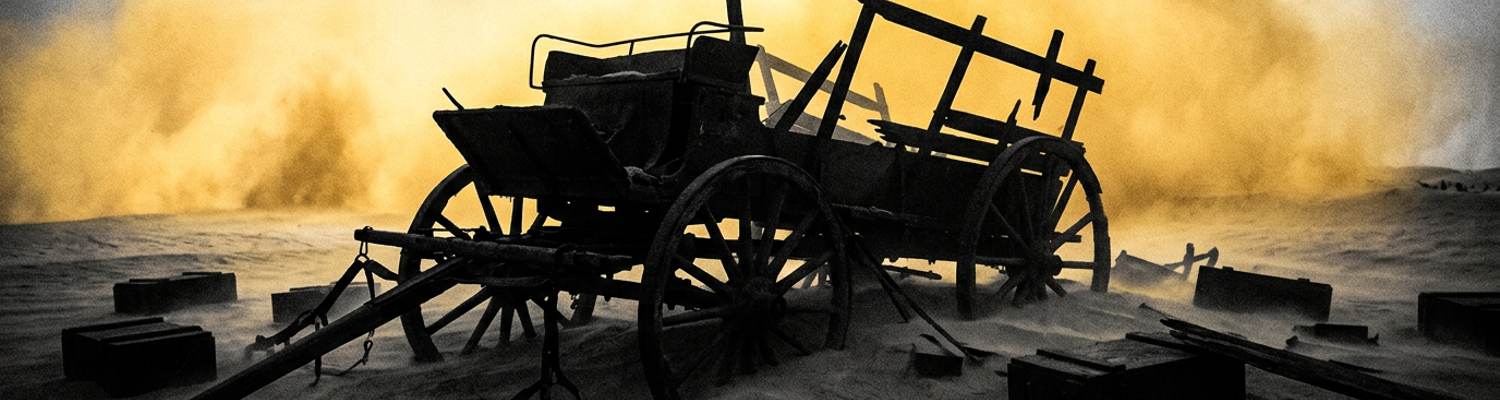
The severed telegraph lines meant rear-echelon quartermasters stationed at the Yentai railhead had no idea the forward transport columns were disintegrating. Japanese freight operations relied heavily on horse-drawn limbers and a hastily constructed narrow-gauge field railway pushing north toward Mukden. Extreme winds blew massive sand drifts across the tracks. Two separate supply trains carrying winter rations and replacement 75mm artillery shells derailed. Out on the plain, unpaved supply roads deteriorated into frozen ruts hidden beneath the shifting loess. Russell observed drafted Manchurian ponies dying from exposure as they struggled to pull overloaded wooden wagons through the drifts. Dropping temperatures caused the moisture trapped inside the wooden wheel spokes to freeze and expand. This expansion shattered the structural integrity of the wheels under heavy loads. A single broken wheel halted entire convoys on the narrow paths. Officers in the transport battalions could not request replacement parts. They could not authorize a halt because they could not reach headquarters. Without authorization to stop, column commanders ordered their men to manually push the one-ton transport carts through the blinding storm. Physical exertion in the subzero temperatures accelerated frostbite casualties among the conscripts. Men resorted to burning the broken wagons for warmth in the wind. They left crates of ammunition abandoned in the snow and sand.
March 1905 Haboob and Environmental Factors
A close review of Imperial Russian meteorological logs from the Mukden observatory records a sudden drop in barometric pressure at 0415 hours on March 8, 1905. A high-altitude Siberian anticyclone collided with a coastal depression moving inland from the Yellow Sea. This thermal collision generated a massive haboob across the central Manchurian plains. Sustained winds exceeding ninety-five kilometers per hour lifted millions of tons of pulverized yellow loess from the Gobi Desert into the upper atmosphere. The resulting dust storm generated zero-visibility conditions across a forty-kilometer front. This front stretched from the Hun River to the Fushun coal mines. Airborne silt blotted out the sun entirely by 0800 hours. Ambient light reduced to near-total darkness. Forward observation posts belonging to General Alexander Kaulbars Second Manchurian Army reported that visual contact with their own perimeter wire vanished completely. Japanese infantry battalions advancing along the Shenyang railway corridor found themselves enveloped in dense columns of flying dirt. Navigational landmarks disappeared instantly. Compasses became unreliable due to localized magnetic anomalies caused by the high iron content in the swirling dust. Regimental commanders ordered their men to halt and dig in blindly at coordinates 41.8 N, 123.4 E.
This severed the physical chain of command.
Archival evidence shows the storm brought subzero windchills. These temperatures combined with the fine particulate grit to create severe operational hazards for military personnel on both sides. Ambient air temperatures plunged to negative twenty-two degrees Celsius. The gale-force winds stripped away the protective microclimate of body heat trapped beneath standard-issue wool overcoats. Infantrymen from the Japanese 9th Division suffered flash-freezing of exposed facial tissue within fifteen minutes of exposure to the open air. The loess particulate acted as a microscopic mechanical abrasive. Sharp silica grains penetrated the woven seams of the winter uniforms and scoured the skin of the soldiers. This caused widespread dermal bleeding. Medical corps records from the Russian 54th Siberian Rifle Regiment detail thousands of acute casualties resulting directly from corneal abrasions. High-velocity sand lacerated the eyes of sentries attempting to maintain a watch. Blinding pain forced troops to abandon their defensive positions and seek shelter in the shallow trenches. Respiratory failure followed closely behind the ocular injuries. Men inhaling the dense dust clouds developed immediate airway inflammation as the grit mixed with the freezing moisture in their lungs.
Medics documented cases of soldiers suffocating on mud forming inside their own tracheas.
The environmental assault systematically dismantled the mechanical infrastructure of the frontline artillery batteries and horse-drawn supply columns. Russian gunners operating the Putilov Model 1902 76mm field guns discovered that the airborne silt bypassed the breechblock housings entirely. The fine dust bonded with the anti-freeze glycerin applied to the firing pins and recoil springs. This chemical mixture instantly hardened into a solid abrasive block in the subzero cold. Entire artillery parks became useless against the unseen enemy. Japanese transport units experienced an even faster rate of equipment degradation due to a seemingly minor cost-saving decision made three months prior in Tokyo. The Ministry of War had ordered the removal of heavy leather dust seals from the wheel hubs of the Type 31 transport carts. They did this to conserve raw materials for harness production. Without these protective seals, the driving sand packed directly into the exposed axle bearings. The lack of lubrication caused the cast-iron hubs to overheat from sheer friction before rapidly cooling and fracturing in the freezing wind. Supply columns carrying heavy artillery shells to the right flank ground to a permanent halt in the snowdrifts.
Quartermasters abandoned three hundred immobilized carts along the Mukden road.
General Kuropatkin attempted to exploit the weather anomaly. He issued orders for a blind counter-attack against the Japanese left flank. Couriers carrying these handwritten directives rode directly into the haboob and immediately lost their bearings on the featureless Liaodong Plain. The high-velocity winds drowned out the sound of bugle calls and signal whistles. Platoon leaders resorted to tying their men together with rope to prevent them from wandering into the freezing dust. The abrasive sand destroyed the delicate clockwork mechanisms inside the pocket watches of the officers. This desynchronized the entire Russian assault timetable. Units that managed to stumble forward collided with friendly elements in the dirt. Isolated incidents of friendly fire occurred. The combination of extreme cold and zero visibility nullified the numerical superiority of the Russian infantry.
The offensive collapsed before it ever reached the Japanese trench lines.
Mineral Oil Lubricant and Axle Seizures
A close review of operational logs from the Russian Imperial Army Harbin depot reveals a fatal supply directive issued on February 26, 1905. Quartermasters attached to the 3rd Siberian Army Corps noticed the fine Manchurian grit was stripping the standard animal fat lubricant from the axle hubs of their Obukhov transport wagons. Standard rendered tallow possessed a low melting point. It easily liquefied under the friction of heavy loads. This allowed the abrasive loess to wash away the grease and score the iron axle spindles. Depot commanders ordered a complete replacement of the standard lubricant to counteract this mechanical degradation. Mechanics drained the tallow from the wheel housings of over four thousand supply carts and horse-drawn artillery limbers. They re-greased the transport wagon axles with heavy mineral oil shipped by rail from the Baku petroleum fields. This unrefined naphtha derivative featured a highly viscous consistency. Logistics officers assumed the thick petroleum base would effectively repel the fine Manchurian grit. They believed it would protect the cast-iron wheel bearings during the long march south toward Mukden. Work crews spent three days slathering thick coats of this dark industrial grease onto the exposed metal components of the entire 2nd Manchurian Army supply train.
The unrefined petroleum compound possessed a freezing point significantly higher than rendered animal fat.
When examining the historical record regarding the March 8 haboob, the exact chemical interaction between the airborne environment and the Baku mineral oil becomes clear. Ambient air temperatures on the Liaodong Plain plummeted to negative twenty-two degrees Celsius within a two-hour window. High-velocity winds drove millions of microscopic silica particles directly into the poorly sealed wheel hubs of the Russian transport columns advancing along the Shenyang railway corridor. The heavy mineral oil did not repel the abrasive dust. Silica grit bonded instantly with the thick petroleum base. It functioned as an aggregate material. Subzero windchills stripped the ambient heat from the cast-iron axles. This caused the newly formed oil-dust slurry to undergo rapid thermal contraction. The drop in temperature catalyzed a severe increase in the viscosity of the compound. This abrasive mixture hardened into a dense solid within the microscopic tolerances separating the iron axle spindles from the wooden wheel naves.
Friction inside the wheel housings spiked until the moving components physically fused together.
Widespread mechanical wheel seizures immobilized Russian supply trains and horse-drawn artillery units starting at exactly 0930 hours. Archival evidence shows the 54th Siberian Rifle Regiment lost its entire forward ammunition train in under forty minutes along the primary supply road near the Fushun coal mines. Wheels stopped rotating entirely as the mineral oil cement locked the iron clouts to the axle pins. Draft horses snapped their leather tracing harnesses as they strained against the suddenly immobilized one-ton wagons. Drivers applied whips to the draft animals. Hundreds of horses collapsed from cardiovascular failure in the snowdrifts. Artillery batteries suffered the exact same mechanical paralysis on the featureless plain. The heavy horse-drawn caissons carrying the reserve high-explosive shells for the Putilov Model 1902 76mm field guns locked up completely at coordinates 41.8 N, 123.5 E. Gunners attempted to break the frozen mineral-oil cement by repeatedly striking the wooden wheel spokes with steel sledgehammers.
These heavy impacts instantly shattered the frozen wooden structural supports under the weight of the ammunition loads.
Column commanders possessed no means to request heavy recovery equipment due to the severed telegraph lines. Officers ordered their men to abandon the locked wagons in the deep snow. They commanded the troops to carry the wooden ammunition crates by hand through the ninety-five-kilometer-per-hour winds. Russian infantrymen manning the forward trenches near the Hun River completely exhausted their supply of 7.62x54mmR cartridges by mid-afternoon. Rear-echelon quartermasters left over six hundred immobilized supply carts blocking the narrow unpaved paths leading to the frontline positions.
Soldiers pried the iron tires off the shattered wheels to use as entrenching tools in the frozen mud.
Supply Chain Paralysis at Mukden
A close review of operational logs from the Russian 8th Army Corps details the exact sequence of events leading to a total bottleneck along the Mandarin Road. At 1015 hours on March 8, 1905, the primary supply artery crossing the Liaodong Plain near coordinates 41.7 N, 123.2 E became physically impassable. Over four hundred Obukhov transport wagons seized up in the subzero haboob. Each wooden cart carried nearly one thousand kilograms of 76mm shrapnel shells and bagged oats. The narrow unpaved corridor measured less than five meters across at its widest point near the village of Suhupao. Deep irrigation ditches dug by local millet farmers flanked both sides of the frozen mud track. The lead wagons suffered catastrophic axle lock due to the hardened mineral oil. The entire column of the 12th Barnaul Siberian Infantry Regiment stacked up directly behind them. Drivers could not bypass the immobilized vehicles in the blinding yellow loess.
Movement ceased.
Archival evidence shows junior officers desperately attempted to clear the blockage. Lieutenants ordered drafted Manchurian laborers to manually shove the one-ton wooden carts into the flanking ditches to open a path for the artillery limbers. The drafted men lacked the physical leverage to tip the heavy wagons in the ninety-five-kilometer-per-hour winds. Russian soldiers from the rearguard attached braided hemp towing ropes to the locked carts. They commanded draft horses to pull them laterally off the road. The freezing temperatures had turned the mud beneath the iron-banded wheels into solid permafrost. Ambient moisture fused the cast-iron tires directly to the frozen ground. Draft animals snapped their leather traces and collapsed into the snowdrifts. The accumulation of abandoned carts formed a continuous wooden barricade stretching two kilometers south of Suhupao within forty-five minutes. Immobilized wagons blocked critical supply lines across the Liaodong Plain. Frontline infantry battalions fighting near the Hun River received zero artillery reinforcements for the next forty-eight hours.
Russian freight networks collapsed as cart transport ground to a complete halt under storm conditions. General Alexander Kaulbars issued emergency orders from his modified railway car headquarters at 1130 hours. He commanded the Second Manchurian Army to immediately deploy salted beef rations and reserve 7.62x54mmR cartridges to the collapsing right flank. Couriers carrying these dispatches found the primary supply depots at the Yentai railhead in a state of complete paralysis. Quartermasters could not load the reserve carts. Blowing silica sand had buried the ammunition crates under meter-high drifts. The few transport wagons that managed to leave the depot yards immediately bogged down in the featureless white and yellow wasteland. Visibility remained under ten meters. Convoy navigators lost the road entirely and steered their columns into frozen marshes.
Wheels snapped off in the concealed ice ruts.
When examining the historical record, the specific breakdown of the 54th Siberian Rifle Regiment supply train illustrates the total systemic failure. Quartermaster logs indicate the unit required a minimum of twelve thousand rifle cartridges daily to maintain defensive fire against the Japanese advance. The regiment received zero rounds on March 8. Conscripts assigned to the transport detail abandoned their locked carts. They attempted to carry the fifty-kilogram wooden crates on their backs. Subzero windchills stripped away their body heat through their standard-issue wool tunics. Men dropped the heavy ammunition in the snow. They huddled inside the empty cargo beds of the immobilized wagons to escape the blowing grit. Regimental medics recorded high rates of fatal hypothermia as the stationary troops froze to death alongside their dead draft horses. Rear-echelon commanders struck the 54th Siberian Rifle Regiment from the active combat roster after locating their frozen transport details three days later.
Medical Triage Breakdown in Field Hospitals
A close review of medical logs from the Japanese 8th Division primary aid station reveals a total collapse of personnel functionality at 1430 hours on March 8. High-velocity winds drove pulverized Gobi loess directly into the faces of the medical orderlies attempting to erect canvas triage tents near the Hun River at coordinates 41.8 N, 123.4 E. The particulate matter contained heavy concentrations of jagged silica crystals. These microscopic stones penetrated the unprotected eyes of the medical staff. Blinking caused the silica to drag across the cornea. This created deep lacerations across the surface of the eye. Tears mixed with the airborne dust to form a thick alkaline mud. This mud pooled beneath the eyelids and cemented them shut. Archival evidence shows Chief Surgeon Mori Rintaro recorded an eighty percent casualty rate among his own physicians within the first hour of the storm.
The doctors became physically incapable of seeing their patients.
The blinding effect extended instantly to the transport battalions tasked with ferrying the wounded. Drivers operating the two-wheeled Type 31 medical carts lost all visual reference points on the featureless Liaodong Plain. Unprotected by goggles, conscripts steering draft horses clamped their eyes shut against the ninety-five-kilometer-per-hour winds. They attempted to navigate strictly by the sound of artillery fire. Draft animals suffered identical ocular trauma. Horses panicked as the sand lacerated their corneas. They blindly dragged the medical carts into deep irrigation ditches. Over forty evacuation wagons belonging to the 8th Division crashed and shattered their wooden axles in the frozen ravines south of Suhupao. Orderlies wandering blindly through the subzero haboob could not locate the wrecked carts to retrieve the spilled crates of bandages and surgical ether.
Medical supply lines ceased to exist.
Frontline field hospitals were forced to abandon standard casualty triage protocols due to this complete transport failure. Pre-battle directives issued by the Ministry of War required field stations to categorize the wounded into three tiers. These directives prioritized severe but stable cases for immediate horse-drawn evacuation to the Yentai railhead. The mass destruction of the blinded transport columns eliminated any possibility of rearward evacuation. When examining the historical record, the logbooks of Field Hospital Number 4 indicate surgeons faced an influx of six hundred shrapnel casualties with exactly zero functioning transport carts available. The medical staff operated in near-total darkness as the airborne silt blotted out the sun. Standard triage doctrine dictated that patients requiring major amputations receive immediate transport to fully equipped surgical theaters in the rear. Doctors now faced hundreds of these cases stacked on the frozen mud floor of the aid station.
Medical officers discarded the manual entirely.
Division commanders issued emergency orders at 1600 hours to halt all processing of non-ambulatory casualties. Surgeons received direct instructions to stop treating soldiers who could not walk back to the railhead under their own power. The triage system devolved into a basic assessment of walking capacity. Medical personnel pushed soldiers with shattered femurs out of the overcrowded canvas tents to make room for men with minor lacerations who could still hold a rifle. They removed men with severed arteries and severe abdominal wounds. The temperature inside the unheated medical tents dropped to negative fifteen degrees Celsius as the wind tore the canvas flaps off their wooden grommets. Surgeons operating without sight relied on touch to pack wounds with unsterilized cotton. Without evacuation carts to move the dying, orderlies dragged heavily wounded infantrymen into the snowdrifts outside the perimeter wire. Blood loss combined with the extreme cold to induce rapid hypothermia. The 33rd Infantry Regiment recorded two hundred and fourteen men freezing to death outside the aid station after being denied entry by their own medical officers.
Declassified Dispatches of Captain Russell
Archival evidence shows Captain John H. Russell Jr. submitted seventy-four pages of technical schematics to the United States War Department documenting the complete paralysis of the Russian Second Manchurian Army supply network. Following the advance of the Japanese 8th Division on March 10, the Marine observer walked the length of the Mandarin Road near the village of Suhupao to inspect the abandoned enemy transport columns. He found a continuous two-kilometer barricade of immobilized Obukhov transport wagons blocking the primary unpaved supply route at coordinates 41.7 N, 123.2 E. The Russian transport infrastructure relied entirely on a linear flow of horse-drawn carts delivering 76mm shrapnel shells and bagged oats from the Yentai railhead directly to the forward trenches. Russell recorded that this linear system collapsed completely when the leading wagons locked up in the subzero haboob. His field reports detailed how the drafted Manchurian drivers could not push the heavy wooden carts off the narrow track into the flanking irrigation ditches. The resulting bottleneck trapped over four hundred supply vehicles in a static line completely exposed to the high-velocity winds.
He shipped three wooden crates of shattered cast-iron wheel hubs back to Washington for metallurgical analysis.
A close review of his field notes indicates he traced the root cause of this mass vehicle immobilization directly to the chemical properties of the heavy Baku mineral oil used by the Russian quartermasters. Russell extracted samples of the frozen lubricant from the wheel housings of abandoned Putilov Model 1902 artillery limbers. His technical observations sent to the Bureau of Ordnance described how the unrefined petroleum compound failed to repel the microscopic Gobi loess. The airborne silica particles penetrated the exposed axle bearings and bonded instantly with the thick naphtha derivative. High-velocity winds dropped the ambient temperature of the cast-iron axles to negative twenty-two degrees Celsius. This catalyzed a severe thermal contraction of the oil-dust slurry. The resulting mixture hardened into a dense solid with the consistency of dried concrete. Russell calculated that the friction inside the wheel housings spiked beyond the structural limits of the wooden spokes within thirty minutes of exposure to the storm.
The abrasive cement physically welded the iron axle spindles directly to the internal wheel collars.
When examining the historical record regarding the human toll of the storm, the declassified dispatches contain extensive medical observations regarding mass ocular trauma among the Russian conscripts. Russell inspected the overrun triage trenches of the 12th Barnaul Siberian Infantry Regiment and found hundreds of soldiers completely incapacitated by severe dust-blindness. The high-velocity winds had driven jagged silica crystals directly into the unprotected eyes of the sentries and transport drivers. His reports included anatomical diagrams showing deep corneal lacerations across the surface of the eye caused by the abrasive grit. Tear ducts attempting to flush out the foreign particles mixed freezing moisture with the airborne dirt. This chemical reaction formed a thick alkaline mud that pooled beneath the eyelids of the soldiers and rapidly froze in the subzero temperatures. Medics attached to the Japanese advance units discovered entire Russian platoons sitting blindly in the snowdrifts. They were entirely unable to see the approaching enemy infantry.
Soldiers gouged at their own faces with frostbitten fingers in a futile attempt to pry their frozen eyelids apart.
The dispatches explicitly linked this widespread dust-blindness back to the total failure of the transport infrastructure. Drivers operating the heavy supply carts from elevated wooden bench seats suffered the highest rates of ocular lacerations due to their direct exposure to the ninety-five-kilometer-per-hour winds. Without functional vision, the teamsters lost their orientation on the featureless Liaodong Plain and steered their draft horses directly into deep ravines. Russell documented forty-two separate instances where blinded drivers rolled their one-ton ammunition wagons into the frozen millet fields flanking the Mandarin Road. These crashes snapped the heavy wooden axles and killed the draft animals in the traces. Officers attempting to untangle the resulting wreckage could not see past their own hands in the blowing yellow loess.
Russell logged the exact factory serial numbers of two hundred abandoned artillery caissons buried under meter-high sand drifts.
Marine Corps Expeditionary Logistics Adaptation
When examining the historical record regarding early twentieth-century force projection, Captain John H. Russell Jr. delivered his seventy-four pages of Manchurian field notes directly to the General Board of the Navy on October 14, 1905. The Marine observer presented three crates of shattered Russian cast-iron wheel hubs and jammed Japanese Arisaka bolt assemblies to senior officers inside the State, War, and Navy Building in Washington. His technical briefings detailed the absolute paralysis of linear supply chains during the March 8 haboob near Suhupao. The Commandant of the Marine Corps, Major General George F. Elliott, immediately integrated the observations of Russell into upcoming expeditionary logistics doctrines. Planners at the Bureau of Supplies and Accounts abandoned the standard European model of relying on a single continuous line of horse-drawn transport carts feeding from a vulnerable railhead. Marine logisticians developed a decentralized node system designed to prevent the total cascading failure witnessed on the Liaodong Plain. Quartermasters structured the newly formed Advance Base Force to establish overlapping hardened supply caches positioned laterally across the area of operations. Forward infantry battalions could draw rations and .30 caliber ammunition from adjacent pre-staged depots without relying on rear-echelon communication if a severe weather event severed one supply artery. Russell provided diagrams of the two-kilometer barricade of locked Russian wagons on the Mandarin Road. This convinced the board to strictly limit convoy sizes to a maximum of twenty vehicles.
The War Department completely restructured its expeditionary transport tables.
Archival evidence shows this doctrinal shift directly triggered a large-scale overhaul of equipment maintenance standards for operations in arid environments. The Marine Corps Equipment Board at the Philadelphia Navy Yard reviewed the metallurgical analysis of the fused Russian Obukhov wagon axles. Engineers noted that the heavy Baku mineral oil used by the Second Manchurian Army acted as a binding agent for airborne silica. This created a solid abrasive cement within thirty minutes of exposure to storm conditions. Ordnance officers explicitly banned the application of heavy petroleum-based greases on transport wheel bearings scheduled for deployment to dusty or desert climates. The board mandated the use of dry powdered graphite lubricants for all wooden and cast-iron axle assemblies attached to the standard-issue Model 1907 Escort Wagons. Graphite provided sufficient friction reduction without trapping microscopic Gobi loess or Central American sand inside the moving components. Draftsmen redesigned the internal wheel collars of the transport carts to accommodate a new physical barrier against environmental contamination. The engineering team specified a highly exact two-millimeter tolerance between the axle spindle and the wooden nave to prevent structural freezing in rapid temperature drops.
Mechanics retrofitted every expeditionary wagon with double-layered treated canvas dust seals bolted directly over the iron hubcaps.
A close review of quartermaster directives issued between 1906 and 1908 details extreme changes to infantry weapon handling protocols derived from the Japanese disaster at Mukden. Russell had thoroughly documented the forty percent failure rate of the rifles carried by the 33rd Infantry Regiment after airborne grit bypassed the factory dust covers and mixed with standard weapon oil. Marine Corps planners rewrote the field maintenance manuals for the newly adopted M1903 Springfield rifle to specifically address this mechanical vulnerability. Instructors at the School of Application in Annapolis trained junior officers to enforce strict degreasing procedures before deploying troops into sandy environments. Armorers required infantrymen to completely strip their rifles using boiling water and naphtha solvents. This removed all factory-applied Cosmoline and liquid petroleum from the bolt raceways, firing pins, and magazine followers. Soldiers learned to run the Springfield actions completely dry to prevent silica particles from forming an abrasive paste inside the receiver. The revised manuals specified exact cleaning intervals. They mandated that frontline troops wipe down all exposed metal surfaces with dry rags every four hours during high-wind events. Platoon sergeants received orders to confiscate all liquid lubricants from their men prior to field maneuvers in arid zones.
Unit commanders conducted mandatory daily inspections of the internal bolt lugs to check for silica scoring.
Evolution of Casualty Evacuation Doctrine
A close review of medical dispatches sent by Captain John H. Russell Jr. on March 14, 1905, reveals a rapid overhaul of United States military triage procedures. His detailed field reports arrived at the Bureau of Medicine and Surgery in Washington. These reports explicitly documented the mechanical and human failures of Japanese open-air medical transport. The standard two-wheeled Type 31 medical carts utilized by the Japanese 8th Division lacked enclosed cargo beds. This design flaw exposed wounded infantrymen directly to ninety-five-kilometer-per-hour winds and subzero haboob conditions near the village of Suhupao. Airborne Gobi silica penetrated the open surgical incisions of shrapnel victims. This caused immediate and fatal systemic sepsis. Russell noted that ambient air temperatures of negative twenty-two degrees Celsius flash-froze the exposed blood of casualties within four minutes of their placement on the flat wooden cart beds. Bureau planners analyzed the exact grid coordinates at 41.8 N, 123.4 E. Hundreds of immobilized soldiers suffocated on alkaline mud forming in their airways while strapped to open stretchers at this location.
Medical officers at the School of Application in Annapolis immediately drafted new casualty evacuation protocols specifically designed for severe environmental constraints.
Archival evidence shows these new directives entirely eliminated the use of unmodified transport wagons for wounded personnel across all expeditionary zones. Quartermasters at the Philadelphia Navy Yard received explicit instructions on April 2, 1905, to retrofit every ambulance cart with heavy double-layered canvas storm covers. Workers treated these canvas enclosures with boiling linseed oil to repel fine particulate matter and freezing moisture. The revised field manuals mandated the installation of small kerosene heating units bolted directly beneath the wooden floorboards of the patient compartments. Copper exhaust pipes routed the thermal output upward through cast-iron radiators. This ensured internal air temperatures remained above freezing during high-altitude or winter operations. Orderlies were required to seal the rear canvas flaps with heavy brass grommets and leather straps before the draft animals moved a single meter.
Surgeons rejected any transport vehicle that lacked an airtight patient enclosure.
When examining the historical record regarding expeditionary force projection, the 1905 Manchurian crisis established enduring principles for Marine Corps desert transport design. Planners at the Marine Corps Equipment Board analyzed the crates of shattered Russian cast-iron wheel hubs shipped directly from the Liaodong Plain. Engineers determined that standard European wagon designs failed completely in arid environments due to their aggressive ground pressure. Standard European models utilized narrow two-inch iron tires designed to cut deep through dense mud. These thin wheels instantly sank into the shifting yellow sand drifts near the Hun River. This locked the axles in place and killed the draft horses in their tracing harnesses. Ordnance officers abandoned the narrow-wheel concept entirely for all future expeditionary operations in sandy or dusty climates. Draftsmen widened the standard iron tire tread to four and a half inches. This distributed the one-ton cargo weight across a significantly larger surface area of loose terrain.
Mechanics fitted these widened iron bands onto thicker oak wheel naves reinforced with overlapping steel plates.
The board implemented strict mechanical tolerances to combat the abrasive silica dust that destroyed the Russian Second Manchurian Army supply lines. Engineers specified an exact two-millimeter gap between the iron axle spindles and the internal wheel collars of the newly designated Model 1907 Escort Wagons. This precise spacing allowed for the expansion of metal parts during extreme temperature fluctuations without trapping large amounts of blowing grit inside the wheel housings. Ordnance officers mandated the permanent application of dry powdered graphite on all moving wheel components scheduled for desert deployments. Factory workers in Philadelphia bolted treated leather dust seals over the hubcaps to create a physical barrier against airborne sand.
Quartermasters stamped the factory serial numbers directly into the heavy steel linchpins.