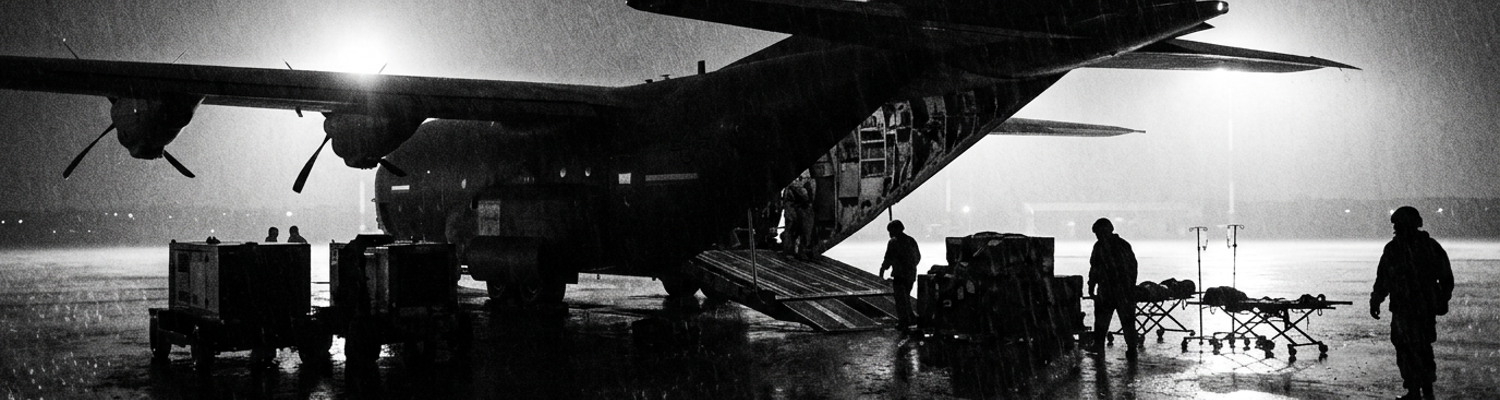

The Beirut Barracks Bombing and Airlift Mobilization
Sixteen-inch high-capacity artillery shells sat aboard the battleship USS New Jersey off the Lebanese coast. Five-inch naval gun mounts and TOW wire-guided anti-tank missile batteries lined the shore. M198 155mm howitzers were emplaced on coastal sand. Tens of thousands of 5.56mm and 7.62mm rounds sat stored in aluminum supply containers. The United States entered the Lebanese Civil War with the heavy inventory of an industrialized military power prepared for conventional surface fire.
Facing this array of firepower stood a single nineteen-thousand-pound explosive package.
It was assembled in the Bekaa Valley. The explosive was loaded into a civilian Mercedes-Benz stake-bed truck and directed toward a four-story aviation administration building at Beirut International Airport.
The balance of force collapsed in under ten seconds.
Archival evidence shows that on October 23, 1983, at 0622 local time, the modified truck crossed the public parking area. It breached a five-foot concertina wire barrier. The vehicle accelerated between two security guard posts. Sentries from the 24th Marine Amphibious Unit operated under strict rules of engagement set by higher command. Rifles carried condition four. Magazines remained in pouches. Chambers were clear. A Marine sentry inserted a magazine and chambered a round into his M16A1. The truck had already broken through the perimeter fence. It bypassed the pipe barriers. The vehicle entered the open lobby of the Battalion Landing Team 1/8 headquarters.
The driver detonated an explosive core wrapped in gas cylinders.
Upward shockwaves severed the main structural columns. All four floors of pre-stressed concrete pancaked downward onto sleeping troops. Rescue teams began cutting through the debris. The casualty count reached 241 American servicemembers. This comprised 220 Marines, 18 Navy sailors, and three Army soldiers. Another 128 wounded personnel lay beneath tons of pulverized masonry.
Washington received the casualty report while hundreds remained trapped beneath collapsed slabs.
A close review of operational logs indicates that the Pentagon bypassed standard theater communication steps within minutes. They alerted Military Airlift Command to begin an immediate mass casualty extraction. Headquarters for the 322nd Airlift Division at Ramstein Air Base in West Germany scrambled C-141B Starlifters. These belonged to the 435th Tactical Airlift Wing based at Rhein-Main Air Base. Ground personnel stripped the transport aircraft of standard freight rollers. They installed vertical litter stanchions. Supplemental oxygen distribution bottles and mobile intensive-care pallets were loaded aboard. Crews pushed four Pratt and Whitney TF33 turbofans to maximum continuous thrust across Mediterranean transit corridors.
They entered Lebanese airspace where militia positions held mortar batteries within direct observation of the runway.
Medical technicians and flight nurses from the 2nd Aeromedical Evacuation Squadron stabilized blast-lung trauma. They treated blunt abdominal injuries and burn shock directly on the aircraft ramp. Artillery exchanges broke out along the airport perimeter. Airframes climbed out of Beirut International Airport into high-altitude corridors. Surviving casualties were redirected to Landstuhl Army Medical Center and the hospital facilities at RAF Akrotiri. Diplomatic channels in Washington had not yet formulated an official response.
The first transport cleared Lebanese airspace with forty-four critically injured men undergoing emergency surgical interventions at twenty-eight thousand feet.
Stratospheric Flight Conditions and High-Altitude Triage
Pilot crews pushed the throttles of four Pratt and Whitney TF33-P-7 turbofans immediately after clearing the Lebanese shoreline. They climbed away from ground fire toward the lower boundary of the stratosphere. C-141B transports reached cruise altitudes of 39,000 feet across the Mediterranean. Outside air temperatures dropped to minus 58 degrees Celsius. At flight level 390, the thin atmosphere stripped away the heavy turbulence of the Levantine coast. It introduced severe thermal and mechanical stresses to the uninsulated cargo bays.
Cold air penetrated the aluminum skin within minutes.
Engine bleed-air systems diverted superheated compressed air across pneumatic ducts. This fought the rapid heat loss through the aluminum alloy hull. Moisture from the breath and exposed body cavities of dozens of wounded Marines condensed. Thick frost formed along the interior structural ribs. Flight engineers monitored cabin differential pressure gauges continuously. They locked the internal environment to an equivalent atmospheric height of approximately six thousand feet. Any loss of pneumatic integrity risked rapid decompression. This would instantly expand trapped air pockets inside the bodies of patients suffering from blast-induced barotrauma.
Within this freezing cabin, aeromedical teams from the 9th Aeromedical Evacuation Squadron conducted mass-casualty triage.
They treated severe blast polytrauma and traumatic amputations. Medical personnel had to negotiate narrow center aisles lined with four tiers of webbed aluminum litter racks. They stepped over drainage tubing and blood-soaked field dressings. Battery packs for portable suction units cluttered the floor. Blast waves had driven pulverized limestone deep into muscle tissue. Glass shards and jagged rebar produced open compound fractures alongside complete limb avulsions. Flight nurses worked down the tiers with surgical shears to cut away dust-caked utility uniforms.
They used manual palpation to detect internal abdominal bleeding under the dull hum of the engines.
Tourniquets applied on the tarmac at Beirut required reassessment. Technicians evaluated vascular viability against the risk of ischemic necrosis. Atmospheric expansion increased arterial bleeding. Technicians repeatedly readjusted hemcon dressings and clamp placements on severed femoral and brachial arteries. They hung intravenous units of whole blood and Ringers lactate.
When examining the historical record, the primary physiological threat came from the expansion of trapped gases under reduced atmospheric pressure.
Blast-lung injuries sustained inside the collapsed concrete barracks had seeded microscopic alveolar tears throughout dozens of lungs. At thirty-nine thousand feet, trapped gas pockets expanded by more than thirty percent. Unvented simple pneumothoraxes rapidly converted into fatal tension pneumothoraxes. This shifted mediastinal structures and compressed the inferior vena cava. Aeromedical technicians identified falling oxygen saturation levels with handheld pulse oximeters. They inserted large-bore chest tubes and Heimlich flutter valves directly into the pleural spaces of convulsing patients. Traumatic amputees presented severe phantom limb pain and hypovolemic shock. They required continuous manual ventilation when battery-powered mechanical ventilators depleted their charges in the cold cargo hold.
Medical crews exhausted their primary supply of morphine before crossing the Ionian Sea.
Bleed-Air System Failures in Uninsulated Cargo Holds
Trouble began inside the primary bleed-air ducting of airframe 65-0243 thirty minutes northwest of Crete. Engine bleed air was extracted from the high-pressure compressor stages of the Pratt and Whitney TF33 turbofans at over four hundred degrees Celsius. It was designed to route through precooler heat exchangers and dual flow-control valves to warm the fuselage. Ground crews had stripped out the standard fiberglass acoustic and thermal insulation blankets along the interior frames at Rhein-Main Air Base. This maximized vertical clearance for four-tier litter stanchions.
Dual air cycle machines suffered pneumatic regulator jams under continuous high-altitude load at flight level 350.
Hot bleed flow dropped by sixty percent. Ambient sub-zero air rushing across uninsulated aluminum skins overwhelmed the remaining heating output. Cargo bay temperatures plummeted from twenty degrees Celsius to below freezing in twenty-five minutes.
Frost formed across the ceiling structural ribs.
A close review of operational logs indicates that the flight engineer attempted manual override procedures on the manifold pressure regulators. The aircraft crossed the Ionian Sea toward the Italian coastline. Cold drafts penetrated the paratroop door seals. Floor-level temperatures dropped to minus twelve degrees Celsius. The lowest tiers of wounded Marines lay strapped to canvas litters in this zone. Flight crews could not descend into warmer air over the Mediterranean without burning through reserve aviation fuel required to reach West Germany. Lower altitudes presented severe storm turbulence. This risked tearing open emergency vascular repairs.
Flight deck personnel directed electrical power exclusively toward cockpit instruments.
They prioritized windshield anti-icing and pitot heat. Non-essential cabin utility buses were shut down to keep primary flight control hydraulics functioning. Aeromedical technicians from the 2nd Aeromedical Evacuation Squadron suddenly faced the freezing of their life-support supplies. Plastic bags containing normal saline and whole blood turned to slush on their hanging stanchions. This blocked gravity-drip chambers. It caused mechanical infusion pumps to alarm continuously.
Flight nurses shoved cold intravenous bags into their own flight suits.
They pressed the plastic against their armpits and torsos. They used body heat to keep fluid moving into collapsed peripheral veins. Overhead fluorescent tubes flickered and died as auxiliary inverters overheated. Medical technicians inspected arterial tourniquets and puncture sites using angled military flashlights held between their teeth.
Frozen plastic intravenous tubing snapped under hand pressure.
Blast victims slipped into acute hypothermic shock as core body temperatures dropped below thirty-two degrees Celsius. Traumatic amputees lost the ability to form clots. Hypothermia inhibited platelet activation and paralyzed the coagulation cascade. Blast wounds that had stopped oozing on the Beirut runway bled freely through soaked cotton dressings. Flight personnel taped chemical heat packs directly over casualty femoral and axillary arteries. They layered wool survival blankets over aluminum space foil. Technicians removed their leather work gloves to palpate vanishing radial pulses. They lost sensation in their own fingertips as they carried out manual chest compressions on casualties. Cardiac conduction collapsed into ventricular fibrillation.
At 1140 coordinated universal time, three litters on the bottom tier registered zero detectable blood pressure.
Transit to West Germany and In-Flight Fatalities
Military Airlift Command navigators routed the heavily laden C-141B Starlifters through narrow air corridors. These extended across the central Mediterranean directly toward West Germany. Flight plans took airframes north of Sicily. They skirted the western flank of the Apennine Peninsula before crossing the southern border of West Germany along standard military transit route Amber 14. Planners at the United States European Command in Stuttgart directed every inbound casualty transport to Ramstein Air Base. Ground ambulances stood staged to transfer blast victims to Landstuhl Regional Medical Center.
Landstuhl operated as the 2nd General Hospital.
It possessed the only military surgical facility within two thousand miles equipped with advanced neurosurgical suites. It had specialized intensive care units capable of managing mass blast-lung polytrauma. Command posts bypassed military airfields in Italy and southern France. Those installations lacked the high-volume vascular repair teams required to treat dozens of arterial hemorrhages simultaneously. Flight crews held throttles steady across Swiss perimeter airspace. They raced against cabin heat loss as West German surgical teams prepared six operating theaters for around-the-clock emergency operations.
Two Marines stopped breathing over the Alps.
In-flight mortalities aboard the Starlifters exposed acute technical limitations in cold-weather military life-support systems. Medical equipment engineered for standard field hospitals failed completely when subjected to sub-zero temperatures inside the uninsulated transport holds. The mechanical bellows on Bird Mark 7 portable ventilators stiffened in the freezing cargo bays. Internal rubber diaphragms lost elasticity and cycled erratically. Cold thickened pulmonary secretions within endotracheal tubes. Solid mucus plugs formed. Flight nurses had to clear them using hand-cranked suction pumps after battery-operated units ceased functioning. Nickel-cadmium battery packs powering electrocardiogram monitors dropped forty percent of their operating voltage within thirty minutes of exposure to the freezing deck plates.
Portable blood warmers drew more current than the depleted secondary electrical bus could provide.
This tripped circuit breakers. Medical staff infused whole blood at near-freezing temperatures directly into central venous catheters. Cardiac conduction systems in shock-trauma patients could not endure the thermal drop. Myocardial hypothermia triggered irreversible ventricular fibrillation in three critically wounded Marines. Their core temperatures slid below twenty-nine degrees Celsius. Technicians attempted manual cardiac massage on metal litter racks.
Metal frames shook as the aircraft began its descent into the Rhineland-Palatinate.
Archival evidence shows these en route deaths triggered immediate panic inside the National Military Command Center in Washington. Encrypted teletype transmissions relayed to National Security Advisor Robert McFarlane and Secretary of Defense Caspar Weinberger. They showed that blast survivors were perishing from equipment failures inside the unheated fuselage of front-line military cargo aircraft. The aeromedical system had broken down under the demands of a high-altitude intercontinental transit corridor. Senior Pentagon officials realized within hours that the armed services possessed no certified thermal life-support system capable of keeping shock patients alive during transcontinental winter transit.
The first transport dropped through low clouds over Kaiserslautern.
It touched down on Runway 27 at Ramstein at 1448 coordinated universal time. It carried four deceased servicemembers alongside forty survivors requiring immediate surgical intervention.
Cabinet Affairs Inquiries and Interagency Repercussions
Declassified Cabinet Affairs weekly reports compiled inside the West Wing documented acute friction by October 25, 1983. This occurred between White House staff led by Assistant to the President Craig Fuller and Secretary of Defense Caspar Weinberger. Fuller used the Cabinet Affairs reporting apparatus to press the Department of Defense for detailed accountability. He demanded to know why wounded personnel were flown into sub-zero stratospheric corridors without operational heating systems. Weinberger pushed back against civilian inquiries from the Executive Office of the President. He treated internal White House probes as political second-guessing of military autonomy during active combat operations.
Defense officials attempted to minimize the in-flight equipment breakdowns in Pentagon briefings.
Private memos routed to National Security Advisor Robert McFarlane framed hypothermia-induced cardiac arrests as unavoidable combat trauma. Fuller escalated the issue directly to senior presidential advisers. He pointed out that initial Pentagon damage-control statements conflicted with incoming medical summaries teletyped from Landstuhl Regional Medical Center. The Office of Cabinet Affairs demanded immediate explanations. They asked why Military Airlift Command transports had departed Ramstein stripped of insulation panels. They questioned who authorized the conversion of unheated cargo spaces for mass trauma cases. They demanded to know why the Joint Chiefs of Staff had failed to coordinate theater evacuation assets with naval task forces anchored off the Lebanese coast.
Paperwork circulating through the West Wing exposed an open administrative rift within seventy-two hours of the bombing.
The administration confronted severe political fallout over the complete absence of unified joint triage protocols and aeromedical airlift preparation across the services. Congressional leaders and White House investigators discovered a massive structural gap. The United States Central Command, the United States European Command, and the Department of the Navy shared no standardized doctrine for managing mass blast casualties between different military branches. The 24th Marine Amphibious Unit operated under maritime medical guidelines. They assumed emergency surgery would occur aboard amphibious assault ships such as the USS Iwo Jima anchored three miles offshore.
The scale of blast-lung trauma overwhelmed naval sickbays within forty-five minutes of the explosion.
Commanders had no joint procedural bridge to transfer Marine patients onto Air Force C-141B airframes managed by the 322nd Airlift Division. Field corpsmen used naval casualty classification tags. Air Force flight surgeons could not interpret these tags under low red cabin lighting. This resulted in critical delays when re-evaluating chest tubes and tourniquets on the ramp at Beirut International Airport. Blood inventory banks between the Navy and Air Force utilized non-interchangeable cold-storage transport containers. They used disparate transfusion tracking forms. Flight nurses had to improvise cross-matching data while climbing over the Mediterranean.
Joint operations existed only on paper.
This doctrinal failure quickly shifted from an interagency feud into a full congressional liability for the White House. House Armed Services Committee members initiated formal inquiries into military aeromedical preparedness. They focused on why the Air Force possessed no specialized thermal heating blankets or cold-weather medical shelters certified for high-altitude mass extraction. Weinberger refused to yield authority to West Wing inquiries. He resisted interagency oversight even as the Long Commission began interviewing ground officers regarding theater command breakdowns.
Navy medical directors acknowledged a severe training deficit to investigators.
The fleet had never conducted a joint mass-casualty airlift drill with Military Airlift Command in the European theater prior to October 1983. Autopsy files from the Armed Forces Institute of Pathology confirmed that freezing temperatures at flight level 350 directly inhibited blood coagulation in blast survivors. This turned treatable soft-tissue wounds into fatal hemorrhages during flight. The Pentagon restricted the release of these autopsy protocols to civilian oversight panels. They locked the initial medical after-action assessments inside classified Joint Staff channels at the National Military Command Center.