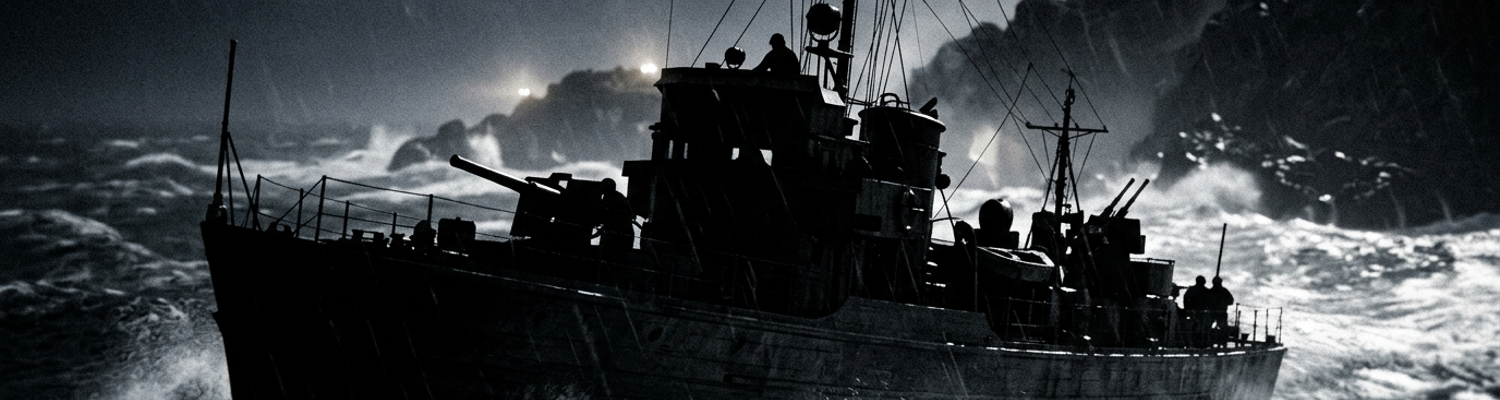

Amphibious Doctrine versus Karst Realities
Radio log entry, liaison monitoring station, 0342 hours.
Red Flight lead craft flooded.
Propeller shafts stripped against submerged stone reefs.
Five personnel in water.
Heavy machine gun fire sweeping grid square six-four-one.
A close review of operational logs indicates that the tactical framework issued to the United States Navy Scouts and Raiders assumed conditions that did not exist in the Velebit Channel. Fleet landing manuals composed at Fort Pierce, Florida, detailed beach assaults across uniform Atlantic sandbars. Breakers dispersed predictably over soft ocean floors in those training environments. The northern Adriatic coastline presented the opposite geological profile. Archival evidence shows that the Velebit mountain massif drops directly into deep water. The rock face terminates not in sand bars but in submerged limestone pavements. Calcified fissures and razor-sharp karst outcrops known as lapies tear through rubber hulls. Hydrographic charts distributed to operational commanders failed to plot these submerged pinnacle rocks. The hazards lay hidden inches beneath the surface of the freezing northern littoral. Cold Adriatic currents constantly shifted water levels against the cliff walls. The soundings published in manual tables proved completely inaccurate.
Standard naval training prepared crews for surf lines on sandbars rather than jagged geological fault lines.
Allied planning mandated a covert insertion of motorized ten-man Landing Craft Rubber Large units along these uncharted northern shoals in December 1944. Mission plans assigned seven specialized rubber boats to transport assault teams across several miles of open water during night maneuvers. Mechanics fitted the craft with twenty-two-horsepower Johnson outboard engines. Freezing bora winds descended from the coastal mountain passes at speeds exceeding forty knots. The gales drove water spray over the low gunwales. Salt encrustation coated the ignition systems. Engine housings cracked when exposed to rapid thermal shocks between cold air and internal engine friction. The shallow karst shoals sliced clean through the multi-ply vulcanized neoprene hulls within seconds of contact. Outboard drive shafts snapped off entirely as propellers struck hidden limestone shelves. Heavily laden assault teams drifted into freezing surf with dead power plants.
Rubber sponsons deflated instantly when dragged across the underwater rock shelves.
The purpose of this winter assault centered on destroying fortified German coastal observation outposts anchored along the Dalmatian littoral. Wehrmacht personnel from the 264th Infantry Division and the Kriegsmarine established hardened monitoring positions in natural caverns hollowed out of the limestone cliffs. These coastal outposts maintained searchlights, optical rangefinders, and telemetry stations. The equipment tracked Allied supply schooners slipping through the Pag sound to supply Yugoslav partisans. Heavy MG-42 machine guns and twenty-millimeter anti-aircraft guns stood mounted in pre-sighted firing slits. The weapons blanketed the narrow maritime channel with interlocking fields of flat-trajectory fire. The assault teams received orders to land silently below these gun positions. Operators planned to scale the vertical rock faces with rope ladders and eliminate the observation crews with satchel charges.
The cliff faces offered zero concealment from the searchlights.
Dawn illuminated the aftermath inside the oil-slicked support boat where surviving personnel gathered for liaison debriefing. The interior reeked of spilled diesel fuel, scorched cordite, wet sheep wool blankets, and decomposing shoreline kelp scraped up by punctured boots. A liaison naval aviator sat behind a portable Remington typewriter. He listened to survivors report the loss of three boats and two operators dead of hypothermia. Operators with gray, frostbitten fingers watched ink smudge against damp paper. Operational amendments were typed directly onto salt-caked casualty rosters. The liaison officer noted the serial numbers of four destroyed Johnson outboards on naval inventory form NAVSANDA 105. He stowed the remaining field charts into water-damaged canvas bags.
The debriefing concluded at 0615 hours.
German Coastal Defenses in the Adriatic Coastland
Archival evidence shows that coastal observation along the jagged littoral fell under the direct authority of the Higher SS and Police Leader in the Operational Zone of the Adriatic Coastland. SS-Obergruppenfuehrer Odilo Globocnik commanded the sector. Command directives funneled detachments from SS-Polizei-Regiment 15 and specialized security battalions into isolated stone outposts. These positions sat wedged between the Velebit crags and the water line. Police units occupied masonry watchtowers originally built by Austro-Hungarian border guards during the nineteenth century at sector stations near Jablanac, Lukovo Sugarje, and Karlobag. Globocnik stationed mixed detachments of German police non-commissioned officers and conscripted Volksdeutsche guards along the barren karst shelves rather than relying on regular army infantry. Personnel endured sub-zero bora gales while scanning the maritime approaches. They used heavy ten-by-eighty Zeiss binocular mounts bolted to stone parapets. Lookouts logged wave patterns, wind direction, and sightings of partisan watercraft crossing the Pag channel every thirty minutes. They recorded the data into logbooks bound in waxcloth. Rations arrived late. Outpost squads supplemented hardtack with salted goat meat traded from nearby mountain hamlets.
The limestone cliffs offered no natural water sources for the isolated observation crews.
German combat engineers blasted reinforced concrete pillboxes directly into the karst faces to anchor these surveillance positions against Allied naval gun strikes. Thick steel embrasures housed twin MG-42 machine guns zeroed over narrow littoral corridors. Observation slits permitted continuous optical tracking of Allied motor torpedo boats and partisan supply trabaccolos slipping out of the island of Vis. Steel-sheathed field telephone lines ran back from these cliffside pillboxes. Engineers buried the cables in shallow trenches hacked out of raw dolomite rock with pickaxes. Other lines hung suspended along low wooden poles secured with wire guys against winter storms. Crews used battery-powered blinker lights to transmit coded Morse pulses across the water to secondary batteries stationed on the island of Pag when bora winds snapped aerial wires. These interconnected surveillance points coordinated artillery fire from coastal batteries armed with captured Italian 149-millimeter guns. The artillery blanketed the sea lanes whenever partisan schooners attempted to drop arms for inland guerrilla units. Blast walls protected internal ammunition lockers from concussive impacts caused by offshore rocket fire.
Field telephone lines shorted out whenever freezing sea spray penetrated the junction boxes.
Administrative distribution of personnel detailed in SS-Polizei muster rolls and regional defense rosters reveals severe structural strain throughout the winter of 1944. A close review of operational logs indicates that regional defense rosters for the Senj-Karlobag defense sub-sector listed an authorized complement of forty-eight men per coastal strongpoint. Actual morning reports logged fewer than twenty-two fit for duty. Muster rolls compiled by SS-Polizei garrison headquarters at Trieste cataloged chronic equipment deficiencies. Squads manned their perimeter trenches with an ad-hoc mix of standard German Kar 98k carbines, aging Italian Carcano rifles, and captured French Hotchkiss machine guns. Ammunition reserves remained low. Roster notations recorded high rates of trench foot and gastrointestinal illness from fouled cistern water. Blast injuries suffered during sudden partisan mortar harassments filled the medical logs. Operational command dispersed these skeleton detachments across two hundred kilometers of shoreline. Isolated three-man listening posts depended entirely on weekly motor launch deliveries of bread, canned pork fat, and 7.92-millimeter ammunition crates.
Delivery boats frequently ran aground on uncharted shoals before unloading their cargo.
The garrison ate salted goat meat for three weeks straight.
Katabatic Bora Gales and Maritime Dispersion
Regional weather detachments stationed on the island of Vis failed to detect the barometric drop gathering over the interior Dinaric Alps on the night of the insertion. Dense, freezing air pooled across the elevated Lika plateau. The air mass found an escape route through mountain gaps such as the Vratnik Pass seven hundred meters above the coastline. Gravity drove this arctic mass straight down the bare, treeless limestone faces of the Velebit range. The geological funnel produced an unforecast katabatic bora that hit the open channel without environmental warning. Wind velocities crossed forty knots within eight minutes of the initial gusts. The gales eventually peaked well past sixty knots against the water surface. Falling air masses tore the crests off incoming swells. The wind whipped the sea into horizontal sheets of blinding salt drift that reduced visibility to less than five yards. The ambient temperature dropped abruptly to minus nine degrees Celsius. Ropes, canvas deck fittings, and the wool watch caps worn by the boat teams froze rigid within minutes under continuous coatings of sea spray.
Pre-mission weather forecasts had predicted calm seas and a four-knot offshore drift.
A close review of operational logs indicates that the sudden wall of wind caught the seven rubber craft three miles outside their designated disembarkation lanes. Steep, short-period chop repeatedly broke over the blunt forward sponsons of the ten-man Landing Craft Rubber Large units. Hundreds of gallons of freezing water filled each hull. The crafts sterns sank lower into the water column. The twenty-two-horsepower Johnson outboards submerged. Carburetors drenched. Ignition sparks failed. The crews bailed furiously using cut-down fuel tins and steel M1 helmets. Water poured into the hulls faster than muscle could remove it. Waterproof vulcanized rubber bags containing the tactical communications suites suffered structural failures against equipment cleats during the violent tossing. Saltwater penetrated the casing seals of the unit SCR-300 backpack transceivers and individual BC-611 handie-talkies. Corrosive liquid bridged the terminal contacts of the BA-70 and BA-38 dry batteries. The resulting electrical shorts melted internal wiring harnesses and shattered delicate radio tubes.
Operational control ceased instantly as the channel net went dead.
The gale scattered the surviving watercraft across ten miles of unmapped coastline between the fishing hamlet of Cesarica and the Lukovo inlet. Drifting powerlessly without steering, several rubber boats slammed directly onto partially submerged karst benches. Razor-sharp lapies tore through the fabric bladders. Surviving operators crawled into wave-cut limestone clefts along the waterline to escape the freezing wind. These narrow geological fissures provided cover from heavy machine gun bursts fired blindly from German observation towers atop the bluffs. They offered no protection against the rising tide. Icy water continually surged through the rock openings. The swells submerged the men to their chests and froze their wool trousers against their skin. Operators wedged fighting knives into stone crevices to prevent the backwash from dragging them back into the surf. Severe peripheral frostbite set in quickly. Feet deadened. Fingers turned waxy white. The men endured eight continuous hours of exposure on the wet stone shelves.
Body temperatures among the isolated operators dropped below thirty-three degrees Celsius by five in the morning.
Several men lost consciousness against the rocks.
Joint OSS Maritime Unit Shoreline Operations
Archival evidence shows that field integration between the US Navy Scouts and Raiders and OSS Maritime Unit personnel relied on an ad-hoc division of labor finalized at advanced boat bases on the island of Vis. Navy personnel from Eighth Amphibious Force Detachment 2 supplied high-speed boat-handling expertise, beachhead hydrographic surveying, and coxswain skills for piloting rubber craft through breaking surf. Operatives from the OSS Maritime Unit Adriatic branch provided language officers, silenced weaponry, and specialized intelligence kits designed to map Axis shoreline defenses for British Land Forces Adriatic. Inter-service friction surfaced immediately over tactical command hierarchy. Naval doctrine dictated that the ranking naval coxswain maintained mission authority until assault troops crossed high water. OSS operational guidelines granted civilian intelligence field leads total autonomy once boots hit foreign soil. Joint teams compromised by assigning Scouts and Raiders primary authority over offshore approach routes and surf navigation. OSS operatives directed shore reconnaissance, partisan contacts, and target prioritization along the Velebit shelf. Specialized equipment arrived in mismatched batches. Navy swimmers shared Lambertsen Amphibious Respiratory Units with OSS divers who possessed zero formal military beach-reconnaissance credentials.
Jurisdiction ended where the surf hit stone.
A close review of operational logs indicates that the total breakdown of tactical radios forced reconnaissance teams to abandon modern coordination protocols entirely. Operators fell back on mechanical signaling routines established before departure from Vis once seawater breached the battery compartments of the SCR-300 transceivers. Reconnaissance teams threaded five-hundred-foot lengths of dark green cotton parachute cord through eyelets along the karst ledges. This established a physical communications spine between water-edge swim teams and inland security watches. Two distinct tugs signaled incoming coastal patrols. Three tugs ordered immediate emergency exfiltration to secondary extraction coves. Swim scouts used brass clickers and waterproof Angle-Head flashlights fitted with slotted red lenses when distance made cord lines impossible. They flashed Morse characters in three-second pulses shielded within natural stone clefts. Swim scouts logged water depths, tidal shifts, and German pillbox coordinates with grease pencils directly onto matte white vinyl strips strapped across their left forearms.
Dead vacuum tubes transformed electronic doctrine into hand signals.
Shoreline reconnaissance teams collided with roving security patrols from SS-Polizei-Regiment 15 within twenty minutes of reaching the rock terrace at Cesarica. Outpost garrisons supplemented regular sentry sweeps by stationing two-man patrols armed with German Kar 98k rifles and Italian Beretta Model 38 submachine guns along coastal sheep paths. German non-commissioned officers handled trained guard dogs. They led German Shepherds along the shelf to sniff out partisan landing sites in the gale. Two Scouts and Raiders operators crawled through a gravel-filled limestone wash. They came face-to-face with an SS-Polizei guard walking the lower terrace above the surf line. A sudden burst from an OSS operator suppressed Sten Mk II eliminated the lead German sentry at three paces before the guard could chamber a round. A second sentry fired two 9-millimeter rounds into the dark. The bullets struck limestone slabs six inches above a submerged Navy scout. An M3 submachine gun burst dropped the second sentry into the freezing tide. The short firefight echoed off the sheer cliff faces. German lookouts atop the Cesarica watchtower fired white parachute flares into the channel and swept the surf zone with 7.92-millimeter MG-42 fire.
The team crawled backward into the freezing surf.
They hauled two wounded men across sixty yards of submerged limestone before reaching the extraction skiff.
Post-Extraction Cataloging of Captured German Intelligence
A close review of operational logs indicates that the extraction coordinated out of Vis relied on two 110-foot wooden-hulled submarine chasers. SC-1029 and SC-1033 operated alongside an armed 63-foot aircraft rescue boat. Shipwrights built the vessels of Douglas fir and white oak to evade magnetic mine detection. These vessels kept their twin General Motors 6-71 diesel power plants throttled down to three knots to deaden engine thrum across the black water. Lookouts on the forward deck scanned the foam line using infrared filter glasses. They watched for blinker signals from the rocks near Lukovo Sugarje. Crews threw heavy manila scram nets over the low wooden freeboard when the extraction skiff drifted alongside at 0514 hours. Sailors hauled nine soaking Scouts and Raiders operators straight up the side. They dropped the men onto the spray-slick deck before cutting the swamped rubber craft adrift with rigging axes. Wounded men stripped off frozen rubber suits inside the cramped crew quarters below. Corpsmen treated second-degree frostbite on sixteen bare feet. Bilge water mixed with the smell of scorched wool blankets, raw diesel, and vomit. The sub-chaser reversed screw and headed south-southwest toward the partisan-held harbor at Komiza.
Limestone dust coated the wet wooden planking.
Administrative inventory began immediately inside the boat ten-by-eight-foot forward chart space. A liaison naval aviator cleared the plotting board of navigation charts. He laid out two captured green canvas courier bags recovered from the dead SS-Polizei sentry. Saltwater had seeped through the canvas flaps. The brine soaked forty-eight pages of personnel muster rolls from the II. Battalion of SS-Polizei-Regiment 15 alongside three cloth-bound radio cipher ledgers. The liaison officer used wooden clothes pins to string the warped paper folios along an overhead copper heater pipe to dry before the purple ink ran into illegibility. Surviving pages cataloged the names, blood types, pay grades, and weapon serial numbers of eighty-four German police troops and Croatian auxiliary conscripts manning strongpoints between Karlobag and Jablanac. Two code sheets contained daily double-transposition key tables used by the German coastal surveillance net. The outposts used these tables to encrypt maritime movement reports before transmission to Globocnik headquarters in Trieste. The aviator worked with a dull graphite pencil. He assigned a seven-digit capture tag to each document and transcribed the German call signs onto standard Eighth Fleet Intelligence memo slips.
The cipher keys expired at midnight.
The captured paperwork traveled across the Adriatic within thirty-six hours of docking at Vis. An OSS courier aircraft flew the dried ledgers from the staging airfield at Komiza across the open sea to Bari, Italy. The pilot delivered the packets directly to Allied Force Headquarters G-2 section for exploitation. Military intelligence teams extracted tactical frequency charts and garrison strengths before forwarding the original folders to the Document Center in Caserta. Naval intelligence clerks boxed the collection alongside thousands of captured German administrative files after the cessation of hostilities in May 1945. They shipped the physical crates to Alexandria, Virginia. Technicians working under the Department of the Army captured records program cataloged the bundles into National Archives Record Group 242. Staff microfilmed the original salt-stained pages under Microfilm Publication T-175. The records remain preserved within the collected files of the Reich Leader of the SS and Chief of the German Police on Roll 281, frame 2741108.
The microfilm captures the water damage perfectly.
Page edges show heavy salt crystallization.
Doctrinal Revisions for Cold-Weather Littoral Raids
Post-mission debriefings commenced inside the engine-warmed wardroom of SC-1029 before the recovery ship cleared the southern mouth of the Velebit Channel. Two naval liaison officers balanced portable Corona typewriters on damp mess benches. They processed surviving scouts on Eighth Fleet Tactical Debriefing Form 14-A and standard medical casualty sheets. Saltwater dripped from sodden wool uniforms. The liquid pooled across the linoleum deck and turned the mimeographed questionnaire sheets into pulp. Officers blotted running purple ribbon ink with dry grease pencils. Debriefers systematically charted physiological breakdowns against exact exposure durations. They logged core body temperatures, shivering cessation points, and skin discoloration markers across forty-minute intervals. Scouts detailed the precise minutes when their motor control vanished in four-degree water while crossing submerged karst shelves near Cesarica. Every lost piece of gear received an inventory notation. The logs recorded the exact water depth and coordinates where an operator jettisoned equipment to prevent drowning.
Ink ran across the waterlogged forms as hypothermic hands signed the logs.
Immediate technical evaluations uncovered extensive design flaws in the standard issue cold-weather gear distributed to Eighth Amphibious Force personnel. The issued N-1 deck suits and heavy wool field trousers absorbed sea spray immediately. The fabric trapped gallons of freezing water against the skin. The saturated clothing added thirty-five pounds of dead weight that dragged swimming scouts downward. Vulcanized rubber combat swim suits suffered adhesive degradation along glued leg seams when exposed to rapid thermal cycling between freezing mountain air and Adriatic salt water. Equipment evaluators cataloged total failures across the radios assigned to the landing teams. Standard neoprene compression gaskets fitted inside the casing lids of SCR-300 transceivers turned brittle under minus-nine-degree temperatures. The hardened seals allowed pressurized salt spray to bypass the moisture barriers. Adriatic brine pooled directly across the BA-70 battery compartments. The saltwater corroded terminal pins, short-circuited internal wiring bundles, and fractured delicate glass vacuum tubes before boats reached the surfline.
Rubber seals cracked under cold pressure.
Mediterranean amphibious commanders used these debriefing tallies to push through emergency amendments to regional assault manuals within forty-eight hours of the disaster. Task Force 86 operational staff stationed at Caserta issued Tactical Bulletin 44-B. The document revised the operational ceiling for small-boat insertions along mountainous coastlines. Staff officers barred ten-man Landing Craft Rubber Large craft from launching whenever local barometers logged a regional drop exceeding three millibars in three hours. Launches halted when coastal wind stations detected mountain pass gusts in excess of twenty knots. Doctrine completely prohibited deep-littoral night insertions without continuous radar tracking from an offshore destroyer escort or a wooden-hulled submarine chaser holding a station within fifteen hundred yards of the surf zone. Planners replaced soft vulcanized rubber transport packs with rigid, pressure-cast aluminum containers. Mechanics fitted these boxes with mechanical screw clamps and silicone O-rings to protect radio suites against high-velocity chop. Supply depots at Vis received orders to strip standard wool garments from scout inventories. Quartermasters replaced them with experimental closed-cell foam undergarments and drysuits equipped with vulcanized brass neck seals. Revised training schedules at the Fort Pierce amphibious center integrated mandatory cold-water immersion testing and rocky-shore night approaches into the scouts curriculum before shipping replacement units overseas.
The updated field orders reached Adriatic operational desks on January 4, 1945.
The Velebit Channel remained unnavigable for the rest of the winter.