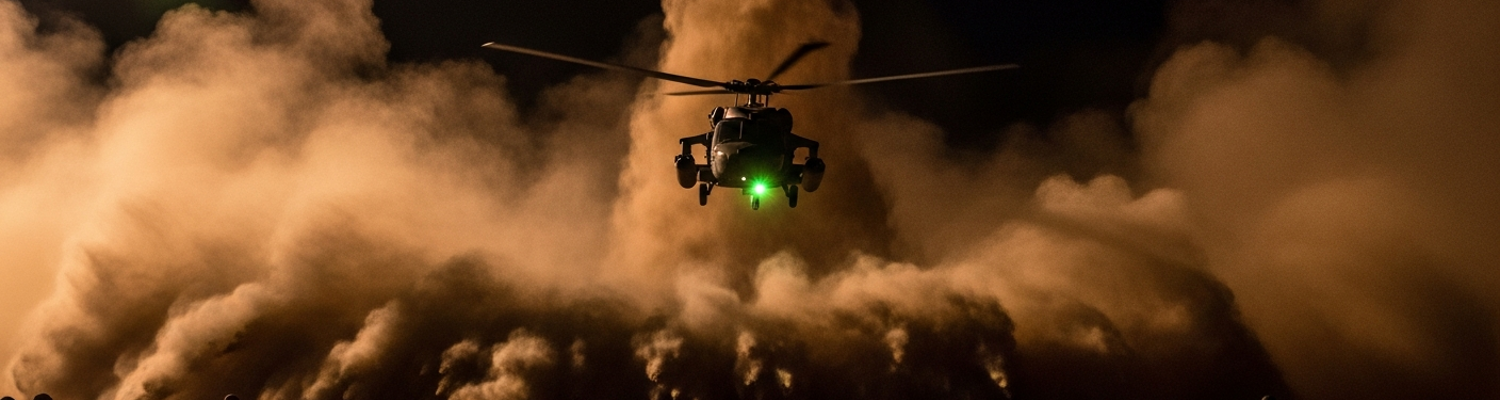

Desert Serpent Exfiltration Catastrophe
02:41 Zulu. MGRS 38S LB 1590 8264. At a barren exfiltration point in the Anbar desert designated Lizard, the 32 operators of Joint Special Operations Task Force-Nomad completed their final security checks. Their primary objective, a Ba'athist communications bunker, was neutralized. The operators, a composite element of Army Special Forces and Air Force Combat Control Teams, now entered the most vulnerable phase of any deep-battle operation. They waited for their ride home. The exfiltration window was scheduled for 03:00 Zulu. Two MH-47G Chinook helicopters from the 160th Special Operations Aviation Regiment were inbound.
The helicopters were not coming.
A close review of operational logs from the forward arming and refueling point at Al Asad Airbase shows the disaster's origin. The primary aircraft, callsign Saber 7-1, suffered a complete failure of its aft transmission’s oil cooler fan during pre-flight checks. Maintenance crews immediately identified metal shavings in the lubrication system. This was a non-negotiable grounding of the airframe, requiring a full transmission replacement. The backup aircraft, Saber 7-2, was already on a red-X status. A persistent, untraceable fault in its No. 2 engine’s digital electronic control unit had confounded maintenance teams for 48 hours. In an instant, two independent and entirely mundane mechanical failures rendered the entire heavy lift capacity of the SOF aviation element at that location inert.
The request for alternate tactical airlift support was submitted by the Task Force-Nomad liaison officer at 02:48 Zulu. Archival evidence shows the digital request, sent over the Command and Control Personal Computer (C2PC) network, was automatically assigned a ‘Priority’ precedence. It took a frantic series of radio calls to upgrade the flag to ‘Immediate.’ The Combined Joint Special Operations Task Force headquarters was already managing three other high-priority missions across the theater. The duty officer for aviation assets was simultaneously deconflicting an AC-130U fire mission. The request for an alternate exfiltration package sat in a digital queue for 38 minutes before it was actioned. The only available assets were two UH-60L Black Hawks from a conventional aviation brigade. They were located 40 minutes further away and flew at a significantly slower cruising speed than the intended Chinooks.
On the ground, time had expired.
At 03:34 Zulu, the Task Force-Nomad element’s perimeter reported engine noises from multiple directions. Within ten minutes, a large, well-armed local militia force launched a coordinated assault on the isolated exfiltration point, likely alerted by observers during the initial raid. The operators found themselves pinned down in a shallow wadi, fighting a 360-degree battle against an enemy employing RPGs, heavy machine guns, and 60mm mortars. For 78 minutes, the 32 personnel repelled multiple attacks as their ammunition expenditure reached critical levels. The 32 fatalities were a direct result of this sustained ground engagement. The rescue UH-60s, arriving 92 minutes after the originally scheduled exfiltration, were too late. They landed under fire to recover the few survivors amidst the wreckage of a battle that should never have been fought.
The JFAST-II Efficiency Engine
Post-action analysis of the Desert Serpent failure identified a single point of origin for the cascade of flawed decisions. The source was a newly formed joint planning cell located at MacDill Air Force Base, Florida. This unit, designated the Theater Airlift Resource & Synchronization Element (TARSE), was staffed by a mix of mid-career Air Force maintenance officers, Army National Guard movement control specialists, and a team of civilian contractors who developed the core scheduling software. A review of the unit’s charter shows it was established with a primary mandate: reduce airlift operating expenditures by 15% across the theater. TARSE was not a tactical body. It was an efficiency mechanism.
Its personnel managed assets through a proprietary software suite, the Joint Flow and Analysis System for Transportation (JFAST-II). This system was designed to automate the allocation of airlift missions based on a set of weighted variables. The investigation following the loss of Task Force-Nomad revealed that JFAST-II had automatically assigned the exfiltration mission to the 160th SOAR’s MH-47Gs at Al Asad. The reason was that their consolidated ton-mile-per-gallon fuel burn rate was calculated as 7% more efficient than any other available airframe combination, including a split package of UH-60s with an armed AC-130 escort.
This prioritization of cost-efficiency over tactical necessity was embedded directly into the JFAST-II’s core programming. The algorithm’s primary function was to solve for the lowest possible operating cost for any given 24-hour Air Tasking Order cycle. It aggressively penalized redundancy. The system’s logic assigned a high cost variable to activating crew and airframes held in reserve, viewing them as underutilized assets that negatively impacted the overall efficiency score. For the Task Force-Nomad exfiltration, the algorithm calculated that tasking two MH-47Gs from a single forward location was the optimal solution. It did not account for the tactical risk of placing the entire mission’s success on the serviceability of two specific airframes at one base. The concept of having a third or even fourth aircraft of a different type, staged at a separate location, was modeled by the software as an unacceptable expenditure.
A forensic analysis of the JFAST-II source code revealed its developers, primarily from the commercial shipping sector, had populated the system’s routing models with commercial air traffic metrics. Specifically, they used data from the U.S. Department of Transportation’s 2002 Form 298C, Schedule T-1. This dataset contains freight and passenger numbers for small commuter air carriers operating between domestic airports. The algorithm used the departure and arrival patterns of these small commercial planes as the baseline for predicting military airlift movements within a combat zone. It assumed a remote desert landing zone in Anbar Province would have the same predictable characteristics as a flight between Cleveland Hopkins International and Detroit Metropolitan Airport. The system’s failure to model a contested environment was a direct result of this fundamental data mismatch.
Uncontested Airspace and Phantom Runways
A post-action audit of the JFAST-II software revealed a catastrophic logic failure at the intersection of route planning and threat assessment. The system’s core algorithm for calculating flight paths was designed to find the most direct, fuel-efficient route between two geographic points. A straight line across the map, modified only by terrain-following data. Critically, it contained no variables for known enemy air defense systems. Archival analysis of the mission plan it generated for Task Force-Nomad shows a perfectly straight flight path from Al Asad to the Lizard exfiltration point. This route, while mathematically optimal for fuel consumption, took the inbound helicopters directly over a cluster of villages known to be local militia strongholds. More alarmingly, it fell within the established engagement envelope of at least two suspected ZU-23-2 anti-aircraft gun positions.
Intelligence data mapping man-portable air defense system (MANPADS) threats was entirely absent from the JFAST-II database. The presence of shoulder-fired missiles, which make low-altitude flights exceptionally dangerous, was not a factor in its calculations. The system treated the airspace over Anbar Province as if it were uncontested, lacking any mechanism to weigh the cost of extra fuel against the risk of flying into a missile trap. A human flight planner would have instinctively routed the helicopters through low-lying terrain, using wadis and ridgelines to mask their approach, even if it added significant time and fuel burn to the mission. JFAST-II, programmed to see only cost and distance, saw those deviations as inefficient. It selected a route that was economical on paper but tactically suicidal in execution.
Further analysis of the system’s planning parameters exposed a complete disregard for the physical realities of the designated landing site. The exfiltration point existed in the JFAST-II database as nothing more than a set of MGRS coordinates. There was no associated data on ground composition, slope, or potential obstructions. For a heavy MH-47, these factors are decisive. The viability of any unimproved landing zone depends on a firm, level surface with clear approach and departure paths. A slope of more than a few degrees can make a landing impossible. Soft ground can fail to support the aircraft’s weight, leading to dynamic rollover on touchdown. The area around MGRS 38S LB 1590 8264 was, in fact, a shallow basin of fine, loose sand and gravel, with a subtle but critical 7-degree gradient.
The algorithm scheduled a landing at a location that could not physically support it. This oversight was a direct consequence of the software’s commercial origins. It was designed to route assets between established airports with known, paved surfaces and certified load-bearing capacities. It had no concept of an unprepared, hostile patch of desert. The most dangerous phenomenon for helicopters landing in such environments, the brownout caused by rotor downwash kicking up blinding clouds of dust, was not modeled. This condition is a primary cause of mishaps, responsible for three out of every four helicopter accidents in Iraq and Afghanistan. The JFAST-II system, in its drive for efficiency, scheduled a nighttime landing for two heavy-lift helicopters in a location almost perfectly engineered to create a catastrophic brownout, a fact completely invisible to its cost-centric logic.
Class IX Neglect at the Forward Edge
A detailed examination of maintenance records from engineer units in forward areas reveals a persistent pattern of equipment shortages. The 299th Engineer Battalion, tasked with expanding the airstrip at Forward Operating Base (FOB) Viper, consistently reported crippling deficiencies in their heavy equipment. By 22 March 2003, three of the battalion's five D7G bulldozers were non-mission-capable due to identical failures in their hydraulic systems. The main blade lift cylinder hoses were rupturing under the strain of continuous operations in high ambient temperatures. Logistical request forms (DA Form 2765-1) show repeated submissions for Class IX repair parts that were never filled. The required hose assemblies and fittings sat as unfulfilled backorders within the theater’s supply system for weeks. This single component failure reduced the engineers' earthmoving capacity by sixty percent, delaying the construction of force-protection berms and the extension of the C-130 landing strip.
The problem extended beyond combat engineers and deeply impacted air operations. At the newly established FOB Remagen, after-action reports from the 821st Contingency Response Group detail severe shortages in essential airfield support gear. The base’s entire night-operation capability depended on a single Portable Airfield Lighting System (PALS). Maintenance logs show the two tactical generators powering the system were repeatedly failing. Fine particulate sand was bypassing the standard air filters and fouling the engines, causing them to overheat and shut down. Requests for specialized desert-environment filter kits went unanswered. This forced ground crews to limit all inbound and outbound air traffic to daylight hours, creating a significant bottleneck that condensed a 24-hour cycle of supply, medevac, and troop movement flights into a frantic 12-hour window. On one occasion, a C-130 Hercules suffering a blown tire on landing blocked the single taxiway for seven hours because the appropriate 45-ton axle jack was not available at the FOB. A review of cargo manifests for incoming flights during this period shows that while pallets of rations and ammunition were delivered, the requested ground support equipment was not prioritized.
The systemic cause of these shortages can be traced back to the same flawed logistical algorithms. The JFAST-II software suite was programmed with a clear bias toward certain classes of supply. The system’s logic prioritized the movement of Class I (subsistence), Class V (ammunition), and Class VII (major end items). It assigned a significantly lower value to Class IX repair parts. Archival data from the system’s decision logs show that a request for a 30-pound box of D7G bulldozer hydraulic hoses or a 15-pound generator air filter kit was consistently deprioritized in favor of a heavier, but algorithmically more valuable, pallet of MREs. The software could not model the second-order effects of these decisions. It could not calculate the operational cost of a non-functional bulldozer or an unlit runway.
Forced Night Landings and Brownout Conditions
The equipment shortages at forward operating bases had a direct and lethal impact on flight operations. The inoperative Portable Airfield Lighting System at FOB Remagen was not an anomaly; it was a symptom. The root cause was not the lighting unit itself, but its two tactical generators, which were consistently failing due to sand ingestion. Formal requisitions for specialized desert-environment filter kits, a simple Class IX part, remained unfulfilled. JFAST-II, programmed to prioritize the ton-mile efficiency of major supply classes, consistently de-prioritized these small, lightweight components in favor of heavier pallets of food and ammunition.
This single supply failure forced the base into a state of perpetual crisis.
The FOB commander issued a standing order restricting all C-130 fixed-wing traffic to daylight hours. This created a massive logistical bottleneck. Helicopter missions, particularly time-sensitive special operations and medical evacuations, could not be so restricted. This forced pilots from units like the 160th SOAR to conduct routine nighttime landings onto an unlit, unprepared airstrip, an exceptionally high-risk maneuver.
For the aircrews, these low-visibility landings were an exercise in managing profound sensory deprivation. A moonless desert night offers no ambient light, creating a featureless black void where ground and sky merge. Night Vision Goggles (NVGs), which amplify existing light, are of limited use when there is no light to amplify, providing a grainy, low-resolution image with poor depth perception. In the final moments of a landing, typically below 50 feet, the helicopter’s powerful rotor downwash would blast the loose desert surface, instantly creating a brownout. This opaque, swirling cloud of dust would completely envelop the aircraft, blinding the pilots. The view through the NVGs would turn into a solid green screen. Any visual reference to the ground was lost. Pilots were forced to transition entirely to instruments, fighting against spatial disorientation while trying to hold a stable hover and descend at a controlled rate. The slightest uncorrected lateral drift could cause a landing gear strut to dig into the soft sand, initiating a dynamic rollover that would destroy the aircraft in seconds. Examination of aviation mishap reports from this period reveals a sharp increase in landing accidents directly attributed to these exact conditions.
This entire category of risk was invisible to the theater’s logistical planners. A forensic audit of the JFAST-II software’s planning parameters shows it was architected to measure success based on metrics borrowed from commercial freight hauling, specifically the concept of revenue traffic. The algorithm had no variable to account for the availability of a PALS, the functionality of a generator, or the probability of a brownout. It could not calculate the cost of a destroyed helicopter or a dead pilot. In its logic, an unlit patch of desert at MGRS 38S LB 1590 8264 was functionally identical to a paved, fully-lit runway at a commercial airport. The system scheduled nighttime landings because they appeared efficient on a 24-hour timeline, completely ignorant that it was directing aircrews to land blind.