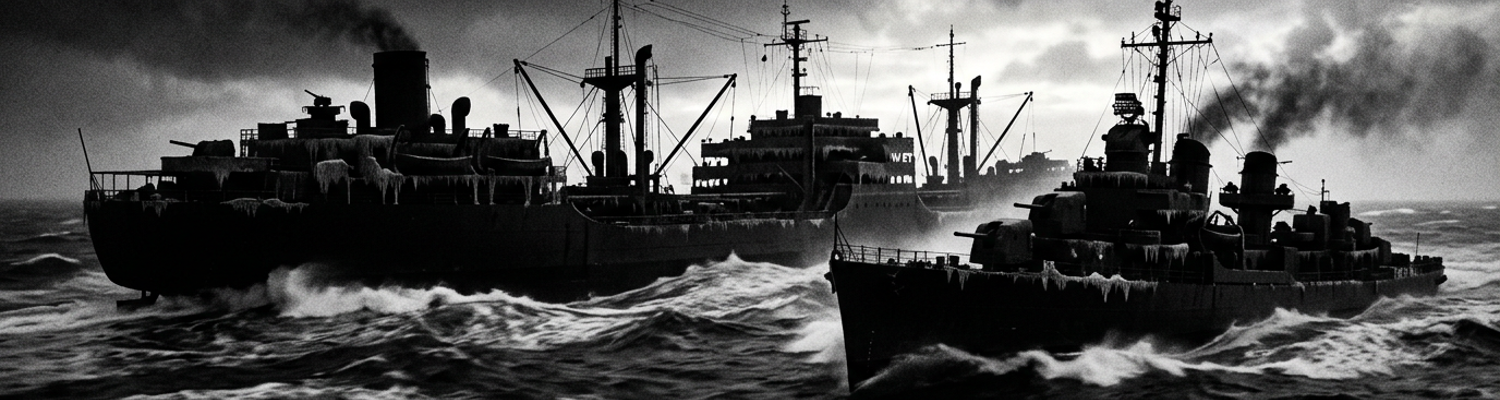

Subarctic Supply Depots and Fleet Malnutrition
At 0314 hours on March 9, the high-frequency radio link between Task Group 16.6 and Alaskan Sector headquarters at Kodiak went dead. Atmospheric ionization across the fifty-third parallel wiped out the transmitter signal on the light cruiser USS Richmond. This severed Rear Admiral Charles H. McMorris from North Pacific Force command. The four destroyers and two cruisers plunged into total electronic isolation in the subarctic swell. Snow squalls reduced visual signaling between the ships to absolute zero.
Isolation arrived without warning.
When examining the historical record, the supply chain supporting this isolated force had already collapsed thousands of miles to the south. Naval Supply Depot Puget Sound at Bremerton and commercial supply piers in Seattle struggled to fill cold-storage requisitions for the subarctic patrol vessels. Archival evidence shows that wartime fish quotas enacted under the War Production Board directed canned salmon and halibut toward Lend-Lease shipments for the Soviet Union. This directly delayed subsistence shipments destined for the Aleutians. Rail freight carrying beef carcasses from Midwestern packing plants sat stalled outside Seattle terminals for weeks. Priority track clearance was assigned to industrial materials bound for West Coast shipyards. Depot administrators attempted to offset frozen meat shortages by requisitioning regional civilian fish packs. Regional canning facilities operated under strict federal allocation limits that barred immediate diversion to naval storehouses. Transports such as the USS Bridge departed Puget Sound with reefer holds packed with rotting greens, salted cod, and dehydrated starch packs instead of balanced frozen protein rations. Depot workers loaded crates marked subsistence that contained only dried beans, spoiled salt pork, and hardtack.
The men ate cold canned beans and lard in wet darkness.
A close review of operational logs indicates that by mid-February 1943 severe physical deterioration among the 2,100 sailors of Task Group 16.6 crippled watch-standing efficiency across the squadron. Berthing compartments aboard the lead heavy cruiser USS Salt Lake City and the destroyers Bailey, Coghlan, Dale, and Monaghan registered temperatures of thirty-four degrees Fahrenheit. Fractured auxiliary steam lines failed to heat the lower decks. Ventilation intakes drew freezing saltwater spray straight onto crew bunks. Galley fires were secured across fifty-hour stretches in seventy-knot gales to prevent fat fires. Watchstanders went without hot food. Daily caloric intake dropped below 1,600 calories per man. This precipitated rapid physical decline, peripheral neuropathy, and hypothermia. Corpsmen on Richmond treated widespread gingival bleeding and skin lesions caused by scurvy. Frostbite claimed toes and fingers among lookouts stationed on exposed bridge wings. Men stood four-hour night watches in stiff canvas parkas. Their shivering was so violent that optical rangefinder readings fluctuated by hundreds of yards.
Weight loss aboard the destroyers averaged twenty-two pounds per sailor.
Supply manifests logged at Kuluk Bay on Adak Island in early March record that Salt Lake City held zero citrus fruit and less than three days of fresh meat. The forward base at Dutch Harbor could issue only emergency hardtack biscuits and weevil-damaged bulk flour stored in damp Quonset huts. Lookout personnel on Bailey wrapped their bare hands around exposed steam exhaust pipes between surface sweeps to prevent motor paralysis. Gun crews on Dale stood watch in sea boots filled with slush. Sixty-degree hull rolls spilled bilgewater into the ammunition handling flats. Mechanical condensation dripped constantly from cold steel bulkheads into the sailors bunk racks. Wool mattresses remained soaked in brackish water that smelled of fuel oil. Medical reports from March 18 registered twenty-eight sailors aboard the destroyer division totally incapacitated by acute respiratory failure and hypothermic shock.
Underway Replenishment Hazards in Sea State Six
Heavy seas broke over the forecastles at fifty-two degrees north.
A close review of operational logs indicates that Task Group 16.6 met its replenishment group south of the Komandorski patrol track under conditions classified as sea state six. Open-ocean swells averaged twenty-two feet from trough to crest. Maintaining a steady eight-knot heading into forty-five-knot westerly winds was required to prevent broaching. Holding that fixed course created severe vulnerability to Imperial Japanese Navy submarines. Archival evidence shows that Sixth Fleet boats patrolled the approaches south of Attu and Kiska. Submarines I-7 and I-9 sought to ambush American surface units during fueling operations. Screening destroyers Dale and Monaghan lost all effective underwater detection. Breaking seas and severe hull pitch drowned their QC sonar transducers in cavitation noise. Lookouts on Richmond and the destroyers stood wedged against bridge bulkheads. They swept designated sectors through salt-crusted binoculars to identify periscope plumes amidst miles of churning white water. Cutting the fuel lines or altering formation heading to counter an unconfirmed sonar contact risked ripping deck chocks directly out of the hull plating. Command was forced to hold the ships parallel across a gap of eighty feet while pumping Bunker C oil and hauling supply nets.
One errant wave trough could ram the hulls together.
When examining the historical record, severe deck-level mechanical failures occurred the moment sub-zero sea spray hit the forward forecastles. Air temperatures at fourteen degrees Fahrenheit froze salt water on contact. Every exposed fitting was encased in sheets of glaze ice. Steam winches on the destroyers locked up because internal condensate froze inside the cylinders. Cast-iron valve casings cracked when operators introduced auxiliary boiler steam to work the drums. Damage control parties battered the winch casings with five-pound copper mallets. They applied kerosene blowtorches directly to the cylinder heads to restore movement. Three-inch hemp messenger lines absorbed brine and froze into unyielding poles. The lines would not conform to fairleads or grip the warping heads. Deck hands attempting to handle the stiffened hemp ropes had the skin stripped from their fingers through wet wool mittens when the cordage slipped off the drum ends. The quick-release toggle pins on the heavy pelican hooks were installed to sever the tensioned steel span-wires instantly in a collision emergency. These pins froze immovably within their steel clevises under continuous sub-zero wash.
Sailors cleared the frozen pins with cold chisels to keep the manual releases operational.
Deck logs on Bailey record that while winching crates of bulk flour and replacement radio tubes across the highline from the supply ship a sudden thirty-degree roll parted the stiffened Manila riding whip. The suspended cargo net fell against the destroyer ice-covered hull plating. Ruined provisions dumped directly into the freezing surf. Hose crews on the heavy cruiser Salt Lake City struggled to steady the six-inch fueling line. The ship heaved through ten-foot vertical cycles that repeatedly pulled the suspended hose taut. Heavy oil pumped through the lines at four hundred gallons per minute. Ice accumulating on the suspension saddles forced the fuel line deep into the freezing ocean swells. The rig threatened to drag into the port screw.
Machinists on Coghlan logged a six-inch fracture along the forward fueling manifold at 1142 hours.
The USS Bailey Span-Wire Winch Seizure
A close review of operational logs indicates that the crisis began precisely at 1214 hours at geographic coordinates 52 degrees 18 minutes North, 174 degrees 22 minutes East. The destroyer USS Bailey steamed abreast the starboard quarter of the fleet oiler. Operating in thirty-foot swells, the destroyer maintained dynamic mooring using an automated American Engineering Company steam winch to govern a seven-eighths-inch steel span-wire. Salt spray at twelve degrees Fahrenheit saturated the winch assembly. Rapid ice accumulation formed across the drive mechanism. The twin-cylinder reciprocating steam engine driving the main drum suffered an instant mechanical lockup. Trapped condensate froze solid within the lower valve chests. The cast-iron eccentric rods sheared completely. Simultaneous thermal contraction caused the bronze friction brake shoes to seize immovably against the steel brake rim. Secondary spur gears stripped their teeth under the sudden thermal shock. The entire gear train jammed. Thirty fathoms of high-tensile wire locked into an unyielding tether between the heaving hulls.
The winch engine died under five hundred pounds of frozen internal pressure.
When examining the historical record, this mechanical failure immediately triggered an acute five-minute hydrodynamic trap between 1215 and 1219 hours. Both vessels were steaming at eight knots. They displaced thousands of tons of seawater through a restricted sixty-foot gap. The disparity in displacement accelerated the Venturi effect between the parallel hulls. Bailey displaced 1,620 tons against the oiler 16,000 tons. This created an asymmetric low-pressure trough. Inrushing ocean currents between the ships generated hydrodynamic suction that seized the destroyer forward quarter. The bow dragged inward toward the oiler midships frames. Normal underway replenishment protocol required the winch drum to veer line continuously to compensate for roll-induced lateral displacement. With the drum immobilized, the tensioned span-wire functioned as an unyielding haul line. This actively forced the inward yaw. Strain gauges on the oiler kingpost registered tension spiking past twenty-eight thousand pounds. The cable came within seconds of catastrophic failure.
Hull separation collapsed to twenty-two feet.
Disaster was averted by decisive bridge commands and manual destruction of the rig on the forecastle between 1217 and 1219 hours. Lieutenant Commander John C. Atkeson observed that Bailey rudder authority had completely dissolved under the combined forces of the suction and the frozen line. Atkeson ordered standard left twenty rudder while executing split-engine propulsion to break the suction. Engine room telegraphs rang for the starboard screw to back full. The port shaft drove ahead at fifteen knots. This attempted to twist the stern out of the trough. Forward on the glazed forecastle, Chief Boatswain Mate Walter Paskoski crawled across ice-coated deck plates. He carried an eight-pound sledgehammer and a cold chisel. Freezing subarctic wash had encased the pelican hook manual mousing wire and safety pin in solid rime. The remote trip toggle was rendered useless. Paskoski positioned the chisel directly against the retaining clevis bolt. He struck the frozen fitting three times in heavy surf. The steel fractured.
The severed span-wire whipped clear over the oiler catwalk at 1219 hours.
Deep paint scores marked Bailey starboard plating where the hulls missed each other by barely five feet.
Damage-Control Intervention on the Frozen Pawls
Clearing the frozen pawls required direct physical intervention under extreme environmental duress. The primary span-wire had been severed at the pelican hook, but the winch drum remained locked solid. The remaining lengths of wire rope trailed in the water, creating a severe fouling hazard for the starboard propeller shaft. The drum had to be freed to reel in the trailing hazard. The mechanical pawls designed to prevent reverse rotation of the drum were encased in three inches of solid ice. The pawl teeth were frozen firmly into the ratchet gear.
Damage control parties deployed from the forward repair locker at 1221 hours.
Archival evidence shows that Machinist Mate Second Class Thomas Vance led a three-man team onto the forecastle carrying high-pressure steam hoses. The hoses were connected directly to the auxiliary steam line running below the main deck. Vance directed a jet of superheated steam at three hundred degrees Fahrenheit directly onto the bronze pawl assemblies. The thermal shock caused the outer layers of ice to sublimate instantly into thick white vapor. The rapid temperature change threatened to crack the cast-iron housing of the winch. Vance had to pulse the steam jet in three-second bursts to prevent metallurgical failure. The ice melted away from the upper ratchet teeth, but the primary locking pawl remained seized in the engaged position. The internal pivot pin was rusted and frozen solid.
Chief Paskoski returned to the winch with his cold chisel.
Working in freezing spray that instantly turned the steam condensate back into ice, Paskoski wedged the steel chisel between the pawl base and the ratchet gear. He struck the chisel repeatedly with the sledgehammer. The physical impacts transferred kinetic energy through the frozen pivot pin. The rust and ice binding the mechanism began to micro-fracture. Vance applied another burst of superheated steam directly to the pivot joint. The combination of thermal expansion and mechanical shock finally broke the bond. The heavy bronze pawl snapped back into the disengaged position with a loud metallic crack. The drum was free to rotate.
Deck hands manually hauled the trailing wire aboard.
The entire evolution from the parting of the span-wire to the securing of the trailing hazard took exactly fourteen minutes. The physical toll on the damage control party was severe. Vance suffered second-degree thermal burns on his left forearm where a ruptured steam coupling leaked superheated vapor through his canvas parka. Paskoski lost feeling in both hands for three hours due to prolonged contact with the freezing steel tools. The forecastle deck plates were covered in a treacherous layer of fresh ice formed by the condensed steam. Sand and salt had to be spread across the deck to provide traction for the crew.
The ship was free to maneuver.
Tactical Preservation Ahead of Komandorski Islands
A close review of operational logs indicates that the five-minute breakaway sequence beginning at 1219 hours preserved the destroyer USS Bailey as an effective surface combatant. Following the parting of the high-tensile span-wire, Lieutenant Commander John C. Atkeson held the vessel on an emergency evasion course of 040 degrees true. Saltwater spray across the fantail threatened to freeze the exposed rudder head casing. The electro-hydraulic steering engine inside the aft steering compartment responded to bridge helm inputs without hydraulic pressure loss. Damage control parties immediately sounded all forward fuel bunkers and double-bottom voids along frames twenty through forty-six. The hull plating on the starboard side displayed heavy paint scouring and superficial indentation between frames thirty-two and thirty-eight. No structural seams split. Water ingress through the riveted shell stayed at zero gallons per hour. Below the waterline, the twin balanced rudders, propeller shafts, and strut bearings showed zero misalignment during crash-stop trials conducted at twelve knots.
The destroyer held complete steering control.
Archival evidence shows that an emergency inspection of the electro-hydraulic steering rams completed at 1245 hours verified forty-five degrees of full rudder travel from hard-left to hard-right within twenty-one seconds. Machinists confirmed that the hydraulic telemotor lines running along the armored wiring trunks below the main deck maintained an operational pressure of eight hundred pounds per square inch. Sub-zero temperatures had failed to freeze the petroleum-based hydraulic fluid inside the steering machinery flats. Auxiliary steam heaters kept the after steering compartment at fifty degrees Fahrenheit. The main steam plant provided superheated steam at six hundred pounds pressure across both boiler rooms. Bailey possessed the full twenty-five knot flank speed capacity demanded of a fleet screen. Commander Atkeson flashed visual confirmation by shuttered lamp to Richmond that his command was fully operational in all offensive and defensive categories.
One broken rudder would have forced an immediate withdrawal to Dutch Harbor.
When examining the historical record, this rapid restoration of Bailey kept the tactical structure of Task Group 16.6 intact across the seventy-two hours preceding the morning of March 26, 1943. Rear Admiral Charles H. McMorris required all four destroyers to execute screening circles around Salt Lake City and Richmond across a forty-mile patrol front south of the Soviet Komandorski Islands. Had Bailey suffered hull buckling or disabled steering gear during the fueling mishap, McMorris would have been forced to assign Dale or Coghlan as an escort. They would have had to tow or shepherd the damaged vessel back to Kuluk Bay. That scenario would have stripped the American task group of half its destroyer screen. It would have slashed McMorris torpedo launch inventory from twenty tubes to ten. It would have deprived the cruisers of anti-submarine screening on their outer flanks.
The task group kept its full tactical speed.
Retaining six combat-ready warships allowed Task Group 16.6 to sweep the subarctic waters at fifteen knots in an open scouting line across geographic coordinates 53 degrees 20 minutes North, 168 degrees 30 minutes East. At 0730 hours on March 26, lookouts on Richmond made radar and visual contact with Vice Admiral Boshiro Hosogaya Northern Force transports and heavy escort cruisers Nachi and Maya. Bailey held her designated forward screen position with intact steering and full engine reserves. McMorris retained the freedom to maneuver his entire battle line into a line-ahead fighting formation. He directly challenged an Imperial Japanese Navy force possessing twice his heavy firepower.