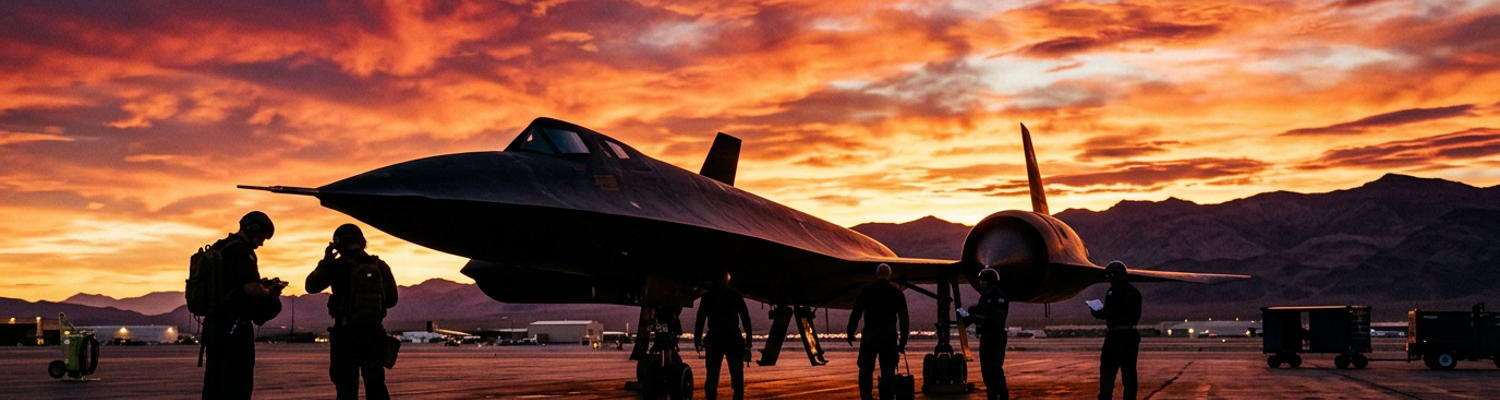

S1034 Pressure Suit Ritual and Cockpit Ingress
Technicians at the operational detachment scrambled to adjust departure timing after an intelligence report warned that Iraqi air defense radar operators had energized target acquisition batteries along the border. Mission commanders ordered the unescorted flight to take off on schedule despite the elevated threat level. The pilot sat reclined in a padded chair inside the physiological support room while breathing pure oxygen through a tight mask. This pre-breathing process purged nitrogen from his bloodstream to prevent decompression sickness during the rapid climb to the edge of space. Two technicians leaned over the gold-colored fabric of the David Clark S1034 full-pressure suit to align the heavy metal collar grooves before dogging down the neck ring into its locked position. The locking latch snapped shut with a dull mechanical click, securing the clear helmet and starting the steady hiss of pressurized oxygen across the inner faceplate.
Oxygen flowing across the faceplate marked the complete physical separation of the aviator from the ambient room. Support specialists inspected every seal and checked the internal pressure bladders for leaks while monitoring the digital readout screens. Pressure gauges connected to the suit registered zero drop across the seams, confirming that the internal seals would hold against the near-vacuum of the upper atmosphere. Crew chiefs guided the suited pilot out to a transport van and drove across the sunbaked concrete to the black U-2S reconnaissance aircraft parked in the staging area. Ground personnel helped the aviator climb the narrow ladder, feeding the life-support hoses and electrical lines into cockpit receptacles before securing the parachute straps across his torso.
Straps pulled tight across the pilot locked him into an ejection seat surrounded by analog dials and digital displays. Cockpit conditions inside the U-2S at seventy thousand feet created an environment where the cabin altitude hovered near twenty-nine thousand feet. This thin atmosphere demanded total reliance on cabin pressure and suit integrity to keep blood from boiling if an airframe seal ruptured. Strict operational rules also enforced complete radio silence from engine start through the duration of the flight. The pilot remained unable to call for help or confirm radar warnings with outside controllers once airborne. Hand signals replaced all voice contact as ground crews conducted their final pre-flight inspections around the long wings and high-altitude airframe before clearing the aircraft to taxi.
Mechanics examined the titanium flight control cables, checked the intake openings of the General Electric F118 engine for foreign objects, and pulled the red safety pins from the dual main gear and tail wheel assemblies. Wing handlers stood at each wingtip to support the detachable pogo wheels that kept the 103-foot wingspan balanced while the pilot worked the rudder pedals and control yoke through their mechanical limits. Ground specialists inspected the sensor bay access doors with flashlights to verify that every fastener sat flush and that no fuel escaped from the plumbing inside the wing tanks. A crew chief stepped back from the nose gear strut, completed a visual scan of the hydraulic lines, and gave a sharp hand salute to signal that the aircraft was cleared for movement. Wheel chocks jerked away from the tires as the pilot advanced the throttle lever to overcome static weight and begin taxiing onto the desert runway.
Throttle input pushed the lightweight airframe forward onto the taxiway concrete. Chase car drivers in white pursuit sedans trailed behind each wing, visually tracking the wing balance and landing gear alignment as the aircraft navigated the turns. Heat shimmered off the tarmac, distorting the horizon while the pilot verified that oxygen flow rates, helmet visor heat, and cabin pressurization valves functioned within operational limits. Flight instruments showed normal electrical and hydraulic pressures, leaving the pilot alone with the rhythmic sound of breathing and the reality of an unescorted flight path into Iraqi missile coverage. The jet swung onto the runway centerline, rolled straight for several yards to align the wheels, and came to a stop as the pilot set the brakes for the high-power engine run-up.
Saddam Hussein and the UNSCOM Inspection Crisis
Brake assemblies groaned under the pilot as the engine reached high power, holding the aircraft stationary while internal cockpit systems stabilized for a mission triggered by an escalating diplomatic showdown. Iraqi authorities had created the crisis in early November 1997 when Saddam Hussein ordered the formal expulsion of American weapons inspectors assigned to the United Nations Special Commission. Baathist security personnel blocked inspection teams from entering suspected chemical and missile sites and commanded all six American specialists to leave the country immediately. This action triggered a full walkout by the remaining United Nations monitors. Saddam claimed that the United States used the international disarmament teams as an espionage cover to collect targeting data for future air strikes against his government. Ground inspections ceased entirely, leaving high-altitude aerial reconnaissance as the only remaining capability able to detect whether Iraqi troops were concealing banned biological agents, toxic chemicals, or hidden missile components.
Baghdad targeted that remaining surveillance capability by issuing an explicit ultimatum that threatened to shoot down any high-altitude reconnaissance aircraft entering sovereign Iraqi air corridors. Iraqi diplomats sent formal letters to the United Nations declaring that the American-operated U-2 flights violated national sovereignty and would be engaged as hostile military targets. Surface-to-air missile units across central and southern Iraq quickly mobilized, powering on their acquisition radars and preparing mobile launchers to contest the northern and southern flight tracks. Military commanders in Baghdad positioned multiple batteries of Soviet-built SA-2 and SA-3 missiles within range of the expected flight paths. These weapons possessed the altitude reach needed to intercept targets near seventy thousand feet. Hostile preparations placed lone, unarmed reconnaissance aircraft in extreme tactical jeopardy, stripping away the safety margin that pilots previously relied on during routine United Nations monitoring patrols.
Commanders at Central Command held intensive assessments to weigh this operational danger against the severe political fallout of yielding to Iraqi demands. Intelligence officers warned that Iraqi air defense crews could track and engage a high-flying aircraft if their fire-control radars achieved lock before the plane cleared missile range. Halting the flights carried massive political liabilities for the government by effectively granting Saddam veto power over United Nations mandates and exposing international disarmament treaties as ineffective. National Security Council planners also faced resistance from key foreign partners on the Security Council, where Russian and French diplomats opposed any escalation into open warfare. Administration officials debated the potential for an international incident against the need for vital intelligence data before agreeing that abandoning the mission would fatally compromise long-term containment of Iraqi military power.
President Bill Clinton approved the high-stakes recommendation, directing Central Command to send the U-2 directly into the contested airspace without armed fighter escorts. National security aides simultaneously notified Baghdad that any missile launch against an American surveillance plane would draw an immediate and devastating military counterstrike. That strategic choice transferred operational responsibility from Washington conference rooms onto the pilot sitting alone on the active runway. Instrument dials on the main panel showed peak engine pressure ratios, prompting the aviator to release the wheel brakes and push the throttle forward into full climb thrust. The aircraft surged down the centerline concrete, rapidly gaining takeoff speed as the wings generated lift for the long ascent toward Iraqi missile coverage.
The November 10 Solo Reconnaissance Sortie
Lift pulled the airframe upward, causing the pogo wheels to drop from the wingtips and clatter across the runway surface behind the ascending jet. The solo U-2S of the 4402nd Reconnaissance Squadron climbed into the morning sky above Taif, Saudi Arabia, on November 10, 1997. Ground crews from the parent 9th Reconnaissance Wing retrieved the discarded balancing gear from the concrete while the aircraft accelerated smoothly through the lower atmosphere. Jet exhaust propelled the lightweight black aircraft past thirty thousand feet, where the outside air temperature dropped rapidly and the horizon curved beneath a darkening canopy of sky. Cockpit instruments registered a steady rate of ascent toward the designated operational altitude of seventy thousand feet, far above civil air traffic routes and dense desert dust storms. The solitary aviator leveled the wings, verified that fuel flow readings remained within normal cruise limits, and directed the nose toward the southern border of Iraq.
Government officials had mandated that this flight proceed entirely without fighter escorts or dedicated radar-jamming aircraft along the route. President Clinton and his national security advisors chose to send the single reconnaissance jet unescorted to prevent an immediate regional escalation that armed combat formations might provoke. A massive strike package crossing into sovereign territory could cause Iraqi missile commanders to panic and launch, whereas a lone surveillance flight operating under United Nations authority called Baghdad to answer the bluff directly. This strategic directive forced Saddam Hussein to choose between backing down from his public threats or deliberately firing upon an unarmed international inspection mission. Planners accepted the immense personal risk imposed on the pilot, calculating that Iraqi leaders would hesitate to trigger an open war over a solitary surveillance platform.
Fighter squadrons and Suppression of Enemy Air Defenses assets stood on strip alert across regional air bases to retaliate instantly if Iraqi forces engaged the aircraft. Air Force F-16CJ Wild Weasel jets carrying AGM-88 High-speed Anti-Radiation Missiles waited on hot pads at bases in Saudi Arabia and Kuwait with their engines ready to start on five-minute notices. Navy strike aircraft sat loaded with precision-guided bombs on carrier flight decks in the Persian Gulf while aircrews sat strapped into their cockpits. Joint operations centers monitored Iraqi communications and tracking radars, holding pre-approved authority to launch defensive strikes the moment an Iraqi fire-control radar locked onto the spy plane. Tactical commanders planned to obliterate the offending missile battery and nearby air defense command posts before the attacking surface-to-air missile could clear the launch rail.
Radar display screens inside the cockpit illuminated as the U-2S crossed the border checkpoint and entered the lethal engagement envelope of southern Iraqi air defense networks. Warning receivers detected the electronic emissions of Soviet-built Spoon Rest acquisition radars sweeping the high-altitude approaches from positions near the city of Basra. The pilot monitored the automated sensor bay cameras and panoramic film advance mechanisms while the long wings glided through the sub-zero air at seventy thousand feet. Iraqi radar operators increased their pulse repetition rates to track the intruder, but the unescorted jet maintained its steady heading along the approved United Nations monitoring track. The aviator kept both hands on the control yoke and checked his emergency descent procedures as the aircraft penetrated deeper into the active missile coverage zone.
Coffin Corner Aerodynamics and Electronic Surveillance Systems
Control cables connected to the yoke responded with stiff resistance as the pilot navigated the narrow aerodynamic margin of coffin corner at seventy thousand feet. The thin air compressed the performance envelope of the U-2S into a hazardous speed window measuring only a few knots. High-speed Mach buffet on the upper end of the airspeed gauge threatened to generate shock waves over the wide wings that could tear the airframe apart. Low-speed aerodynamic stall on the bottom end meant losing lift entirely and plunging into an unrecoverable spin. The aviator adjusted the throttle and pitch trim with tiny, steady hand movements to hold the airspeed precisely centered between both aerodynamic hazards. Atmospheric turbulence or sudden evasive maneuvers to avoid surface fire would disrupt this delicate balance and overstress the lightweight aluminum airframe. This aerodynamic reality forced the pilot to keep the jet flying straight and level through contested airspace, offering Iraqi radar operators a predictable, unswerving target.
Target warning receivers flashed bright alerts across the instrument panel as Iraqi air defense units tracked the aircraft throughout the five-hour mission path. Green tracking symbols illuminated the circular display scope, identifying electronic emissions from Soviet-built SA-2 and SA-3 surface-to-air missile radar stations positioned around Baghdad and the Tigris River valley. Fire-control operators on the ground repeatedly illuminated the U-2S with tracking beams, shifting their radars from wide surveillance sweeps into locked targeting modes designed to guide high-explosive missiles into the aircraft. Each radar lock triggered audible alert tones inside the pilot helmet, signaling that ground crews had the spy plane within engagement parameters and held the physical capability to launch. The aviator kept his hands off the defensive flare dispensers and held his designated heading, knowing that taking evasive action would stall the aircraft or abort the reconnaissance objectives. Iraqi missile officers continued tracking the solitary target across each defensive sector, but fire-control commanders held their missile launches while sensors inside the aircraft recorded military installations below.
Sensors mounted inside a rounded dorsal pod along the upper fuselage transmitted these real-time intelligence feeds directly back to theater commanders. Steerable dish antennas inside the pod established continuous high-bandwidth links with military satellites orbiting thousands of miles overhead. These systems beamed digital optical photography, radar sweeps, and signals intercepts straight to command centers in Saudi Arabia and the United States. Operations officers and intelligence analysts reviewed live mission feeds that revealed Iraqi military units loading trucks, concealing mobile missile launchers, and securing ammunition bunkers away from United Nations inspection zones. This constant data stream proved that the unescorted flight was exposing the very weapons concealment operations Saddam Hussein had tried to hide by banning American inspectors. The pilot monitored the data link indicator lights on the main avionics console, noted that the digital transmission carrier wave remained steady, and banked the wings five degrees to align the camera sensors with the next targeted military complex.
Strategic Aftermath and Operation Olive Branch Continuation
Camera shutter assemblies completed their optical scan cycles across the Iraqi target complex, clearing the pilot to level the wide wings and steer the aircraft south toward the border. Exhaust temperatures dropped as the aviator pulled back the throttle and began a long, step-down descent from seventy thousand feet into Saudi airspace. Heavy titanium landing gear wheels touched down on the runway at Taif, where white chase cars raced alongside the slowing jet to help ground handlers catch the balanced wingtips. Support specialists disconnected the oxygen hoses from the pressure suit, helped the exhausted pilot unfasten the helmet seals, and assisted him down the boarding ladder into a transport van. Intelligence analysts hurried the data storage drives to the field processing center, where inspection of the telemetry confirmed that Iraqi air defense batteries had refrained from firing a single surface-to-air missile during the entire mission. Surface radar units had locked onto the jet across multiple sectors, but the complete lack of fire proved that Iraqi forces withheld their weapons, exposing Baghdad and its tactical hesitation to risk an immediate military confrontation.
Commanders at Central Command capitalized on this Iraqi hesitation by ordering the immediate continuation of Operation Olive Branch reconnaissance flights over central Iraq. Pilots of the 9th Reconnaissance Wing climbed back into their full-pressure suits on regular schedules, flying solo tracks through sovereign Iraqi airspace to uphold United Nations Security Council monitoring mandates. Ground crews at Taif worked around the clock between missions to inspect airframes, reload high-altitude cameras, and test satellite transmission systems for follow-on sorties. United Nations disarmament officials in New York received digitized imagery packets within hours of each touchdown, allowing analysts to track newly excavated trenches and altered bunker roofs. Operational planners adjusted flight routes across the Tigris and Euphrates river valleys to sweep newly identified concealment zones while keeping the aircraft inside safe aerodynamic operating limits. Iraqi air defense units continued tracking the surveillance flights with their acquisition radars, but launch crews consistently kept their missiles on their rails to avoid triggering retaliatory airstrikes from waiting coalition fighters.
Photographs brought back from these ongoing Olive Branch sorties provided undeniable proof that Iraqi military units were systematically concealing equipment and sanitizing suspected weapons sites. Administration officials and national security advisors studied the photographic evidence, concluding that diplomatic compromises and intermittent ground inspections were no longer containing Iraqi weapons programs. Washington hardened its military policy, establishing clear plans to strike the Iraqi regime if it continued to block international oversight. Iraqi authorities severed all cooperation with United Nations disarmament teams in late 1998, accelerating the crisis toward an armed showdown. President Clinton ordered the execution of Operation Desert Fox in December 1998, launching a four-day campaign of cruise missiles and strike aircraft against Iraqi military infrastructure. Navy warships in the Persian Gulf fired hundreds of Tomahawk cruise missiles, while Air Force bombers struck communications hubs that had coordinated the previous year air defense tracking operations. Strike aircraft relied directly on the radar plots, air defense maps, and facility coordinates mapped out by the U-2 flights to demolish Iraqi surface-to-air missile sites, military headquarters, and weapons research centers across central Iraq.