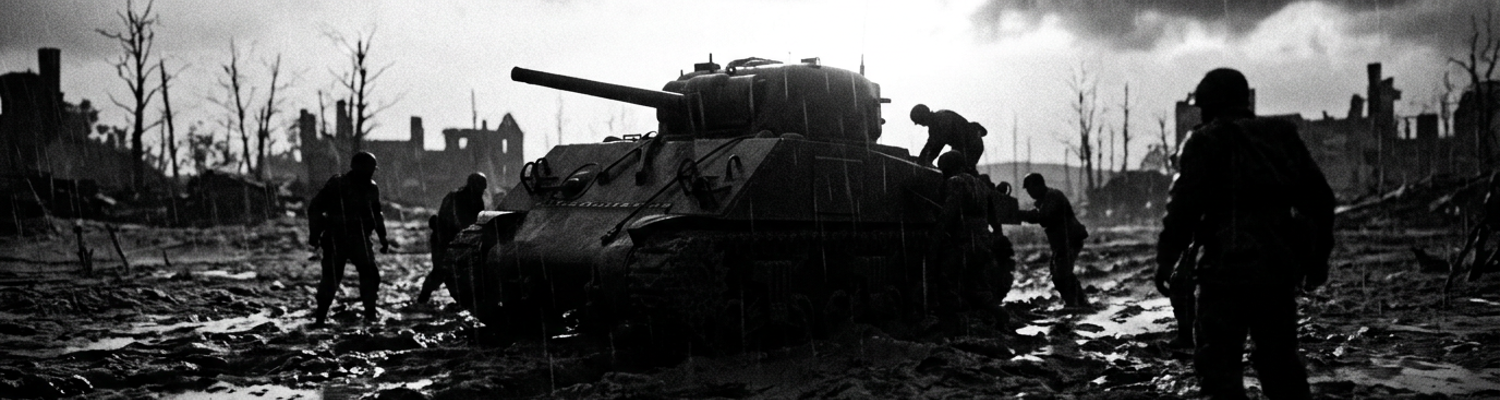

Combat Spearhead Isolation and Initial Camp Discovery
At precisely 0640 hours on 10 April 1945, the remote whip antenna of an M8 Greyhound armored car snapped against the low-hanging pines of the Emsland marsh. This severed all VHF radio contact with corps command. The combat spearhead was left in total operational isolation. Reconnaissance detachments pushed blind toward the rail corridor outside Lathen through waterlogged moorland west of the Dortmund-Ems Canal. Mechanical breakdowns mounted immediately across the sodden terrain. Heavy M4A3 Sherman medium tanks stripped final drive assemblies. Road wheels slipped in the acidic peat. The single-lane access track churned into impassable mire.
Forward units received no intelligence warnings regarding the vast infrastructure hidden between the canal embankments and the Dutch frontier.
Advancing armored patrols suddenly slammed into the barbed-wire perimeters of the Emslandlager camp network. These were specifically the penal installations flanking Lathen and Esterwegen. Tactical planners had charted this area as vacant bogland. It was instead a densely populated matrix of fifteen separate punitive enclosures. They were overrun in rapid succession as German guards abandoned watchtowers and fled eastward into the mist.
The advance plunged into an administrative void.
A close review of operational logs indicates that combat elements of the US Eighth Armored Division and the British Second Army found themselves instantly paralyzed by the human disaster sprawling inside the wire. Frontline patrols stumbled across thousands of emaciated Polish and Soviet detainees crammed into unheated timber barracks. Over 1,700 Polish Home Army women occupied Camp VI Oberlangen alone. Thousands of Soviet prisoners of war occupied nearby compounds in advanced stages of clinical starvation. Epidemic typhus and bacillary dysentery ran unchecked through the barracks. Unburied corpses lay stacked alongside living inmates.
Tactical commanders lacked the personnel to establish containment lines or enforce quarantine protocols.
Frontline medics carried only individual field dressings and morphine syrettes. These supplies were designed for traumatic combat wounds rather than massive enteric infections. Armored division personnel stood guard over sprawling perimeter fences to prevent starving detainees from dispersing into active combat sectors. Division field ambulances broke down under the physical strain of hauling comatose civilians over rutted canal towpaths.
Standard C-rations killed starving men within hours.
Theater supply allocations reveal why immediate civilian relief proved impossible. Allied supply officers had calibrated pipelines strictly around combat consumption rates. This meant Class III petroleum and lubricants to feed tank engines alongside Class V high-explosive ordnance for the push into northern Germany. Railheads sat pinned west of the Rhine due to demolished bridges at Wesel and Rees. All supply columns were forced onto worn two-and-a-half-ton GMC trucks traversing cratered secondary roads.
Not a single supply depot maintained surplus stocks of skim milk or water-purification kits anywhere within eighty kilometers of Lathen.
Division staff officers attempting to requisition emergency food rations encountered an unyielding military supply hierarchy. This system prioritized ammunition replenishment over non-combatant survival. Forward supply officers stripped municipal German granaries and commandeered local dairy livestock. This stopgap measure yielded barely three hundred calories per detainee per day. By 14 April 1945, the advance elements had exhausted their own organic field rations. Divisional brass halted further tactical maneuvers along the Dortmund-Ems Canal simply to maintain armed security over their unprovisioned rescue zones.
Moorland Terrain and Drainage Trench Failures
Allied tactical planners treated the flat expanse west of the Ems River as conventional tank country. Aerial reconnaissance photographs failed to identify the severe structural instability of the underlying Bourtanger Moor basin.
Decades after the war, an April 1993 technical audit conducted by the Federal Railroad Administration and the Volpe National Transportation Systems Center documented the precise geotechnical profile of this exact ground.
That investigation revealed that the upper strata consisted of highly decomposed fen peat extending down six to eight meters. This layer carried a natural moisture content exceeding eighty percent by mass. Beneath this saturated organic layer lay fine silty sand possessing negligible internal friction and high liquefaction potential. Structural engineers analyzing the corridor discovered that standard pile foundations experienced extreme lateral displacement under dynamic loading.
In April 1945, Allied combat units attempted to drive thirty-ton vehicles directly across this specific crust.
The ground had zero load-bearing capability once mechanical vibrations fractured the surface root mat. Tracked vehicles sheared the vegetative carpet and sank straight into fluid muck.
Thirty-ton tanks sank to their hulls.
A close review of operational logs indicates that the entire camp network depended on a fragile system of hand-dug drainage trenches to keep barracks platforms out of the groundwater. Penal laborers had maintained hundreds of kilometers of perimeter ditches for over a decade to lower the local water table across the moorland. Manual maintenance stopped completely when German camp guards fled on 10 April 1945. Subterranean hydrostatic pressure immediately pushed against the unreinforced ditch walls. High soil acidity with a pH below four dissolved root binders. This stripped the peat of what little cohesive strength it possessed.
Perimeter revetments sloughed inward within forty-eight hours of guard abandonment.
Tons of black sediment dumped back into the channels. Water tables rose twenty centimeters per day. This saturated the compound floors at Camp VI Oberlangen, Camp VII Esterwegen, and Camp II Aschendorfermoor. Open-pit latrines flooded into detention yards. Fecal matter spread directly into sleeping quarters. Detainees had to sleep standing up or balance on upper timber bunks to stay out of the rising slurry.
Every drainage cut turned into standing swamp.
Mechanical logs confirm that heavy vehicular movement ceased entirely outside the few paved roads. Advancing columns were forced onto narrow elevated causeways lined with brushwood fascines. These rapidly broke apart under sustained military tonnage. An M4A3 Sherman medium tank (serial number 44-12998) veered thirty centimeters off the crowned lane outside Lathen. It slid down the bank and sheared off its final drive assembly against subterranean bog oak. A dispatched M32 tank recovery vehicle set its ground spades to haul the tank out. The anchor spades tore clean through the mossy soil. This dragged the wrecker into the same trench.
Standard two-and-a-half-ton GMC trucks sank down to their transfer cases after traveling less than fifty meters into camp access paths.
Drivers trying to power out stripped their ring gears and incinerated their clutches against the suction of the bog. Winch crews snapped five-eighths-inch steel recovery cables under the tensile drag of buried chassis. Supply columns carrying fuel and rations sat gridlocked for twenty-two kilometers along the west bank of the Dortmund-Ems Canal by 13 April. They were completely unable to reach the camps.
Abrasive Silt and Mechanical Pump Failures
Royal Engineers field utility detachments arriving at Camp VII Esterwegen on 12 April 1945 attempted to draw raw water from adjacent canal cuts using standard mobile filtration trailers.
Trailer-mounted Pegson centrifugal pumps pulled up an abrasive slurry of fine quartz sand mixed with decaying sphagnum peat directly from marsh drainage ditches. Suspended particles measuring under sixty microns bypassed the coarse wire intake strainers. They ground directly against bronze impeller vanes and cast-iron pump casings. High acidity in the moorland run-off registered between 3.6 and 4.1 pH. This accelerated galvanic corrosion across aluminum pump housings and stripped lubricating grease from drive shaft packings.
Bearings overheated and locked within four hours of continuous pumping.
Replacement assemblies arrived from field park squadrons outside Meppen. Their self-priming seals disintegrated after processing less than two thousand gallons of turbid ditch water. Engineering officers shut down central purification points. This cut the distribution of chlorinated potable water to zero across three neighboring satellite compounds.
Rotary impellers ground to metal shavings inside half a shift.
Archival evidence shows that this same airborne and waterborne silt crippled the frontline security units assigned to contain