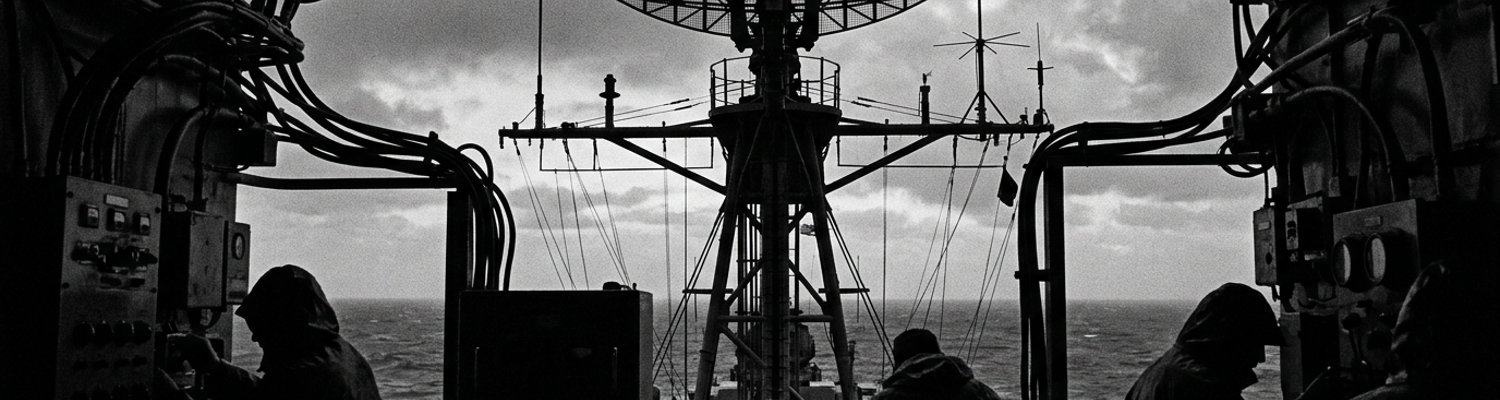

World War II Hull Conversion and Electrical Demands
At 0314 hours on November 12, 1961.
The encrypted teletype feed with naval headquarters in Honolulu abruptly severed. This isolated the frontline collection detachment completely from the Pentagon command chain. Archival evidence shows that this total systems blackout traced directly back to the hasty structural origins of the vessel itself. Commissioned on July 8, 1961, as the inaugural Technical Research Ship under joint National Security Agency and Navy Bureau of Ships direction, USS Oxford began its service life as a stopgap platform for oceanic signals collection. Bureau planners designated the conversion under Ship Characteristics Board Project 192. They pulled an aging, mothballed World War II Liberty ship hull out of the reserve fleet. (Hull number AGTR-1, originally laid down in 1945 as the cargo carrier Samuel R. Aitken). Shipyard workers at the New York Naval Shipyard in Brooklyn stripped the interior cargo spaces. They packed four thousand tons of permanent water and concrete ballast into the double bottoms to stabilize the top-heavy design. They partitioned the cavernous holds into seven thousand square feet of heavily shielded, restricted compartments. Classified direction from NSA leadership required the vessel to operate as a self-contained offshore interception site. Bureau of Ships naval architects attempted to squeeze an unprecedented volume of electronic gear into a hull intended strictly for slow-speed wartime convoy hauling. The compromise left original mechanical systems directly coupled to experimental collection apparatuses that had never faced maritime field conditions.
Primary power generation systems failed to support the newly mounted hardware.
When examining the historical record, the primary source of equipment strain stemmed from the specialized AN/WLR receivers and microwave telemetry systems bolted into the newly constructed intelligence bays. Technicians packed racks of AN/WLR-1 and AN/WLR-3 electronic reconnaissance receivers across the forward intercept rooms. They paired them with an experimental sixteen-foot steerable dish mounted directly over the stern for microwave telemetry and satellite data relay. These complex systems demanded continuous direct current and high-amperage alternating current. Oxford possessed a wartime propulsion package consisting of two 220-pound-per-square-inch steam boilers feeding a single triple-expansion reciprocating steam engine. Legacy auxiliary generators rated for simple cargo handling flanked this engine. Bringing the high-frequency microwave receivers online spiked shipboard consumption far beyond the designed three-hundred-kilowatt safety threshold of the generators. Steam line pressure dropped instantly whenever radar tracking antennas rotated. Auxiliary generator turbines experienced extreme thermal stress. They threw circuit breakers and starved the ship primary radio arrays of operating voltage.
A close review of operational logs indicates that the internal distribution network failed just as severely as the power plants. Below the main deck, high current draws from early electronic vacuum-tube intercept suites generated intense heat within the distribution conduits. Each receiver cabinet housed hundreds of individual vacuum tubes. These tubes pulled dozens of amperes apiece just to keep the internal filament arrays energized around the clock. The ship main copper electrical bus bars were never upgraded to handle continuous heavy current cycles. They began overheating within hours of continuous collection runs. Temperatures along the primary switchboards rose past 160 degrees Fahrenheit. This melted the rubber cable insulation and filled narrow engineering passages with toxic fumes. Watchstanders stripped off fire-retardant smocks. They mounted commercial box fans directly against open electrical cabinets to keep the air moving across glowing metal bars. Cabinet casing surfaces began blistering the paint. Technicians routed emergency salt-water heat-exchange lines through the workspace bulkheads. They directed compressed-air hoses onto the switchgear to stave off electrical fires.
Copper bus bars warped several millimeters out of true alignment during peak monitoring shifts.
Defense Supply Agency Logistics Bottlenecks in the Pacific
Procurement breakdown began in administrative processing centers six thousand miles to the east.
Archival evidence shows that naval supply officers in late 1961 were forced to adopt newly established Defense Supply Agency and General Services Administration inventory directives. Defense Secretary Robert McNamara pushed for centralized military distribution. He required every branch of the armed forces to order equipment through standardized eleven-digit Federal Stock Number schedules. Administrative clerks quickly discarded older military branch cataloging systems. This procedural change instantly paralyzed specialized collection platforms like Oxford. Low-volume, experimental intelligence hardware engineered under classified National Security Agency contracts had never received civilian or general military catalog numbers. (NSA Contract File 44-A902). Cryptologic requisition requests radioed from the Western Pacific to the Naval Supply Center in Oakland, California, listed proprietary manufacturer codes from specialized defense contractors rather than eleven-digit supply entries. IBM card-sorting machines at the supply depot automatically routed these unscheduled orders into reject bins. Clerks marked the requisitions as unidentifiable inventory. This left the vessel without replacement modules while naval headquarters expected continuous surveillance of radar sites near Hainan Island.
Depots across the Pacific held nothing the intelligence detachment needed.
A close review of operational logs indicates that regional supply outposts failed to stock specialized hardware. Storage manifests at Naval Supply Depot Subic Bay in the Philippines, Naval Station Sangley Point, and Fleet Activities Yokosuka contained basic fleet consumables. They prioritized bulk engine oil, deck hardware, and general-purpose 6SN7 vacuum tubes designed for navigational radar. Missing entirely from forward depot records were the specialized traveling-wave tubes, low-noise beam-deflection tubes, and ultra-high-frequency miniature pentodes required by the ship AN/WLR-1 and AN/WLR-3 collection receivers. Cryptologic operators monitored Chinese army teleprinter traffic and North Vietnamese coastal communications. They needed quartz crystals sliced to exacting physical dimensions for specific military frequencies between 3 and 30 megahertz. Manifest checks across Subic Bay turned up zero matching frequency crystals.
External antenna connections presented another material breakdown. Salt air in the Gulf of Tonkin rapidly corroded the high-frequency feedlines on the upper deck. It oxidized the silver-plated rectangular waveguides that transferred microwave energy from the mast antennas to the receivers below. The flaking silver coatings distorted standing wave ratios and burned out fragile crystal mixer diodes. Western Pacific supply clerks possessed only standard industrial copper tubing and common coaxial lines. They received no allocations of silver-plated waveguide sections.
Intelligence mission survival fell entirely on improvised maintenance inside restricted compartments.
When examining the historical record, engineering logs show that maintenance personnel kept intercept gear operational through desperate cannibalization and local manufacturing. Cryptologic technicians systematically harvested electronic components from non-essential equipment. They gutted internal circuitry from secondary audio monitoring decks, AN/SPA-4 radar repeaters, and spare teletype amplifiers. Technicians carried salvaged crystal blanks to the auxiliary machine shop. They used abrasive aluminum oxide paste and thick plate glass to grind the faces down by fractions of a millimeter until the quartz resonated at target communication frequencies. Machinist mates turned down scrap brass bars on a lathe. They milled custom coupling flanges. They soldered the segments together with silver-bearing dental solder obtained from the ship medical officer. This replaced rotted microwave waveguides. Electronics personnel rewound burned-out intermediate-frequency transformer bobbins by hand with thin enameled wire unspooled from auxiliary electric motors. They worked under magnifying lights as the converted cargo ship rolled across heavy ocean swells at coordinates 16 degrees 30 minutes North, 108 degrees 45 minutes East.
Monsoon Swells and Salt-Crusted Antenna Feeders
A close review of operational logs indicates that environmental conditions disintegrated rapidly once USS Oxford entered the winter northeast monsoon belt north of the Paracel Islands. Tracking runs along the 112th meridian east positioned the converted Liberty hull squarely in open, unsheltered waters between Hainan Island and the rocky reefs of Lincoln Island. Sustained gale-force gusts routinely generated twenty-five-foot ocean swells that battered the ship broad, unarmored beam. The hull lacked modern bilge keels. The vessel pitched violently through thirty-five-degree arcs every eight seconds. Green water broke continuously over the bow. Sheets of atomized ocean brine swept across the 01, 02, and 03 weather decks. This airborne salt slurry coated every square inch of the topside surveillance installations. Dense arrays of log-periodic antennas, omnidirectional biconical horns, and AS-571 direction-finding dipoles took direct, unbroken drenchings of aerated sea brine. Crews had mounted these along the former cargo masts up to ninety feet above the waterline.
Salt water breached every topside seal within forty-eight hours.
Archival evidence shows that this relentless brine exposure triggered severe signal degradation across the entire electronic intelligence intercept suite. Seawater washed across the upper superstructures. The tropical wind evaporated the moisture instantly. This left dense sheets of crystallized sodium chloride encrusted over exposed coaxial feeder lines and antenna feed horns. The crystalline salt deposits formed conductive surface layers that wrecked high-frequency impedance matching. Exposed RG-17/U and RG-8/U coaxial lines suffered immediate dielectric breakdown at connection collars. Creeping moisture penetrated past aged rubber gaskets into the braided outer shields. Standing wave ratios on primary ultra-high-frequency receiving lines skyrocketed from a baseline 1.1 to 1 up past 7 to 1. This dumped microvolt-level intercept signals into ground loops before the energy ever reached the cryptologic spaces below. Telemetry signal reception from Chinese ground-based coastal radar installations dropped by thirty-two decibels. Intermediate-frequency signal monitors on the AN/WLR-1 consoles registered broad patterns of dielectric tracking that blinded operators to pulse-width shifts.
Intercept displays registered only uniform white noise.
When examining the historical record, Seventh Fleet operational directives strictly prohibited de-energizing or lowering the topside receiving lines. National Security Agency tasking required unbroken coverage of active air-defense tracking radars along the South China coast. Technicians had to conduct field repairs on live circuits. Cryptologic technicians and electronics mates climbed into wet canvas safety harnesses. They tethered themselves to icy mast steps as the vessel rolled through heavy swells in near-zero visibility. Repair parties worked directly on energized preamplifier feeds carrying active direct-current bias voltages. They scrubbed the crusted fittings with stiff horsehair brushes soaked in pure distilled boiler feed water hauled up from the engine spaces in five-gallon galvanized buckets. Teams followed the freshwater wash with baths of technical-grade anhydrous isopropyl alcohol to displace micro-droplets trapped inside connector threads. They absorbed painful electrical shocks whenever wet skin brushed active antenna elements. Technicians wrapped each wiped joint in multiple layers of self-bonding silicone rubber tape. They sealed the edges with petroleum jelly and slathered the assemblies in thick coats of air-drying liquid neoprene.
At 0440 hours, teams completed the final seal on the forward masthead array.
Standing water reached four inches across the signal bridge. Signal attenuation along the primary feeder line fell back to 2.4 decibels.
Generator Transformer Failures Under Strict Emission Control
The intelligence hold went completely dark when the primary step-down transformers caught fire.
Archival evidence shows that the electrical breakdown centered on the 440-to-115-volt dry-type step-down transformers mounted directly beneath the cryptologic vault. These units supplied steady single-phase power to banks of AN/UGC teletypes and KW-26 cryptological transceivers. These machines maintained synchronized frequency-shift keying feeds to Seventh Fleet headquarters at Naval Station Sangley Point. They operated continuously under ambient temperatures exceeding 120 degrees Fahrenheit. The lacquer insulation across the secondary copper coils degraded until winding-to-winding arc faults erupted. Voltage dropped from a stable 115 volts down to 78 volts in fractions of a second. This collapse instantly starved the telegraph terminal units of bias current. Without constant voltage, the KW-26 crypto keys dropped synchronization. This scattered incoming and outgoing fleet communications into garbled binary errors. Operators watched red warning strobes flash across the teletype consoles as mechanical printer carriages slammed against their stops and locked. Every attempt to restart the encrypted teletype channel failed. The scorched transformer coils welded together under continuous inductive load. This blew primary fuse links and severed the data stream to fleet commanders.
The ship could not broadcast a distress call.
A close review of operational logs indicates that Commander Seventh Fleet had imposed strict Emission Control Condition Alpha across the entire operational box off Hainan Island. Fleet directives barred all high-frequency radio transmissions, navigation radars, and secondary radiating transmitters. This prevented Chinese coastal direction-finding networks in Guangdong from fixing Oxford maritime coordinates. Technicians were explicitly forbidden from firing up the ship AN/URC-32 high-frequency transceivers. They could not transmit standard logistical emergency requests or casualty reports to the repair tender USS Jason at Subic Bay. Breaking radio silence risked exposing the covert electronic intelligence collection mission to Soviet-supplied coastal surveillance stations and People Liberation Army Navy patrol craft monitoring the Gulf of Tonkin. Even low-power emergency distress transmitters remained mechanically disconnected at the switchboards. Operating under radio blackout stripped the ship of any external engineering assistance. The bridge could not report propulsion slowdowns or ask fleet logistics for replacement parts.
Repairs had to happen in the dark.
When examining the historical record, maintenance teams were forced into the unventilated auxiliary machinery flats located three decks below the waterline. Primary ventilation blowers sat dead following the feeder line collapse. Compartment temperatures climbed past 135 degrees within forty minutes. Stagnant humidity condensed across the raw steel bulkheads. Electricians worked exclusively under the dim red beams of battle lanterns and handheld six-volt dry-cell lights. They pulled scorched metal covers off the 440-volt distribution switchboards. The air inside the narrow crawl spaces reeked of vaporized phenolic resin, molten copper, and melted neoprene wire jackets. Electricians used Simpson 260 analog multimeters to probe burned terminal blocks. They read erratic resistances across carbonized Bakelite barriers that had melted into conductive sludge. Technicians stripped away blistered insulation with pocket knives. They spliced temporary heavy-gauge bus jumpers directly onto intact copper studs. They worked by flashlight while sea swells tossed the ship through twelve-degree rolls.
By 0615 hours, watchstanders completed a bypass around the third distribution breaker.
This restored auxiliary direct current to the forward crypto room at eighty-nine volts.
Round-the-Clock Manual Circuit Shunting and Data Recovery
Archival evidence shows that Naval Security Group technicians and interior communications electricians instituted continuous four-hour emergency maintenance cycles inside the sweltering cable chases beneath the main deck. Damaged distribution circuits had severed direct-current feed lines between auxiliary switchboard two and the forward signals intelligence spaces. Technicians bypassed destroyed circuit panels by fabricating improvised copper shunts. They stripped neoprene insulation off heavy-gauge welding cables with pocket knives. Jumper cables were clamped directly across scorched knife switches and carbonized terminal lugs. This routed electrical power across buckled steel bulkheads without fuse protection. Watchstanders crawled through unventilated thirty-inch crawlways beneath the intercept consoles. They secured vibrating bypass lines with friction tape to prevent copper braids from arcing against the bare hull plating. Every pitch of the hull threatened to snap the unbolted shunts off their contacts. Overheated terminal studs regularly burned through technician work gloves during peak shifts. Arcing faults across manual shunts melted Bakelite mounting plates within minutes of contact.
Bare copper conductors glowed dull red in the crawlspaces.
When examining the historical record, restoring functionality to the KW-26 crypto keys and AN/UGC teletype sets demanded direct intervention at the chassis level. Scorched power supplies inside the cryptologic vault had left the terminal units without operating voltage. This threatened to permanently dump the synchronized encryption variables held in core memory. Maintenance teams severed scorched wiring harnesses behind the teletype consoles. They discarded charred multi-pin Amphenol plugs. Technicians stripped solid-core copper wire harvested from inactive fathometer cables. They utilized manual wire-wrap hand tools to bind bare lines directly onto terminal pins behind the vacuum-tube keying assemblies. Specialists bypassed burned internal rectifiers. They patched direct-current bias lines directly into twenty-four-volt auxiliary battery banks located two decks below in the forward gyrocompass room. Operators worked under amber neon pilot lamps while specialists ran bypass wiring across the overhead cable racks. These field-routed lines supplied the strict sixty-milliampere neutral telegraph loop current required to step the mechanical distributor brushes without introducing signal jitter. A three-volt drop across the improvised run caused teletype carriages to freeze mid-character.
Teletype gears seized the second loop current dropped below fifty-seven milliamps.
A close review of operational logs indicates that ship engineers sustained the primary collection footprint through strict thermal load-shedding procedures on the two vintage Westinghouse 300-kilowatt turbo-generators. Seawater injection temperatures reached eighty-six degrees Fahrenheit in the open waters southeast of Hainan Island. This drastically reduced auxiliary condenser efficiency and drove generator core temperatures toward thermal breakdown limits. Engineering officers instituted rolling blackouts across secondary hull systems to preserve generator capacity for high-draw electronic surveillance suites. Crew galleys, refrigeration compressors, hot-water booster heaters, and compartment ventilation blowers were killed at the primary switchboard on alternating twenty-minute cycles. Shifting this electrical budget freed up eighty kilowatts of three-phase 440-volt power. They directly allocated this to feed the AN/WLR-1 microwave telemetry tracking receiver and the hydraulic drive motors of the steerable dish antenna. Steam watchstanders monitored condenser vacuum gauges reading fourteen inches of mercury instead of the standard twenty-eight. They fought persistent vacuum leaks along aged copper flange packings. Boiler technicians manually opened auxiliary turbine bypass valves with steel wrenches whenever directional motor slews drove generator phase loads past 410 amperes. This dumped excess exhaust steam straight into the bilges.
Generator winding temperatures stabilized at 218 degrees Fahrenheit.
The hull maintained station at coordinates 17 degrees 15 minutes North, 111 degrees 02 minutes East.