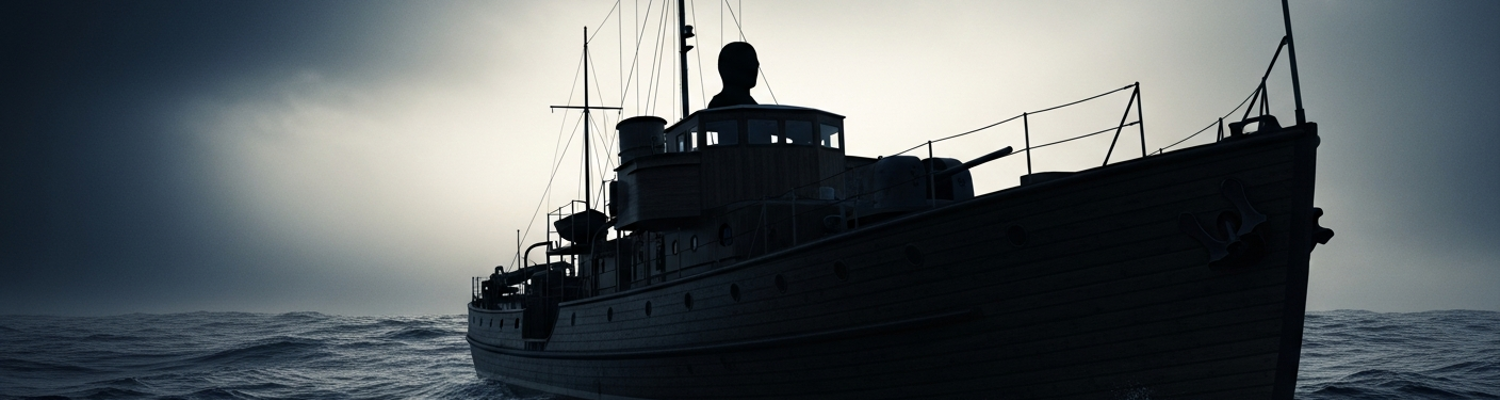

Training manuals for the Aggressive-class ocean minesweepers (MSO) promised a new era of scientific precision in countering the naval mine. Commissioned beginning in 1953, ships like USS Enhance (MSO-437) were purpose-built instruments of a new doctrine, conceived after the U.S. Navy’s painful experience in the mine-choked waters off Wonsan, Korea. They were constructed of wood and non-magnetic metals, powered by special Packard diesel engines, and packed with advanced equipment to detect and neutralize the three primary mine types: moored, magnetic, and acoustic. Doctrine called for these 172-foot vessels to methodically sweep contested waters, towing Oropesa gear to cut the cables of moored mines, a magnetic "tail" to trigger influence mines, and acoustic hammer devices to detonate others from a safe distance. On paper, it was a clean, systematic process.
The reality for the crews was a grueling battle against their own equipment. The complex diesel engines were prone to fires, disabling USS Enhance on at least two separate occasions in 1973 and 1975. The UQS-1 mine-locating sonar, a key component of the new mine-hunting capability, was first-generation technology that required constant calibration and expert interpretation. In practice, the tidy solutions of the training manual dissolved into the chaos of at-sea operations, where mechanical reliability was a constant concern.
A close review of operational logs and intelligence assessments from the mid-1950s reveals a profound and dangerous intelligence vacuum concerning the primary adversary: the Soviet Navy. While the Korean War offered a glimpse into Soviet mine doctrine, showing their preference for mixed fields of contact and influence mines to defend coastlines, this was merely a snapshot. U.S. naval intelligence lacked actionable data on the specifics of the Soviet mine inventory. Critical questions went unanswered. How many mines did the Soviets possess? Archival evidence suggests that estimates varied wildly, with some later analyses placing the number in the hundreds of thousands. What were the precise technical characteristics of their new influence mines, the specific magnetic signatures or acoustic frequencies that would trigger them? What were their arming and sterilization mechanisms? Did they possess advanced pressure-activated mines, for which the U.S. had no reliable counter? This lack of information was a direct result of the closed nature of the Soviet state. Soviet military capabilities were shrouded in secrecy. U.S. intelligence relied heavily on technical means like spy plane overflights and submarine reconnaissance, which were better suited to spotting large strategic assets like bombers and missile silos than to inventorying naval mines stockpiled in warehouses.
This lack of precise threat data forced naval planners into a reactive posture. They were compelled to base operational doctrine on a series of worst-case assumptions. Without knowing the specific nature of the threat, the Navy had to prepare for every conceivable threat. Minesweeping procedures became extraordinarily cautious and time-consuming. Planners had to assume that any potential minefield could contain the most sophisticated multi-influence mines in the Soviet arsenal. This required ships like the Aggressive-class to perform slow, repetitive sweeps for magnetic, acoustic, and pressure signatures, even if the actual threat was a simple pre-World War II contact mine. This worst-case approach had a cascading effect, influencing ship design and equipment procurement. Mine countermeasures had to be developed to counter not just known Soviet mines, but hypothetical ones as well. This drove the demand for ever more complex and expensive sweeping gear, which in turn placed greater strain on the already mechanically-unreliable MSOs. This planning posture persisted for decades, a direct consequence of the intelligence black hole regarding the specifics of the Soviet mine warfare program.
The National Security Act of 1947 was intended to streamline America’s defense and intelligence apparatus. It created the Central Intelligence Agency (CIA) and a unified Department of Defense to prevent another surprise like Pearl Harbor. In practice, it created a sprawling infrastructure of competing agencies. For the specific, granular needs of naval mine countermeasures (MCM), this new world was a bureaucratic nightmare. The core problem was the "stovepiping" of information. Communication barriers, hierarchies, and compartmentalization actively impeded collaboration. The Navy’s Office of Naval Intelligence (ONI) required a fusion of technical intelligence on Soviet mine fuses, signals intelligence on minelaying fleet communications, and imagery intelligence of potential storage depots. Yet these pieces were not collected or held by a single entity. The National Security Agency (NSA) handled signals intelligence. The CIA had its own sources. The Air Force produced the most extensive imagery intelligence from high-altitude reconnaissance flights. A declassified history from the NSA itself acknowledges that a lack of cooperation and unity was one of the greatest impediments to the national signals intelligence effort throughout the Cold War. A request from a fleet MCM commander for a threat assessment in a specific area could languish for weeks or months, caught in a maze of inter-agency classification reviews and turf wars. The information often existed, but it was splintered across a dozen agencies, each with its own priorities and an institutional reluctance to share its most sensitive data.
The consequences of this intelligence disconnect were most acute in the maritime chokepoints of Europe. NATO’s naval strategy depended on controlling the Greenland-Iceland-UK (GIUK) Gap, the Danish Straits, and the Turkish Straits to contain the Soviet Northern and Black Sea Fleets. These were the precise areas where the Soviets were expected to use naval mines offensively, seeking to block shipping lanes, isolate naval forces, and deny transit. Yet specific intelligence for these zones was dangerously inadequate. A close review of the period reveals a persistent failure to understand Soviet strategic intentions. For decades, the ONI, with little critical oversight, insisted the primary Soviet naval mission was a World War II-style campaign against Atlantic convoys. This was incorrect. By the 1970s, the Soviet Navy’s main role had shifted to defending its ballistic missile submarine "bastions" in the Barents Sea and other home waters. This fundamental misreading of enemy doctrine, born from a lack of integrated intelligence, meant that war planning for chokepoints was based on flawed assumptions. Minesweeper captains preparing for a potential conflict in the Danish Straits had little more than generalized warnings. They lacked detailed hydrographic data, knowledge of specific mine types stockpiled for the region, or an understanding of Soviet mining doctrine for that exact geography, all information their adversaries would possess.
The operational impact of these intelligence gaps was profound and uniformly negative. Without reliable data, naval planners were forced to default to worst-case scenarios for every potential theater. The lack of clarity from the wider intelligence community forced the Navy to assume that any given area could be seeded with the most sophisticated, multi-influence mines rumored to be in the Soviet arsenal, even if none existed there. This assumption directly degraded operational readiness. It dictated that minesweepers like USS Aggressive had to practice slow, repetitive, and time-consuming sweeps for acoustic, magnetic, and pressure signatures. This reduced the time available to train on countering more probable threats like older, simpler contact mines.
This constant planning for a hypothetical super-mine drove the procurement of ever more complex and expensive MCM hardware. This then placed greater maintenance burdens on already unreliable platforms. For commanders of amphibious task forces, the intelligence vacuum created paralyzing uncertainty. The inability of the intelligence apparatus to state definitively what threats were, and were not, present meant that clearing a channel for a Marine landing could be estimated to take weeks instead of days. This planning reality severely limited strategic options and undermined confidence in the Navy’s ability to project power ashore against a mined coastline, a direct consequence of bureaucratic friction miles away from any battlefield.
A critical examination of planned NATO flank operations during the mid-Cold War period reveals a deep and hazardous disconnect between U.S. Navy mine warfare units and U.S. Air Force reconnaissance assets. On paper, the services were meant to operate as a cohesive joint force. In practice, they were two separate entities with incompatible cultures, technologies, and priorities. The Air Force's strategic reconnaissance programs, such as those using the U-2 and SR-71, were national assets focused on identifying fixed, high-value targets like Soviet ICBM silos and bomber bases. The intelligence they gathered was analyzed through a strategic lens, often with a multi-week turnaround time.
Mine Countermeasures commanders, however, required near-real-time, tactical intelligence.
The location of a Soviet minelaying vessel was only valuable for a few hours, not weeks. Archival evidence shows a persistent failure to integrate these collection cycles. An Air Force flight might capture imagery of naval activity in a Baltic port, but by the time the film was processed, analyzed, and disseminated through a choked, multi-layered command system, the minelayers were long gone. The intelligence was operationally useless for the waiting minesweeper crews. This was not merely a procedural issue; it was a technical one. The two services lacked widespread interoperable data links. Time-sensitive information had to be physically transported or passed through slow, cumbersome communication relays that were ill-suited for the pace of modern naval conflict. The Navy was often left blind, forced to rely on its own limited organic reconnaissance, which lacked the synoptic view the Air Force could provide.
The failure to find the enemy was matched by the failure to supply friendly forces. The Aggressive-class ocean minesweepers formed the backbone of the U.S. Navy’s MCM fleet, but they were notoriously difficult to maintain. Nowhere was this more apparent than with their specialized Packard 1D-1700 diesel engines. These V-12 engines were marvels of non-magnetic engineering, built largely of aluminum, bronze, and stainless steel to avoid triggering influence mines. They were also temperamental, complex, and a logistical nightmare. A close review of operational logs for ships like USS Enhance (MSO-437) shows how this logistical fragility could idle assets for extended periods. A single failed component, a fuel injector, a turbocharger bearing, or a governor for one of the ship’s four engines, could not be easily replaced. Spare parts for the Packard engines, which ceased production in the 1950s, were scarce. For a vessel deployed to a NATO flank like the Mediterranean or the Danish Straits, obtaining a replacement part involved a torturous journey through the supply bureaucracy. A request would have to travel from the ship to its parent tender, then to a regional supply depot like Naples, and often all the way back to a stateside warehouse. Each step added days or weeks of delay. A front-line minesweeper could be left tied to a pier, mission-incapable, waiting for a single crate to navigate a byzantine logistics system configured for carrier battle groups, not small, specialized units. USS Enhance itself was disabled by engine room fires on at least two separate occasions, underscoring the constant risk posed by its troublesome machinery.
Paperwork was its own kind of minefield. This deep-seated institutional friction crippled tactical flexibility. NATO’s military command structure, which at its peak comprised 78 distinct headquarters, was a product of political compromise designed for large-scale, deliberate warfare against a Soviet land invasion of Europe. It was fundamentally unsuited for the dynamic and unpredictable nature of mine countermeasures. A U.S. minesweeper commander, operating as part of a Standing NATO Maritime Group, worked within a rigid chain of command that might extend through multiple national authorities before reaching a decision-making level like Allied Forces Southern Europe (AFSOUTH). If a sonar operator detected a possible mine type not covered in the pre-approved operational plan, or if unusual currents required an immediate alteration of a sweep pattern, the commander on scene lacked the authority to adapt. Any deviation required a formal request sent up the chain, where it would be debated by staff officers from different nations with different doctrinal approaches. By the time a decision was rendered and sent back down, the tactical opportunity was often lost. This bureaucratic inertia effectively stripped away the initiative of the on-scene commander, forcing MCM units into slow, methodical, and predictable patterns that an adversary could easily exploit. The strategy of "flexible response" adopted by NATO in 1967 was meant to provide a range of options, but for the MCM forces on the flanks, the reality was one of paralyzing rigidity.
A close review of operational logs for the Navy’s Aggressive-class ocean minesweepers reveals a fleet often defeated not by an enemy, but by its own supply chain. The ships were built around a complex and temperamental heart: four Packard 1D-1700 diesel engines. These were not standard naval powerplants. To minimize the ship’s magnetic signature, they were constructed largely of aluminum, brass, and stainless steel. This non-magnetic engineering made them a logistical nightmare. Production of the Packard engines ceased in 1956, only a few years after the first MSOs were commissioned, creating a finite and dwindling supply of spare parts. A single failure of a fuel injector, a turbocharger, or a governor could render a frontline minesweeper inert. For a vessel deployed to a NATO flank, such as the Mediterranean or the Danish Straits, acquiring a replacement was a bureaucratic marathon. A requisition for a new component would travel from the ship, to its tender, to a regional supply depot in a place like Naples, and frequently all the way back to a warehouse in the United States. Each step in this chain, managed by the Naval Supply Systems Command (NAVSUP), introduced delays that could stretch for weeks or months. Minesweepers were frequently tied to a pier, fully crewed but tactically useless, waiting for a single part to navigate a logistics system geared for the priorities of carrier battle groups, not specialized support craft.
This was not an occasional inconvenience.
The chronic shortage of parts and the unreliability of the engines enforced a cripplingly slow pace on all operations. The wooden-hulled MSOs were already prone to fires, with vessels like USS Force (MSO-445) and USS Stalwart (MSO-493) lost entirely to engine room fires. Knowing that a replacement engine component was not readily available, commanders and engineering officers were forced to operate their machinery with extreme caution. This meant running engines at reduced power and avoiding rapid changes in speed, which in turn dictated slow, methodical, and predictable sweep patterns. Any tactical desire to conduct a faster, more aggressive search of a suspected minefield was overruled by the mechanical fragility of the ship itself. The logistics system was so unresponsive that it actively discouraged the type of tactical initiative that might risk breaking a piece of equipment. The process of simply getting a ship ready for a mission was an exercise in bureaucratic patience, with maintenance availabilities often extending far beyond their scheduled dates due to delays in parts delivery.
The problem was systemic. A 1996 Government Accountability Office report highlighted that reliability problems and parts shortages for mine countermeasures ships had been a known issue for several years. The entire supply philosophy of the Cold War Navy prioritized the high-visibility assets of the fleet. While NAVSUP’s mission was to sustain all naval forces, the practical effect was that the vast inventories and logistical muscle were aligned with nuclear carriers and submarines. Minesweepers, with their unique, out-of-production engines and specialized gear, were an afterthought. This forced MSO crews into a state of perpetual resourcefulness, cannibalizing parts from other ships in the squadron or attempting complex at-sea repairs for which they were not equipped. A review of operational histories shows that fleet exercises were consistently hampered or canceled because a participating minesweeper suffered an engineering casualty it could not quickly repair. This constant struggle against their own supply lines meant that a significant portion of a minesweeper’s deployed time was spent not training for combat, but simply trying to remain operational. The dominance of logistics over tactics was absolute. The ability to fight was determined not by the captain on the bridge, but by a supply clerk thousands of miles away.
A close examination of the Aggressive-class ocean minesweeper’s design specifications reveals a vessel engineered for a single purpose, often to the detriment of its own survival. With a maximum speed of just 14 knots, the wooden-hulled MSO was a plodding, vulnerable target. This slow speed was a direct consequence of its non-magnetic Packard or Waukesha diesel engines, which were designed for a low magnetic signature, not for performance or horsepower. The ship was built to avoid setting off mines, not to outrun an attacker. Its defensive armament was perilously thin, often consisting of a single 40mm gun, later replaced by a twin 20mm mount, and two .50 caliber machine guns. This was armament suitable for destroying a floating mine or warding off a small patrol boat. It was completely inadequate for the realities of mid-to-late Cold War combat. The MSO lacked any form of integrated air search radar, electronic countermeasures, or systems to defeat guided munitions. In any potential conflict zone, from the Danish Straits to the Sea of Japan, the MSO was a ship designed to hunt for a hidden enemy while being almost completely blind and defenseless against a conventional surface or air attack.
This made them bait.
The ship’s inherent vulnerabilities were magnified by the emergence of a specific and lethal threat: the Soviet-designed anti-ship missile. Proliferated widely among Soviet client states, the P-15 Termit, known to NATO as the SS-N-2 "Styx," revolutionized coastal warfare. Launched from small, fast, and difficult-to-detect platforms like the Komar and Osa-class missile boats, the Styx presented a terminal problem for an Aggressive-class minesweeper. The subsonic missile, carrying a heavy 1,000-pound warhead, flew at low altitude and used active radar homing in its terminal phase. A 172-foot wooden vessel like an MSO had no effective counter. It could not outrun the missile. It possessed no jamming equipment to confuse its seeker. It had no close-in weapon system to shoot it down. The 1967 sinking of the Israeli destroyer Eilat by Egyptian Komar-class boats firing Styx missiles provided a stark demonstration of this new warfare. Even a modern destroyer could be overwhelmed. A slow, flammable, wooden minesweeper stood no chance. The threat was not limited to missiles. Conventional air attack by jet aircraft posed an equally grave danger. The MSO's wooden construction made it exceptionally vulnerable to fire, and its lack of speed and meaningful anti-aircraft weaponry made it a simple target for cannon or rocket attacks.
The combination of a vulnerable but essential asset and a new generation of lethal threats created a paralyzing strategic dilemma for NATO planners. The alliance’s naval strategy relied on controlling maritime chokepoints like the Greenland-Iceland-UK (GIUK) Gap and the Danish Straits to contain Soviet fleets and secure sea lines of communication. These were precisely the areas where Soviet doctrine called for the extensive use of mines. Clearing these waterways was a non-negotiable task that fell to the specialized minesweeping forces. Yet, sending unescorted MSOs into these contested waters, which were well within the operating range of Warsaw Pact missile boats and tactical aircraft, was tantamount to a suicide mission.
The only solution was to provide dedicated escorts and air cover.
This exposed a critical friction point in Cold War force structure. High-value escorts, such as destroyers and frigates, were a finite resource, prioritized for the protection of aircraft carrier battle groups and anti-submarine warfare tasks. There were never enough to form dedicated shields for slow-moving minesweeping flotillas. Similarly, tactical air power was overwhelmingly focused on blunting a potential Warsaw Pact land invasion of Central Europe, not providing low-and-slow combat air patrols for naval support ships. Archival analyses of NATO planning reveal a constant struggle over these assets. A commander needing to clear a lane through the Danish Straits would find his request for a frigate escort competing with the needs of an Atlantic convoy or a carrier group transiting the GIUK gap. The result was a constant, unresolved tension: the mission was essential, the ships required to perform it were defenseless, and the assets needed to protect them were almost always allocated elsewhere.