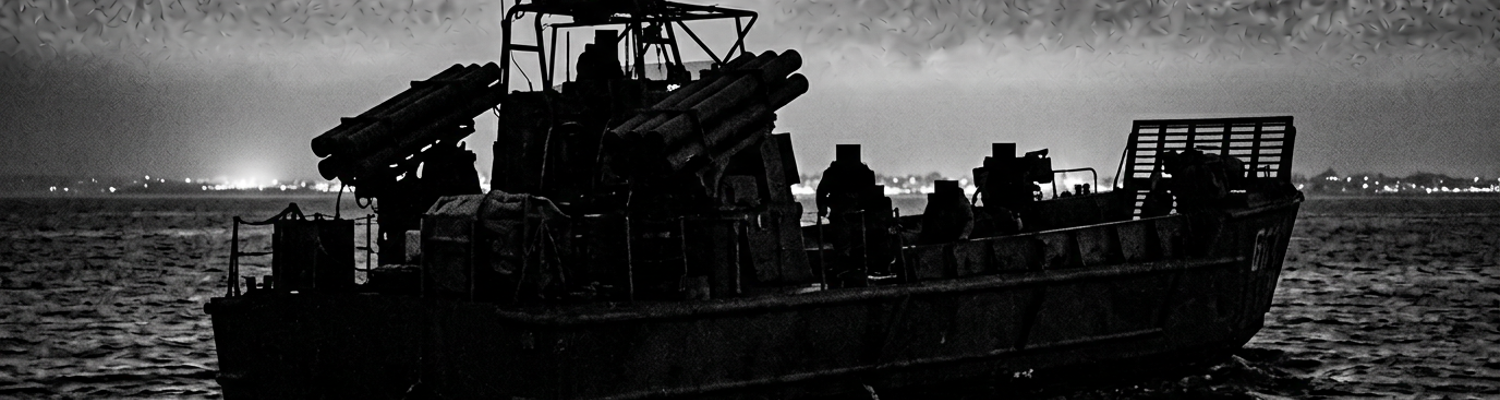

Night Supply Shuttles Along Western Leyte
Archival evidence shows theater payload manifests for the amphibious assault into western Leyte listed forty-eight Mk 7 rocket projectors. The manifests included 4,200 rounds of 4.5-inch fin-stabilized spin rockets. They also cataloged 80,000 rounds of linked .50-caliber armor-piercing ammunition. Quartermasters logged 6,000 rounds of 105mm high-explosive artillery shells and 400 fifty-five-gallon drums of 80-octane gasoline. These munitions sat packed into the open wells of Landing Craft Mechanized of the 2nd Engineer Special Brigade throughout December 1944. Major General Andrew Bruce and his 77th Infantry Division severed the main Japanese supply line by landing at Deposito on December 7. The division held an isolated beachhead. They had no overland supply routes across the razor-backed Ormoc Valley mountains. Sustaining their northern push toward Ormoc town required moving every carton of K-rations over water from staging bases at Baybay.
Operating under torrential tropical cloudbursts.
Boat companies of the 532nd and 592nd Engineer Boat and Shore Regiments handled these nightly sea runs up the Camotes Sea coastline. Engineer coxswains ran twenty-to-forty-mile routes after sundown. They timed departures to allow heavily loaded LCM-3s to beach before dawn.
Every run ran dark.
A close review of operational logs indicates these night waterborne corridors offered zero room for piloting errors. Charts of the western Leyte coast dated to pre-war surveys. They showed blank littoral bands. Uncharted coral heads and drowned mangrove forests sat inches below the surface. Boat crews operated fifty-foot LCM-3 craft without radar. They guided their flat-bottomed steel hulls purely by sounding leads dropped over the gunwales. Dense mangrove stands fringed the mouths of coastal streams like the Bao River. Silt bars shifted after every mountain rainstorm.
Propeller shafts struck submerged mahogany snags at full throttle.
Bronze drive pins sheared off. Three-bladed wheels bent into useless iron. Saltwater mixed with swamp mud fouled engine sea-strainers within twenty minutes of littoral maneuvering. This starved the twin 225-horsepower Gray Marine 6-71 diesel engines of cooling water. Mechanics pulled scalding zinc heat exchangers apart in total blackout. They cleared debris with scrap wire while bilge pumps struggled with sprung hull rivets.
Engineers muffled exhaust manifolds with burlap sacks soaked in engine oil.
Defensive geography heavily favored the Imperial Japanese Army. Observers from the Japanese 35th Army held reinforced bunker positions dug into the high limestone ridges of Mount Catmon. They occupied the heights above Camp Downes. Japanese spotters looked directly down across the littoral shelf of Ormoc Bay. Engine diesel rumbles echoed off the flat water. The sound struck the mountain walls. This revealed approaching American craft long before hulls broke through the coastal mist. Shore spotters directed batteries of Type 97 81mm infantry mortars using registered coordinates calibrated to coastal river mouths. When boat crews throttled back to work around shoals near Ipil, Japanese batteries fired illumination star shells overhead.
The flares silhouetted the unarmored supply craft against the water.
Splintered steel fragments punctured fuel drums stacked three-high in the open cargo bays. Raw gasoline dumped over active bilge pump motors. Artillery duels along the ridge line continued through December 25.
Japanese Littoral Ambush Tactics at Ormoc Bay
A close review of operational logs indicates coastal defense units of the Imperial Japanese Army 35th Army transformed western Leyte river mouths into fortified ambush zones. Japanese defensive planners anchored their perimeter around tidal estuaries between the Bao River and the downstream shoals of the Panitian River. This sat roughly four miles north of Albuera. Detachment infantry from the 1st and 26th Divisions dug two-tier timber bunkers directly into muddy riverbanks at water level. They worked under palm-frond camouflage nets. Earthworks were braced with double rows of coconut logs packed with crushed coral.
Each estuary complex held Type 97 81mm smoothbore infantry mortars.
Gunners paired these tubes with Type 92 7.7mm heavy machine guns. Emplacements sat barely three feet above the high-tide mark. This positioned automatic weapons on low grazing axes directly parallel to the sandbars. Japanese gunners zeroed their Type 97 tubes onto specific nautical chokepoints. Littoral currents pushed deep-draft craft within two hundred yards of the mangrove fringes at these exact spots. Firing pins received heavy coatings of palm oil to prevent salt-air corrosion. Ammunition crews stacked 6.5-pound Type 00 high-explosive finned mortar rounds inside dry oil drums buried beneath bunker floors.
Every firing position remained concealed under living riverbank vegetation.
Estuary ambush positions stayed dead silent until targets drifted into fixed pre-sighted coordinates.
Archival evidence shows Japanese intercept teams relied almost entirely on acoustic detection across the glassy waters of Ormoc Bay. Engine sound propagated over the mirror surface for distances exceeding four thousand yards at night. Listeners from the Japanese 1st Division manned listening pits cut into spit heads. They tracked the heavy mechanical thump of American twin Gray Marine 6-71 diesel engines. Directional listening horns fabricated from sheet zinc helped crews fix exact compass bearings.
Decelerating engine pitch signaled an inbound vessel had throttled down.
At that exact acoustic cue, Japanese mortar crews initiated concentrated fire. They did not launch illumination star shells. Weapon pits dropped rapid salvos of four to eight high-explosive mortar rounds down pre-registered bearings in less than thirty seconds. Splintering airbursts detonated twelve feet above the water. Jagged steel fragments raked open boat wells before coxswains could identify the gun flashes through the mangroves. Impacting shrapnel pierced hull plating above the water line.
Communications headsets shattered. Cargo tarpaulins tore open.
Standard LCM-3 landing craft lacked the organic firepower required to suppress these concealed shore fortifications. Factory production lines outfitted fifty-foot steel LCM-3 hulls with only two open-ring skate mounts for M2 .50-caliber Browning heavy machine guns. These sat aft alongside the coxswain shielded conning station. Twin Brownings fired 487-grain armor-piercing projectiles. These rounds embedded harmlessly into six-foot-thick packed earth. Ring-mount traverse arcs prevented machine gunners from depressing barrels low enough to sweep mudbanks. Plunging mortar fragments severed exposed hydraulic steering lines.
American engineer gunners firing forward faced a flat steel bow ramp.
This ramp blocked direct fields of view. Gunners fired blindly into black jungle silhouettes. Japanese Type 92 heavy machine guns punched clean holes through the three-eighths-inch mild steel gunwales. Return fire from aft ring mounts could not generate the high explosive blast effect required to collapse fortified mortar pits. Armor-piercing machine gun fire failed to silence buried timber bunkers.
Sixth Army Supply Bottlenecks and Ordnance Denials
Maintenance officers from the 532nd Engineer Boat and Shore Regiment submitted emergency requisitions to Base K depots at Tacloban. Rear-echelon quartermasters rejected every form. Engineers requested standard United States Navy Mark 7 launcher mounts and factory-welded deck cradles. They asked for Mark 47 mod 0 electrical fire-control switchboards to equip fifty-foot LCM-3 craft for littoral counter-battery fire. Quartermaster clerks operating under Sixth Army General Headquarters strictly enforced Army Table of Organization and Equipment 5-535S.
This document classified landing craft strictly as non-combat cargo haulers.
Supplying specialized Navy ordnance hardware to shore-to-shore army units violated inter-service distribution protocols. Depot ordnance officers possessed stockpiles of crated naval launchers shipped ashore during the initial Leyte Gulf assault. Administrators locked the materiel behind barbed-wire holding pens pending Pacific Fleet clearance. Navy supply officers refused to release fire-control consoles to army personnel who lacked formal naval gunnery ratings. Army ordnance officers refused to sign custody receipts for non-standard calibers.
Engineer crews defending coastal waterways were instructed to rely solely on pedestal-mounted M2 machine guns.
Administrative forms blocked launcher deliveries at the waterline.
A close review of operational logs indicates supply bottlenecks worsened whenever engineer craft sustained catastrophic structural damage. Depot property auditors at Tanauan required field commanders to submit War Department Form 15 property-loss certificates. They demanded these forms before issuing replacement items for parts destroyed in action. Japanese Type 97 81mm mortar airbursts shredded steering quadrants. Depot examiners required surviving coxswains to furnish sworn officer affidavits. They had to verify precise map coordinates of the equipment loss.
Clerks demanded surviving metallic remnants for physical serial number verification.
Fire-control wiring harnesses lay submerged under thirty fathoms of water inside Ormoc Bay. Depot accountants marked the items as unverified command losses. Supply depots withheld replacement starter motors and heavy-gauge copper conductors. Structural deck steel remained impounded until investigating officers completed formal line-of-duty liability inquiries. Combat-damaged landing craft sat dead at Baybay moorings awaiting paperwork.
Engineer officers broke supply protocol out of operational necessity.
This drew immediate punitive backlash from theater command. Maintenance teams from the 2nd Engineer Special Brigade began salvaging steel I-beams directly from stripped naval landing craft broached on the Red Beach reef. Technicians traded captured Japanese Arisaka rifles to Seabee detachments for salvaged electrical components. They acquired Plainville Electrical knife switches and automotive junction boxes stripped from scuttled diesel trucks. Sixth Army provost marshals responded by stationing military police at base supply dumps.
Provost marshals issued written warnings of General Court-Martial under Article of War 94.
Theater staff officers threatened brigade company commanders with formal court-martial proceedings. Officers had drilled launcher mounting bolt patterns through LCM-3 cargo deck bulkheads without prior authorization from the Army Service Forces technical bureau. Military police impounded two supply trucks carrying salvaged naval ordnance outside Dulag on December 14.
Plainville Electrical Switchboard Cannibalization
Archival evidence shows maintenance personnel from the 532nd Engineer Boat and Shore Regiment bypassed depot security at Tacloban on December 11. They diverted two tons of crated electrical switchgear. Manifest records cataloged these assemblies as heavy-duty industrial distribution panels manufactured by the Plainville Electrical Products Company of Plainville, Connecticut. The switchboards were shipped across the Pacific inside tar-lined pine crates banded with steel strapping. They were originally slated for permanent shore power plants under construction near the Tanauan airfield.
Regimental logistics officers stamped the transfer slips with emergency field requisitions.
They listed the gear for general utility installation to slip past quartermaster inspectors. Six-by-six trucks hauled the cargo to the Baybay repair bivouac. Inside the crates sat thick ebony-asbestos insulating slabs and solid copper bus bars. Porcelain terminal posts and double-pole disconnect knife switches built to handle three-phase industrial current filled the wooden boxes. No mention of combat craft modifications appeared on any official receipt. Sergeants signed falsified destination manifests to clear the perimeter gates.
Fabrication began immediately along the dark coconut groves south of Baybay.
Boat maintenance technicians hung rubberized ponchos over bamboo frames. This formed sealed light-traps against strict theater blackout orders. Red-lensed flashlights held between teeth illuminated the work surfaces. Technicians dismantled the crated Plainville assemblies. Soldiers drove cold chisels and hacksaw blades into the slate panels. They pried out forty-eight heavy copper knife switches without cracking the brittle ceramic mounting bases.
Saltwater mist rolling off the Camotes Sea had already begun oxidizing unpainted metal contacts.
Technicians scoured every copper blade and jaw with emery cloth. They tinned the terminals with rosin-core solder. Technicians spliced rubber-sheathed twelve-gauge wire harvested from wrecked trucks into the switch lugs. Bare splices received tight wraps of friction tape. Technicians bolted the cannibalized knife switches inside empty wooden ten-in-one ration boxes. They waterproofed the joints with melted candle wax to withstand breaking surf.
Soldering irons ran off idling generator trucks muffled under wet burlap.
Standard Navy Mark 47 mod 0 electrical consoles relied on motorized rotary selectors to fire rocket batteries. This equipment class remained completely denied to the Army engineers. Factory-built automated intervalometers did not exist on western Leyte. Regimental electricians constructed a manual firing matrix wired directly into two heavy-duty twelve-volt lead-acid marine starting batteries connected in series. Insulated copper conductors ran forward along the interior ribs of the landing craft.
Wires connected to the ignition squibs of twenty-four 4.5-inch finned rockets racked on Mark 7 deck rails.
Closing a single primary knife switch sent twenty-four volts down one selected line. This triggered an initial ranging shot. The coxswain could spot the splash against enemy shoreline shadows. Raking a heavy brass wiper contact across multiple switch blades in rapid succession completed circuits sequentially. This produced a staggered ripple fire of eight to twelve rockets within four seconds. The manual wipe prevented inductive voltage drops across the battery bank. Maintenance teams mounted the first completed firing box inside landing craft hull 384 at 0240 hours on December 15.
Mounting M8 Aircraft Rocket Launchers on LCM-3s
Ordnance search parties from the 532nd Engineer Boat and Shore Regiment drove requisitioned flatbed trucks north to Tacloban airfield during the second week of December 1944. Strip revetments were choked with cracked airframes from the 348th and 475th Fighter Groups. Republic P-47 Thunderbolts and Lockheed P-38 Lightnings had suffered gear collapses in the deep mud. Engineers targeted the underwing armament assemblies. Fifth Air Force armorers had fitted these fighter-bombers with three-tube cluster racks designed to launch 4.5-inch M8 fin-stabilized aircraft rockets.
Maintenance teams scavenged thirty-six operable M10 three-tube launcher barrels.
They pulled mounting brackets directly from the crushed wing spars of stripped aircraft. Technicians unbolted the magnesium-alloy and extruded-steel tube clusters under heavy rain. Cold chisels sheared stripped mounting studs when corrosion froze the factory locknuts. Mechanics loaded the salvaged clusters into ration crates alongside recovered ignition contacts. They carried the hardware back down the Leyte coast to the 2nd Engineer Special Brigade repair depot at Baybay. Wrecked aircraft wings yielded fifty-two salvageable launch tubes in forty-eight hours.
Securing aircraft rocket clusters to fifty-foot landing craft generated severe structural hazards during live-fire testing.
Standard LCM-3 gunwales consisted of three-eighths-inch mild steel coaming. This steel buckled instantly under the concussive launch impulse of multiple 4.5-inch rocket motors firing simultaneously. Regimental welders at Baybay addressed this failure by building heavy external skeleton cradles. Maintenance crews sliced four-inch structural steel channel beams and heavy angle iron salvaged from sunken Japanese coastal freighters off Ormoc. They operated gasoline-powered Lincoln electric arc welders shielded inside canvas wall tents.
Welders joined these members directly onto the forward port and starboard gunwales of LCM-3 hulls.
This formed triangular box trusses bridging the open cargo well behind the bow ramp. Technicians reinforced every deck-to-frame joint with double fillet welds. They bolted gusset plates through the craft primary interior ribbing. This structural lattice transferred thousands of pounds of instantaneous rearward recoil directly into the lower hull framework. The unreinforced cargo coaming survived the waterline stress during salvo releases. Arc-welder electrodes burned through rain-soaked gloves as night shifts worked around the clock.
Rocket exhaust proved highly lethal to American crews.
The solid-propellant grain inside an M8 rocket burned at temperatures exceeding 3,000 degrees Fahrenheit. It expelled incandescent gas and unburned potassium perchlorate granules rearward at supersonic speeds. This toxic thermal plume swept straight down the length of the cargo bay on an open fifty-foot LCM-3. The coxswain at the aft conning wheel faced an immediate danger of blinding or suffocating. Maintenance personnel eliminated this backblast hazard by constructing improvised blast shields.
They used three-eighths-inch high-tensile hull plating cut from scuttled LCVP wrecks along the Baybay shoreline.
Mechanics torched the salvage plate into trapezoidal panels. They mounted them on welded pipe stanchions twelve inches forward of the steering station. Technicians angled the face of the deflector twenty-five degrees to divert expanding combustion gases up and away from the open cockpit. They cut two three-by-six-inch horizontal viewing slits into the plate. The coxswain could maintain visual contact with coastal navigation landmarks. Technicians finished welding the blast shield onto hull 384 forty minutes before evening departure.
Night Engagements and Suppression of Shore Batteries
The 532nd Engineer Boat and Shore Regiment integrated modified rocket-bearing LCM-3s directly into nocturnal supply convoys during the third week of December 1944. Convoys ran between Baybay and the 77th Infantry Division perimeter at Deposito. Wallowing cargo landing craft carried eighty tons of artillery shells and drummed aviation gasoline apiece. Freeboards were cut down to twelve inches. Top speeds choked to six knots. Regimental commanders assigned two rocket-rigged LCM-3 hulls to screen each supply echelon along the five-mile coastal shelf between Albuera and Ipil.
Coxswains ran these converted craft three hundred yards to the landward flank of the transport line.
They operated inside the shallow three-fathom drop-off. Boat mechanics cut engine throttles to half-speed to dampen the acoustic resonance of twin Gray Marine diesels. Lookout engineers scanned the pitch-black mangrove fringes through night glasses. Saltwater spray constantly threatened to short out the uninsulated Plainville knife switches mounted inside forward cargo wells. Crewmen wiped brass contacts with kerosene-soaked rags while drifting past registered Japanese mortar coordinates. Escort craft paced the wallowing supply barges in total blackout.
Coastal ambushes erupted whenever the supply line passed within five hundred yards of estuary banks at the Bao and Panitian Rivers.
Concealed Japanese 1st Division bunker crews triggered grazing fire with Type 92 heavy machine guns. They tracked the cargo craft silhouettes. Type 97 81mm mortar squads dropped high-explosive shells across the channel. Rocket boat coxswains instantly hauled their wheels hard toward the shoreline. They aligned their bow ramps directly with enemy muzzle flashes. Engineers dropped the primary Plainville disconnect switch when the modified craft reached seven hundred yards from shore.
Twenty-four 4.5-inch M8 aircraft rockets ripped off their launch rails in a four-second staggered ripple.
The launch expelled blinding white magnesium backblast against the improvised LCVP steel deflector shields. Each rocket carried 4.3 pounds of high-explosive Composition B. Warheads detonated on contact with the sandbars and mangrove roots. The resulting blast saturated beach positions with thousands of razor-edged steel casing fragments. Sandbag revetments shredded. Palm-log parapets sheared off. Exposed Japanese ready-use mortar ammunition stockpiles cached along the mudbanks detonated.
Exploding high-explosive warheads stripped the swamp canopy down to bare timber within five seconds.
Rocket crews possessed no defensive armor against shore-based artillery once their firing positions were exposed. The blinding flash of twenty-four solid-fuel propellant burns illuminated the rocket LCM-3 against the black surface of Ormoc Bay. This presented an immediate target to Japanese artillery spotters dug into Mount Catmon. Imperial Japanese Army batteries of Type 41 75mm mountain guns held pre-plotted fire coordinates for the offshore shoals. They required less than fifty seconds to adjust onto visual signatures.
The coxswain spun the conning wheel the moment the final rocket cleared its rail.
He shoved both throttle levers forward to 2,100 RPM. The steel hull swung seaward before exhaust smoke cleared the well deck. Gunner mates dropped smoke pots off the stern coaming to obscure their exit vector. Heavy 75mm counter-battery rounds erupted into the water four hundred yards behind the craft. Geysers of brine churned across empty ocean where the rocket boat had floated forty seconds earlier. Battery fire from the heights struck undisturbed water at coordinates 10 degrees 56 minutes North, 124 degrees 37 minutes East at 0248 hours.
Bureaucratic Clashes Over Unauthorized Field Modifications
Sixth Army ordnance inspectors arrived at the Baybay boat staging pens on December 16, 1944. They carried clipboards and impoundment tags. Technical inspection teams operating under the authority of Base K Ordnance Section boarded modified LCM-3 hulls tied off along the mangrove slips. They identified non-standard firing boxes bolted directly behind the forward gunwales. Depot auditors immediately cited Article of War 83. They declared the wooden ten-in-one ration boxes and Plainville Electrical knife switches to be gross deviations from Army Service Forces equipment standards.
Inspectors attempted to confiscate the firing assemblies on the spot.
They ordered boat mechanics to unbolt the terminal blocks and sever the twelve-gauge trunk lines running to the forward M8 rocket racks. Engineer company commanders refused to surrender the equipment. Enlisted mechanics blocked the boarding gangways with spud wrenches and grease guns. Boat coxswains claimed the firing consoles were permanent structural installations wired directly into primary 24-volt battery circuits. Maintenance officers stalled the inspectors behind the repair revetments.
They demanded formal administrative impoundment manifests bearing the direct authorization of the theater ordnance officer at Tacloban.
Heated confrontations on the wet sandbars ended only when regimental officers ordered armed sentries to clear all non-divisional inspection personnel from the revetment perimeters before nightfall. Inspectors left the beachhead without a single wire harness. Staff officers within the 2nd Engineer Special Brigade instituted a systematic paper deception to shield their modified craft from subsequent administrative seizures. Regimental logistics clerks began filing falsified War Department Form 15 property-loss certificates for every piece of electrical switchgear taken from Base K supply yards.
Company commanders reported these components as destroyed during combat engagements in the Camotes Sea.
They drafted sworn affidavits claiming entire crates of Plainville distribution equipment had taken direct hits from Japanese 75mm mountain gun shells off Albuera. False map coordinates were logged into the casualty registers. This specifically placed non-existent equipment detonations in deep water at 10 degrees 55 minutes North, 124 degrees 38 minutes East. Rear-echelon inspectors could never conduct physical serial-number recoveries at those depths. Field officers officially wiped the hardware from active Sixth Army property books by recording functional switchboards as scrap iron resting on the sea floor.
Mechanics continued mounting the components into hulls across the Baybay repair yards.
Supply ledgers classified fully operational rocket boats as sunken tonnage. The unquestioned operational utility of the improvised rocket craft abruptly halted all disciplinary investigations from General Headquarters. Major General Andrew Bruce and his 77th Infantry Division faced severe ammunition depletion north of Deposito. They required thirty tons of artillery shells and rations per day to sustain the offensive against the Japanese 12th Independent Infantry Regiment. Japanese coastal ambushes threatened to cut this sole maritime lifeline between Albuera and Ipil.
Escorting rocket LCM-3s repeatedly broke the ambushes by firing high-explosive saturation salvos.
Delivery logs show rocket-escorted supply runs pushed over 1,200 tons of munitions and fuel into the 77th Division beachhead between December 18 and December 24. They did not lose a single cargo lighter. Theater ordnance auditors quietly shelved pending court-martial charges against the engineer officers. Base K property files marked the unauthorized conversions as unresolved field adjustments on December 28.
Tactical Legacy of Army Engineer Flotillas
The field conversions welded together along Ormoc Bay established the United States Army first formal tactical doctrine for littoral support gunboats. Theater planning previously treated Engineer Boat and Shore Regiments strictly as waterborne transport companies tasked with unloading Navy transports onto secure beaches. The improvised installation of M8 aircraft rocket racks onto LCM-3 hulls proved landing craft could act as self-contained strike vessels inside restricted waterways. Deep-draft Navy destroyers could not enter these zones.
Combat engineers drafted improvised standing operating procedures directly from nocturnal rivermouth skirmishes.
They standardized firing protocols pairing sweeping .50-caliber machine gun fire with sudden forty-round rocket salvos launched within eight hundred yards of concealed shore targets. Boat company commanders codified specific battle drills. Coxswains formed wedge formations upon approaching contested estuaries. Lead boats suppressed shore emplacements with high-explosive area saturation. Trailing cargo craft skirted the shoals outside Japanese mortar range. These field-tested procedures transformed flat-bottomed transport hulls into aggressive shore-suppression gunboats capable of breaking coordinated coastal ambushes without direct naval or air support.
The army stopped viewing landing craft strictly as floating trucks.
Sixth Army headquarters directly adopted these lessons for the January 1945 invasion of Luzon. They replaced makeshift field fabrications with factory-standard rocket-armed LCMs. The 2nd Engineer Special Brigade mounted assault landings across Lingayen Gulf and later pushed along the Bataan Peninsula. Boat companies deployed production-line rocket landing craft manufactured in mainland United States shipyards. These newly delivered hulls arrived with factory-installed Mark 7 rocket projectors and heavy-gauge steel splinter shields.
They featured sealed Navy Mark 47 electrical fire-control consoles.
This eliminated the need for cannibalized Plainville knife switches. Engineer coxswains operated craft equipped with calibrated automatic intervalometers during landings around Corregidor and inside Manila Bay through February 1945. This hardware distributed circuit voltages uniformly across twenty-four-rail launcher assemblies. It prevented the dangerous misfires that plagued early trials on Leyte. Factory ordnance kits included shock-absorbing recoil cradles bolted through primary frames. This protected engine bedplates from concussive fractures during rapid salvo releases.
Maintenance companies in the 532nd, 542nd, and 592nd Engineer Boat and Shore Regiments integrated these standardized craft directly into littoral assault waves.
They used them to saturate seawall fortifications and caves around Mariveles Harbor before infantry scrambled down the bow ramps. Luzon gunboat crews fired factory-calibrated launcher banks instead of stripped aircraft tubes. The engagements along western Leyte demonstrated the absolute requirement for autonomous organic fire support within army littoral engineering units. Seventh Fleet destroyers and specialized landing craft gunboats frequently pulled away from shallow coastal corridors to fulfill blue-water fleet protection missions.
Naval task forces focused high-caliber gunfire on offshore survival when Japanese kamikaze attacks escalated across Leyte Gulf.
This left army supply craft defenseless inside four-foot-deep tidal river channels. Engineer commanders could not wait two hours for corps artillery clearance or naval gunfire liaison approval while shore mortars walked high-explosive rounds across beached wooden supply lighters. Direct command of rocket-armed gunboats gave engineer regimental commanders immediate tactical autonomy. Local officers suppressed sudden ambushes within forty seconds of initial contact. Operational reports compiled after the surrender of Manila documented over eighty independent combat missions where 2nd Engineer Special Brigade rocket craft neutralized shore fire without requesting a single salvo from offshore naval vessels. The 2nd Engineer Special Brigade logged its final autonomous rocket engagement near Corregidor at coordinates 14 degrees 23 minutes North, 120 degrees 35 minutes East on March 2, 1945.