
Branch Rickey and the Chemical Warfare Service
At 0415 hours on November 4 1918 a German 150 millimeter artillery salvo shattered the primary copper wire trunk south of Romagne sous Montfaucon.
This severed all contact between forward medical triage teams and division headquarters.
A close review of operational logs indicates that the troops trapped along the ravine line had already absorbed hours of saturated chemical fire. German artillery batteries alternated high explosive concussive rounds with Green Cross phosgene and Yellow Cross mustard agent shells. They saturated the damp limestone ravines of the Meuse Argonne sector. Phosgene entered the lower respiratory tracts of men caught without their charcoal canister masks properly seated within the mandatory six second window. Once inhaled carbonyl chloride reacted with moisture across lung tissues. It converted into hydrochloric acid and carbon dioxide. The acid destroyed alveolar walls. Blood plasma leaked into the air sacs over a latent period lasting between four and twenty four hours.
Soldiers who seemed uninjured at dawn collapsed by midday.
They suffocated internally as their lungs filled with their own bodily fluids. Yellow Cross shells deposited oily liquid mustard agent that adhered to uniform wool and exposed skin. The agent penetrated three layers of standard issue clothing within fifteen minutes. It produced deep chemical burns across the groin and neck folds. Vapor concentrations burned corneas and swelled eyelids shut. Entire companies were functionally blind and non ambulatory.
Standard litter bearer evacuations collapsed under the sheer volume of chemically incapacitated soldiers.
When examining the historical record this systemic crisis fell directly upon the newly formed administration of the United States Army Chemical Warfare Service. Archival evidence shows that on August 15 1918 Wesley Branch Rickey was commissioned directly as a major in the Chemical Warfare Service under War Department General Orders. Rickey was the thirty six year old field manager of the St Louis Cardinals. His Official Military Personnel File is preserved in the National Personnel Records Center in St Louis. It documents his immediate processing through Camp Kendrick in Lakehurst New Jersey. Officers underwent rapid technical training in gas defense doctrine and toxic munitions handling before embarkation for France. Travel manifests placed him at the headquarters of the American Expeditionary Forces in Chaumont by late September 1918. He carried orders that embedded him directly within the administrative hierarchy responsible for standardizing chemical defense protocols across forward divisions.
His administrative background was built on years of tracking player physical metrics and organizational charts in professional baseball.
This made him suited to managing large scale troop survival programs rather than static trench combat. Rickey was assigned to forward gas defense administration and casualty pipelines. He worked across sectors where American units suffered their highest chemical loss rates. His duty sheets confirm that his mandate covered coordinating the delivery of thousands of replacement Small Box Respirators. He managed supply depots for neutralization bleach. He established decontamination staging areas behind active lines. Forward field hospitals were overwhelmed. Treated mustard casualties routinely off gassed inside enclosed medical tents. This incapacitated doctors and orderly crews who had not yet masked.
Inspections of transport bottlenecks along shell churned roads showed horse drawn ambulances and heavy White Motor Company trucks bogged down in knee deep chalk mud.
They blocked clearance routes back to base hospitals at Souilly. Records from these field checks demonstrated that ground ambulances took upwards of sixteen hours to transport severely gassed soldiers over a distance of only twelve miles. This delay turned treatable phosgene exposure into terminal pulmonary edema. Operational directives produced during this period detailed the necessity of separating gas casualties by chemical agent type at the collection point. They demanded rapid air exchange procedures and expedited mechanical transport before secondary lung infections developed.
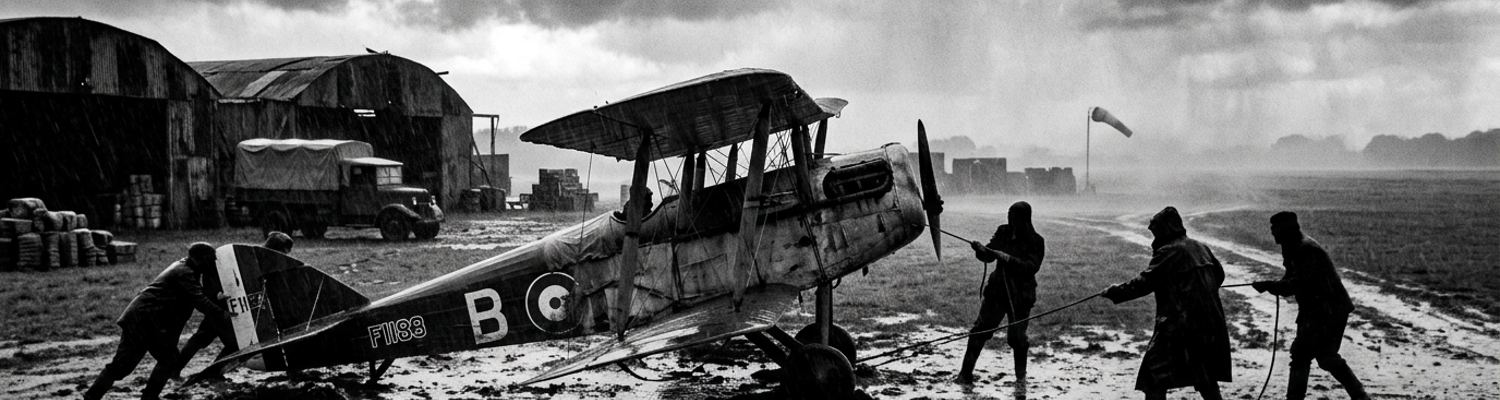
By the first week of November Rickey was evaluating forward airstrips near the front line.
He needed to determine whether open cockpit biplanes could bypass the paralyzed road networks entirely.
Meuse Argonne Ground Transport Paralysis
When examining the historical record of the 107th Sanitary Train during the drive past Montfaucon physical movement along Route Nationale 46 had dissolved into an absolute standstill. Relentless barrages from German 210 millimeter mortars pulverized the macadam surface between Avocourt and Romagne sous Montfaucon. The road became knee deep liquefied limestone chalk. Into this churned sediment rolled the standard evacuation fleet. Three quarter ton Model 1917 GMC motorized ambulances entered the mud. Stripped Model T Fords followed. Wooden Model 1909 escort wagons drawn by four mule teams sank immediately.
Front axle steering knuckles snapped when wheel hubs struck submerged artillery craters.
Wooden artillery spokes splintered across the rocky sub base. Heavy vehicles stranded directly in the single available traffic lane. Cooling fans sucked thick liquid clay through exposed radiator honeycombs. Ambulance engines overheated within four hundred yards of the forward lines. Mechanics operating under the First Army Motor Transport Service reported stripped differential gears. Shattered leaf springs disabled the suspension systems. Ruined drive shafts could not be repaired in the field. Spare castings were completely absent from the supply chain. Teamsters attempted to bypass stalled motor columns. Draft mules sank past their hocks in sticky mire. Leather traces snapped. High sided wooden wagons overturned into inundated roadside shell craters.
Shattered wagon frames permanently obstructed the clearance corridor.
Archival evidence shows that German artillery crews intentionally saturated these vehicle blockages with yellow cross dichloroethyl sulfide shells. Low lying depressions along the road network held heavy oily mustard agent. It failed to disperse in the cold stagnant November air. Ambulance tires picked up the dark viscous liquid. They flung it against floorboards and hot exhaust manifolds. Engine heat instantly vaporized the trapped agent. Concentrated toxic fumes piped directly into unventilated driving compartments. Drivers belonging to the 314th Ambulance Company were already working without sleep for forty eight hours. They suffered rapid corneal ulcerations and temporary blindness while steering through shell holes.
Chemical vapors seeped through standard fabric gas masks.
These masks lacked specialized eye protection against persistent vesicants. Mules inhaling vapors from road puddles developed necrotic ulcers across their nasal mucosa. Pulmonary hemorrhages followed. Chemical hoof rot forced teamsters to shoot dozens of draft animals directly in the harness. Stalled convoys could neither advance toward forward triage posts nor reverse along single track lanes flanked by flooded marshland. Entire casualty evacuation lines locked into place. Evacuation times stretched from sixty minutes to nearly a full day.
A close review of operational logs indicates that this transit paralysis erased the golden hour necessary to keep acute phosgene victims alive.
Battalion aid stations operating out of basements in Gesnes en Argonne and Romagne received hundreds of men presenting with latent carbonyl chloride poisoning. The chemical destroyed alveolar membranes. It triggered an internal exudation of blood plasma that progressively drowned the patient. Clinical protocol required immediate absolute physical immobility combined with continuous pure oxygen administration. This arrested the process before irreversible cyanosis set in. Forward medical officers had no oxygen. Steel H cylinders containing pressurized medical gas sat stranded in rear echelon supply depots at Souilly. They were forty miles behind the stalled transport columns.
Frontline dressing stations possessed only three portable Haldane oxygen facepieces per division.
All of them sat empty after the first forty eight hours of the offensive. Medical corpsmen placed gassed infantrymen on wet canvas stretchers. They covered them with damp blankets to mitigate freezing autumn rain. Shivering and involuntary coughing drastically elevated muscular oxygen demand. Mild pulmonary edema converted into acute asphyxiation within ninety minutes of exposure. Men died silently while awaiting ambulances that never arrived. Field Hospital 110 recorded that over seventy percent of phosgene casualties arriving after a six hour delay died within twelve hours of admission.
Medical personnel could only prop dying soldiers upright against stone cellar walls to relieve airway pressure.
They suctioned pink frothy discharge from their throats with manual rubber bulb syringes. Without mechanical ventilation or oxygenation cardiac failure inevitably followed massive pulmonary anoxia. Triage officers had to mark stable walking wounded cases for transport priority. They left blue faced gurgling pulmonary casualties on cellar floors to succumb to internal fluid accumulation. Records from the 37th Division confirm that sixty eight phosgene victims suffocated on their litters in a single cellar outside Romagne between midnight and dawn on November 5.
Field Conversion of Frontline Observation Biplanes
Archival evidence shows that during the first week of November 1918 mechanics attached to the First Army Air Service repair park at Rarecourt began stripping standard Dayton Wright DH 4 observation biplanes. They modified the airframes to accommodate supine casualties. Flight mechanics unbolted the rear Scarff gun ring. They detached the twin 0.30 caliber Lewis guns. They removed the observer folding bench seat. Riggers used handsaws to cut away internal spruce fuselage cross bracing. They sawed through upper fuselage longerons behind the rear cockpit.
They slit and pulled back the doped Irish linen covering.
Mechanics removed the curved mahogany plywood turtledeck to create an open rectangular aperture along the top of the rear fuselage. Ground crews riveted angle iron brackets directly into the lower ash structural members. They installed spring loaded steel clamps to lock standard Stokes wire basket litters into place. This installation pushed the aircraft center of gravity five inches aft of its engineered balance point. Adjusting for this rearward mass required inserting beveled wooden shims beneath the leading edge of the horizontal stabilizer. This maintained level flight trim under the deadweight of an immobilized soldier.
A loose litter handle could slide three inches sideways.
It wedged against the exposed elevator control wires running down the inner fuselage wall. When examining the historical record of test flights conducted between Clermont en Argonne and the triage center at Souilly low altitude aeromedical profiles through the Meuse River valley revealed severe propulsion vulnerabilities. Both Liberty L 12 and Curtiss engine configurations failed repeatedly. Autumn rain and dense river valley fog dropped ambient temperatures to near freezing. Ice formed inside the dual Zenith duplex carburetors of the 400 horsepower Liberty engines. Moisture penetrated unsealed distributor caps in the Liberty Delco battery generator ignition system.
Immediate short circuits and misfires occurred across entire cylinder banks.
Units attempting low altitude runs with lower output Curtiss engines ran into cooling breakdowns. Flying at eighty feet over the mud to stay beneath low cloud decks cut airflow through the frontal radiators. The engine ran at sustained full throttle. Churned clay thrown up from unpaved staging strips coated the brass radiator fins. Water temperatures exceeded ninety six degrees Celsius within eight minutes of liftoff. Violent evasive banking maneuvers to escape German machine gun arcs caused air pockets to form in the gravity feed fuel lines. This starved the carburetors of aviation gasoline. Carburetor throat icing dropped propeller output by three hundred revolutions per minute over the broken ravines of the Aire Valley.
A close review of operational logs indicates that ground crews under the 1st Air Depot faced severe structural degradation.
These converted airframes operated from waterlogged soil south of Montfaucon. Mechanics had to slice away wet exterior fabric with straight razors. They inspected fuselage joints that cracked under the unbraced weight of the stretcher bay. Cellulose nitrate dope refused to dry in the eighty five percent humidity. Bare spruce framing remained exposed to steady autumn drizzle. This added twenty five pounds of water weight to each lower wing. Pilots flying aeromedical evacuation runs could not exceed sixty miles per hour without triggering violent tailplane vibration. The altered airflow over the open rear cockpit trough caused this instability. On November 5 at the Vavincourt depot diagnostic measurements showed that cutting the upper decking had reduced the rear fuselage torsional rigidity by twenty eight percent. The tail structure twisted two inches out of alignment under heavy rudder input.
Communications Failure Across Forward Triage Sectors
Archival evidence shows that by 0500 hours on November 4 1918 German counter battery concentrations systematically dismantled the American wire network across the Cunel Romagne corridor. Batteries of 150 millimeter sFH 13 howitzers zeroed in on physical junction boxes along the road banks of Ravin de la Ferme de la Madeleine. Heavy steel fragments severed standard Signal Corps eleven strand twisted pair copper clad steel wire. The lines broke into unusable segments measuring less than three feet long. Field line crews operating Model 1917 breast reels attempted to splice the breaks under continuous shell bursts.
Fresh detonations blasted the circuits out of the sod within minutes of repair.
Ground shock waves pulverized subterranean line splices buried three feet beneath the chalk loam. By sunrise switchboard operators attached to the 89th Division post at Bantheville were listening to dead magneto lines across seven separate forward triage sectors. Wire crews died within twenty minutes of entering the open shell fields. A close review of operational logs indicates that alternate runner routes dissolved under the same sustained bombardment. German artillery gunners maintained continuous creeping interdiction barrages over the sunken lanes connecting the 353rd Ambulance Company triage point to the rear relay posts at Cierges.
Infantry couriers carrying message envelopes through the Ravin aux Pierres crossed saturated ground.
Persistent diphenylchloroarsine sternutator dust and yellow cross blister agent coated the path. Shell craters overlapped so densely across grid coordinates 303.4 to 281.2 that couriers lost physical bearings in the dark. They slipped into liquid muck holes contaminated with concentrated chemical sediment. Casualty sheets demonstrate that runner losses exceeded sixty eight percent along this three mile sector between midnight and dawn. Two out of every three couriers sent back with casualty estimates or requests for ground transport collapsed from pulmonary edema or explosive shrapnel strikes before reaching the division clearing station.
Every physical link back to corps headquarters ceased to exist before first light.
When examining the historical record of the forward collection posts near Sommerance this absolute technical silence forced Chemical Warfare Service detachment officers into immediate administrative mutiny. Standard American Expeditionary Forces evacuation doctrine strictly required Fifth Army Corps medical controllers and First Army Air Service coordinators to approve any reallocation of observation aircraft. Those command elements sat miles to the rear at Souilly. They were completely out of reach. Major Branch Rickey and the Chemical Warfare Service inspectors on site faced holding pens packed with three hundred acute gas victims. Their pulmonary tissues were disintegrating. Carbonyl chloride inhalation cases had approximately ninety minutes before irreversible fluid accumulation choked off airway oxygen exchange completely.
Waiting for motor ambulances trapped in mud twenty miles south meant certain death for every suffocating soldier in the ravine.
Army Field Service Regulations strictly prohibited local officers from assigning military aeroplanes to unsanctioned medical evacuations. Archival evidence shows that forward Chemical Warfare Service officers abandoned corps level clearance entirely. They seized direct control over local aeromedical sorting. They instituted an unauthorized triage system based solely on toxic agent physics. Officers bypassed standard divisional triage priority boards. They rejected severe mustard gas casualties. Widespread blistering and hypothermia would prove fatal in an open eighty mile per hour slipstream at freezing altitudes.
Inspectors pushed acute phosgene victims with early stage cyanosis straight toward improvised airstrips.
They manually chalked transport numbers onto their helmets. Mechanics loaded these men into converted Dayton Wright DH 4 observation aircraft without written orders from division surgeons or flight clearance authorizations from the First Army Air Service commander. Ground officers shoved litters into raw timber fuselage brackets under bursting shrapnel rounds. They signed zero transfer manifests as the biplanes taxied through deep mud.
Engine Fuel Locks Under Counter Battery Fire
When examining the historical record of operations on November 4 1918 an unpaved pasture strip at coordinate 304.2 to 280.9 southwest of Romagne became the site of a severe mechanical breakdown. A Dayton Wright DH 4 biplane lost all power during its takeoff run. It featured an open rear fuselage trough holding two comatose phosgene casualties. The aircraft belonged to an emergency air detachment operating with the 1st Air Depot. Its 400 horsepower Liberty L 12 engine shuddered violently and died. Air pockets formed within the gravity feed fuel lines.
Mechanics had rerouted the primary lines from the upper wing gravity tank.
They ran exposed five sixteenths inch annealed copper tubing down to the dual Zenith carburetors. Stagnant engine heat trapped against the cowlings while idling in deep mud boiled the low grade wartime aviation fuel inside the uninsulated feed pipes. Gaseous vapor replaced liquid gasoline at the carburetor needle seats. This cut fuel flow to the twelve cylinders instantly. Sergeant Michael H Varner crawled directly into the churned loam beneath the nose. He was an engine specialist assigned to the First Army Air Service maintenance pool. He needed to reach the fuel petcock before the cylinders seized.
Raw aviation gasoline dribbled over the hot exhaust manifold.
Varner hammered the brass union nut free with an eight inch wrench. A close review of operational logs indicates that German batteries positioned along the Bois des Loges ridge detected the engine noise. They initiated concentrated counter battery interdiction. Salvos of 105 millimeter light field howitzer shells and 150 millimeter high explosive rounds slammed into the wet pasture grass at ninety second intervals. Shrapnel tore jagged slits through the linen covering on the lower left mainplane. Iron fragments embedded into the spruce wing spars. Ground handling crews from the 353rd Infantry Regiment and two flight mechanics were forced to manually hand prop the stalled Liberty inline engine. They also prepped an adjacent backup pursuit biplane equipped with a 160 horsepower Gnome Monosoupape rotary.
Hand starting these powerplants under falling artillery shells required lethal physical coordination.
Ground crewmen locked hands in a human chain across the slick mud. They grabbed the laminated walnut propeller blade to pull it downward past dead center with their combined weight. If an engine kicked backward the eight foot wooden blade severed hands and fractured skulls instantly. Splattering clay ruined the men footing. Handlers slid on their bellies into the turning arc of the propeller hub. Fragments from nearby bursts whined overhead. Shell concussions threw two mechanics into the mud. Steel splinters shredded the biplane left aileron cables.
Archival evidence shows that clearing the vapor lock inside the DH 4 required disconnecting the lower carburetor inlet pipe.
Pressurized fuel sprayed over Varner face. The sergeant unscrewed the union nut. He vented trapped vapor pockets until a continuous stream of pure liquid gasoline drained into his sleeves. In the front cockpit Second Lieutenant Paul R Albright worked the hand pressure pump. He set the ignition switch to the battery side of the Delco dual distributor assembly. Cold autumn drizzle and splashing chalk sludge coated the spark plug terminals. This caused intermittent electrical grounding along the right cylinder bank. Varner retightened the brass fitting with bare hands. He ignored chemical burns from the aviation spirit. He signaled Albright to prime the induction manifolds.
Two infantrymen pulled down on the propeller blade once more.
They threw their bodies clear into the waterlogged wheel ruts as the cylinders fired in an irregular sequence. The twelve cylinder Liberty engine caught at 1400 revolutions per minute. Liquid mud and unburnt fuel blew across the open stretcher deck.
Operational Legacy of WWI Aeromedical Evacuation
Flight logs preserved at the National Archives recorded the first aerial delivery touchdown fifty two minutes after wheels lifted from the Meuse mud. Archival evidence shows that surviving receiving logs from Base Hospital 82 in Toul and Base Hospital 117 at Neufchateau trace the direct clinical results of these emergency flights. Transport manifests signed by receiving surgeons between November 4 and November 8 indicate that eighteen acute gas casualties bypassed the sixteen hour ground ambulance bottleneck along Route Nationale 46 entirely. Flight times from the forward strip near Romagne sous Montfaucon to the graded turf runways behind Toul averaged forty one minutes. The aircraft crossed forty five miles of shell cratered terrain at an altitude of twelve hundred feet.
Admitting physicians at Toul noted that phosgene victims arrived with stabilized pulse rates.
They presented lower levels of tracheal froth than ground transfers who had lingered in unventilated holding cellars. Receiving manifests at Neufchateau documented that seven out of eight aerial evacuees survived the critical initial twenty four hour observation window. This compared to an admission mortality rate topping sixty four percent for phosgene cases arriving by GMC motor ambulance. Flight crews handed over carbon stained ledger cards. The cards listed patient tags and estimated cubic centimeters of phosgene inhaled. Airfield line sergeants recorded precise departure times to the second.
Speed preserved human lung tissue.
A close review of operational logs indicates that the ad hoc November 1918 flights provided the primary empirical data set used by the Army Air Service to construct its interwar aeromedical ambulance doctrine. Flight surgeons led by Major Louis H Bauer studied the mechanical and physiological deficits recorded during the Meuse Argonne air transfers. They used this data when establishing the initial curriculum for the School of Aviation Medicine at Brooks Field. The improvised wooden braces and uninsulated cockpits of the November conversions exposed casualties to freezing slipstreams. This induced severe shock and accelerated hypothermia in mustard gas victims. To rectify this the Air Service Engineering Division at McCook Field in Dayton Ohio used the Meuse Argonne data to design dedicated air ambulances.
They began with the 1920 conversion of the Curtiss JN 4H.
This culminated in the Cox Klemin XA 1. These aircraft incorporated fully enclosed internal rear fuselage bays engineered specifically to receive two standard Stokes litters. Field mechanics no longer needed to saw through structural longerons. Designers added steel sheet insulation. They diverted engine exhaust gases through belly manifolds to heat the casualty compartment. This directly resolved the freezing air issues documented in the Toul delivery files. Draftsmen redesigned the airframes around the stretcher. When examining the historical record of interwar field service regulations the unauthorized initiative shown by forward Chemical Warfare Service officers was codified into formal military instruction.
Army Regulations 40 1025 and subsequent Air Corps tactical circulars formally recognized aircraft as specialized medical transports.
They were no longer viewed as repurposed observation tools. The regulations mandated dedicated litter locking mechanisms and continuous cabin oxygen supplies for high altitude transport. Planners recognized that communication blackouts and pulverized road networks were standard conditions of high intensity artillery combat. They were not isolated accidents. Training programs established during the late 1920s incorporated forward casualty evacuation drills directly into staff officer exercises at the Air Corps Tactical School at Maxwell Field. Medical logistics officers analyzed the specific fuel line vapor locks and wet turf takeoff weights experienced south of Montfaucon. They calculated required runway lengths fuel reserves and aircraft engine maintenance schedules for future frontline medical evacuations.