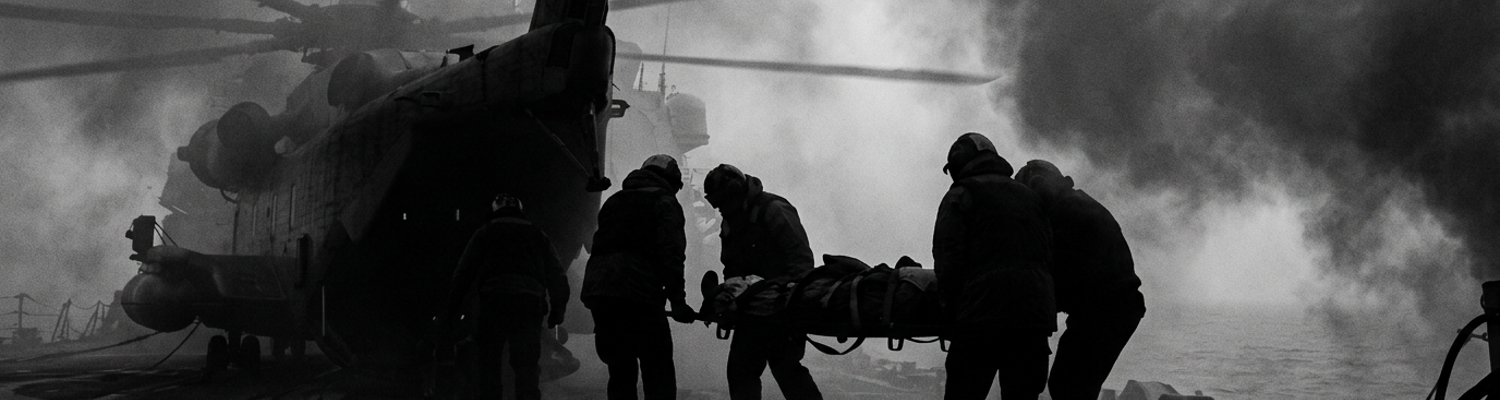

Northern Persian Gulf Minefield Deployment Parameters
Emergency flash traffic crossed the northern Persian Gulf tactical net at 0435 hours on February 18, 1991. Operators logged an immediate underwater detonation. The starboard bow of USS Tripoli suffered violent hull flex. Progressive flooding followed. Steel frames buckled. A sixteen-by-twenty-foot breach opened below the waterline at geographic coordinate 28 degrees 58 minutes north, 49 degrees 15 minutes east. Archival evidence shows the flagship was attempting to establish an operating pocket inside an active Iraqi minefield. The objective was to sustain around-the-clock clearance tracks. Water rushed directly into third-deck storage compartments. JP-5 jet fuel spilled into adjacent passageways. The ship listed three degrees to starboard.
The task group had sailed past the outer perimeter of an unmapped defensive belt. No warnings existed.
Iraqi forces anchored four layered mine barriers across the northern littoral between September 1990 and January 1991. They deployed more than 1,300 individual ordnance units between the Kuwaiti coastline and the twelve-fathom curve. The primary contact threat came from the LUGM-145. This was an Iraqi-assembled moored spherical mine carrying 145 kilograms of cast TNT. These steel spheres used lead chemical horns containing glass ampoules filled with electrolyte solution. Crushing a horn closed an internal circuit. Electric current dumped directly into the central detonator. Iraqi naval command interspersed these moored weapons with Italian-designed Misar MANTA influence mines to defeat shallow-draft sweep vessels. These low-profile fiberglass cones rested flat on the muddy seabed floor. Conventional search sonars could not easily locate them. Inside each housing, multi-sensor microprocessors monitored ambient acoustic signatures and magnetic anomalies simultaneously. Once an approaching warship met the target signature profile, the MANTA initiated a 140-kilogram hexolite shaped-charge warhead. A high-velocity jet projected upward through the hull. Civilian dhows and commercial tugs rolled these devices directly off their stern ramps. They did not record accurate deployment coordinates.
No accurate plots existed for the southern boundary.
(Defense Intelligence Agency report 91-042)
A close review of operational logs indicates the United States Navy assigned USS Tripoli to coordinate the clearance of a twelve-by-five-mile Fire Support Area. Battleships USS Missouri and USS Wisconsin required this swept corridor within twenty nautical miles of Faylaka Island. They needed this position to suppress Iraqi shore artillery and coastal anti-ship missile sites. Operating with ocean minesweepers USS Impervious, USS Leader, and USS Adroit, Tripoli functioned as an afloat staging base for Airborne Mine Countermeasures Squadron 14. Heavy MH-53E Sea Dragon helicopters worked off the flight deck. They towed mechanical cutter cables and Mk 105 magnetic hydrofoil sleds through coastal waters. Flight crews flew low-altitude patterns for hours under severe physical strain. They fought three-knot tidal currents. Heavy particulate salt built up on turboshaft compressor blades. Surface sweeping ships crept forward behind the aircraft at three knots. They used AN/SQQ-14 hull sonars. These sensors struggled to differentiate MANTA casings from discarded shipping debris and seabed silt mounds.
Clearance speeds slowed to less than five square miles every twenty-four hours.
Tripoli pushed forward into uncleared water. The goal was to reduce helicopter transit distances and maintain continuous flight operations. That decision exposed the non-mine-hardened amphibious hull to moored contact spheres swaying just beneath the surface swell. The blast sheared through the starboard fuel handling rooms. Diesel fuel saturated lower compartments. Toxic vapors drove through the forward ventilation trunks.
Dual Mine Detonations on Tripoli and Princeton
The explosion against Tripoli occurred at 0436 local time. An anchored LUGM-145 contact sphere impacted the forward starboard hull. Seawater rushed through frames 14 to 28 at a rate exceeding several thousand gallons per minute. Forward storerooms were destroyed. Aviation fuel transfer lines perforated. Third-deck bulkheads took the brunt of the hydrodynamic blast. They bulged under the kinetic load. JP-5 fuel mixed with incoming water. This created an explosive oxygen-depleting vapor pocket. Captain John C. McFadden faced a mathematical crisis. Withdrawing the damaged flagship would shut down airborne mine clearance operations entirely. Naval gunfire support groups would lose their operational path toward the Kuwaiti coast. McFadden chose to stay. Damage control parties shored up secondary bulkheads with heavy timbers. They rigged electric submersible pumps across three flooded decks. Four portside void tanks were counter-ballasted to correct the three-degree list. The flagship operated without functional sonar or forward collision safety margins. It sustained helicopter sorties from its aft flight deck while floating directly over an unmapped mine line.
Leaving the minefield meant abandoning the fire support mission.
Naval planners pushed the Aegis guided-missile cruiser USS Princeton into the same uncleared quadrant. The objective was to shield the vulnerable minesweeping flotilla from shore-based Iraqi Silkworm anti-ship missile batteries and low-altitude Mirage F1 strike runs. Archival evidence shows commanding officer Captain Edward B. Hontz positioned his warship twenty-eight nautical miles off Failaka Island. He accepted severe underwater exposure to maintain continuous radar coverage. Combat Information Center consoles tracked tactical tracks across the northern theater. The ship crept ahead at barely five knots to minimize its acoustic profile. Below the water, multiple bottom sensors had already calculated the hull displacement and magnetic field strength.
(Hull Inspection Report PR-91-02)
Disaster struck three hours after the Tripoli detonation. At 0715 hours, USS Princeton detonated two MANTA influence mines within seconds. The first acoustic-magnetic bottom mine initiated in sixteen meters of water directly beneath the stern. The shockwave lifted the 9,600-ton warship out of the sea. Main propulsion shafts severed from their bearings. Two seconds later, a second MANTA detonated two hundred yards off the starboard bow. The keel counter-flexed. The hull whip cracked the superstructure from the main deck through the 03 level. Internal electrical conduits snapped. The AN/SPY-1A phased array radar cooling lines dislodged. Primary coolant drained into the forward auxiliary spaces. A three-inch firemain pipe ruptured. System pressure dropped from 150 psi to zero in twelve seconds. Hydraulic pressure loss locked the port rudder rigidly at eleven degrees left. The sudden failure of the aft electrical switchboards plunged the ship into darkness. Power died to both propeller shafts. Severe vertical deck displacement injured three sailors in the auxiliary machinery rooms.
The billion-dollar cruiser drifted without steerage inside an active detonation zone.
A close review of operational logs indicates damage control teams restored emergency diesel generators within fifteen minutes. They bypassed split wiring harnesses to re-energize the forward combat systems. The minesweeper USS Adroit and salvage tugs moved into position to rig tow lines. Princeton missile technicians brought the forward Mark 41 Vertical Launch System back online. This maintained local anti-air warfare coverage. Hontz refused early evacuation orders. He kept his crew at general quarters to track incoming air contacts. Engineers secured leaking fuel tanks. They monitored progressive hairline fractures spreading along the aluminum deckhouse. The ship sat dead in the water for thirty-three hours. Seabed influence sensors pinned it in place until ocean-going tug USNS Beaufort hooked onto the bow.
Below-Deck Blast Trauma and Engineering Space Triage
The upward transmission of energy through the keel drove steel deckplates vertically upward with sudden kinetic force. In the auxiliary machinery rooms and lower engineering spaces of USS Princeton, the shockwave hit before any acoustic warning could register. Personnel standing directly on unyielding diamond-plate floor grates absorbed hundreds of Gs of vertical acceleration through their ankles, shins, and spinal columns. The sudden upward heave hurled watchstanders toward overhead cable trays and high-pressure steam pipes. Skulls fractured. Collarbones snapped. The crew fell back down onto dislodged pump housings. Heavy machinery ripped completely from hardened shock mounts. It shifted across multiple engineering flats. High-pressure fuel lines and electrical junction boxes tore free from the bulkheads. Flying metal fragments and shifting motor assemblies pinned trapped sailors. This produced compound crush injuries to their lower legs and pelvises. In auxiliary machinery room number two, a sheared pipe flange struck an auxiliary machinist. The impact caused an open compound fracture. It severed a femoral artery. Catastrophic arterial bleeding began within seconds.
Unsecured gear turned into lethal high-velocity fragments across thirty compartments simultaneously.
(Medical Department Triage Log 0730)
Hospital corpsmen and designated repair locker personnel faced an immediate mass-casualty crisis inside Repair Locker 5 and the aft engineering compartments. Corpsmen entered pitch-black machinery flats lit only by battle lanterns. They waded through cold bilge water. The water was already two feet deep and rising from sheared sea chest valves. Progressive flooding forced the medical personnel to perform battlefield triage directly on slippery deck plates. They applied mechanical tourniquets and pressure dressings to open fractures. They balanced wounded sailors on rising water lines. The physical environment deteriorated quickly. Ruptured refrigeration coils dumped dense Freon gas into the unventilated bilges. This displaced breathable oxygen. Corpsmen fitted casualties into emergency escape breathing apparatuses while working. Diesel fuel and aviation lubricants slicked the access ladders. They mixed with incoming seawater to form an emulsion. This degraded traction and filled the compartment air with hydrocarbon mists. Halon fire-suppression systems triggered from sudden thermal spikes and severed control wiring. Chemical smothering agents dumped into the confined spaces. Acute chemical inhalation risks threatened both the wounded and the responders attempting to keep their airways clear.
Every breath in the lower bilges drew aerosolized fuel directly into damaged lung tissue.
Damage Control Locker 3 coordinated the extraction of immobilized personnel up narrow vertical escape scuttles. They simultaneously set watertight boundaries. The buckled hull structure distorted doorframes. Quick-acting watertight doors jammed. Rescue teams employed sledgehammers, hydraulic spreaders, and portable cutting torches to access injured engineers. Stretcher bearers could not maneuver standard rigid litters through the distorted dog-legged access trunks of the lower platforms. Corpsmen lashed the most severely injured into flexible fabric rescue sleeves. This included the sailor with the severed femoral artery. They hoisted them vertically through three decks of buckled framing. Below them, damage control parties fought to maintain suction on portable dewatering pumps. These pumps choked repeatedly on floating debris, insulation foam, and saturated uniform fragments. Toxic gas testing teams armed with chemical detection tubes moved ahead of the stretcher parties. They monitored lower explosive limits as fuel levels rose alongside seawater in the auxiliary spaces. Shipboard medical officers converted the mess decks into an emergency triage clearing station. They prioritized patients by blood loss severity and respiratory failure rates. Exterior medevac flights into the contested airspace above were arranged.
FLTSATCOM Circuit Failure and Medical Telemetry Loss
Defense Communications Agency ultra-high-frequency FLTSATCOM channels collapsed under atmospheric interference and combat bandwidth exhaustion within minutes of the second explosion. Aboard both USS Tripoli and USS Princeton, shipboard AN/WSC-3 transceiver terminals attempted to transmit high-priority operational messages and digitized casualty rosters through the Indian Ocean FLTSAT satellite. Over the northern Persian Gulf, ambient meteorological conditions severely degraded signal propagation. Low-level marine temperature inversions combined with heavy soot suspended from scorched Kuwaiti oil facilities. This created severe atmospheric ducting and multipath phase cancellation along the 25-kilohertz UHF satellite downlink paths. Concurrently, the operational tempo of the air campaign choked the Defense Communications Agency shared satellite architecture. Air Tasking Order distribution, tactical strike coordinating nets, and higher-headquarters flash precedence traffic saturated the available transponders. Lower-priority shipboard administrative and secondary supply circuits were automatically bumped offline. Signal-to-noise ratios plunged past the functional threshold of the shipboard demodulators. Radio operators cycled through backup frequencies. They encountered carrier cross-talk, unreadable cryptographic synchronization loops, and constant carrier drops.
The satellite link died completely.
(Communications Log 0735)
A close review of operational logs indicates this outage caused a complete loss of real-time casualty status updates and surgical telemetry between damaged combatants and the hospital ship USNS Mercy. Anchored south near Jubail, Saudi Arabia, medical staff aboard the thousand-bed treatment ship had prepped specialized trauma suites to receive blast casualties from Task Group 151.1. Complex clinical telemetry packages were designed to push baseline blood pressure readings, blood requirements, burn surface percentages, and electrocardiogram data directly from Princeton medical department to the hospital ship receiving surgeons. These failed to pass through the packet-switched data streams. Triage teams on Mercy had no incoming information regarding the severe arterial injuries, skull fractures, and hydrocarbon inhalation trauma sustained in Princeton auxiliary machinery spaces. Radiomen on the damaged cruiser attempted to route urgent casualty manifests across terrestrial high-frequency nets. The AN/URT-23 transmitters suffered antenna matching unit faults caused by structural deck displacement from the bottom-mine detonation. Without functioning high-frequency or satellite links, text messages entered manual paper processing queues. These took hours to transmit across congested ultra-high-frequency line-of-sight relays.
Mercy had twelve operating rooms standing empty.
Flight surgeons aboard Tripoli resorted to hand-scribbled grease pencil notes taped directly to the casualties flight vests. This communicated field intubations and tourniquet application times. Evacuation flight routes crossed over contested coastal air defense zones. Aircrews could not establish direct ultra-high-frequency voice contact with Mercy casualty clearing desk while flying below the radar horizon to evade shore-based Iraqi radar tracking. Operating without patient load projections, surgical specialists on the hospital ship could not prepare targeted blood products, neurosurgical instrument trays, or autologous transfusion systems prior to helicopter touch-downs. In the receiving bays, teams of twenty corpsmen stood by portable stretchers. They did not know whether inbound CH-46 helicopters were delivering ambulatory smoke-inhalation cases or expiring surgical emergencies with catastrophic hemorrhages.
Triage teams cut away soaked battle dress uniforms with trauma shears to discover the injuries on the deck.
EMCON Alpha Breach Under Faylaka Silkworm Threat
Faylaka Island sat less than thirty nautical miles northwest of the damaged warships. It anchored the eastern flank of Iraq coastal missile defense network. Shore-based Iraqi HY-2 Silkworm anti-ship missile batteries and fire-control radars remained active on nearby Faylaka Island. Operating from reinforced concrete revetments near the island southern airfield, the Second Coastal Defense Missile Battalion manned mobile CSS-C-3 launchers. These were loaded with six-meter-long liquid-fueled cruise missiles carrying 513-kilogram shaped-charge warheads. Target acquisition fell to truck-mounted Type 352 Square Tie and Cross Slot fire-control radars. These swept the maritime approaches toward Kuwait City in periodic bursts to evade coalition electronic jamming. From these prepared coastal berms, Iraqi battery crews maintained clear lines of fire across a forty-five-nautical-mile operational radius. This directly overlapped the swept channel where US combatants operated. Princeton was dead in the water from two bottom-laid MANTA mines. Its cracked superstructure and locked port rudder left the billion-dollar combatant completely unable to maneuver out of targeting vectors. Damage control teams had extinguished secondary fires. The ship was an immovable radar target floating inside sixteen meters of water. A single direct impact from a half-ton shaped-charge warhead would slice through the compromised keel girder.
Iraqi fire-direction crews required ninety seconds of steady emission data to calculate a firing solution.
(Threat Assessment Report 0850)
Seventh Fleet tactical doctrine mandated strict Emission Control Alpha across the northern Gulf to deny Iraqi direction-finders that exact baseline. Standard operating procedures for EMCON Alpha prohibited all electromagnetic radiation across the entire radio frequency spectrum. Ships were barred from transmitting on active search radars, navigation sets, and voice networks. Paralyzed FLTSATCOM channels had already severed digital casualty data streams to the hospital ship USNS Mercy. Trauma surgeons were left completely blind to incoming surgical cases. Medical officers in Princeton auxiliary engineering spaces reported that an auxiliary machinist with a severed femoral artery had entered irreversible hemorrhagic shock. Inbound CH-46 Sea Knight casualty evacuation helicopters launched from USS Tripoli could not pinpoint the drifting cruiser. Dense soot drifting off burning Kuwaiti oil fields choked visibility to less than one nautical mile. Low-altitude flight paths prevented aircrews from establishing line-of-sight ultra-high-frequency radio contact with the ship.
Strict operational discipline preserved the warship while guaranteeing the death of wounded personnel below decks.
Commanders deliberately violated EMCON Alpha restrictions to broadcast unencrypted high-frequency emergency casualty transmission coordinates. Captain Edward B. Hontz chose to risk the ship to preserve the lives of his severely injured crewmen. In Princeton aft radio central, radiomen rigged jumper cables across buckled switchboards. They routed emergency power from auxiliary diesel generators to an AN/URT-23 transmitter. They disconnected the KG-84 cryptographic keying units. Operators patched directly into surviving broadband fan-wire antennas on the mast. They selected an open tactical high-frequency channel. They broadcast in clear voice without encryption. Radio watchstanders spoke the coordinates of 28 degrees 54 minutes north, 49 degrees 12 minutes east openly into the microphone. They repeated the warship exact grid position, drift vector, landing flight path, and casualty categories. High-frequency ground waves propagated across the northern littoral. This gave Iraqi electronic support measures units on Faylaka Island an instantaneous radio line of bearing. Tactical action officers countered this severe targeting exposure by keeping Princeton forward Mark 41 Vertical Launch System fully energized on auxiliary power. They calculated that shipboard Standard SM-2 surface-to-air missiles had roughly forty seconds of flight time to intercept any inbound cruise missile.
Unencrypted voice transmissions punched through the atmospheric interference.
The transmissions guided the inbound evacuation pilots directly onto Princeton smoking flight deck. Flight crews held their CH-46 hovering over buckled deck framing. They loaded the unconscious machinist and two blast-concussion casualties into the cabin. They initiated immediate liftoff toward USNS Mercy at 0920 local time. Damage control parties immediately secured the high-frequency transmitters. The cruiser plunged back into complete electromagnetic silence. Lookouts scanned the western horizon for low-altitude cruise missile exhaust plumes.
Royal Navy Sea King Aeromedical Evacuation Execution
Flight crews of Royal Navy 845 Naval Air Squadron operated Westland Sea King HC.4 helicopters from forward staging platforms. They intercepted the unencrypted high-frequency emergency call within seconds of broadcast. Pilots copied the coordinates of 28 degrees 54 minutes north, 49 degrees 12 minutes east. They spun up their twin Rolls-Royce Gnome H1400-1 turboshaft engines. They launched into low-visibility airspace without waiting for escort clearance. To evade detection from Iraqi Type 352 Square Tie fire-control radars on Faylaka Island, the Sea King crews dropped to twenty-five feet above the surface swell. Flying at 120 knots beneath hostile radar beams, the pilots held magnetic headings through oily smoke clouds. Forward sightlines were cut to several hundred yards. Salt spray crusted across cockpit windshields. Aircrews relied on Doppler instruments and radar altimeters while skimming across the unmapped mine barrier.
The Sea Kings reached the crippled cruiser without alerting coastal missile batteries.
(Flight Profile Record 0915)
The lead Sea King touched its landing gear onto Princeton distorted flight deck at 0928 local time. The pilot kept rotor thrust engaged to prevent sliding across buckled steel plating. Stretcher teams hauled three severely injured men up the rear ramp into the cabin within ninety seconds. The auxiliary machinist arrived in deep hemorrhagic shock. His femoral artery had been severed by a sheared pipe flange. His pulse exceeded 140 beats per minute. Royal Navy medical attendants secured the mechanical tourniquet. They initiated rapid intravenous fluid expansion using normal saline bags hung from overhead cargo netting. They monitored the failing respiration of the casualty. Two other blast casualties suffered from depressed skull fractures and chemical lung damage from fuel fumes. They were strapped onto floor tie-downs. The pilots pulled maximum collective away from the cruiser cracked superstructure.
Rotor wash churned oily sea foam across the water as the transport accelerated south.
The flight to the hospital ship USNS Mercy covered sixty-two nautical miles across the northern Gulf combat corridor. Flight crews pushed the Gnome engines to top continuous output. They maintained an altitude under fifty feet to shield the helicopter from mainland search antennas until crossing south of the contested sector. Fifty-one minutes after the mine detonated beneath Princeton auxiliary engineering flats, the Sea King touched down on Mercy flight deck off Jubail. By delivering the hemorrhaging machinist to surgical staff under the sixty-minute threshold, the aeromedical team successfully met the clinical standard for the trauma golden hour. The direct flight arrived fifty-six nautical miles south of the mine barrier. This was forty minutes ahead of standard supply routing estimates.
Trauma teams wheeled the casualties off the flight deck within two minutes of touchdown.
Clinical logs from USNS Mercy indicate that receiving surgical staff moved the machinist directly into Operating Room 3 without secondary staging. Operating teams were already prepped from Princeton emergency radio broadcast. They placed arterial clamps across the severed femoral vessels. They evacuated massive hematomas. They inserted a saphenous vein graft before irreversible tissue death set in. Specialists simultaneously elevated a depressed skull fracture on the second sailor. This relieved intracranial pressure that had caused pupillary dilation. USNS Mercy logged all three patients as stabilized in the intensive care unit by 1145 hours. Electronic surveillance aircraft confirmed that Iraqi Silkworm missile batteries on Faylaka Island stayed dormant throughout the entire flight profile.