
Imperial Japanese Navy Incursions and Regional Vulnerability
Eight hundred-kilogram Type 99 Number 80 armor-piercing bombs. Two hundred and fifty-kilogram Type 98 high-explosive ordnance. Forty-five-centimeter Type 91 aerial torpedoes containing two hundred and five kilograms of explosive charge. Twelve-centimeter naval shells. Hundreds of thousands of rounds of twenty-millimeter autocannon ammunition entered the Indian Ocean theater inside the magazines of the Imperial Japanese Navy First Air Fleet.
When examining the historical record, this carrier strike force under Vice Admiral Chuichi Nagumo shattered Allied naval dispositions across the Bay of Bengal during early April 1942. Five fleet carriers launched hundreds of aircraft against Colombo and Trincomalee. Japanese aviators sank the carrier HMS Hermes, the heavy cruisers HMS Cornwall and HMS Dorsetshire, and thousands of gross register tons of merchant shipping in days. Coastal telegraph stations from Durban to Mogadishu flashed urgent interception warnings to British outposts that previously considered themselves protected by distance. Panic gripped Allied bases throughout East Africa as regional commands calculated that Japanese task forces possessed complete sea control between the Sunda Strait and Madagascar. East Africa Command headquarters in Nairobi tracked reports of Japanese submarine reconnaissance flights off the coast and prepared for imminent shore bombardment.
Allied naval dominance in the western hemisphere vanished overnight.
A close review of operational logs indicates that Admiral Sir James Somerville ordered the surviving elements of the British Eastern Fleet to fall back across thousands of nautical miles to Kilindini Harbor. This anchorage was situated on the southwestern flank of Mombasa Island at coordinates 4 degrees 03 minutes South, 39 degrees 39 minutes East. Kilindini offered a deep-water basin shielded by offshore coral reefs. This provided the fleet with its sole functional redoubt between Colombo and South Africa. Somerville dispersed four vintage Revenge-class battleships into the tidal waters of the harbor basin. These included Resolution, Ramillies, Revenge, and Royal Sovereign, along with the fleet carrier HMS Formidable. Protecting this concentration of capital assets presented severe defensive problems. Shore emplacements around the narrow harbor entrance at Likoni and Ras Serani consisted of only a few fixed naval rifles and outdated QF 4.7-inch guns. The surrounding landward approaches possessed almost no natural barriers against a mechanized landing force. The Royal Navy needed this harbor operational to refuel destroyers and escort convoys northward into the Red Sea. Colonial planners had to devise rapid static defenses before Japanese carriers sailed westward from Ceylon.
Kilindini became an indispensable fleet base without possessing the armaments to defend its own perimeter.
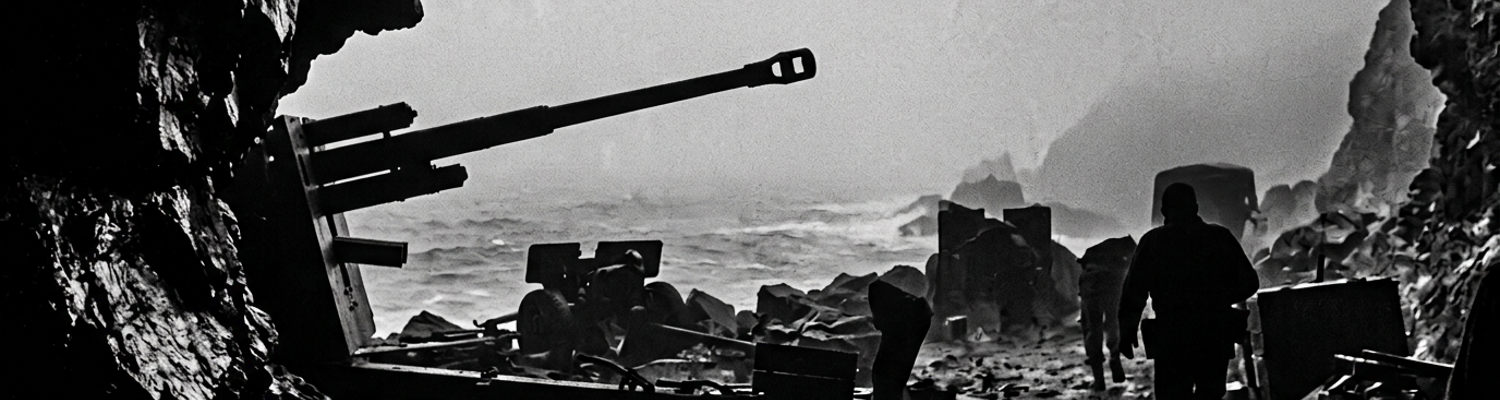
Archival evidence shows that Lieutenant-General William Platt ordered the immediate construction of subterranean fortifications along the Mombasa coastline to neutralize amphibious armor. Platt commanded British East Africa Command. Tactical intelligence circulated in mid-1942 warned that Japanese invasion doctrines utilized tracked landing craft and light amphibious vehicles. Planners specifically feared the Type 2 Ka-Mi establishing beachheads ahead of infantry battalions. Sappers from the East African Engineers and drafted laborers cut deep into the fossilized Pleistocene coral rag along Shelly Beach and Nyali. Crews used pneumatic jackhammers, black powder, and high explosives to bore underground command posts, communications trenches, and subterranean pillboxes flush with the coral plateaus. Excavators carved wide antitank ditches directly across the shoreline shelves to trap tracked armor in dead ground. Engineers covered these kill zones with recessed concrete bunkers mounting QF 2-pounder and 6-pounder antitank guns. Underground galleries linked these coastal hardpoints to ammunition magazines sunk six feet into the limestone. Kenyan and British enlisted gun crews occupied these subterranean bunkers in ninety percent humidity. They stood watch over the low-water marks where Japanese landing craft were expected to strike.
US Army and British Command Redoubt Inspections
Archival evidence shows that in June 1942, technical observers from the United States Army Middle East Force landed at Port Reitz airfield. They joined British East Africa Command engineers on a comprehensive defensive survey. Washington needed immediate verification that Mombasa could survive a carrier-borne amphibious assault. Millions of tons of Lend-Lease supplies for the Eighth Army passed directly through the port facilities of Kilindini. Captain Arthur Vance and technical specialists from the US Army Ordnance Department met with British fortress commanders. They drove down to coastal battle stations in canvas-topped Ford trucks. The humid air sat at ninety-five degrees Fahrenheit with near-total saturation. British staff officers unrolled tactical maps over field tables. These documents revealed troop dispositions spread thin across forty square miles of mangrove swamps, tidal creeks, and exposed coastline. American engineers carried calibrated gauges and optical range equipment to measure gun embrasures, weapon clearance sectors, and shell-hoist mechanics.
Both delegations knew the island was isolated.
When examining the historical record, engineering teams began their physical inspection inside the subterranean galleries cut directly into the porous coral limestone along the cliffs of Ras Serani. Sappers from the 34th Field Company, East African Engineers, had blasted these tunnels six to fifteen feet beneath the surface using gelignite. The geological formation resisted clean excavation. The Pleistocene coral rag shattered into brittle, jagged fissures rather than smooth faces. Heavy humidity condensed along the bare rock walls. This created subterranean pools that fouled electrical wiring, corroded battery terminals, and rusted the traverse rings of artillery mountings. Vibrations from overhead diesel generators shook fine limestone dust loose from the unlined ceilings. This particulate matter clogged ventilation louvers and suffocated the enlisted gunners stationed below ground. American observers documented that these tunnels lacked structural timber or reinforced concrete liners to arrest shock waves. A direct naval bombardment from fourteen-inch shells would collapse the porous overhead limestone directly onto the garrison.
Water dripped ceaselessly into open ammunition boxes.
A close review of operational logs indicates that technical assessments concentrated heavily on forward defensive saps dug outward toward the Shelly Beach low-water line. These sunken, narrow firing trenches were laid out to enfilade landing beaches with interlocking antitank fields of fire. Royal Engineers sited Ordnance QF 2-pounder guns and 6-pounder antitank positions inside concrete-reinforced apertures. They angled them across the tidal flats where Japanese Type 2 Ka-Mi amphibious armor was expected to ground against the reef. Gun crews possessed traversing arcs of barely thirty-five degrees through narrow horizontal viewing slits cut through four feet of coral rock. American observers measured the overlap between adjacent redoubts. They discovered severe ballistic blind zones where the coastal shelf dipped behind tidal sandbars. If Japanese landing craft beached during a five-foot spring low tide, the depressed barrels of the antitank guns could not traverse down far enough to hit them.
Enclosed gun chambers turned into toxic gas environments during live-fire tests.
Firing tests recorded in field inspection logs revealed that discharge gases from the 2-pounders lingered inside the unventilated saps for minutes after firing. This nauseated the loaders and blinded the gun layers with pungent cordite smoke. Recoil buffer cylinders on two inspected guns leaked hydraulic mineral oil after ten rounds. Fine coral grit scoured the internal rubber piston seals. Observers found that field phone wires strung through unarmored trenches had already degraded from saltwater spray. This severed fire control communications between the forward saps and the subterranean plotting room at Fort Jesus. American inspectors noted on July 14, 1942, that the entire interlocking fire plan depended on mechanical target spotters. These spotters used hand-cranked searchlights powered by single, unshielded gasoline engines sitting exposed on the open cliffs above the waterline.
Excavation Conditions within Porous Coral Formations
Pneumatic drill bits sheared off inside the coastal bluffs every twenty minutes.
Archival evidence shows that during July 1942, enlisted fatigue details drawn from the 56th Field Company, East African Engineers, and drafted detachments of the African Pioneer Corps labored along the limestone escarpments of Shelly Beach. They operated under direct orders to hack out four primary firing embrasures. Diesel-driven Broomwade two-tool compressors overheated continuously in the tropical sun. Crews hauled these machines across sand dunes on iron-rimmed carts. Rubber delivery hoses degraded rapidly against sharp coral outcrops. The lines ruptured under eighty pounds per square inch of working pressure. This sprayed scalding compressor oil across the trench floors. When pneumatic breakers stalled, Pioneer sappers fell back on hand tools. Crews drove iron wedges and six-pound sledgehammers directly into the fossilized Pleistocene reef. They attempted to square off fifty-millimeter gun apertures pointed across the surf line. Striking the erratic coral head fractures sent jagged fragments flying into exposed limbs. The porous rock trapped tool steel without cleaving along predictable bedding planes. Black powder charges placed in hand-drilled shot holes failed to produce uniform blast faces. The explosions often vented sideways through hidden subterranean fissures and blew back into the access trenches.
The excavation chambers possessed no natural airflow.
A close review of operational logs indicates that the mechanical cutting and explosive clearing rapidly turned unventilated saps into choking subterranean traps. Suspended calcium carbonate particles hung motionless in the ninety-eight percent coastal humidity. This dust consisted of microscopic crystalline aragonite and pulverized marine fossils. Enlisted diggers working by kerosene hurricane lamps inside four-foot-wide dead ends inhaled dense clouds of pulverized lime with every breath. Issue Mark IV service respirators proved useless. Damp, alkaline dust coated the wool-felt air filters within twenty minutes. This formed a solid crust that suffocated the wearer and forced laborers to tear the rubber facepieces off. Without protection, the abrasive alkaline grit dissolved in perspiration and eye moisture. This caused severe chemical conjunctivitis, temporary blindness, and raw ulcerations across the eyelids. Medical stations at Likoni treated dozens of sappers daily for acute tracheobronchitis and coughing spasms mixed with blood. The microscopic, needle-like mineral shards tore through bronchial membranes during eight-hour excavation shifts.
Shockwaves found every geological fault.
When examining the historical record, Royal Artillery engineers discovered that the structural properties of raw coral limestone posed lethal threats during live-fire testing. Crews fired Ordnance QF 6-pounder guns inside the finished cuts at Ras Serani. The unlined cavern ceilings possessed zero tensile cohesion under concussive overpressure. These ceilings were perforated by prehistoric solution tubes and water pockets. Test firings occurred on August 4, 1942, using full-charge armor-piercing shot. The muzzle blast generated an expanding sonic pressure wave within the confined firing chamber. This compressive pulse struck the raw limestone overhead, rebounded as a tensile wave, and triggered violent ceiling spalling across the traverse pit. Jagged slabs of coral rag weighing up to forty pounds detached from the ceiling fissures. They crashed onto the weapon cradle, crushing the elevation gears and burying the two-man sighting crew under sharp debris. Inspection teams found that without steel mesh rock-bolting or foot-thick reinforced concrete liners, repeated antitank gunfire would shatter the overhead rock formation. This would collapse the subterranean roof directly onto the breech within three consecutive rounds.
Mechanical Failure of Emplaced Light Antitank Guns
Grease and coral dust formed grinding paste inside the firing chambers within ninety seconds of live fire.
Archival evidence shows that during the third week of August 1942, East Africa Command forced two incompatible weapon systems into the newly blasted cavern redoubts guarding the entrance to Kilindini Harbor. Sappers from the 34th Field Company, East African Engineers, dragged eight American 37mm antitank guns M3 alongside twelve British Ordnance QF 2-pounders down into subterranean chambers. These positions were cut into the coastal cliffs south of Ras Muaka at coordinates 4 degrees 04 minutes 12 seconds South, 39 degrees 40 minutes 30 seconds East. The American weapons arrived under early Lend-Lease shipments without protective packaging. They sat on split-trail carriages squeezed into low-ceilinged firing bays measuring barely ten feet across. British Ordnance QF 2-pounders sat bolted directly to timber floor skids. Their heavy horizontal sliding-wedge breeches occupied nearly half the available floor space. Gun crews from the 1st East African Artillery Brigade worked in cramped compartments designed with thirty-degree horizontal traverses. This gave the loaders less than eighteen inches of clearance between the rear casing of the weapon and the unlined limestone walls. Sweat saturated their canvas uniforms as temperatures inside the unventilated rock pockets reached one hundred and two degrees Fahrenheit. Handling twenty-pound ammunition crates required loaders to contort their bodies around the carriage wheels.
Gunners had no room to swing extraction bars when the mechanisms locked up.
A close review of operational logs indicates that the physical environment immediately attacked the precision machining of both weapon types. Muzzle blast overpressure from initial test discharges pulverized the exposed ceiling rock. This stripped micro-fine calcium carbonate dust and crystalline aragonite flakes off the unsealed cave faces. Airborne mineral grit settled across exposed steel surfaces within seconds. British Ordnance QF 2-pounders operated with horizontal sliding-block breeches machined to tolerances of less than five-thousandths of an inch. American 37mm M3 guns utilized a vertical sliding breech block designed to drop open automatically upon recoil to eject the empty casing. Standard maintenance doctrine instructed crews to lubricate the sliding block channels and cocking cams with heavy mineral grease to prevent salt air corrosion. That grease captured the airborne limestone sediment. Within minutes, the oily film became an abrasive paste. It scoured the guide tracks, chewed into the bronze recoil bushings, and cemented the breech block tracks inside their housings.
The steel sliding blocks seized solid inside their guideways.
When examining the historical record, timed cycle drills conducted on August 24, 1942, revealed complete mechanical failure during combat simulation. Royal Artillery battery officers ordered the enlisted crews to sustain a rapid firing cadence of twenty rounds per minute against moored target barrels offshore. Both weapon models broke down almost immediately. Abrasive limestone powder adhered to the cylindrical chambers of the 37mm M3 guns. This scored the chamber walls and prevented the thin brass cartridge cases from expanding and extracting cleanly after discharge. Extractor claws sheared completely through cartridge rims. This left swollen, spent shell casings lodged immovably inside the hot barrels. Slotted horizontal blocks on the British 2-pounders failed to achieve full battery closure. They jammed three-quarters of the way into the breech ring as coral grit jammed the breech-closing springs. Hand-operated cocking levers bent under manual force when desperate loaders struck them with mallet handles to dislodge trapped rounds. Field inspection sheets logged eight out of twelve 2-pounders out of action after delivering fewer than six rounds apiece. Four American 37mm weapons suffered permanent extractor shaft fractures that required factory-level depot repair in Nairobi.
Saline Condensation and Rapid Ordnance Corrosion
Brine seeped through the porous limestone vaults at a rate of four pints per square yard every twenty-four hours.
Archival evidence shows that by September 1942, subterranean galleries blasted into the sea cliffs at Ras Serani functioned as uncontrolled condensing chambers for vaporized ocean spray. Trade winds driving across the Indian Ocean forced humid, sodium chloride-saturated maritime air into the unsealed embrasure apertures of the 1st East African Artillery Brigade. Subterranean temperatures inside the coral caverns remained ten degrees lower than ambient surface heat. This thermal drop caused suspended saline vapors to liquefy immediately against the cold, uninsulated ceiling rock. Dense droplets formed along the jagged limestone stalactites overhead. They collected chemical chlorides as they leached through the mineral strata before falling onto the weapons below. Gun mounts and breech assemblies on the British Ordnance QF 2-pounders took the direct impact of this continuous caustic downpour. Salty water accumulated in the traverse rings, coated the elevation gear racks, and penetrated the inner recesses of the horizontal breech blocks. This deposited crystalline salt rings inside the sliding-wedge tracks within hours of wipe-down routines.
Steel components rusted before installation crews finished tightening the foundation bolts.
A close review of operational logs indicates that the enclosed humidity rapidly compromised the internal firing and cycling components of both British 2-pounders and American 37mm M3 antitank weapons. Corrosive moisture penetrated the firing pin channels. It reacted with trace sulfur residues left behind by cordite propellants to form an acidic brine. Within two weeks of frontline deployment, firing pin assemblies seized completely inside their striker guides. Gun captains tripped the mechanical foot pedals or pulled the hand lanyards. The striker springs lacked the kinetic force to overcome the gritty oxidation bonding the pins to the housing walls. This produced repeated misfires during readiness drills. Beneath the breech rings, the tempered alloy steel used to manufacture the extractor springs suffered from severe stress corrosion cracking. Constant exposure to damp, saline air stripped the spring steel of its elastic memory. The coils lost their mechanical tension and sagged under load. By the third week of September, battery mechanics at Likoni recorded that forty percent of inspected 2-pounders failed to trip their automatic extraction cycles. Collapsed extractor springs could no longer pull fired brass cases clear of the chamber mouths.
Every mechanical action became a physical struggle against chemical decay.
When examining the historical record, East Africa Command attempted to arrest this destruction by issuing direct standing orders to the enlisted gun detachments of the African Pioneer Corps and Royal Artillery. Battery officers mandated non-stop maintenance cycles. They divided six-man gun crews into rotating two-hour watches tasked exclusively with grease packing. Enlisted gunners used wooden spatulas and bare fingers to pack mineral jelly and heavy Ordnance compound grease into every exposed seam, traverse ball race, and sliding surface. They stripped the vertical and horizontal breech blocks down to their constituent springs twice every twelve hours. Gunners boiled the raw steel parts in freshwater drums over gasoline stoves to dissolve salt crystals before coating them in thick petroleum wax. This protective barrier trapped airborne coral sand. The grease turned into an abrasive paste that had to be scraped clean with copper wire brushes and reapplied before oxidation could pit the bare metal. Supply manifests show the Ras Muaka garrison consumed over four hundred pounds of heavy gun grease per battery each month solely to prevent the complete structural freezing of their weapon carriages.
Depot stocks of anti-corrosive lubricants across the Mombasa sub-area were entirely exhausted by October 12, 1942.
Signal Attenuation Across Subterranean Line Networks
Copper conductors grounded out across the wet limestone before linesmen could wire the central switchboard at Fort Jesus.
Archival evidence shows that throughout September 1942, linesmen from the East African Corps of Signals hauled British Army Cable D Mark III and D Mark VIII spools through the subterranean galleries. These galleries linked the Ras Serani battery to forward antitank positions near the Likoni ferry. Signallers worked in pitch-black corridors lit only by smoking kerosene lanterns. They drove steel dog-staples directly into the brittle Pleistocene coral walls to suspend the lines above standing floor pools. The jagged, calcium-encrusted rock faces scraped and stripped the moving cable. Every tensioning pull dragged the vulcanized rubber insulation across sharp aragonite crystals. This sliced open the outer braided cotton coverings and sheared the thin protective sheaths beneath. Moisture dripping from the ceiling vaults was saturated with dissolved marine salts. This quickly coated the hung wires in a hard, conductive crust. Signallers spent six hours at a time crawling through eighteen-inch crawlways while carrying fifty-pound line drums on their backs. Sharp coral spurs ripped through their canvas dungarees. This caused deep lacerations that became infected by marine bacteria within twenty-four hours. By late September, over fifteen miles of tactical wire ran exposed across the unlined subterranean chambers, suspended mere inches above tidal seepage channels.
Tapping the hand-crank generator sent electric current directly into the dripping rock face.
A close review of operational logs indicates that this coastal moisture destroyed circuit integrity across every primary firing sector. Standard military wire splices failed completely against the penetrating brine. Linesmen fastened these splices using rubber adhesive tape and friction compound. High concentrations of sodium chloride dissolved the sticky binding resins within forty-eight hours of installation. Saline water seeped beneath the tape layers, pooling directly against the twisted steel and tinned-copper wire strands. This created an immediate galvanic reaction between the dissimilar metals. It accelerated conductor corrosion while forming a low-resistance electrical bridge directly to the wet limestone walls. Loop resistance across the line to the Ras Muaka 2-pounder redoubt plummeted from several thousand ohms to less than forty. Telephones Type D Mark V connected to the network lost their audio signals to deafening ground hums. Battery cells powering the magneto ringing circuits drained flat in three hours because the continuous current leaked straight into the mineralized earth. Battery commanders spinning the telephone generator handles to order range corrections heard nothing through the earpieces except static buzz and dead line hiss.
High-frequency radio sets could not push a single watt of transmission power out through twenty feet of solid Pleistocene reef.
When examining the historical record, garrison commanders discovered that portable radio equipment proved entirely nonfunctional inside the subterranean defense network. Signal detachments brought British Wireless Set No. 18 manpack transceivers down into the Ras Serani command caverns. These served as redundant links if physical telephone lines failed. Operating across high frequencies between 6 and 9 megahertz, these low-power six-volt units possessed an effective radiated power of barely a quarter-watt. The physical geology of Mombasa Island blocked their transmission instantly. Dense limestone strata, thoroughly saturated with seawater, acted as an electromagnetic barrier. The rock absorbed high-frequency radio waves within three to four feet of the cave walls. Radio operators extended twelve-foot collapsible steel rod aerials inside the chambers. The surrounding mineral mass absorbed the signals before they reached open air. Transmitters drawn down to battery compartments south of the harbor mouth could not contact the coastal watchtower situated just eight hundred yards away on the cliffs above. Signal officers attempting to rig external antenna feeders up through narrow ventilation shafts found that damp limestone dust coated the coaxial lines. This created severe impedance mismatches that burned out the final output valves within ten minutes of continuous keying.
By October 20, 1942, East Africa Command reverted all communication between subterranean antitank redoubts and central headquarters to enlisted runners carrying written messages on foot.
Communications Collapse and Misrouted Fire Missions
Static hiss obliterated nine out of every ten bearing digits transmitted down from the cliffs.
Archival evidence shows that during the final week of October 1942, forward observation posts established by the 1st East African Artillery Brigade on the limestone bluffs of Ras Serani attempted to relay target tracking plots to the subterranean QF 2-pounder emplacements at Likoni. Cliff-top observers tracking seaward sectors used Barr and Stroud optical rangefinders. They attempted to transmit target deflection, range-to-target in hundreds of yards, and rates of closure over wet ground lines. The electrical resistance across the saturated D Mark III lines degraded audio gain by as much as thirty-five decibels. Battery plotting rooms received garbled numerical strings. Numerals three, five, and nine sounded identical through the distorted earpieces of Type D Mark V telephones. Gun layers inside the subterranean chambers set elevation drums based on fragmented digits. They pointed weapon barrels at empty sandbars instead of designated surf zones. Line inductance across uninsulated rock faces produced capacitive lag. This delayed oral coordinate relays by up to forty seconds while coastal target vessels moved three hundred yards through the entrance channel. Enlisted plotters scribbled contradictory ranges onto graphite tracking boards. They reset deflection angles every twelve seconds as battery officers shouted into unresponsive bakelite handsets.
Copper line connections severed entirely across three bunker sectors at 0940 hours.
A close review of operational logs indicates that total telephone line blackouts forced garrison staff to deploy enlisted runners from the African Pioneer Corps and the 34th Field Company as emergency acoustic messengers. These men ran through four-hundred-yard subterranean communication corridors cut directly through fossilized Pleistocene coral to deliver verbal target bearings. The corridors measured three feet wide and five feet high. This left no clearance for helmets or webbing. Protruding stalactites and sharp aragonite spurs tore through uniform shirts, slicing into foreheads, shoulders, and knees in the total darkness. Runners carried no flashlights because standard paraffin lanterns consumed breathable oxygen inside the unventilated saps. Message runners memorized four-part alphanumeric fire mission codes. They sprinted through standing pools of alkaline water that concealed jagged coral drop-offs up to eighteen inches deep. Concussive reverberations from surface surf combined with ambient mechanical noise from ventilation blowers to drown out vocal shouts. Runners had to slam their bodies directly into the timber blast baffles of the redoubts before shouting target data straight into the ear of the battery sergeant. Medical logs at Likoni recorded thirteen runners treated in forty-eight hours for fractured collarbones, shredded palms, and septic lacerations caused by running blind into blind-corner limestone bulkheads.
Verbal coordinates arrived at the guns twenty-two minutes after targets cleared the kill zone.
When examining the historical record, a major live-fire coastal defense exercise conducted on November 3, 1942, exposed the total tactical failure of the subterranean gun network. East Africa Command deployed tugs towing target sleds across the outer reef at eight knots to simulate an amphibious incursion by Imperial Japanese Navy landing craft. Battery command posts misdirected distribution orders because plotting tables failed to track which subterranean guns were operational. Redoubt Number Two received bearing coordinates meant for Redoubt Number Four. This caused its Ordnance QF 2-pounder to traverse thirty degrees into solid cavern wall limestone. The two-gun section stationed at Ras Muaka received overlapping traverse orders. This converged both weapons onto the same empty stretch of open water two thousand yards behind the target sled. Gun lines lost temporal synchronization completely. Redoubts fired ragged single shots separated by intervals of up to four minutes rather than coordinated four-gun defensive barrages. Spent cartridge cases jammed extraction trays while spotters waited for impact plumes that never materialized. The towed target sled crossed the designated low-water defensive belt without a single projectile striking within one hundred yards of its wake. Subterranean redoubts expended eighty-four rounds of armor-piercing shot into unpopulated outer reefs and submerged coral shelves.
Tactical Limitations of Enclosed Cave Defenses
A three-round fire mission filled the interior of every firing sap with toxic combustion gases.
Archival evidence shows that during trials at Shelly Beach in November 1942, gun crews operating Ordnance QF 2-pounders inside closed limestone chambers faced immediate atmospheric poisoning. Cordite MD propellant, packed into brass cartridge casings, required hundreds of cubic feet of fresh air per minute to disperse its gaseous combustion byproducts. The narrow coral galleries measured barely six feet by eight feet. Only the thirty-five-degree horizontal embrasure vented to the outside surf. When the gun fired, the expanding muzzle blast generated an overpressure wave exceeding fifteen pounds per square inch that could not escape through the restricted opening. The compression wave rebounded off the solid coral rear walls. It shoved concentrated plumes of carbon monoxide, nitrogen dioxide, and suspended nitric acid vapors back over the breech. Within thirty seconds of opening fire, oxygen levels in the dead-end saps plummeted below fourteen percent. Standard service respirators lacked chemical scrubbers for carbon monoxide. Kenyan gunners from the 1st East African Artillery Brigade gasped in stagnant air pockets heated past one hundred and ten degrees Fahrenheit. Hand-cranked exhaust dampers choked on powdery limestone dislodged by the initial muzzle blast. This trapped the toxic cloud inside the enclosed space for up to forty minutes after firing ceased.
Blood dripped from the gunners ears before the fourth shell hit the breech.
A close review of operational logs indicates that Captain Arthur Vance and technical observers from the US Army Middle East Force tracked severe physical breakdown among gun detachments during the November exercises. The concussive blast reflection produced by firing high-velocity antitank ordnance in confined spaces acted directly on human tissue. Acoustic energy striking the irregular coral faces reflected at compound angles. This doubled peak overpressure levels across the crew positions. American medical observers documented that after five rounds of rapid fire, gun layers and loaders suffered bilateral rupture of the tympanic membranes, severe epistaxis, and hemoptysis from alveolar capillary hemorrhages in the lungs. Concussive shock waves scrambled the vestibular systems of the enlisted men. Loaders dropped active armor-piercing shells onto the stone flooring after experiencing profound spatial disorientation and violent nausea. Gun captains lost the ability to process vocal commands or see target reticles as optic nerve shock and blast-induced nystagmus blurred their vision. Vance recorded that every inspected detachment became entirely combat-ineffective within four minutes of initiating continuous fire. Men collapsed unconscious across the spent brass casings without ever receiving an enemy return strike.
No crew could survive twenty minutes of continuous contact.
When examining the historical record, joint technical surveys compiled in December 1942 by British engineering staff and US Army Ordnance observers reached an absolute tactical conclusion. Subterranean coral positions functioned as unsurvivable confined spaces under sustained combat conditions. Raw limestone lacked the tensile elasticity to absorb repetitive shock cycles. The bunkers would self-demolish under extended fire missions even without enemy intervention. If hostile naval artillery found the embrasure openings, incoming blast overpressure channeled down the access shafts like a pneumatic piston. This instantly crushed the lungs of anyone stationed inside the traverse pits. Escape routes comprised narrow, ninety-degree crawlways that prevented the evacuation of incapacitated casualties. Minor smoke inhalation or small ceiling fractures trapped whole detachments beneath pulverized rubble. East Africa Command received Vance and his field logs alongside War Office inspection sheets on December 18, 1942. This prompted regional planners to halt all further subterranean excavation across Mombasa Island and abandon the coral saps in favor of open revetted surface emplacements.