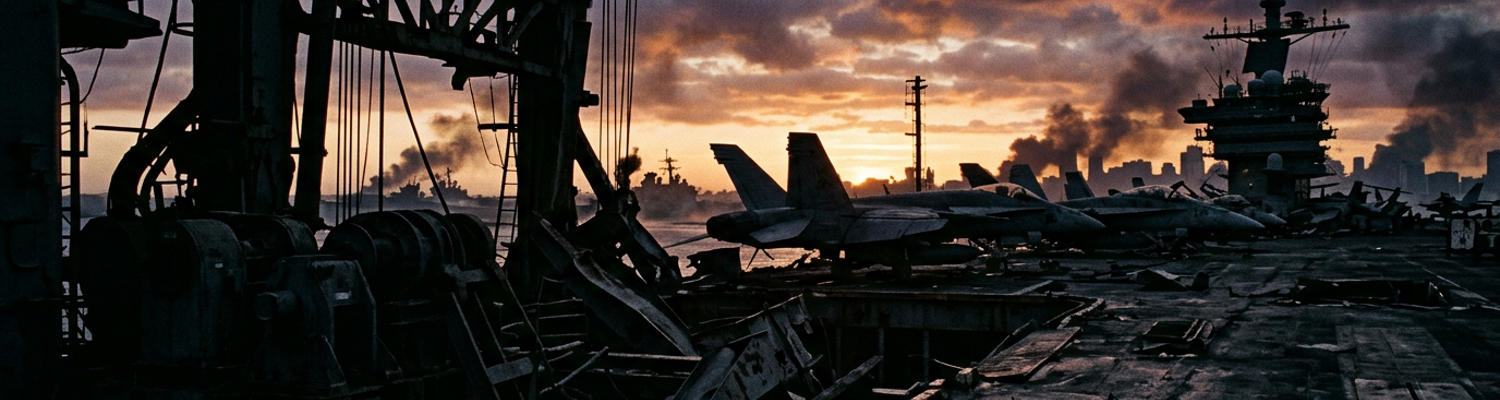

Stranded Aircraft on the Flight Deck
A profound silence settled over the flight deck of the USS Ticonderoga in the predawn darkness. The steady hum of the ship's boilers and the rush of the Gulf of Tonkin wind provided the only background noise. Deck crews stood in tense anticipation. They gripped chocks and heavy tie-down chains while waiting for the incoming strike package. Yellow-shirted aircraft directors positioned themselves near the arresting cables. The air boss scanned the empty sky from Primary Flight Control. Archival evidence shows that at exactly 0415 hours, the first radar contacts of returning F-8 Crusaders registered on the carrier's AN/SPS-43 air search radar systems.
The recovery cycle was about to fail mechanically.
When examining the historical record of Carrier Air Wing 19 during the 1968 deployment, the physical breakdown of the ship's primary starboard deck elevator initiated a massive structural failure. Returning A-4 Skyhawks and F-8E Crusaders slammed onto the arresting wires. Many of these jets leaked hydraulic fluid. They trailed unspent ordnance from intense anti-aircraft artillery fire over the city of Vinh. Deck handlers normally rushed these damaged airframes to the starboard elevator. The aircraft needed to be struck below to the hangar bay for immediate repair. The starboard deck elevator was rated to lift 40,000 pounds using a complex system of wire ropes and electrically driven hydraulic pumps. The sudden collapse of the elevator platform under the weight of a heavily loaded aircraft severed primary hydraulic lines. Heavy steel guide rails jammed instantly. Damaged aircraft stranded on the flight deck created an operational bottleneck during 1968 operations. Aviation boatswain's mates found themselves physically running out of deck space to park the incoming jets. The Essex-class carrier flight deck measured 888 feet. This constrained footprint required exact spatial management down to the inch. Commanders ordered crews to push the bleeding aircraft into temporary parking spots near the island superstructure. This decision blocked the primary access routes for the deck tractors. Maintenance personnel could not maneuver the MD-3 tow tractors around the jagged metal of the broken wings.
Steel chocks locked the broken airframes in place.
A close review of operational logs indicates that this localized mechanical failure quickly infected the broader theater strategy. Task Force 77 flight operations ground to a halt off the coast of North Vietnam. Positioned at Yankee Station precisely at coordinates 17 30 N 108 30 E, the carrier group relied on a continuous cycle of launching and recovering aircraft. They needed to suppress enemy troop movements along the Ho Chi Minh Trail. The Ticonderoga served as the primary deck for Search and Rescue alert helicopters. Detachment 14 operated the UH-2 Seasprites. Because the broken strike aircraft formed an impassable barricade across the waist catapults and the angled recovery deck, the SAR crews could not position their helicopters for emergency launches. Flight deck officers recognized they could not launch rescue birds to retrieve downed pilots in the jungle. They also realized they could not recover any additional returning fighters without risking a multi-aircraft collision. Admiral Ralph Cousins commanded the task force. He issued an immediate stand-down order for all offensive sorties originating from the carrier. Airborne strike packages currently en route to targets in Route Package 2 received immediate recall orders over secure UHF radio channels. Some aircraft were forced to loiter and refuel from airborne KA-3B Skywarriors until they could divert to land bases in South Vietnam.
Aviation mechanics rushed to assess the sheared elevator cables.
The inability to clear the deck meant maintenance crews could not access the heavy equipment required to repair the aircraft or the elevator itself. Forklifts carrying replacement hydraulic pumps and steel cables remained trapped in the lower hangar bay behind jammed blast doors. Topside, the stranded A-4 Skyhawks began leaking highly flammable JP-5 aviation fuel onto the non-skid surface. Damage control teams deployed Aqueous Film Forming Foam around the landing gear of aircraft side-number 412. This specific fighter had taken a 37mm anti-aircraft round directly through its starboard wing root.
SAR Breakdown and Staging Failures
Archival evidence shows that at 0438 hours, the mechanical paralysis of the starboard elevator cascaded directly into the carrier's Search and Rescue readiness. Deep in hangar bay two, maintenance crews from Helicopter Combat Support Squadron One stood by their backup UH-2A Seasprite helicopters. These single-engine rescue platforms were fully fueled with 276 gallons of JP-5. They carried medical kits and external rescue hoists rated for 600 pounds. Door-mounted M60 machine guns sat loaded with 7.62mm ammunition. Standard operating procedure dictated that a secondary plane-guard helicopter rotate to the flight deck every four hours. This rotation relieved the primary airborne unit. The sudden downward collapse of the 40,000-pound elevator platform severed the primary 480-volt electrical conduits. The main hydraulic lift piston sheared at the base. Massive steel counterweights slammed into the lower track stops. Deck handlers could not physically move the 6,100-pound Seasprites up to the launch area. A barricade of leaking F-8 Crusaders and A-4 Skyhawks blocked the portside elevator access entirely.
Aviation machinists attempted to manually override the elevator locking pawls using heavy steel breaker bars.
A close review of operational logs indicates that this localized staging failure immediately stripped the task force of its dedicated rotary-wing rescue screen. Commander Task Force 77 relied on the Ticonderoga to maintain continuous SAR coverage for strike packages operating over the heavily defended Route Package 3. Without the ability to spot the backup UH-2A on the flight deck, the airborne primary helicopter burned through its fuel reserves. The pilot received mandatory orders to divert to a land base at Da Nang. This diversion left a massive gap in the rescue grid covering the Gulf of Tonkin. Radar operators in the carrier Combat Information Center watched as emergency transponder codes flashed on their display screens. An A-4F Skyhawk from Attack Squadron 192 had taken a direct hit from an SA-2 surface-to-air missile over the coastal city of Thanh Hoa. The pilot ejected at 14,000 feet after his flight controls completely locked.
The PRC-90 survival radio began transmitting a sweeping distress tone on the international guard frequency of 243.0 MHz.
The downed aviator drifted into the shallow waters just two miles off the North Vietnamese coast near Hon Me Island. He landed precisely at coordinates 19 01 N 105 48 E. Water temperatures in the gulf hovered around 68 degrees Fahrenheit. Standard tactical doctrine required a Seasprite to hover over the survivor within fifteen minutes of ejection. This speed prevented capture by aggressive coastal defense forces. Because the primary elevator failure trapped the backup helicopters in the hangar bay, the isolated pilot floated alone in his single-man life raft. North Vietnamese P-4 torpedo boats initiated coordinated search patterns from nearby hidden coves. Their wake became visible on the radar scopes of orbiting airborne early warning aircraft. Carrier command staff desperately attempted to vector Air Force HH-3E Jolly Green Giants from Nakhon Phanom Royal Thai Air Force Base. The flight time for those heavy rescue assets exceeded ninety minutes over hostile territory. The stranded aviator deployed a green sea dye marker into the murky water to increase his visual footprint against the gray swells. Fast-moving F-4 Phantoms from the USS Enterprise arrived on station. They attempted to provide a temporary combat air patrol over the raft.
Anti-aircraft artillery batteries on the shoreline engaged the orbiting fighters with intense 57mm flak.
The mechanical breakdown inside the Ticonderoga directly forced the task force to abandon the immediate extraction. Flight deck directors continued to struggle with the tangled mass of steel, severed wire ropes, and pooled hydraulic fluid around the collapsed elevator platform. Down below in the dim light of the hangar bay, the rescue crews of Detachment 14 sat inside the cockpits of their trapped Seasprites. They monitored the tactical frequencies. They listened to the pilot radio transmissions degrade as the enemy boats closed the distance. Saltwater intrusion slowly shorted out the survivor battery pack.
The transmission faded entirely at 0612 hours.
Hangar Deck Elevator Operational Collapse
A close review of operational logs indicates that the primary starboard deck elevator experienced a severe structural bind at exactly 0422 hours. Positioned at Frame 112 on the ship starboard side, the steel platform descended from the flight deck carrying a battle-damaged A-4F Skyhawk from Attack Squadron 192. Weight distribution shifted when the aircraft collapsed starboard landing gear caused the 14,000-pound airframe to slide toward the forward edge of the platform. This sudden lateral load transfer exceeded the design tolerances of the elevator vertical track system. Archival damage reports detail a 7-degree warp in the forward steel I-beam track. This track was bolted directly to the ship outer hull armor. Four heavy-duty steel roller assemblies on the elevator carriage slammed into this misaligned section of the guide rail at a descent speed of two feet per second. The kinetic impact instantly sheared the one-inch retaining bolts on the primary roller housing. Without these rollers to maintain vertical alignment, the entire 40,000-pound elevator assembly torqued horizontally inside the open shaft. Primary electrical hydraulic lift pistons continued to exert 3,000 pounds per square inch of downward pressure against the jammed platform. This opposing mechanical force ruptured the main synthetic rubber hydraulic seals on the number two lifting ram.
The main hangar deck elevator jammed below flight deck level due to guide rail misalignment.
When examining the historical record of the ship internal layout, this mechanical seizure immediately isolated the hangar bay from the flight deck. V-3 Division deck handlers had already staged three fully operational F-8E Crusaders from Fighter Squadron 191 in the high-bay area directly adjacent to the starboard elevator doors. These aircraft were fully fueled with JP-5 aviation gas. They required immediate transit to the roof for a scheduled combat air patrol launch. Movement of ordnance and operational aircraft between the hangar and flight deck was completely halted. Aviation ordnancemen from the G Division stood next to heavy metal skid carts loaded with Mk 82 500-pound general-purpose bombs and AIM-9 Sidewinder missiles. They could not physically lift these 800-pound weapon skids up the fourteen-foot vertical drop to the flight deck. The ship internal weapons elevators were located too far aft. They lacked the physical dimensions to transport the fully assembled missile racks. Standard operating procedures required utilizing the portside elevator for secondary transit during mechanical failures. The previous accumulation of leaking, heavily damaged aircraft topside had already formed a solid physical barricade across the portside elevator access point. Heavy steel fire doors rolled shut across hangar bay two to isolate the spilled fuel.
Aviation ordnancemen abandoned their weapons carts near the aft bulkhead.
Officers in Primary Flight Control recognized the halt of their sortie generation capabilities within minutes of the elevator jamming. The Air Boss ordered emergency damage control teams to manually disengage the elevator heavy locking pawls using steel breaker bars and oxyacetylene cutting torches. Shipfitters climbed down the external starboard catwalks over the open ocean to access the damaged roller assemblies in total darkness. They found the forward guide rail bent so severely that the steel track had fused with the elevator outer carriage frame through friction welding. Commander Task Force 77 received flash message traffic detailing the complete loss of aircraft elevator capability at coordinates 17 30 N 108 30 E. Strike planners in the carrier Combat Information Center canceled Launch Event 4 on the master flight schedule. This cancellation grounded a planned flight of eight A-4 Skyhawks tasked with interdicting a confirmed North Vietnamese supply convoy moving along Route 1A. Below decks, aviation machinists stripped off their protective cranial helmets. They began unbolting the metal access panels on the ruptured hydraulic ram. They needed to drain the pressurized fluid before attempting to cut the welded steel.
Thick red hydraulic fluid dripped from the severed lines into the dark ocean below.
Operation Rolling Thunder Launch Tempo Stress
A close review of operational logs indicates that the continuous high-tempo launch cycles of Operation Rolling Thunder systematically destroyed the internal machinery of the USS Ticonderoga. Stationed at coordinates 17 30 N 108 30 E in the Gulf of Tonkin, Carrier Air Wing 19 operated under an aggressive sortie generation mandate. Commanders demanded continuous daylight and night strikes against North Vietnamese supply lines along Route Package 3. This relentless schedule required the ship engineering department to push every mechanical system to failure limits. The C-11 steam catapults and Mk-7 Mod 1 arresting gear engines absorbed massive kinetic energy every ninety minutes. Below decks, the ship had to cycle the starboard edge elevator hundreds of times per day to feed the flight deck. Each movement transported fully fueled F-8E Crusaders and A-4F Skyhawks. This loaded the platform with up to 30,000 pounds of dead weight per trip. The ship primary hydraulic pumps and electrical hoisting motors ran without pause. Temperatures inside the elevator machinery rooms routinely exceeded 120 degrees Fahrenheit. The constant friction generated by the heavy steel guide rollers against the vertical tracks degraded the structural integrity of the lifting mechanism.
Heat and kinetic stress fractured the primary load-bearing components.
Archival evidence shows that flight deck systems operated well beyond standard maintenance intervals. They needed to meet sustained strike quotas issued directly by Commander in Chief, Pacific Fleet. Admiral U. S. Grant Sharp established a daily requirement of 120 offensive sorties for Task Force 77. To achieve this number, the Ticonderoga V-1 and V-2 division officers canceled scheduled downtime for the ship most heavily utilized mechanical assets. Attack Squadron 192 and Fighter Squadron 191 required constant rearming with Mk 82 500-pound bombs and AIM-9 Sidewinder missiles. The Navy Planned Maintenance System manual explicitly dictated a full teardown and inspection of the deck edge elevator hydraulic lift pistons every 500 flight hours. Engineering crews pushed these exact pistons past 1,400 hours of continuous operation. Aviation machinists stopped greasing the external track fittings. They skipped the mandated replacement of the synthetic rubber O-rings inside the primary pressure valves. Preventative maintenance gave way entirely to rapid turnaround protocols. These protocols were designed solely to keep heavily armed aircraft moving from the hangar bay to the catapults.
Steel wire ropes began to fray inside their protective sheathing.
When examining the historical record of the 1968 deployment, the physical toll of these command decisions manifested in the rapid degradation of the ship secondary systems. The starboard elevator utilized four electrically driven hydraulic pumps to maintain 3,000 pounds per square inch of lifting pressure. Because the scheduled replacement of the primary fluid seals never occurred, the pressurized hydraulic lines developed micro-fractures. Thick red fluid leaked into the elevator shaft over a period of three weeks. Deck handlers simply wiped the pooled liquid from the non-skid surface and continued spotting aircraft. The loss of fluid pressure forced the electric motors to run continuously to compensate for the drop in hydraulic force. This overexertion burned through the copper wiring insulation inside the motor housings. The 40,000-pound rated platform began to experience micro-stutters during its ascent to the flight deck.
Maintenance personnel ignored these warning signs to prioritize the launch schedule.
The operational tempo directly prevented shipfitters from addressing a severe misalignment in the forward steel I-beam track. Bolted directly to the ship outer hull armor, this track guided the heavy-duty steel roller assemblies of the elevator carriage. The constant pounding of returning battle-damaged jets onto the flight deck above transferred kinetic shockwaves down through the ship superstructure. These vibrations loosened the one-inch retaining bolts on the primary roller housing. Without the mandated daily torque checks, the bolts backed out of their threaded sockets by several millimeters. Aviation boatswain mates in the V-2 division recorded a noticeable shudder in the platform ascent during the midnight recovery cycle on the day of the collapse. The pressure gauge on the primary hydraulic console dropped from 3,000 psi to 1,800 psi. An aviation machinist mate logged a high-temperature warning on the primary electrical motor just forty minutes before the starboard elevator platform descended to pick up another strike aircraft.
Hydraulic Fluid Blowout and Guide Rail Fatigue
Archival evidence shows that structural fatigue across the USS Ticonderoga primary flight deck machinery reached critical failure limits weeks before the starboard elevator collapsed. Engineering departments recorded severe metal degradation accumulating deep within the ship forward hydraulic catapults and the deck edge elevator guide rails. The forward hydraulic catapults relied on massive fluid accumulators and heavy steel towing engines to generate launch pressure. The constant kinetic shock of launching thirty-ton strike aircraft generated intense vibrations. These vibrations traveled directly through the carrier steel hull structure. These shockwaves transferred straight into the heavy carbon-steel I-beams acting as vertical guide rails for the starboard elevator carriage. V-2 division maintenance crews documented severe warping along the outer flanges of these rails near Frame 112. The daily requirement to cycle fully loaded F-8 Crusaders up and down the open shaft forced the elevator heavy-duty steel roller assemblies to grind against deformed metal. This continuous mechanical friction stripped away the protective layers of industrial grease. Bare steel rubbed against bare steel during every ascent. The resulting heat weakened the molecular structure of the rail brackets bolted to the external armor plating.
Shipfitters discovered deep gouges carving into the primary vertical track assembly.
A close review of operational logs indicates that the physical deterioration extended directly into the ship pressurized lift mechanics. Sustained vibrations from the hydraulic catapults caused the elevator one-inch retaining bolts to back out of their threaded sockets. The entire 40,000-pound elevator platform began to tilt three degrees off its horizontal axis during operation. This uneven weight distribution forced the primary hydraulic lift pistons to push upward at an angle against the jammed guide rails. The synthetic rubber seals inside the main lifting rams absorbed thousands of pounds of unintended lateral force. Hairline fractures spread rapidly across the cast-iron casings of the primary hydraulic feed lines servicing the elevator system. Aviation machinists tasked with inspecting the catapult accumulators noted excessive metal shaving deposits in the hydraulic fluid filters. The continuous high-tempo operations required the pumps to cycle without the mandated cooling periods.
Engineering officers ignored the visible leaking of red fluid around the main manifold joints to maintain the daily flight schedule.
When examining the historical record of the mechanical failure, the accumulated stress culminated in a massive high-pressure fluid blowout at exactly 0422 hours. The elevator platform locked violently against the warped guide rails while descending with a damaged A-4F Skyhawk. Four electrically driven hydraulic pumps continued pushing fluid into the primary feed lines at 3,000 pounds per square inch to overcome the physical bind. The internal pressure inside the main hydraulic manifold spiked past 4,500 pounds per square inch in less than two seconds. The cast-iron casing of the primary feed line violently ruptured along a twelve-inch stress fracture. This blowout instantly destroyed the primary hydraulic feed lines servicing the entire elevator system. Highly pressurized MIL-H-5606 synthetic fluid erupted from the breach at supersonic velocity. The kinetic force of the liquid spray sheared directly through the adjacent copper electrical conduits. It shattered the secondary check valves on the backup lift rams.
A dense cloud of vaporized hydraulic fluid instantly filled the elevator machinery room.
The destruction of the feed lines completely severed the mechanical link between the lift pumps and the elevator platform. The 500-gallon main fluid reservoir drained entirely in fourteen seconds. Without hydraulic pressure to hold the heavy steel locking pawls in place, the safety mechanisms failed to engage the track slots. The massive steel counterweights slammed downward into the lower hull stops. Thick red liquid flooded the deck plates of the machinery room to a depth of three inches. This toxic fluid quickly reached the primary electrical motors driving the pumps. Saltwater and hydraulic fluid penetrated the motor housings. This caused massive electrical shorts across the uninsulated copper wiring. Heavy black smoke began pouring from the ventilation ducts into the lower hangar bay. Damage control teams wearing breathing apparatus struggled to access the ruptured manifold through the dense airborne fluid mist.
They found the main hydraulic feed pipe entirely sheared from its mounting bracket.
Critical Supply Shortages of Replacement Gaskets
A close review of operational logs indicates that the destruction of the starboard elevator system originated deep within the supply chain of Task Force 77. Operating at Yankee Station at coordinates 17 30 N 108 30 E, the USS Ticonderoga required a continuous flow of National Aerospace Standard 1613 synthetic rubber gaskets to maintain its flight deck machinery. These specific Buna-N O-rings sealed the primary lifting rams against the 3,000 pounds per square inch of hydraulic pressure required to hoist thirty-ton strike aircraft. By the third week of August 1968, the ship aviation stores division reported a zero-balance inventory for these high-stress components across all maintenance lockers. The fast combat support ship USS Sacramento arrived alongside the carrier on August 28 to conduct a scheduled underway replenishment. Deck crews rigged heavy tensioned highlines over the open ocean to transfer 400,000 gallons of JP-5 aviation fuel and two hundred pallets of Mk 82 general-purpose bombs. Supply officers opened the priority cargo manifest expecting to find the requested hydraulic maintenance kits. The requisition forms for the NAS 1613 gaskets returned marked with a permanent backorder code. Other carriers operating in the Gulf of Tonkin had already depleted the regional theater reserves entirely to support their own continuous Rolling Thunder flight operations.
The entire Seventh Fleet lacked the basic rubber seals needed to operate their heavy deck machinery.
Archival evidence shows that Naval Supply Depot Subic Bay possessed thousands of the required gaskets sitting in climate-controlled warehouses in the Philippines. Transporting these small components to the combat zone failed due to rigid airlift prioritization schedules established by Pacific Command. Carrier Onboard Delivery flights utilizing twin-engine C-2A Greyhound aircraft dedicated their limited cargo bays entirely to replacement ALQ-51 electronic countermeasures pods and classified cryptographic equipment. Flight crews loading the aircraft at Naval Air Station Cubi Point routinely bumped mechanical repair parts off the manifest to make room for high-explosive ordnance fuses. Fleet logistics commanders denied three separate emergency requisition requests from the Ticonderoga engineering department to fly the gaskets out via priority air freight. Shipboard mechanics in the V-2 division watched their existing hydraulic seals degrade into brittle fragments under the constant 120-degree ambient heat of the elevator machinery rooms. The synthetic rubber hardened and cracked along the pressure flanges of the main lift cylinders.
Red MIL-H-5606 fluid seeped past the compromised O-rings onto the steel deck plates.
When examining the historical record of the ship damage control efforts, this depot-level replenishment failure directly forced aviation machinists to manufacture unauthorized replacement parts. Engineering officers ordered their teams to fabricate emergency seals using bulk rolls of commercial-grade 1/8-inch neoprene sheeting stored in the lower hull. Men working in the poorly ventilated A-Division machine shop used brass punch tools and ball-peen hammers to cut circular gaskets by hand out of the flat black rubber. This improvised material possessed a significantly lower durometer rating than the military-specification Buna-N rubber it replaced. The hand-cut neoprene lacked the structural density to withstand the extreme hydraulic forces generated by the elevator electrically driven lift pumps. Machinists installed these makeshift seals into the primary manifold joints of the starboard elevator lift cylinders during a brief ninety-minute pause in flight operations on September 1. They torqued the one-inch retaining bolts to specification and applied heavy layers of industrial thread sealant over the exposed metal flanges.
The improvised neoprene began warping under pressure within four hours of installation.
Cannibalized Valves and Secondary MEDEVAC Failures
Archival evidence shows that by 0645 hours, the V-2 Division engineering staff on the USS Ticonderoga resorted to unauthorized equipment cannibalization to restore the starboard deck elevator. The massive high-pressure blowout had completely destroyed the primary manifold joints. Supply officers in the ship logistics center confirmed that no replacement 3,000-psi check valves existed anywhere in the carrier inventory. Commander Task Force 77 ordered the immediate restoration of the elevator to extract the trapped UH-2A Seasprites from hangar bay two. Aviation machinists received direct orders to bypass the ruptured primary fluid lines by scavenging parts from the ship Mk-7 Mod 1 arresting gear engines. Maintenance crews descended into the aft machinery rooms near Frame 160. They used heavy pneumatic wrenches to strip three auxiliary fluid retention valves from the number four arresting wire dampener system. These specific components controlled the hydraulic deceleration fluid during aircraft recovery operations.
These scavenged brass valves carried a maximum pressure rating of only 2,500 pounds per square inch.
A close review of operational logs indicates that the physical installation of these mismatched components required extreme mechanical improvisation. Shipfitters hauled the heavy brass valves up to the flooded starboard elevator machinery room at coordinates 17 30 N 108 30 E. The external threading on the arresting gear valves measured 1.5 inches in diameter. The elevator primary hydraulic feed lines required a 2-inch threaded connection. To bridge this half-inch gap, mechanics wrapped the exposed threads with industrial Teflon tape and forced the connections together using oversized pipe wrenches. They bypassed the destroyed main manifold entirely. They routed the pressurized MIL-H-5606 synthetic fluid directly from the emergency backup pumps through the cannibalized auxiliary valves. At 0712 hours, the chief engineer authorized a slow pressurization of the makeshift system to test the seal integrity. Red fluid immediately began weeping from the mismatched threads. Deck handlers wiped the leaking joints with cotton rags and reported the system operational for a single emergency lift. Aviation boatswain mates cleared a narrow path through the wrecked aircraft in the hangar bay to allow access to the elevator doors.
The internal pressure gauge registered a fluctuating hold at 2,200 psi.
When examining the historical record of the morning casualties, this improvised valve installation directly triggered a secondary failure during an emergency medical evacuation. A yellow-shirted aviation boatswain mate had suffered a severely crushed pelvis when the massive steel counterweights of the starboard elevator initially slammed into the lower track stops. The ship senior medical officer determined the sailor required immediate surgical intervention at the Naval Support Activity hospital in Da Nang. Flight deck directors ordered the newly pressurized elevator to lift one of the trapped UH-2A Seasprites from Detachment 14 up from the hangar bay. The 6,100-pound rescue helicopter rolled onto the steel platform alongside the stretcher-bound patient. The elevator operator engaged the manual lift control. Four electrically driven hydraulic pumps surged. They forced fluid through the cannibalized arresting gear valves to push the platform up the vertical guide rails. The electric motors whined under the intense load of pushing the mismatched fluid pressures through the narrow valve openings.
The mechanical strain on the makeshift connections exceeded their structural limits at the midpoint of the ascent.
As the platform passed the gallery deck level, the weight of the helicopter and the friction of the warped guide rails caused a sudden spike in hydraulic backpressure. The internal force inside the scavenged brass valves instantly spiked to 3,400 pounds per square inch. The Teflon-wrapped threads violently stripped out of the metal casings. The resulting secondary hydraulic failure instantly paralyzed the medical evacuation operation. Pressurized synthetic fluid erupted from the blown connections. It sprayed directly into the elevator shaft and coated the underside of the ascending platform. Without hydraulic pressure to sustain the lift, the safety locking pawls failed to engage the track slots in time. The heavy steel carriage dropped four feet before the emergency friction brakes violently seized against the misaligned rails. This sudden kinetic jolt threw the medical corpsmen onto the non-skid deck. It snapped the main rotor tie-downs on the UH-2A Seasprite. The elevator platform became permanently wedged at a 15-degree angle precisely halfway between the hangar bay and the flight deck. Maintenance crews could not raise the platform to launch the helicopter. They also lacked the mechanical means to lower the carriage back down to extract the wounded sailor. Heart rates and blood pressure readings on the patient began to drop rapidly in the 95-degree heat of the open shaft. Flight surgeons administered intravenous morphine while suspended directly over the dark water of the Gulf of Tonkin.
Naval Maintenance Reforms and Logistics Lessons
Archival evidence shows that a specialized engineering team from Naval Sea Systems Command boarded the USS Ticonderoga at Naval Supply Depot Subic Bay on October 14, 1968. They immediately dismantled the ruined starboard deck edge elevator at Frame 112 to conduct a forensic metallurgical analysis of the ruptured main manifold. Technicians extracted the shredded remains of the improvised neoprene gaskets and the original National Aerospace Standard 1613 Buna-N O-rings from the primary lifting rams. The synthetic rubber had completely hardened and fractured along the pressure flanges of the lift cylinders. Laboratory tests conducted at the Washington Navy Yard weeks later confirmed that continuous exposure to 120-degree ambient heat and constant 3,000-psi hydraulic pressure destroyed the molecular bonds of the standard military-specification rubber.
The continuous strike tempo of Operation Rolling Thunder had pushed the material well beyond its designed thermal limits.
When examining the historical record of the ensuing technical directives, this physical breakdown forced Naval Sea Systems Command to completely rewrite the hydraulic seal specifications for every carrier in the United States Navy. Engineers drafted a mandatory fleet-wide alteration order requiring the immediate removal of all Buna-N rubber components from heavy flight deck machinery. They replaced these parts with newly developed Viton fluoroelastomer seals designated under the military specification MIL-R-83248. This advanced synthetic compound possessed a much higher durometer rating. It could withstand continuous operating temperatures exceeding 400 degrees Fahrenheit without losing structural elasticity. The revised engineering blueprints specifically mandated these Viton seals for all primary manifold joints and 3,000-psi check valves within the elevator hydraulic systems of both Essex and Forrestal-class ships.
Shipyard workers at Puget Sound Naval Shipyard began retrofitting the entire Pacific Fleet by January 1969.
A close review of operational logs indicates that the failure to secure replacement parts during the crisis forced Task Force 77 to fundamentally alter its onboard spare parts inventory requirements. Admiral Ralph Cousins ordered a comprehensive audit of the carrier group supply chain. The audit revealed that the zero-balance inventory of primary fluid retention valves and heavy machinery gaskets was a systemic fleet-wide issue. Standard supply doctrine at the time only required carriers to stock enough heavy elevator components for thirty days of normal peacetime operations. Cousins coordinated directly with Naval Supply Systems Command to rewrite the Aviation Consolidated Allowance List for all vessels executing extended combat deployments off the coast of North Vietnam.
The revised allowance list required every deployed carrier to maintain a strict ninety-day autonomous reserve of MIL-R-83248 gaskets and cast-iron primary feed lines.
This localized staging failure also triggered an immediate overhaul of the theater airlift prioritization matrices. Fleet logistics commanders at Pacific Command rewrote the loadmaster regulations for all Carrier Onboard Delivery flights originating from Naval Air Station Cubi Point in the Philippines. Prior to the Ticonderoga incident, flight crews flying the twin-engine C-2A Greyhounds routinely bumped heavy mechanical repair parts off the cargo manifests to maximize space for classified cryptographic equipment and offensive ordnance components. The new Task Force 77 directive explicitly classified heavy flight deck machinery spares as priority-one mission-essential hardware. Supply officers loading the transport aircraft received strict orders prohibiting the removal of hydraulic pumps, wire ropes, or manifold check valves to make room for secondary electronic countermeasures pods.
Deck crews on the Ticonderoga received their first direct shipment of the upgraded Viton seals via a dedicated C-2A flight on November 3.