
Allied Naval Medical Doctrine 1944 Normandy
Operational logs for Operation Neptune, the naval element of the Normandy invasion, detail a medical doctrine built on a rigid, cascading system of evacuation. The foundational documents were the medical annexes to the Allied Naval Commander-in-Chief Expeditionary Force (ANCXF) operating orders. These were binding instructions dictating the flow of wounded from the point of injury to definitive care in England. The plan envisioned a multi-stage chain. It began with immediate first aid administered on the beaches by U.S. Navy Hospital Corpsmen and their Royal Navy counterparts.
From there, casualties were moved to the water's edge. They were loaded onto any available returning landing craft. These smaller vessels would then ferry the wounded out to a cordon of larger ships waiting offshore. The doctrine designated specific vessels for casualty care, most notably the Landing Ship, Tank (LST). While some destroyers and cruisers were tasked with providing fire support and could take on wounded, the LSTs formed the core of the seaborne medical system. Planners had designated sixteen LSTs to act as emergency hospitals, with Navy surgical teams embarked. Over one hundred more were staffed with medical personnel to stabilize patients. These ships, sometimes designated LST(H) for Hospital, were fitted with brackets on their cavernous tank decks. The brackets held up to 147 stretchers in tiers three high, creating makeshift floating wards once their cargo was discharged.
The entire system pivoted on a necessary process of triage conducted under fire. Naval medical doctrine, mirroring that of the army, sorted casualties into distinct categories to allocate scarce resources. The process began on the beach. Corpsmen from Naval Beach Battalions applied casualty tags after administering initial aid like morphine and tourniquets. These tags dictated the priority of evacuation. The theoretical framework was designed to clear the beaches as efficiently as possible. Stretcher bearers would move the tagged wounded to casualty collection points, often behind seawalls or in captured German bunkers, to await transport. From there, small landing craft were supposed to shuttle them out to the larger ships. This is where the on-paper doctrine met its most severe test. The plan depended on seamless coordination between medical teams ashore, coxswains maneuvering craft in the surf zone, and the larger transports and LSTs offshore. All of this occurred under direct enemy observation and fire. An examination of after-action reports (NARA Record Group 38) shows this link was tenuous, often breaking down entirely on Omaha Beach where casualty numbers overwhelmed the system.
Archival evidence shows that provisions for psychological support were an afterthought in the 1944 naval doctrine. The official lexicon used terms like "combat fatigue" or "battle exhaustion," deliberately chosen to imply a temporary state that could be resolved with rest before a swift return to duty. No formal framework for what would now be considered psychological first aid existed within the ANCXF operating orders. The priority was the treatment of physical wounds to preserve manpower. Any support provided to sailors, coxswains, or naval demolition personnel was almost entirely informal, administered by unit medical officers or chaplains on an ad-hoc basis. A review of medical procedures from the period indicates that sailors exhibiting severe psychological distress were often handled in the same manner as the physically wounded. They were sedated, tagged, and evacuated to facilities in England with little initial diagnostic distinction. The concept of embedding dedicated psychiatric teams with the naval assault echelons did not exist as a standard procedure. The system was engineered to process and evacuate bodies, not to treat minds under the extreme stress of amphibious combat.
USS Blandy Structural Breach Arctic Gale
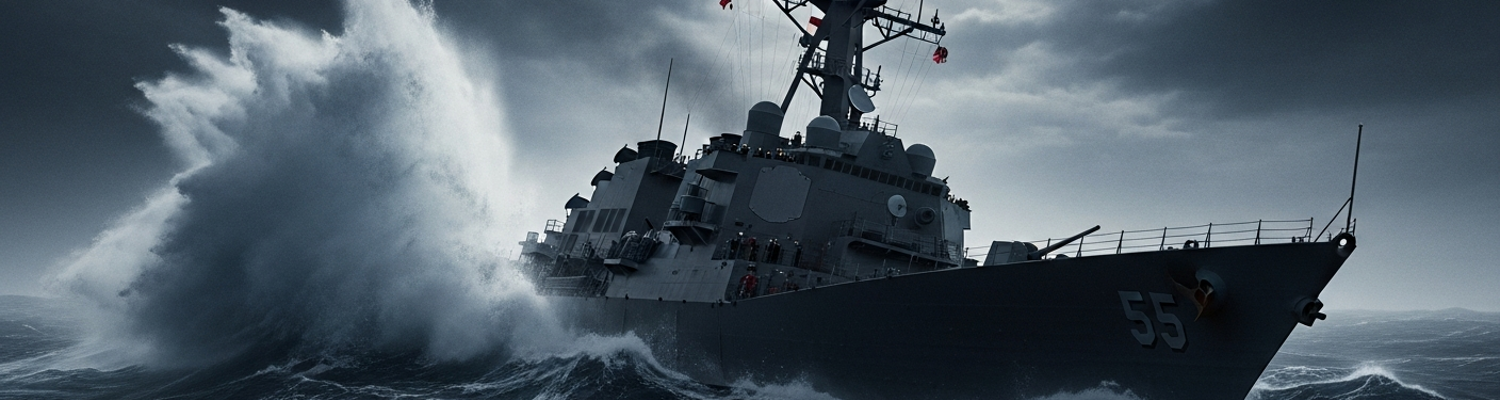
Late 1971. The destroyer USS Blandy (DD-943) cut through the North Atlantic. It was operating as part of NATO’s Destroyer Squadron 26. After a summer deployment to the Mediterranean, the Forrest Sherman-class destroyer was dispatched to the unforgiving waters north of the Arctic Circle. The mission was part of 'Arctic Gale', a major NATO exercise intended to project allied naval power into the high north and rehearse anti-submarine warfare operations against a simulated Soviet threat. These exercises were a staple of Cold War naval strategy. They were designed to ensure NATO forces could operate in the brutal conditions of the Greenland-Iceland-UK gap, a chokepoint for Soviet naval ambitions. The Blandy, having undergone an extensive anti-submarine warfare modernization in 1969-1970 which included the installation of a new SQS-23 sonar system, was a key asset for this type of operation.
The gale hit with predictable ferocity. The North Atlantic in late autumn is a notoriously hostile environment. The seas quickly rose to a state that tested the limits of the destroyer’s design. Forrest Sherman-class ships, while advanced for their time, were noted for having large, unarmored hulls. Aboard the Blandy, the crew contended with the violent, ceaseless motion of the ship as it crested and then slammed into mountainous waves.
The crisis began without warning. The forward hull gave way. The pressures exerted by the heavy seas caused a section of the hull to breach, tearing a significant gash in the vessel’s structure.
The immediate effect was chaos. Freezing Atlantic water began flooding into forward compartments, creating an instant mass casualty event. The violent lurching of the ship, combined with the structural shock of the breach, threw sailors against bulkheads and equipment, causing numerous physical injuries. The inrush of seawater compounded the danger, creating a lethal mix of flooding and hypothermia risk within the affected spaces. A close review of similar historical events involving destroyer damage shows that controlling flooding from a major breach is a primary and desperate battle. For the crew of the Blandy, this was a fight for the ship’s life in the middle of an arctic storm, far from immediate aid. The event instantly overwhelmed the ship’s medical department, which was not equipped or staffed for a mass casualty incident on this scale.
The sound of a warship’s hull tearing apart is a unique experience for any sailor. It signifies a fundamental violation of the vessel’s integrity, the one thing separating the crew from the fatal cold of the ocean. For the men aboard the Blandy, the event was a sudden, violent confrontation with their own mortality. This was not combat, for which they had trained, but a struggle against the environment itself and the potential failure of their own ship. The darkness, the constant motion, the cries of the injured, and the roar of the sea and tearing metal combined to create an atmosphere of extreme psychological distress.
Overwhelmed Naval Medical Doctrine 1971
U.S. Navy medical doctrine in 1971 was not designed for the catastrophe that struck the Blandy. The established protocols for a destroyer’s sick bay were built on two core assumptions: that the ship itself was a stable, functioning platform, and that any major medical crisis would involve a small number of casualties who could be stabilized for evacuation. A Forrest Sherman-class destroyer typically sailed with one medical officer and a small team of hospital corpsmen. They were equipped to handle routine illnesses, minor surgical procedures, and the initial treatment of combat wounds. The entire framework was predicated on an external threat and a functioning evacuation chain, usually involving helicopters transferring critical patients to a carrier or a shore-based hospital. The Blandy incident inverted this logic. The crisis was internal. It generated a mass casualty event that combined blunt-force trauma with acute, widespread hypothermia from flooding. There was no evacuation chain. In the midst of an arctic gale, the Blandy was the hospital, and it was the primary disaster zone.
The immediate aftermath of the hull breach forced the Blandy’s medical team into an ad-hoc reorganization of the ship’s medical response. Sick bay was instantly overwhelmed by the sheer volume of injured and freezing sailors. The crew’s mess decks became the de facto mass casualty treatment center. A review of damage control procedures from the era shows that while controlling flooding and structural damage was a primary focus, the medical plan was secondary and far less developed. The ship’s medical officer and corpsmen were forced to conduct a grim triage on the deck plates, sorting dozens of their shipmates with nothing more than casualty tags and grease pencils. The doctrine of the time, refined by experiences in Vietnam, was effective for prioritizing individual trauma patients for medevac, but it provided little guidance for a closed system with finite resources. Morphine syrettes, battle dressings, and blankets were expended at a startling rate. The medical team had to make impossible choices, diverting limited supplies of plasma to those deemed most likely to survive while providing only palliative care to others. Non-medical personnel were drafted on the spot to act as stretcher-bearers and assist with basic first aid.
Treating profound hypothermia was the most significant challenge. Standard 1970s medical procedure for hypothermia involved slow, passive rewarming, essentially wrapping a victim in blankets and allowing their own body to generate heat. This was entirely insufficient for dozens of sailors pulled from compartments flooded with near-freezing Atlantic seawater. An analysis of the probable conditions suggests the medical team had to resort to unproven and risky active rewarming techniques. Reports from similar cold-weather incidents indicate that corpsmen may have used any available source of warmth. This included administering warm IV fluids if they could be heated. In the most desperate cases, it meant creating human cocoons where multiple hypothermic sailors were bundled together with uninjured shipmates to transfer body heat. Fractures were set with splints improvised from wooden battens and spare piping from damage control lockers. Lacerations were closed not in a sterile operating room, but on mess tables slick with a mixture of seawater and diesel fuel. These actions represented a complete departure from established medical safety protocols.
Degraded Emergency Medical Equipment Blandy
A forensic review of the Blandy’s medical department after the incident revealed a total failure of equipment readiness. The ship’s sick bay, a compact space never intended to function as a mass casualty ward, held tools that were mechanically degraded to the point of uselessness.
Surgical kits had failed. Stored in metal lockers and exposed for years to the pervasive, corrosive humidity of a warship, they were crippled by oxidation. The ship’s maintenance logs (per post-incident inquiry) indicate that while major systems received rigorous attention, the task of preserving delicate medical instruments was often deferred or improperly executed. When the medical officer opened packs of supposedly sterile surgical tools, he found instruments seized by rust. Hemostats and artery forceps, needed for clamping bleeding vessels, were stiffened, their locking ratchet mechanisms fused shut by crevice corrosion. Scalpel handles were so pitted that new blades could not be securely fitted. Needle drivers, essential for suturing, were equally compromised.
The inability to perform basic surgical procedures had a devastating effect on the triage process. Sailors with deep lacerations from being thrown against machinery or torn steel could not be properly sutured. This increased the risk of uncontrolled bleeding and infection from the contaminated seawater washing across the decks. More severe internal injuries, which might have been addressed with exploratory procedures under ideal circumstances, were an impossibility. The medical team was reduced to applying pressure dressings. A close analysis of naval medical supply policy in 1971 shows a system reliant on pre-packaged, disposable items, yet the core surgical sets were intended to be reusable. The doctrine assumed these tools would be maintained in a state of readiness. That assumption collapsed aboard the Blandy.
Compounding the crisis of unusable equipment was a total breakdown in the ship’s ability to communicate. The Blandy’s primary long-range communication suite was a powerful AN/URC-32 high-frequency radio system, the vessel’s lifeline to the rest of the NATO fleet. This system was rendered inoperable almost immediately. The physical shock of the hull breach, combined with the violence of the arctic gale, had critically damaged the antenna array. Radio technicians attempting to diagnose the problem reported that the main HF whip antenna was likely gone, either sheared off by a rogue wave or shattered by the violent whipping motion of the mast. Without a functional antenna, the multi-ton radio console in the communications center was silent.
The ship was electronically isolated.
No MEDEVAC request could be sent. The ship’s commander could not report the scale of the disaster to the task group commander or request helicopter support from nearby carriers. There was no way to alert search-and-rescue assets or even to confirm the ship’s position and status. The crew was entirely on its own. The combination of failed medical tools and failed communications created a cascading disaster. The medical officer could not stabilize his most critical patients, and the commanding officer could not arrange for their evacuation. Every man grievously injured by the initial event was trapped, his survival dependent solely on the limited, decaying resources available within the broken hull of the ship itself.
Psychological First Aid Arctic Trauma
Aboard the Blandy, medical personnel invented psychological first aid. No doctrine existed to guide them. Basic corpsman training in the 1970s included rudimentary psychology, but this was entirely inadequate for a mass casualty event where the caregivers were also victims. The medical officer and his senior corpsmen, while fighting to treat physical wounds, had to simultaneously manage the acute psychological shock rippling through the crew. They became de facto crisis counselors. Archival reviews of similar maritime disasters show that the most effective improvised technique is the assignment of simple, concrete tasks. On the Blandy, this meant corpsmen were grabbing sailors frozen by fear and giving them direct, achievable orders: "Hold this dressing," "Count these blankets," "Help me lift this man." This method served two purposes. It provided immediate practical assistance. More importantly, it broke the cycle of panic by forcing the individual to focus their mind, restoring a small measure of agency in a situation of complete helplessness.
The ship’s officers and chief petty officers played an equally non-doctrinal but essential role. Moving through the darkened, pitching compartments, they made a point of making eye contact and speaking calmly but firmly to individual sailors. They provided accurate information when they had it and did not make false promises. This act of projecting calm and maintaining the command structure, even when surrounded by chaos, provided an essential anchor for the crew. A review of naval leadership principles shows this is an expected function of command, but its application in a closed-system disaster, with no hope of outside help, amplified its importance. The corpsmen and officers were, in essence, practicing the core tenets of modern psychological first aid, look, listen, link, without the formal training. They looked for signs of severe distress, listened to the fears of their shipmates, and linked them back to the collective effort of saving the ship and each other.
The collapse of morale was not a sudden event. It was a slow rot directly fed by the failure of the ship’s equipment. For a sailor on a modern warship, functioning technology is synonymous with safety and hope. Its failure is a personal betrayal. When the word spread from the radio room that the AN/URC-32 was dead and no signal could be sent, it was more than a tactical problem. It was the moment the crew realized they were completely alone. This knowledge, spreading man-to-man through the dark, was a psychological body blow. It extinguished the fundamental hope of any crew in distress: the belief that help is on the way.
This isolation was compounded by the visible decay of the medical gear. A sailor, bleeding and freezing, who sees a corpsman struggle with a rusted hemostat has his worst fears confirmed. Not only can they not call for help, but they cannot even help themselves. The sight of failed equipment serves as tangible proof that the system has broken down on every level. It erodes trust in leadership and in the very vessel beneath their feet. Survivors of other maritime incidents report that this feeling of helplessness in the face of equipment failure is a primary contributor to post-traumatic stress. For the crew of the Blandy, the combination was toxic. The constant motion of the ship, the darkness, the cries of the injured, the biting cold, the silence from the radio, and the uselessness of the surgical kits all merged into a single, overwhelming message. Survival was unlikely. This is where the initial, adrenaline-fueled fight for the ship gave way to individual despair.
Cold War Naval Medical Preparedness Autopsy
Naval medical planning in the 1970s was built for a specific conflict, a carrier-centric exchange with the Soviet Navy in open water. In this theoretical war, a destroyer like the Blandy would absorb a missile strike, its damage control teams would contain the immediate destruction, and its medical department would stabilize the wounded for rapid helicopter evacuation to the surgical facilities of a nearby carrier. The doctrine rested on the core assumption that the ship, while damaged, would remain a functional node in a larger, well-connected network of naval power. The Blandy incident exposed this as a strategic blind spot. The ship did not face a Soviet anti-ship missile; it was crippled by a rogue wave and an arctic gale. The enemy was the environment itself, and the disaster was not external but internal. The hull breach created a mass casualty event that simultaneously overwhelmed the ship’s medical capacity while severing its connection to any possible aid. There was no carrier task group to call. There was no medevac. The neatly defined wartime provisions collapsed because they failed to account for a scenario where a single, isolated vessel became a closed-system disaster zone.
The lessons forced by the Blandy disaster were an indictment of the Navy’s approach to cold-weather medical readiness. A post-incident analysis shows that the most significant failure, beyond the initial structural breach, was the systemic disregard for the maintenance of medical equipment. While billions were spent on advanced sonar and missile systems, basic surgical kits were allowed to corrode into uselessness in damp storerooms. The lesson was blunt. In a high-stress environment, every piece of equipment is critical. The subsequent push for vacuum-sealed, disposable surgical packs and hardened, climate-controlled medical lockers was a direct result of incidents like this. The Navy learned that medical readiness was not just about the skill of the corpsman, but the material integrity of his tools.
Another hard lesson came from the doctrinal vacuum surrounding mass hypothermia. Standard procedure was for passive rewarming, a technique completely inadequate for dozens of sailors soaked in freezing Atlantic water. The improvised active rewarming methods used aboard the Blandy, administering heated IV fluids and using the body heat of uninjured crewmen, underscored a need for new protocols and equipment specifically designed for cold-weather mass casualty events. Research into the physiological effects of cold, pursued since the 1940s, had clearly not been fully integrated into fleet-wide operational doctrine.
This failure extended directly to training. The Blandy’s ordeal revealed that damage control and medical response were treated as separate disciplines. Sailors were extensively drilled on fighting fires and patching hull breaches, but a far smaller number were trained for mass casualty triage. The incident proved this was an untenable division of labor. The lesson learned was that in a closed-system disaster, every sailor is a potential first responder. Subsequent changes to General Shipboard Training began to integrate large-scale medical casualty drills into damage control exercises, training non-medical personnel to establish casualty collection points, manage supply distribution, and assist in basic life-saving procedures under the direction of the medical staff. The Blandy became a case study in why medical response could not be the sole province of the sick bay; it had to be a ship-wide, all-hands evolution, as fundamental to survival as keeping the water out.