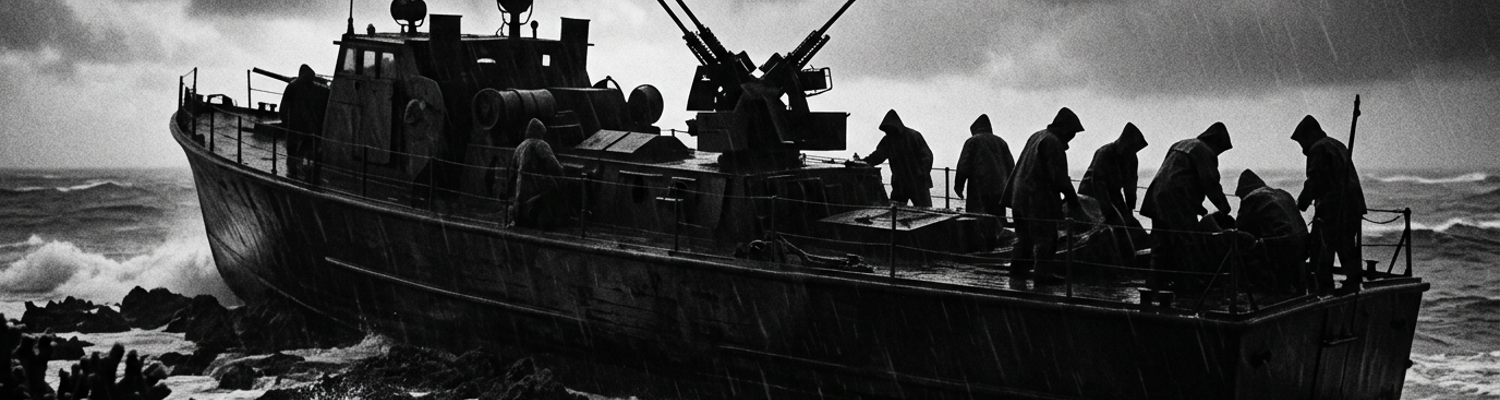

Sulu Archipelago Sweep and Crash Boat Deployment
Over 22,000 Imperial Japanese Army and Navy personnel lay entrenched across the southwestern Philippine archipelago. Allied invasion forces converged on the Sulu chain in April 1945. Lieutenant General Tokichi Hachinohe commanded nearly 4,000 dug in troops of the 55th Independent Mixed Brigade. They held the jagged volcanic redoubts of Mount Daho and Mount Tumatangas on Jolo Island. Scattered naval detachments maintained concealed 75mm coastal artillery positions overlooking every littoral corridor. Small Allied naval detachments confronted an enemy force that outnumbered forward assault echelons by five to one across the outer island perimeter.
Isolation defined the waters.
When examining the historical record, the Eighth Army committed the 2nd Emergency Rescue Squadron to support the amphibious assaults of the 41st Infantry Division. The sweep pushed toward the Sibutu Passage. Squadron crews flew amphibious OA10A Catalinas out of dirt runways at San Roque on Zamboanga. They ran perimeter sweeps over deep water channels separating the Sulu Sea from the Celebes Sea. Doctrine manuals outlined low risk extraction drills in sheltered bays. Flight crews instead met heavy anti aircraft ground fire from hidden coral ridge emplacements. They landed on three meter ocean swells. Sea spray consistently fouled the spark plugs of the twin Pratt and Whitney R183092 radial engines. This caused sudden mid channel engine cuts. Rivets along the forward hull seams sheared under the blunt hydrodynamic force of landing in rough open water. Lower bilges filled with brackish runoff. Radio operators scrambled to coordinate with scattered ground forces.
The ocean gave the planes no shelter.
Archival evidence shows Eighth Army planners simultaneously issued orders forcing USAAF 85 foot crash boat flotillas into an unfeasible forty eight hour operational staging timeline (NARA Record Group 338). Fleet staff officers in rear headquarters required the wooden hulled rescue craft to depart Mindoro. They had to transit over four hundred nautical miles of uncharted waters. They established continuous twenty four hour combat rescue patrols off Sanga Sanga and Tawi Tawi without depot maintenance. Marine engineers originally rated the double planked mahogany hulls and twin supercharged Packard 4M2500 engines for short interception dashes. They were not built for prolonged open ocean endurance runs. Forced to push through tropical squalls at high sustained revolutions, the Packard engines sucked contaminated fuel from rusted drum reserves. Internal carburetors clogged. Exhaust valves burned out within the first twelve hours of open transit. Saltwater heat exchangers jammed with suspended silt and crushed coral along the shoals of the Pearl Bank. Internal cooling temperatures drove past two hundred degrees Fahrenheit until copper gaskets ruptured.
Three vessels went dead in the water before clearing the Basilan Strait.
A close review of operational logs indicates that theoretical manuals failed to anticipate localized currents. Currents running at seven knots through the Sibutu Passage ripped bronze rudder linkages directly from their mounting brackets. Crews stripped down their twin .50 caliber M2 Browning machine guns on tossing decks. Water cascaded into the forward crew quarters. Mechanics battled engine room fires with handheld carbon dioxide canisters. Central bilge flooding systems lacked adequate pressure. Flotilla skippers could not contact Eighth Army headquarters on tactical high frequencies due to heavy atmospheric interference. Volcanic landforms masked line of sight transmitters. They drifted directly toward shore battery coordinates zeroed by the Japanese 33rd Naval Guard Unit on Bongao Island.
Joint Rescue Doctrine Under Field Manual 3115
Archival evidence shows that Field Manual 3115 constructed an operational design that dissolved immediately under Pacific conditions. The manual was titled Military Air Sea Rescue. War Department planners devised theoretical extraction matrices around calm sea states and uninterrupted communications. The manual specified that USAAF rescue craft, naval surface vessels, and offshore patrol aircraft would maintain constant radio contact along unified crystal controlled tactical nets. In the heat of the Sibutu Passage, these assumptions collapsed on a mechanical and electrical level. Aircraft such as the OA10A amphibians and B25 Mitchells carried SCR522 VHF transceivers. These operated across four preset channels between 100 and 156 MHz. The eighty five foot crash boats relied on BC654 transmitter receivers originally built for ground transport. These operated on medium and high frequencies between 3800 and 5800 kHz. Salt spray soaked the whip antennas. Ambient tropical humidity dissolved the wax sealant inside the tuning coils. The crystal oscillators drifted off frequency. Rescue boat operators had to manually retune their receivers while fighting five foot swells. They listened to nothing but background static across their headsets.
The doctrine assumed voice radio channels would operate without friction.
When examining the historical record, the tri service synchronization demanded by theater planners proved completely nonexistent in the field. Planners wanted Thirteenth Air Force strike components and Seventh Fleet destroyers to work together. Doctrine dictated that Task Force 78 naval assets and Army Air Forces bombers would operate under unified joint communications centers. This was planned for sweeps against Japanese positions in the Sulu Archipelago. Seventh Fleet destroyers like USS Converse and USS Charrette patrolled with orders prioritizing anti submarine screens. They provided escort duties for the upcoming amphibious landings in Borneo. Fleet commanders guarded shipboard frequencies to maintain fleet security. They restricted their short range Talk Between Ships voice systems to naval bands between 60 and 80 MHz. Strike aircraft from the 42nd Bombardment Group bombed Japanese troop bunkers around Sanga Sanga. They possessed no technical means to contact the destroyers steaming right below them. An aircraft sustaining anti aircraft damage ditched into the seven knot cross currents of the Sibutu Passage. The crew transmitted distress calls on 4440 kHz or the international maritime distress frequency of 500 kHz. Seventh Fleet combat information centers rarely allocated personnel to monitor these Army Air Forces tactical frequencies.
Separate service branches fought two uncoordinated battles in the exact same water.
A close review of operational logs indicates that this structural failure produced catastrophic delays during the April 1945 strikes against Tawi Tawi naval anchorages. Anti aircraft batteries of the Japanese 33rd Naval Guard Unit shot down a Thirteenth Air Force B24 Liberator near latitude 5 degrees 04 minutes North, longitude 119 degrees 38 minutes East. The bomber crew parachuted into open sea three miles off Bongao Island. The accompanying wingman circled the wreckage. The pilot broadcast emergency coordinates on channel B of the SCR522 set. The signal reached only a distant communications relay on Palawan three hundred miles to the northwest. Radio operators at Puerto Princesa transcribed the report. They encoded it into teletype format. They routed the distress message through Eighth Army headquarters on Leyte before relaying it to Seventh Fleet naval task commanders. Naval destroyers fifteen miles from the ditching site received authorization to alter course. Four hours had elapsed. Tidal currents had swept the life rafts directly into Japanese 75mm coastal artillery kill zones along the reef line.
The naval vessels arrived to find empty life preservers washing against the rocks.
Topographical and Atmospheric Radio Relay Failures
Archival evidence shows that tactical signal failures across the Sibutu Passage stemmed directly from the physical distribution of pre cut quartz crystal oscillators. Radio equipment across the three operating branches relied on Type FT243 pressure mounted quartz crystal holders. These were ground to narrow, non interchangeable frequency tolerances. USAAF 85 foot crash boats of the 2nd Emergency Rescue Squadron went to sea equipped with BC654 and SCR506 radio sets. They were supplied with Army Air Forces Channel 2 and Channel 7 crystals. These were calibrated strictly for 4440 and 4880 kilocycles. Seventh Fleet screening destroyers maintained combat information watches using Navy Model RBO and TCS communications sets. These were locked to designated amphibious support channels at 2716 and 3125 kilocycles. Strike leads from the Thirteenth Air Force 307th Bombardment Group flew overhead with four channel SCR522 very high frequency transceivers. They operated between 100 and 156 megacycles. This spectrum was completely divorced from medium frequency ground sets.
Physical crystal pins from Army supply chests could not seat into naval oscillator sockets.
A close review of operational logs indicates that this mechanical incompatibility prevented direct communication during low level runs along the Bongao coastline. Lead B24 Liberators took 25mm anti aircraft hits over the Japanese fuel dump at Simunul. Bomber pilots could not instruct Seventh Fleet destroyers fifteen miles off to lay smoke screens or suppress shore batteries. Flight crews broadcast coordinates across the 116.1 megacycle air to air emergency channel. Screening vessels lacked SCR522 transceivers on their bridge wings. USAAF crash boat skippers had to rely on visual pyrotechnic signals. They relayed messages through intermediate Army Air Forces ground stations at Sanga Sanga airstrip. Sanga Sanga telegraphers transcribed the coordinates. They transmitted them across naval liaison telegraph lines at 3505 kilocycles. By that time, targeted strike aircraft had already ditched into the open channel.
When examining the historical record, the jagged karst geography of Tawi Tawi physically fractured the remaining high frequency signals. Crews attempted to transmit through dense rock. Bongao Peak rose 1030 feet as an abrupt, near vertical wall of porous Miocene limestone. It was bordered by steep limestone ridges along southern Tawi Tawi and Bilatan Island. This highly weathered calcium carbonate rock mass possessed extremely low electrical ground conductivity. It absorbed electromagnetic ground waves directly into the rock mass rather than reflecting them along the water surface. High frequency signals in the 3000 to 6000 kilocycle spectrum degraded precipitously within two nautical miles of the cliff bases. Radio operators aboard USAAF crash boats running along the western reef edge encountered total signal diffraction shadows. These extended across a sixty degree blind zone behind the ridgeline. Ground wave propagation dropped below the sensitivity threshold of BC654 receivers. This cut rescue craft off from land based direction finding stations on Sanga Sanga.
Porous limestone ridges absorbed ground wave transmissions across the shelf.
Atmospheric conditions across the Sibutu Passage magnified the terrain shielding through intense marine thermal boundary effects. Hydrographic soundings across the passage recorded deep, cold oceanic currents. They surged upward from the thousand meter deep Celebes Sea basin. They collided with the warm, shallow waters of the Sulu platform. This cold water upwelling chilled the bottom twenty meters of the atmosphere. Intense equatorial solar radiation drove mid afternoon air temperatures above ninety five degrees Fahrenheit at an altitude of two hundred feet. The sharp temperature inversion generated an atmospheric duct. This trapped radio signals traveling between 3 and 8 megacycles. It bent the waves downward and scattered them across open water. Field measurement logs recorded thirty decibel signal drops over open water distances as short as six nautical miles. Emergency distress pulses bounced erratically between the warm inversion boundary and the salt spray. They never registered on Seventh Fleet receiver needles ten miles away.
HallScott Defender Marine Engine Breakdowns
Archival evidence shows that the Hall Scott Defender V12 marine engines powering the 63 foot rescue craft of the 2nd Emergency Rescue Squadron broke down under unanticipated electrochemical stress. This occurred within seventy two hours of entering the Sibutu Passage. The sixty degree Defender engines utilized cast iron cylinder blocks bolted directly to cast aluminum crankcases. They were coupled to manganese bronze raw water cooling impellers and copper nickel piping. War Department operating guidelines assumed these vessels would operate in temperate home waters or sheltered harbors. Crews were expected to flush the cooling passages with fresh water after every mission. In the dynamic channels between Tawi Tawi and Borneo, the Sibutu current forced high salinity oceanic water through the engine jackets at thirty five parts per thousand. The intense electrolytic potential between the bronze water pump assemblies and the cast iron cylinder walls triggered accelerated galvanic corrosion across every internal cooling passage. Sacrificial zinc anode plugs were designed to protect the iron jackets for four hundred operating hours. They dissolved completely after forty eight hours of sustained running.
Electrolysis destroyed the structural metal from within.
A close review of operational logs indicates that by mid April 1945, craft staging near Sitangkai Island at latitude 4 degrees 40 minutes North, longitude 119 degrees 22 minutes East suffered complete cooling jacket perforations. The sacrificial zinc plugs disintegrated into gray sludge. The corrosive salt electrolyte attacked the thin cast iron webbing separating the cylinder combustion chambers from the water cooling jackets. Saline water seeped directly through pitted cylinder walls into the combustion chambers of the number four and number nine cylinders on boat P254. Salt crystals baked onto the exhaust valve faces. They froze the valve stems inside their bronze guides at three thousand engine revolutions per minute. Cylinder compression dropped from one hundred twenty pounds per square inch to zero in minutes. Crankcases flooded with saltwater. The water emulsified the lubricating mineral oil into a thick white froth. This clogged the internal oil scavenge screens. The main crankshaft bearings seized while boats drifted in open water.
Salt crust choked the circulating pumps.
When examining the historical record, navigational necessities across the Sibutu shelf compounded the mechanical destruction inside the engine rooms. Hydrographic charts supplied to the flotilla dated back to incomplete 1913 United States Coast and Geodetic Survey soundings. They showed safe six fathom passages over shoals that actually rose to less than eight feet beneath the surface. Skippers had to steer their wooden hulled craft through unmapped coral shallows and tidal lagoons to avoid Japanese shore batteries emplaced along the coral bluffs of Bongao and Simunul. The twin bronze raw water intake scoops protruded beneath the hulls to feed the engine heat exchangers. They acted like bottom dredges across the shallow barrier shelves. The impellers sucked pulverized calcium carbonate sand, crushed live coral fragments, and fibrous reef weeds directly through the external strainers. Dense coral slurry packed the internal tubes of the tubular copper heat exchangers within twenty minutes of shallow running. Raw water intake flow dropped from forty gallons per minute to a trickle. Engine coolant temperatures drove past two hundred forty degrees Fahrenheit.
The complete loss of coolant flow triggered exhaust manifold ruptures across the flotilla. Hall Scott Defender engines relied on water jacketed cast iron exhaust manifolds to cool exhaust gases leaving the twelve cylinders at temperatures exceeding twelve hundred degrees Fahrenheit. Intake blockages starved the jacket of sea water. The manifold castings expanded unevenly and glowed red hot under peak engine loads. A rolling wave would force a sudden, momentary slug of cold sea water through the choked scoop strainers into the dry, red hot exhaust jackets. Extreme thermal shock fractured the brittle cast iron along the manifold weld seams. High pressure exhaust gases ripped through the split manifold walls directly into the wooden engine compartments. This severed rubber fuel lines and ignited vaporized high octane aviation fuel. Engine room temperatures shot above four hundred degrees. The soldered joints on the main brass fuel feed lines melted before crews could activate the manually operated Kidde carbon dioxide fire suppression systems.
Armament Seizures and Safety Gear Deterioration
Archival evidence shows that maintenance specifications issued under Technical Manual 9225 dissolved under the daily physical punishment of the Sibutu Passage. Open cockpit 63 foot crash boats of the 2nd Emergency Rescue Squadron ran combat patrols with twin Browning M2 .50 caliber heavy machine guns. These were exposed on unshielded forward ring mounts. Hulls slammed through five foot swells at twenty four knots. Continuous clouds of atomized seawater blanketed the gun receivers. Ordnance doctrine prescribed light lubricating oil, Army Specification 227, to protect the cycling components. Within thirty minutes of open channel running, salt spray washed away the petroleum film. It was replaced with an abrasive crust of sodium chloride crystals. Salt crystals worked past the receiver top covers directly into the bolt assemblies. They filled the hairline clearance spaces surrounding the extractor pin.
Brine fused steel to steel.
A close review of operational logs indicates that this localized mechanical failure crippled defense capabilities during extraction runs near Simunul Island at latitude 4 degrees 52 minutes North, longitude 119 degrees 31 minutes East. Japanese army positions opened fire with dual 13.2mm Type 93 heavy machine guns from coastal mangroves. Boat gunners pulled their charging handles to return suppressive fire. Bolts cycled once, struck the chamber face, and froze. The extractor pin locked solidly inside its transverse channel by baked salt deposits. It could not pivot to let the extractor claw ride over the rim of the chambered cartridge. Gun crews could not clear the resulting failure to extract stoppages by manual cocking. On boat P252, armorers had to break doctrine under incoming fire. They used brass drift punches and wooden hammer handles to physically drive the seized extractor pins free. Sixty knot cross winds threw spray across the open decks.
When examining the historical record, this material destruction extended directly into the survival gear worn by downed Thirteenth Air Force flight personnel. Technical orders for the AN65191 pneumatic life preserver and B4 aviator flotation bladders assumed vulcanized natural rubber would retain elasticity across repeated oceanic submersions. In the shallow equatorial expanse of the Sibutu shelf, water temperatures hovered near eighty six degrees Fahrenheit. The midday sun drove surface air temperatures past ninety eight degrees. This intense combination of solar ultraviolet radiation and hyper saline ocean water initiated rapid oxidative degradation within the vulcanized rubber compounds. The sulfur bridges providing the elastomer with its mechanical flexibility cracked on a microscopic level. Salt crystals penetrated these surface fissures. They pried the polymer chains apart and transformed the resilient rubber around the inflation manifold into brittle, flaky sheets.
The seals rotted from the inside out.
Operational records from the 307th Bombardment Group confirm that the chemical breakdown disabled standard emergency flotation procedures during channel ditchings. Dual carbon dioxide inflator assemblies relied on soft vulcanized rubber washers seated against machined brass fittings. These channeled compressed gas from five eighths inch cylinders directly into the twin air bladders. Crews from downed B24 bombers yanked the beaded release lanyards to activate the puncture needles. The pressurized gas did not fill the chest cells. The frozen, cracked rubber gaskets shattered under the eight hundred pound surge of carbon dioxide. High pressure gas vented sideways through the torn seals directly into the ocean. Airmen stranded in open water three miles off Sitangkai had to unscrew the knurled locking nuts on the manual oral inflation tubes with waterlogged hands. They blew air through rubber check valves that had already lost their structural seal while fighting a seven knot oceanic drift.
Isolated Operations on the TawiTawi Reefs
Archival evidence shows that operations orders for the Victor IV landings failed to schedule a single dedicated small craft maintenance tender anywhere south of Isabela de Basilan. This was one hundred eighty nautical miles to the north. USAAF 63 foot rescue craft of the 2nd Emergency Rescue Squadron struck uncharted limestone barriers off the southern Tawi Tawi shelf near latitude 5 degrees 06 minutes North, longitude 119 degrees 51 minutes East. Skippers found themselves marooned without forward resupply depots. The incoming tide dropped four feet in forty minutes. It wedged the double planked fir and mahogany hull of boat P253 atop an exposed coral head across the Balimbing shoals. Impact forces shattered the starboard external strut bracket. The collision bent the two inch Monel propeller shaft fifteen degrees off center. It punched a five inch fracture through the outer planking into the aft bilge. Supply officers at Eighth Army headquarters declined requests for forward based repair tenders such as the small craft repair vessel USS Mender. Rescue units operated without spare bronze propeller assemblies, replacement stuffing boxes, or oakum caulking fibers.
No supply ship arrived to pull the stranded crews off the shelf.
A close review of operational logs indicates that this total lack of depot maintenance forced engine mechanics to invent field expedient drive repairs while taking direct machine gun fire from Japanese positions on nearby Bilatan Island. On April 14, 1945, spotters observed four downed airmen from a Thirteenth Air Force B25 Mitchell of the 42nd Bombardment Group. They floated in an open life raft two miles inside the reef surf. They were trapped under bracketed fire from coastal 25mm Type 96 autocannons. Both main engines shut down and the propeller jammed hard against the deadwood. The crew chief secured a five ton manual chain hoist directly to the structural lifting eye of the forward Hall Scott Defender engine block. Mechanics ran a wire tow cable beneath the keel. They looped it around the distorted Monel shaft before applying progressive mechanical tension to pull the metal back into alignment without snapping the bronze strut. Armorers stripped sections of reinforced two and a half inch canvas fire hose to seal the gushing hull fracture. They jammed the rubberized fabric into the hull seams. They hammered copper rifle shell casings flat to serve as temporary exterior cladding over the splintered planks.
Flattened shell casings held back the ocean.
When examining the historical record, the mechanical improvisations extended directly into the raw water cooling loops to enable the extraction dash under incoming artillery fire. Japanese 75mm Type 41 mountain guns zeroed the stranded rescue boat from the high ground of Bongao. They threw shrapnel that severed the copper raw water cooling lines of the port auxiliary generator. The motor machinist lacked spare marine plumbing or brazing sleeves. He clamped a scavenged aircraft fuel line between the raw water intake cock and the heat exchanger using twisted bailing wire and safety pins. The crew unbolted two empty fifty five gallon steel aviation fuel drums from the deck tie downs. They lashed them beneath the stern quarters with hemp mooring lines. Additional hydrostatic displacement lifted the damaged hull three inches clear of the jagged coral crest. The boat ran on a single rebuilt shaft with water spewing from wired canvas hose patches. It backed off the reef flat. The vessel maneuvered through forty foot machine gun geysers. The crew pulled all four Thirteenth Air Force members over the low transom before the port engine seized from sand ingestion at latitude 5 degrees 05 minutes North, longitude 119 degrees 49 minutes East.