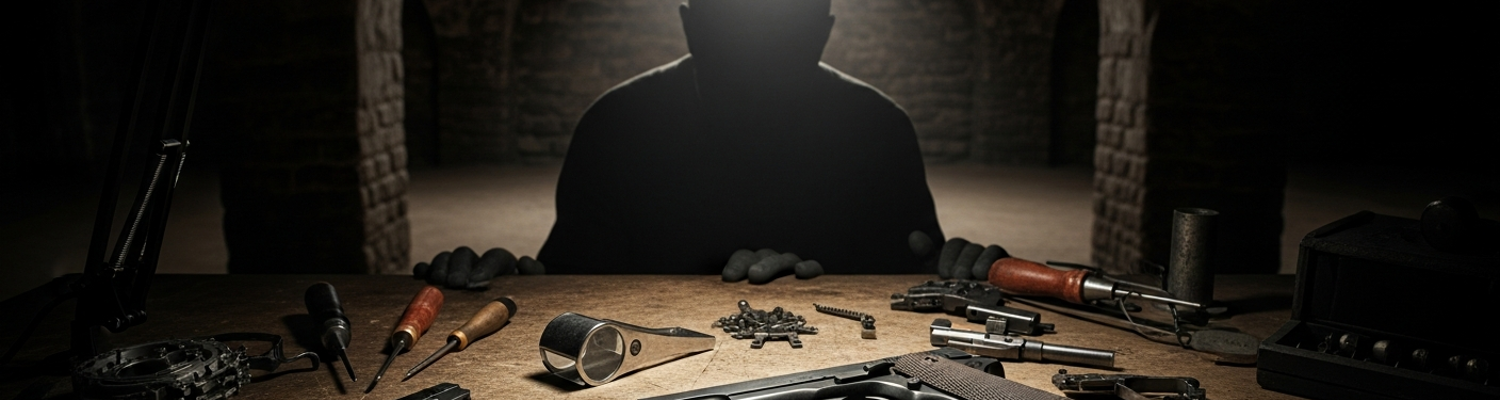

The mandate was simple. The execution was not.
The concept behind the FP-45 pistol, later nicknamed the Liberator, hinged on mass production entirely divorced from traditional arsenals. Responsibility fell to the Guide Lamp Division of General Motors, a manufacturer of automotive headlights, not firearms. This was by design. The objective was a weapon of simple, stamped metal parts that any factory could produce. For eleven weeks, working around the clock, 300 workers produced approximately one million of these single-shot pistols. Each consisted of only 23 parts. The production process itself was an industrial achievement, averaging a completed pistol every 6.6 seconds for just over two dollars per unit. This was not fine gunsmithing. It was industrial force applied to psychological warfare.
Its ground-level application was a different story. The pistol was unrifled, giving it an effective range of only a few yards before the .45 ACP slug began to tumble. Operation was clumsy, requiring the user to manually retract the cocking piece, load a single round, and then, after firing, use a supplied wooden dowel to eject the spent casing. The plan to airdrop millions of these across occupied Europe was largely curtailed by high command. Generals like Eisenhower saw it as a poor use of aircraft resources. Most of the million units produced were eventually turned over to the OSS or destroyed after the war.
Sabotage devices faced an even more complex path. A close review of operational logs (NARA Record Group 226) reveals the difficulty of deploying items like explosive coal. This device, developed by both the British SOE and American OSS, consisted of a hollowed-out piece of coal packed with a plastic explosive like Composition C. The idea was for an operative to slip it into a tender supplying a locomotive or a factory furnace, causing a boiler explosion. The challenge was not the explosive, but the delivery. An agent could not simply throw the device onto a coal pile; it had to be the right type of coal. Lignite, anthracite, and bituminous coal all have distinct appearances. To address this, the OSS created camouflage kits with paints and brushes to allow an agent to match the explosive to the local supply. This presumed the agent had the time, security, and artistic skill to perform this modification in the field, a highly unlikely scenario. Getting a single lump of coal from an agent’s hands into a furnace, bypassing guards and inspectors, was a mission of near-impossible precision. Confirmed successful uses were exceptionally rare.
High-technology intelligence tools presented their own failures. The microdot camera was a revolutionary piece of equipment, shrinking a full page of text to the size of a printed period. Both Allied and Axis powers used this technology. The German Abwehr, for example, used dolls to smuggle microdots. For the OSS, the challenge was twofold: delivering the camera and its associated development chemicals to an agent, and ensuring the agent had the skill to use it. The cameras were hidden in items like fountain pens or shaving brushes, but this created irregularities in weight that could betray the device during a search. The actual use of the camera was a technical process requiring a secure location, precise chemical mixing, and a steady hand. An agent under pressure, working in a damp cellar with limited supplies, was more likely to produce a useless smudge than a clear, readable microdot, rendering the entire elaborate and risky supply effort a failure.
Archival evidence shows a persistent and dangerous disconnect between the advanced nature of Office of Strategic Services R&D devices and the training provided to the operatives expected to use them. These were soldiers recruited for their grit and independent thinking, not their engineering acumen. A device might be conceived in a Maryland laboratory, prototyped by a company like Eastman Kodak, and then handed to an agent with only a cursory briefing before a mission into occupied France. The operational tempo and intense secrecy precluded comprehensive training. An operative might receive a few hours to learn the function of a new explosive pencil or a radio transceiver disguised within a canteen. This was insufficient.
Faulty timers on demolition charges plagued early missions in Burma, with one premature explosion on the Namhkwin bridge jeopardizing the efforts of multiple teams. The problem was systemic. The focus was on invention and deployment, with field-user education a distant third priority.
This was compounded by a near-total absence of specialized repair kits. The very nature of the devices, bespoke and often sealed for clandestine purposes, made field repair impossible. These were not standard-issue hardware with interchangeable parts and detailed maintenance manuals. If the custom-molded power connection on a "Casey" portable radio set snapped during a parachute drop, the mission was effectively over. There were no spare parts. There was no manual for troubleshooting a dead transmitter. An operative could not simply solder a new wire, as many components were encased in waterproof resin or disguised within everyday objects. A review of operational logs indicates this lack of repairability was a known but accepted risk. R&D prioritized novelty over durability. A single point of failure, like a corroded battery contact in a humid environment, could render an entire intelligence operation useless.
It was the operative's unfamiliarity with the technology that often proved most dangerous. The T-13 "Beano" grenade, developed with Eastman Kodak and shaped like a baseball for an intuitive throwing, was a prime example. Its impact fuze was dangerously sensitive. Early tests saw numerous premature detonations; one incident at the Aberdeen Proving Ground wounded 44 personnel and killed two. Despite this, thousands were shipped to Europe. An operative, conditioned by standard time-fuzed grenades, could easily make a fatal error. Dropping the grenade could arm it, and its performance was inconsistent on soft ground. This weapon, intended to be intuitive, injured and killed more American personnel than the enemy. The files pertaining to the weapon were classified after the war and the remaining stock was ordered destroyed.
A close review of after-action reports reveals the consistent failure of specialized equipment under combat duress. The High Standard HDM .22 caliber suppressed pistol, a cornerstone of clandestine operations, provides a stark example. Designed for silent elimination of sentries, its effectiveness was entirely dependent on flawless mechanical function. The weapon’s simple blowback action and integrated suppressor were effective, reducing the shot’s report to around 20 decibels. However, its reliance on .22 rimfire ammunition was a known weakness; rimfire cartridges have less reliable primers than centerfire rounds. An operative, concealed in darkness mere feet from a target, could squeeze the trigger only to be met with a dead click from a dud round. The pistol also lacked a feed ramp, meaning the bullet fed directly from the magazine into the chamber. A slightly bent or dirty magazine, a common occurrence in the field, could cause the soft lead bullet to jam against the top of the chamber, failing to feed. An operative in occupied France, preparing to neutralize a guard, would then be forced into a desperate, noisy struggle to manually clear the action, the metallic scrape of the bolt betraying their position.
Secure communications, the lifeline for teams operating deep within enemy territory, were plagued by their own failures. The "Jed Set," the suitcase radio carried by Jedburgh teams, was the sole link to Allied command. These three-man teams, dropped into regions like the Vosges mountains of France, found that the terrain itself was often the enemy of the radio. Low-power transmitters, often powered by a hand-crank generator, struggled to push a signal through dense forests and mountain ranges. Atmospheric conditions could render a scheduled transmission impossible. After-action reports from numerous Jedburgh teams describe deep frustration over the inability to contact London. The radio operator would have to extend an antenna, a significant security risk, and transmit for a set period. German direction-finding units were constantly on the hunt for such signals. The experience for the team on the ground was one of exhausting work on the generator crank, followed by the demoralizing hiss of static in the headphones. A missed transmission window meant failure, forcing the team to remain exposed and wait for the next attempt.
For saboteurs, the failure of an explosive charge was often a death sentence. The "time pencil," a fuze designed for silent, delayed demolitions, epitomized this high-stakes gamble. Developed by the British SOE and used by the OSS, the device consisted of a brass tube containing a glass vial of corrosive liquid and a wire holding back a spring-loaded striker. Crushing the vial started a chemical reaction that would eat through the wire, eventually releasing the striker to hit a percussion cap. Its reliability was heavily dependent on environmental factors. In the cold, the chemical reaction slowed dramatically, delaying detonation by minutes or even hours. In one instance, a similar fuze failed in the unheated cargo hold of an aircraft during an operation. Conversely, the warmth from an operative’s body could accelerate the process. This uncertainty turned every sabotage mission into a game of chance. An agent placing a charge of Composition C on a rail line had to trust this unpredictable device to detonate correctly. A fuze that failed to fire meant the charge would be found, compromising the agent and the resistance network.
The journey of specialized equipment from R&D to an operative in the field was a gantlet of bureaucratic failure. Shipping manifests and after-action reports reveal a persistent misrouting of mission-specific gear. In one documented case from late 1944, a shipment of specialized battery packs for the "Joan-Eleanor" portable radio system, desperately needed by an intelligence network near Lyon, France (Circuit JOCKEY), was instead flown to the China-Burma-India theater. The batteries were useless to the Detachment 101 personnel in Burma who operated with different communication sets. The error originated in a London supply depot where two crates, both marked with similar OSS internal coding, were swapped by a logistics officer unfamiliar with the experimental equipment. The team near Lyon, unable to power their only link to Allied command, was forced to rely on slow and insecure couriers. Three members of the network were compromised and captured by the Gestapo while attempting to make contact with a neighboring circuit.
This was a direct result of the fragmented command channels that governed specialized technology. The OSS R&D branch, under Stanley Lovell in Washington, was a civilian-led entity focused on rapid innovation. Deploying its inventions required navigating the rigid supply structures of the U.S. Army, Navy, and theater commanders. General MacArthur, for example, actively resisted OSS operations within his command, creating a near-impenetrable wall for new equipment. Even in Europe, the system was flawed. An Operational Group in Italy might request a new type of limpet mine. That request would then have to be routed through the Army’s ordnance supply chain for the Mediterranean Theater of Operations, which prioritized conventional infantry divisions. An Army quartermaster in Algiers, facing requests for standard-issue bazookas, would often de-prioritize a request for two dozen experimental magnetic mines intended for a small team. This disconnect created enormous delays and frequent mission cancellations.
The intent behind a device conceived in a Maryland laboratory was frequently lost by the time it reached a partisan group in the frozen mountains of Norway. An operative trained on standard time-fuzed explosives could fatally misunderstand the mechanics of a pressure-activated fuze like the M1 pressure-release firing device, known as the "mousetrap." An agent expecting a simple timer might try to handle the device after placing it under a railroad tie, triggering an instant detonation. Archival reports detail instances where operatives, unfamiliar with the precise arming sequence of a new explosive pencil, failed to crush the internal acid vial correctly. They would place the dud charge and retreat, believing the mission complete, only for the device to be discovered hours later by an enemy patrol, compromising the entire operation.
A review of operational logs from Jedburgh teams in France reveals a pattern of field-expedient repairs that were both inventive and frequently futile. When the fragile vacuum tubes of a "Jed Set" radio shattered during a parachute drop into the Corrèze region, the team’s radio operator tried to bridge the broken connections inside the radio’s chassis with a knife and wire stripped from a detonator. Without schematics, he was working blind. The resulting short circuit fried the set’s remaining functional components.
Mission abandonment was the direct consequence of these gear failures. Special Forces Headquarters records show numerous planned operations were scrubbed not by enemy action, but by equipment malfunction. Jedburgh Team ALEXANDER, inserted into the Ain department of eastern France in August 1944, spent twelve critical days completely out of contact with London. Their radio, damaged in the drop, could not transmit. The team was forced to abort its primary mission of coordinating air drops to a large Maquis group preparing to disrupt German withdrawals. They had to rely on local guides to make a perilous journey on foot to link up with a neighboring team simply to report their status.
In another documented incident, a planned sabotage of a railway turntable near Chalon-sur-Saône was abandoned because the specialized magnetic limpet mines failed to adhere to the target. The operative discovered that heavy grease and grime on the turntable’s surface prevented the magnets from seating correctly. Lacking the tools or time to clean the surface under the eyes of German patrols, he was forced to retrieve the useless mines and abort, risking capture for no strategic gain.