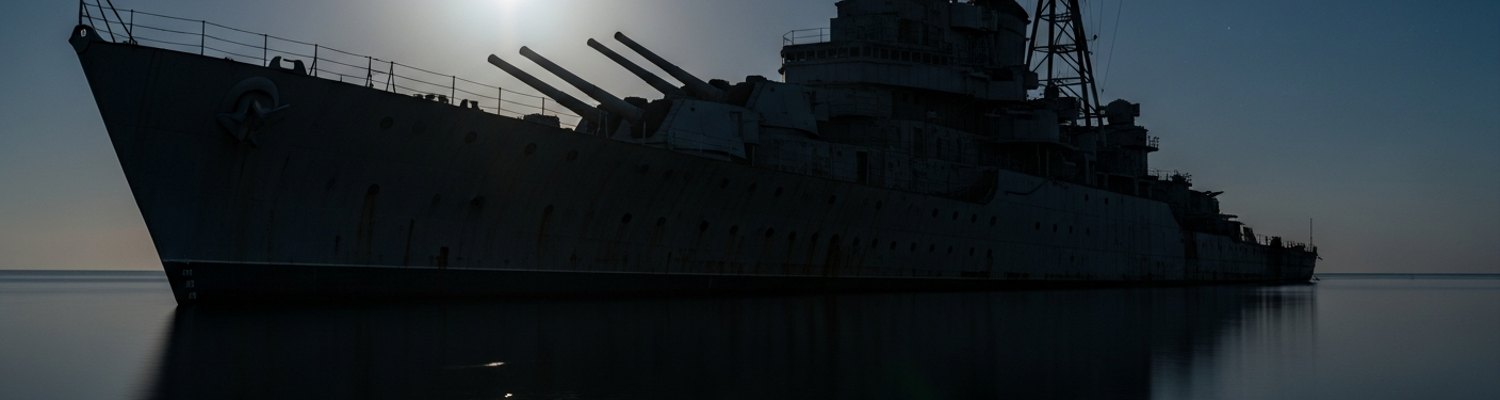

In the quiet aftermath of global victory, the United States Navy stood as the undisputed master of the world's oceans. Its fleets had crushed the Imperial Japanese Navy and swept the seas of Axis threats. Yet, in the summer of 1946, this same institution, built on centuries of gunnery, armor, and maritime tradition, steered itself into a terrifying new reality in the placid waters of the Marshall Islands. The lagoon at Bikini Atoll became the stage for Operation Crossroads, a series of tests that were not a celebration of power but a violent, public vivisection of the Navy itself. The two atomic detonations, codenamed 'Able' and 'Baker', did more than sink warships. They sank the foundational doctrines of naval warfare, exposed the terrifying persistence of radiological poison, and forced a strategic awakening that would define the Cold War fleet and cast a long shadow over international relations.
An Armada for Armageddon
Under the command of Vice Admiral William H.P. Blandy, Joint Task Force One orchestrated a spectacle of destruction born from intense inter-service politics. With the creation of the Army Air Forces and the dawn of the atomic age, naval traditionalists feared their fleets, especially the costly aircraft carriers, would be deemed obsolete. Crossroads was, in part, the Navy's defiant attempt to prove its relevance. To do this, it assembled an unprecedented target fleet of ninety-five vessels. This was no simple collection of scrap metal. It was a ghost armada of storied warships, a floating museum of naval history sacrificed for science. The array included American veterans like the dreadnought USS Arkansas (BB-33), which had served in two world wars, and the iconic aircraft carrier USS Saratoga (CV-3). These American giants were joined by captured enemy flagships, potent symbols of defeated powers now serving as atomic test subjects. The Japanese battleship Nagato, Admiral Yamamoto's flagship during the Pearl Harbor attack, and the German heavy cruiser Prinz Eugen, a survivor of the hunt for the Bismarck, were moored in the lagoon. This diverse fleet was meticulously arranged in a tight bullseye pattern. The ships were loaded with measured amounts of fuel and ammunition to simulate combat readiness. They were also outfitted with a vast array of scientific instruments to record pressure, heat, and the invisible energies of the atomic blast. In a grim preview of the weapon's human cost, two hundred pigs, sixty goats, and three thousand rats were placed on various ships to study the biological effects of radiation, their bodies serving as proxies for the sailors who would crew such vessels in a nuclear war. The native inhabitants of Bikini Atoll were relocated by the U.S. military, told their displacement was a temporary sacrifice for the good of mankind and the end of all world wars. They would never permanently return.
The Tale of Two Detonations
The first test, 'Able', took place on July 1, 1946. A 23-kiloton bomb, a duplicate of the 'Fat Man' device used on Nagasaki, was dropped from the B-29 'Dave's Dream'. It missed its intended aimpoint, the brightly painted battleship USS Nevada, by nearly half a mile. The resulting air burst was a spectacle of raw power. It sank five ships, including the Japanese cruiser Sakawa, and inflicted heavy damage to the superstructures of many others. Yet, for some observers, the result was almost reassuring. The tough hulls of battleships like Arkansas and the carrier Saratoga survived the initial shock. The blast demonstrated that well-built ships, if not directly under the fireball, could potentially weather an atomic air attack. This provided a moment of false comfort, a brief belief that traditional naval construction still held value.
That comfort was annihilated twenty-four days later. The 'Baker' test on July 25 was a different phenomenon entirely. The same 23-kiloton device was suspended 90 feet beneath the landing craft LSM-60 in the center of the target array. Its underwater detonation was a vision of aquatic apocalypse. It created no mushroom cloud in the sky. Instead, it generated a rapidly expanding bubble of superheated gas that vented the surface, throwing two million tons of water and seabed sand a mile into the air. This formed a hollow column of spray 2,000 feet wide, which then collapsed into a fast-moving, radioactive wave known as a base surge. This rolling fog of poison water washed over the target fleet. The underwater shockwave was devastating. The USS Arkansas, moored just 500 yards from ground zero, was lifted vertically before the immense water pressure crushed its hull from below, capsizing and sinking the dreadnought in minutes. The mighty Saratoga survived the initial blast but was swamped by the radioactive surge. The water pouring over and into her decks made any damage control impossible for human crews. She slipped beneath the waves seven hours later, a victim not of the blast, but of the poison it left behind. 'Baker' sank eight major vessels, but its true legacy was the insidious, persistent contamination. The base surge coated every remaining ship in a film of deadly fission products. The lagoon itself became a toxic soup. The Navy suddenly owned a fleet of ghost ships it could not board, repair, or even approach safely. Initial attempts to decontaminate the vessels by scrubbing them with fire hoses and soap proved dangerously ineffective. The radiation had bonded with the steel itself. Colonel Stafford Warren, the chief of radiological safety, recognized the catastrophe immediately, stating that the unseen hazard was the most profound threat. The inability to save ships like the Prinz Eugen, which later capsized at Kwajalein Atoll from an unrepaired leak because its high radiation levels forbade repair crews, was a stark lesson. Crossroads had created a fleet of radioactive hulks, a logistical and safety nightmare that sent a chilling message to the world about the true nature of nuclear fallout.
Rewriting the Rules of Sea Power
The strategic implications of Operation Crossroads were immediate. The vulnerability of a concentrated naval fleet to a single atomic weapon, particularly the 'Baker' shot, was undeniable. The pre-war doctrine of massed battle lines meeting in a decisive surface engagement was rendered obsolete. The image of the Arkansas being violently destroyed by an underwater force proved that armor was no defense. The new reality demanded a radical shift in thinking. The Navy's future lay not in concentration, but in dispersion and speed. Fleets would need to operate in spread-out formations, making them less valuable targets for a single nuclear strike. This thinking directly accelerated the rise of the carrier task force as the centerpiece of naval power. Its mobility and long-range aircraft provided a flexible striking capability far better suited to the nuclear era than any gun line.
More than anything, Crossroads was the catalyst for the Navy's determined push into nuclear propulsion. The tests had graphically shown that conventional, oil-burning ships were tethered to a vulnerable logistics chain of slow, soft-skinned tankers. To achieve true dispersal and near-limitless endurance, warships needed a power source that freed them from the constant need to refuel. One man, then-Captain Hyman G. Rickover, had already been assigned to Oak Ridge in 1946 to study nuclear energy. A brilliant and notoriously difficult engineer, Rickover saw that the future of the Navy, especially its submarine force, was nuclear. He argued that nuclear power would allow submarines to become true submersibles, capable of operating at high speed while submerged indefinitely. They would no longer be torpedo boats that had to surface to recharge batteries. Operation Crossroads provided the frightening, empirical evidence needed to give his vision unstoppable momentum. Through sheer force of will and bureaucratic genius, Rickover established the Navy's Nuclear Power Division and drove the development of the world's first nuclear-powered submarine, the USS Nautilus (SSN-571). The nuclear-powered submarine, fast, stealthy, and capable of long-range independent operations, became the ultimate weapon for this new age, a key asset for both attack and strategic deterrence. The nuclear awakening at Bikini Atoll, born of fire and radioactive water, forced the U.S. Navy to abandon its most cherished traditions and embrace a technological revolution, creating the fleet architecture that would define sea power for the rest of the Cold War.