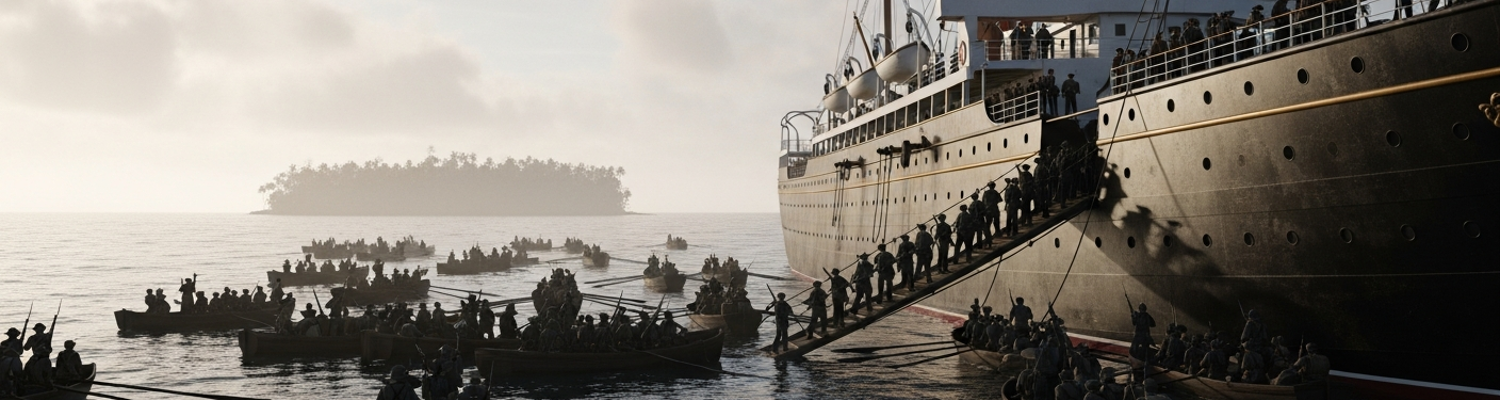

In early 1898, the United States Army was a frontier constabulary force, hardened by decades of small-unit actions but utterly unprepared for a global conflict. The sinking of the USS Maine in Havana harbor forced a reckoning. Suddenly, this small army had to project power not just across the Caribbean, but 7,000 miles across the Pacific to the Spanish-held Philippines. What followed was a logistical ordeal, a brutal, seat-of-the-pants education in expeditionary warfare that fundamentally reshaped the American military. The campaign to seize and hold the Philippines was not a simple story of battles. It was a war against distance, climate, and the Army's own institutional shortcomings.
A Phantom Fleet Forged in Panic
The most immediate crisis was transportation. The U.S. Army possessed no deep-water transport fleet of its own. At the outbreak of war, the Quartermaster’s Department had only a handful of small harbor boats, completely inadequate for a transoceanic invasion. This forced the department, under the direction of Quartermaster General Marshall I. Ludington, into a frantic scramble to charter or purchase civilian vessels. The docks of San Francisco, the primary port of embarkation, became a chaotic marketplace where anything that could float and hold men was considered. Ship owners, sensing desperation, often gouged the government on charter fees.
In a matter of weeks, the Army chartered an ad-hoc armada. On the Pacific coast, dozens of steamers were eventually chartered to move the waves of troops. These were not purpose-built troopships. They were merchant vessels, cargo haulers, and passenger liners designed for entirely different purposes. The job of converting them fell to an overworked Quartermaster Corps and civilian contractors like the Union Iron Works. Carpenters swarmed the ships, hastily erecting thousands of rough wooden bunks in cargo holds never meant for human habitation. Ventilation was an afterthought, sanitation facilities were rudimentary, and galleys were undersized for feeding a thousand soldiers at a time. The SS Morgan City, for example, had to be fitted with temporary bunks for 650 men and stalls for 450 animals, all crammed into spaces meant for non-living cargo.
The first expedition to the Philippines, commanded by Major General Wesley Merritt, departed San Francisco in May 1898. It was a motley convoy. The flagship was the SS City of Peking, a large passenger-cargo steamer built in 1874. Chartered for $1,500 a day, she carried the 1st California Volunteer Regiment, cramming nearly 1,000 men into her holds. She was joined by vessels like the Australia and the SS Senator, a steel-hulled steamship that carried over 1,000 men of the 1st Nebraska Volunteers. The departure of the Eighth Army Corps became a drawn-out affair, moving in seven installments between May and October because not enough ships could be found and converted at once. This piecemeal deployment delayed the arrival of the full American force and complicated the strategic timeline for the capture of Manila. The third expedition, for instance, had to wait weeks for the return of ships from the first expedition before it could depart.
Life aboard these ships was grim. Soldiers were packed into dark, foul-smelling holds. The long voyage across the Pacific, lasting upwards of 30 days, became an endurance test. One soldier aboard the transport Indiana wrote of men being packed so tightly they had to coordinate turning over in their bunks at night. The diet consisted mainly of canned beef and hardtack. The lack of proper facilities for washing clothes or bathing meant the men lived in increasing filth as the journey wore on. Seasickness, boredom, and the sheer discomfort of close quarters degraded morale and physical fitness long before the troops ever saw combat. Animal transport was even worse, with horses and mules suffering terribly in the poorly ventilated holds, arriving in the Philippines weak and unfit for service.
The Indispensable Stepping Stones
Crossing the vast Pacific Ocean in a coal-powered steamship presented a challenge as fundamental as finding the ships themselves: fuel. The 7,000-mile journey from San Francisco to Manila was impossible to make on a single load of coal. The Army’s makeshift transport fleet was utterly dependent on establishing a chain of island coaling stations. This geopolitical necessity drove American policy in the Pacific in 1898.
The Hawaiian Islands became the first and most vital link in this chain. While American commercial interests had long been present, the strategic imperative of securing Pearl Harbor as a naval and coaling station provided the final push for annexation. Military planners argued that controlling Hawaii was non-negotiable for any Pacific operation. On July 7, 1898, President McKinley signed the Newlands Resolution, making Hawaii a U.S. territory. The harbor at Honolulu immediately became a mandatory stop for every transport vessel steaming west. Ships like the City of Peking and the Senator would limp into port, their coal bunkers nearly empty, and spend several days taking on fresh fuel, water, and provisions before continuing their journey. The Army Corps of Engineers began preliminary work to dredge channels and establish permanent facilities. By May 1899, a 1,000-ton capacity coaling station was established at Pearl Harbor, with plans to expand it twenty-fold. The island became a garrisoned, militarized waypoint, the lynchpin of the trans-pacific supply line.
The second essential waypoint was Guam. When the first transport convoy, escorted by the cruiser USS Charleston, left Honolulu, its captain, Henry Glass, carried sealed orders to capture the Spanish-held island. The seizure of Guam on June 20, 1898, was a nearly bloodless affair, bordering on the absurd. The Spanish governor, Juan Marina, was unaware that war had been declared and mistook the Charleston’s warning shots for a salute. He even sent an officer to apologize for not having the gunpowder to return the gesture. The capture’s ease belied its immense strategic value. It provided a secure coaling station and telegraph link in the deep Pacific, breaking up the longest and most perilous leg of the journey to the Philippines. The Navy quickly prioritized the development of Guam’s Apra Harbor for this purpose, transforming it from a remote colonial outpost into a key logistical hub for American power projection. Without these two island bases, the entire Philippine campaign would have been logistically impossible.
A War Against the Environment
If the journey to the Philippines was an ordeal, arrival was a descent into a new kind of logistical hell. The unfamiliar tropical environment savaged the Army’s supplies and its soldiers with equal ferocity. The men of the Eighth Army Corps, mostly volunteers from state militias, were equipped for a temperate North American climate. They landed in the Philippines wearing heavy wool uniforms that were completely unsuitable for the oppressive heat and humidity. Heatstroke and exhaustion were rampant.
Food supplies began to break down almost immediately. The Army’s primary field rations were canned beef, bacon, and hardtack. The canned beef, often of dubious quality from the start, became the subject of a massive scandal that reached the highest levels of government. Major General Nelson Miles, commanding general of the Army, famously dubbed it "embalmed beef," charging that contractors like Armour & Company treated it with chemical preservatives that made it sickening. An Army medical officer described some refrigerated beef as having an odor "similar to that of a dead human body after being injected with formaldehyde." Whether due to chemical adulteration or simply poor preservation in the tropical heat, the meat caused widespread dysentery and food poisoning. Soldiers wrote of throwing their rations away rather than eating the foul-smelling, stringy substance. The resulting scandal led to a contentious court of inquiry and damaged the reputation of Secretary of War Russell A. Alger.
Other supplies fared no better. The constant humidity caused leather gear like shoes and harnesses to rot and grow mold, falling apart in the field. Canvas tents and leggings deteriorated quickly. Paper-cased ammunition was ruined by the dampness, forcing a complete reliance on more expensive brass cartridges. The environment was a relentless enemy. Insects, particularly mosquitoes, spread malaria, dengue fever, and yellow fever through the ranks. Poor field sanitation led to devastating outbreaks of typhoid and dysentery. The 1st North Dakota Volunteer Infantry, for example, saw over a third of its strength incapacitated by disease at one point. Across the entire campaign, for every one American soldier killed in action, approximately ten died from disease. This catastrophic loss rate placed a tremendous strain on a medical corps that was itself ill-equipped for the scale of the crisis. The supply chain was not just a matter of providing bullets and beans; it was a desperate fight against an environment that actively sought to destroy men and material.
Legacy Forged in Failure
The Army’s trans-pacific supply ordeal was a brutal, costly lesson. The frantic scramble for ships, the strategic necessity of island bases, and the horrific impact of the tropical environment forced a generation of officers to confront the realities of modern, expeditionary warfare. The glaring failures in the Philippines directly spurred a wave of sweeping military reforms. The public outcry over the "embalmed beef" scandal and the high disease rates created political pressure that could not be ignored.
One of the most direct institutional changes was the official establishment of the Army Transport Service (ATS) in the fall of 1898. The ATS took over the management of all ocean-going transport, standardizing procedures for chartering, converting, and operating ships. This ended the chaotic, decentralized system that had plagued the initial deployment. The Quartermaster Corps was reorganized and given a far more sophisticated mandate for procurement and logistics, with new specifications for tropical clothing, rations, and equipment. The experiences also provided a powerful argument for the reforms pushed by Secretary of War Elihu Root, leading to the Army Reorganization Act of 1901. This act created a General Staff to handle strategic planning and address the very kind of inter-departmental chaos seen in 1898. The Gilded Age Army, a force built for the frontier, was painfully and irrevocably transformed into a military capable of operating across the globe.