
Diplomatic Deadlock and Operation Uphold Democracy
Archival evidence shows that the crisis escalated at the commercial docks of Port-au-Prince on October 11, 1993. The USS Harlan County approached the terminal at coordinates 18 degrees 33 minutes North, 72 degrees 21 minutes West. Armed attachés belonging to the Front for the Advancement and Progress of Haiti swarmed the wharf. They brandished automatic rifles and machetes. Naval commanders chose extraction. The retreat aborted the deployment of one hundred ninety-three military engineers and medical personnel. The Governors Island Agreement collapsed immediately.
General Raoul Cédras exploited this hesitation. He entrenched his three-man military junta. Brigadier General Philippe Biamby and Lieutenant Colonel Michel François shared executive command. The regime maintained control of the capital through state-sponsored force. They executed political dissidents. They mobilized armed gangs across the slums of Cité Soleil and Bel Air.
United Nations Security Council Resolution 841 instituted an oil and arms embargo. Resolution 917 reinforced these measures with trade prohibitions. American destroyers and Coast Guard cutters patrolled the Windward Passage. They halted commercial fuel shipments. The junta bypassed these maritime cordons through illicit overland smuggling across the Dominican Republic border. Fuel reserves sequestered in underground storage tanks near Carrefour kept regime patrol vehicles running. The civilian electrical grid collapsed into total blackout. Cédras dismissed every diplomatic envoy from the Organization of American States. He ignored formal departure deadlines issued by the United Nations on August 15.
President Bill Clinton secured United Nations Security Council Resolution 940 on July 31, 1994. The mandate authorized member states to form a multinational task force. The objective was to depose the military dictatorship and restore the constitutionally elected president. Clinton tasked the United States Atlantic Command with constructing an invasion force. Admiral Paul David Miller led the effort. Operating out of Fort Bragg and naval installations along the Eastern Seaboard, American planners formulated Operation Plan 2370. Joint Task Force 180 prepared an airborne assault. Lieutenant General Henry H. Shelton of the XVIII Airborne Corps commanded the task force. The plan assigned sixty aircraft loads of paratroopers to target Port-au-Prince International Airport and military airfields at Cap-Haïtien. Aircraft carriers USS Dwight D. Eisenhower and USS America stripped their standard air wings. They housed United States Army special operations helicopters and elements of the 10th Mountain Division.
Air Force planners at Langley Air Force Base and Tinker Air Force Base integrated E-3 Sentry Airborne Warning and Control System platforms into the theater architecture. The radar aircraft managed the high-density airspace over the Caribbean Sea. Flight routes funneled through narrow air corridors north of Cuba. This required continuous synchronization with Federal Aviation Administration oceanic control centers in Miami. Heavy cargo haulers staged tens of thousands of tons of ammunition, field hospital units, and fuel bladders across Naval Station Roosevelt Roads in Puerto Rico and Guantanamo Bay. Shelton moved his command post onto the amphibious command ship USS Mount Whitney. He waited for the final execution order scheduled for the night of September 18.
USAF E-3 Sentry Orbit and Fleet Coordination
A close review of operational logs indicates that at 14:15 Zulu on September 18, 1994, two USAF E-3 Sentry aircraft established an airborne command and control orbit. The aircraft belonged to the 552nd Air Control Wing. They operated at flight level 310 approximately seventy nautical miles north of Cap-Haïtien. The flight crews initiated station-keeping orbits to direct theater air traffic. The aircraft rotodomes housed Westinghouse AN/APY-2 radar arrays. The arrays rotated at six revolutions per minute. They energized their pulse-Doppler transmitters across multiple maritime surveillance sectors. Technicians inside the cabin confronted persistent thermal drift on analog receiver channels. Ambient equipment rack temperatures climbed past operational baselines. Ground returns from the jagged ridge lines of the Massif du Nord produced radar clutter. This threatened to blind operators to low-altitude target signatures. Radar operators adjusted velocity tracking gates and constant false alarm rate thresholds. They filtered false echoes generated by tropical cumulus storm tops and Caribbean surface swells.
Sixty-one combat transports were inbound from the Carolina coast.
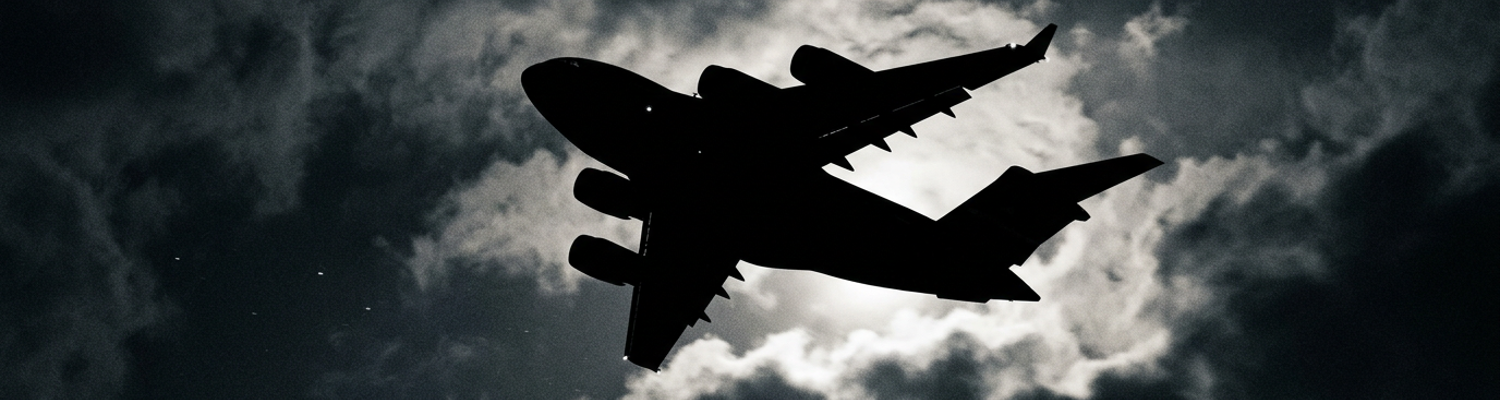
Battle managers aboard the E-3 coordinated the transport aircraft. The planes carried elements of the 82nd Airborne Division. These C-130 Hercules and C-141B Starlifter aircraft launched from Pope Air Force Base. They departed North Carolina in rapid succession. The aerial stream stretched over one hundred miles across oceanic flight tracks. Paratroopers from the 1st Brigade, 504th Parachute Infantry Regiment sat onboard. They were rigged with combat equipment. Heavy-drop pallets carrying M1025 trucks and field artillery occupied the centerline rails. Battle managers seated at the display consoles used Link 11 and Link 16 tactical data networks. They used Have Quick II frequency-hopping ultra-high-frequency radios to maintain aircraft separation. Flight paths converged along oceanic air route Yankee. This prevented wake turbulence accidents in zero-visibility night conditions. Each transport maintained an assigned altitude block between nine thousand and sixteen thousand feet. They burned fuel while waiting for clearance to descend over the drop zones at Port-au-Prince.
Every transport flew without defensive electronic countermeasure pods against Haitian anti-aircraft artillery.
Secure satellite communications links between the airborne command deck and Admiral Paul David Miller suffered recurring signal degradation. Atmospheric moisture over the Windward Passage attenuated the ultra-high-frequency satellite downlink. Battle managers routed status reports through high-frequency radio relays stationed at Guantanamo Bay. Mission crew commanders adjusted tactical frequencies every thirty minutes. This overcame coastal signal jammers attempting to monitor United States military air corridors. The air tactical officers checked the fuel consumption profiles of every C-141B airframe. They compared these against KC-135R tanker positions orbiting between the Bahamas and the Turks and Caicos Islands. Eight KC-135R aircraft held their tracks at flight level 240. They pumped fuel into trailing transports whose fuel reserves had dropped below diversion thresholds. Time was running out for the invasion force.
The transport formation entered the outer radar identification zone forty-five minutes out from the drop zone.
Flight data recorders log that the lead C-130 and C-141 formations began establishing initial approach fixes at 23:45 local time. Inside the E-3 command cabin, weapons directors monitored twenty-eight discrete tactical display stations. They assigned specific drop zone approach headings to the incoming aircraft loads. Two C-130 transports reported electrical bus failures. The failures knocked out their primary tactical air navigation receivers. The Sentry crew provided direct radar vectoring across the final ninety miles of ocean transit. Paratroopers inside the lead transports stood up. They hooked their static lines to the anchor cables. They waited for jump door commands.
Tactical Reconnaissance Failures in Port-au-Prince
When examining the historical record, tactical imagery intelligence assets failed to map the defensive preparations of the Front for the Advancement and Progress of Haiti. High-altitude optical platforms and tactical aerial photography passes operated by Joint Task Force 180 encountered heavy coastal cloud decks. The clouds obscured low-elevation targets across the capital. Below the cloud ceilings, FRAPH militia fighters converted commercial avenues into fortified strongpoints. Emmanuel Constant directed the militia. American imagery analysts detected none of this activity. Heavy barricades constructed from overturned commercial flatbed trucks and reinforced concrete sewer pipes cut off Boulevard Jean-Jacques Dessalines. Piles of burning tires blocked the main arteries connecting the commercial port to Route Nationale 1. Militia squads established firing positions inside two-story cinderblock buildings. They cut horizontal firing slits through masonry walls to cover intersections with automatic rifles and light machine guns. Overhead electro-optical sensors could not penetrate corrugated tin roofing. They could not differentiate sandbagged machine-gun nests from standard domestic scrap in the dense slums of Bel Air and Cité Soleil.
Processing delays at image exploitation centers worsened the problem. Wet-film imagery canisters recovered from daytime photo runs required four to six hours of chemical development at staging facilities. This delivered photographic assessments to battle managers that were completely out of date by nightfall.
Urban shadows concealed armed militia squads across every transit corridor.
Airborne controllers aboard the E-3 Sentry and EC-130E command aircraft confronted severe target uncertainty. The ground environment around Port-au-Prince International Airport remained unmapped. Planners had designated the single asphalt runway and adjacent grassy strips as Drop Zone Golf. This was the primary impact point for twenty-four C-141B Starlifters carrying the 82nd Airborne Division. Controllers possessed zero real-time intelligence on civilian crowd densities along the perimeter fence lines. Unverified radio intercepts indicated that thousands of local civilians had gathered within two hundred meters of the eastern taxiways. The civilians were displaced by nightly blackouts and economic collapse. Battle managers could not verify whether these gatherings represented curious non-combatants, political sympathizers, or armed FRAPH irregulars equipped with shoulder-fired rocket-propelled grenades. Drop zone coordinates sat adjacent to densely populated settlements along Route de Delmas. Parachute drift in fluctuating night crosswinds risked throwing fully laden combat infantrymen into tin roofs. They risked landing on high-voltage electrical wires and walled residential compounds.
Combat controllers lacked definitive confirmation of enemy heavy weapon emplacements.
This intelligence void left mission planners unable to identify Haitian military air defense capabilities ringing the airfield. Haitian Armed Forces garrisons possessed dual-mount heavy machine guns and small-caliber anti-aircraft artillery pieces. These weapons were capable of firing into the low-altitude final approach glide paths. Imagery analysts could not establish whether Haitian troops had moved these weapons from the military compound near Casernes Dessalines to the airport perimeter. They could not confirm if FRAPH gunners had positioned crew-served weapons inside civilian hangars. Airborne controllers had no reliable ground beacons to guide the inbound transports. The lead pilots depended on onboard inertial navigation systems. Coastal humidity and signal drift degraded these systems. Dropping thousands of paratroopers from five hundred feet above ground level into an unverified target area threatened immediate collateral damage. It threatened high-casualty urban engagements before perimeter assembly could begin.
Jimmy Carter Delegation and the Cédras Agreement
Archival evidence shows that on the morning of September 17, 1994, an unarmed United States Air Force C-9 transport touched down at Port-au-Prince International Airport. The aircraft delivered an eleventh-hour negotiating team authorized directly by the White House. Former President Jimmy Carter led the mission. Retired Chairman of the Joint Chiefs of Staff General Colin Powell and Senate Armed Services Committee Chairman Sam Nunn accompanied him. The mission drove through heavily armed street checkpoints to reach the Haitian Armed Forces headquarters on Rue Geffrard. The headquarters sat adjacent to the Champ de Mars. Inside a spartan, un-airconditioned conference room on the second floor, the American delegation faced Lieutenant General Raoul Cédras. Brigadier General Philippe Biamby accompanied Cédras. Carter directed the primary diplomatic dialogue. He offered Cédras an honorable transition and personal security guarantees. Nunn outlined the absolute bipartisan support within Congress for presidential action. Powell established a blunt, professional military dialogue with Cédras. He utilized tactical maps to detail the exact combat capabilities of Joint Task Force 180.
Haitian perimeter guards armed with Galil rifles maintained defensive cordons outside the windows. Anti-American street demonstrations flickered under heavy Caribbean humidity. For over twenty-four hours of grinding discussions, Cédras rejected unconditional surrender terms. He repeatedly claimed his officer corps would resist foreign intervention to preserve national honor.
Diplomacy was running on a fixed mechanical countdown.
The leverage shifted violently at 16:30 Eastern Daylight Time on September 18. Pope Air Force Base launched the lead elements of the 82nd Airborne Division under Operation Plan 2370. Sixty-one transport aircraft climbed into the night sky from North Carolina. The fleet consisted of C-130 Hercules tactical airlifters and C-141B Starlifter transports from the 437th and 305th Airlift Wings. They carried nearly four thousand combat-rigged paratroopers directly toward Hispaniola. Secure satellite communications between the National Military Command Center in Washington and Carter's secure portable radio unit confirmed the launch. Combat aircraft were tracking south along oceanic route Yankee. Powell placed his pocket watch directly on the wooden table. He pointed to the sweeping hands to signal that combat battalions were burning aviation fuel at cruising altitude. They were approaching their drop points. Paratroopers from the 504th Parachute Infantry Regiment were already hooked to anchor cables in cramped fuselages. They carried live ammunition, night vision optics, and Bangalore torpedoes intended to clear runway barriers at Port-au-Prince.
The air armada could not hold formation indefinitely.
The critical psychological break occurred shortly before 20:00 local time. Brigadier General Biamby bolted into the conference room with an urgent intelligence intercept. Pentagon reports broadcast across open commercial news networks and intercepted radio traffic confirmed the deployment. United States military transport squadrons were airborne and closing on the Haitian coast. Biamby reached for his sidearm in fury. He shouted that the delegation was acting as an advance party to mask a surprise invasion. Powell countered the panic by presenting the physical facts of aerial warfare. He warned Cédras that elite paratroopers would drop across Port-au-Prince International Airport within hours. They would sweep aside resistance with overwhelming night combat power. The irreversible flight profile of sixty-one combat transports acted as the decisive lever. It collapsed the junta's negotiating posture in minutes.
Faced with total tactical annihilation, Cédras broke.
Carter exploited the panic by presenting a ready agreement. The agreement allowed a permissive entry under Operation Plan 2380. It sidestepped the combat assault in exchange for the peaceful deployment of the 10th Mountain Division. Provisional President Émile Jonassaint stepped forward to sign the eight-point document under flickering emergency lights. The document guaranteed the departure of the military regime. It authorized American units to secure strategic facilities without bloodshed. Shelton received the confirmed signature aboard the amphibious command ship USS Mount Whitney at 20:30 local time.
In-Flight Mission Abort and Tactical Rerouting
A close review of operational logs indicates that at 20:32 local time, tactical communications operators inside the rotating surveillance dome of the E-3 Sentry received an unprecedented flash-priority directive. The directive originated directly from the National Command Authority. The National Military Command Center relayed the broadcast through Admiral Paul David Miller at Atlantic Command to the amphibious command ship USS Mount Whitney. The emergency broadcast bypassed standard joint task force routing channels to reach the airborne battle staff over secure satellite links. Mission controllers on station at flight level 310 northern tracking coordinate 20 degrees 50 minutes North immediately initiated emergency authentication procedures. They cross-checked encrypted alphanumeric code groups against sealed authentication tables. This verified that President Bill Clinton had formally rescinded the strike authorization. Jump coordinators had sixty-one combat transports bearing down on Hispaniola. They were mere minutes away from dropping four thousand paratroopers of the 82nd Airborne Division directly into hostile drop zones surrounding Port-au-Prince. Sentry flight directors keyed high-power UHF transmitters across Have Quick II frequency-hopping circuits. They interrupted active landing vectors to broadcast an immediate, total mission abort across the entire airborne armada.
Sixty-one heavily laden airlifters reversed heading simultaneously across oceanic route Yankee.
This sudden airborne reversal triggered intense physical and equipment strain inside the cabins of every transport plane. Jumpmasters inside the leading C-141B Starlifters belonging to the 437th Airlift Wing manually hauled jump doors shut against 150-knot freezing slipstreams. They disengaged universal static lines. Four thousand fully armed soldiers staggered against centrifugal pull to collapse back into cargo webbing. Flight engineers recalculated fuel burn rates instantly. They found that multiple C-130 airframes lacked sufficient fuel reserves to safely reverse course back to Pope Air Force Base without running dry over the Atlantic Ocean. Battle managers aboard the E-3 assumed direct procedural separation over the scattered airframes. They deconflicted sudden altitude changes as heavy transports banked into 180-degree climbing turns. This avoided collisions in zero-visibility cloud banks. Controllers vectored eight KC-135R Stratotankers out of their holding tracks near the Turks and Caicos Islands. They hooked up with fuel-starved transports, offloading thousands of pounds of JP-8 jet fuel. Air traffic controllers in Miami scrambled to open commercial airways to handle the sudden military retreat.
Operation Plan 2370 was dismantled in mid-air.
This airborne redirect inverted the entire military architecture. It transformed an active combat assault into a permissive stabilization deployment under Operation Plan 2380. Instead of storming the runways of Port-au-Prince with Bangalore torpedoes and live automatic weapons, American military command pivoted. They established a peaceful, negotiated footprint led by Major General David C. Meade and the 10th Mountain Division. Transport squadrons diverted to secondary recovery bases across the southeastern United States. They touched down at Homestead Air Force Base and Jacksonville International Airport. This allowed infantrymen to download live munitions and reconfigure cargo manifests for non-combat operations. Naval task groups offshore received orders to stand down carrier strike packages. They redirected sixty-two UH-60 Black Hawk and CH-47 Chinook helicopters aboard the USS Dwight D. Eisenhower and USS America. The helicopters flew uncontested logistics ferry runs rather than night combat assaults. Haitian army officers watched the drone of transport engines fade into the northern horizon. They awaited the unarmed arrival of American liaison officers scheduled to touch down at sunrise.
The lead transport touched down at Pope Air Force Base at 03:15 with static lines still coiled across its cargo floor.
Congressional Scrutiny and Civil-Military Repercussions
The immediate recall of the 82nd Airborne Division sparked sharp resistance within the Pentagon. It opened deep fissures between uniform commanders and White House civilian leadership. Inside the National Military Command Center, senior flag officers reviewed flight telemetry. The data indicated that the sixty-one transport planes had reversed course less than thirty minutes before Drop Zone Golf would have received the first wave of paratroopers. Air Force planners argued that executing an evasive reversal of heavily loaded C-141B and C-130 airframes inside congested Caribbean flight tracks introduced severe, uncalculated flight-safety hazards. General Henry H. Shelton faced operational confusion aboard USS Mount Whitney. Communication channels jammed with conflicting orders regarding weapons status, aircraft diverting on fumes, and rules of engagement for ground forces. Civilian national security officials maintained that the National Command Authority retained the absolute constitutional right to halt combat operations at any point before troops hit the soil. Uniformed planners countered that allowing diplomatic negotiations to dictate airborne strike packages up to the point of descent degraded the safety margin of aerial operations.
A direct mid-air cancellation of a combat airborne invasion had no operational precedent in modern American warfare.
The narrow abort window triggered formal inquiries inside Air Mobility Command and the office of the Chairman of the Joint Chiefs of Staff. Battle managers aboard the E-3 Sentry had operated on the perimeter of radar horizon coverage. They handled sixty-one transports banked in violent turns while coordinating with tanker assets over the Turks and Caicos. Flight logs revealed that three C-130s nearly breached mandatory minimum separation distances during the retrograde maneuver. Four C-141 transports landed at secondary diverts with auxiliary fuel cells completely depleted. Inside the Pentagon, debates centered on how far civilian authority should project into the cockpit during active combat entries. Defense analysts questioned whether political aides on the National Security Council understood that a loaded combat drop formation cannot maneuver or hold orbit like naval surface vessels. The physical dynamics of static-line paratroopers standing in gear-stuffed cabins for over six hours, coupled with the danger of mid-air structural collisions during night formations, made the late recall an unacceptable gamble in the eyes of tactical aviators.
Capitol Hill moved swiftly to challenge the White House over the intervention.
Congressional leaders mounted immediate opposition against the Clinton administration. They focused on legal compliance and strategic ambiguity. Lawmakers in the Senate and House of Representatives argued that deploying twenty thousand troops to Hispaniola without explicit prior legislative authorization violated the statutory requirements of the 1973 War Powers Resolution. Senate Minority Leader Bob Dole and Senator John McCain publicly challenged the administration's legal rationale. They rejected the assertion that United Nations Security Council Resolution 940 superseded domestic congressional consultation. Lawmakers questioned the rapid shift from a violent takedown under Operation Plan 2370 to a prolonged stabilization mission under Operation Plan 2380. They warned that American ground units were entering an open-ended quagmire characterized by mission creep. During closed-door hearings before the Senate Armed Services Committee, members pressed Deputy Secretary of Defense John Deutch and Joint Chiefs Vice Chairman Admiral William Owens. They demanded clear exit criteria for Joint Task Force 180 and the follow-on 10th Mountain Division.
Congressional scrutiny turned directly toward the compounding financial cost of maintaining the permissive occupation. Fiscal records registered that the deployment consumed over four hundred million dollars from Department of Defense operations and maintenance accounts within the first ninety days of operations. Representative Dick Armey and members of the House Appropriations Committee demanded immediate accounting audits. They targeted the diversion of readiness funds into Haitian police training programs, infrastructure repair in Port-au-Prince, and United Nations Mission in Haiti transition logistics. Armed services panels introduced restrictive legislative riders designed to cap funding allocations. They forced a mandatory troop withdrawal date before the deployment surpassed the one-billion-dollar benchmark. By December 1994, the House National Security Committee formally subpoenaed the Pentagon for all flight routing logs, communications transcripts, and fiscal records tied to the Caribbean mobilization.