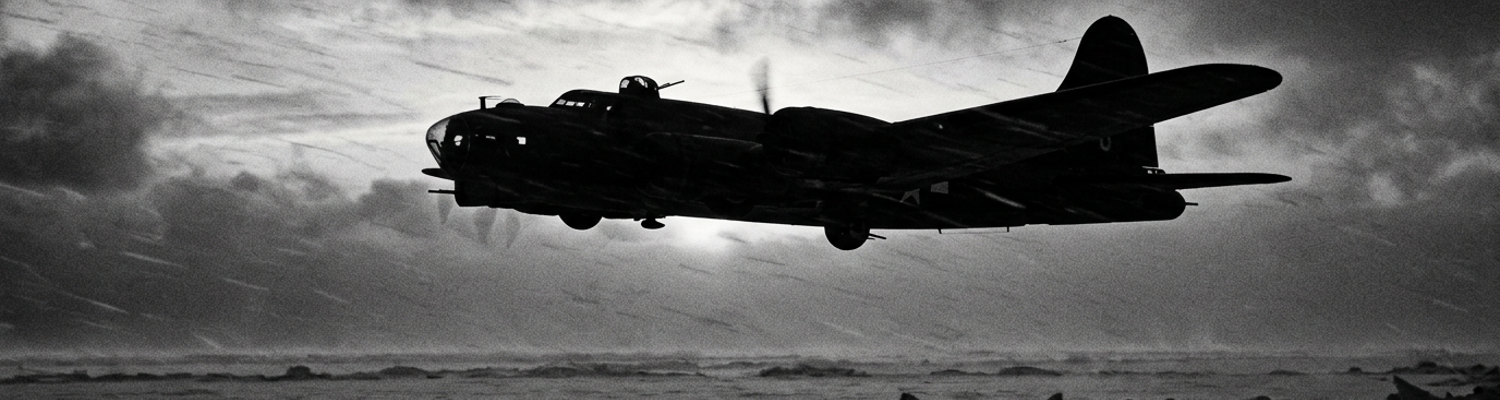

Postwar Arctic Reconnaissance From Argentia Air Base
14 April 1948. 0522Z. Coordinates 47 degrees 18 minutes North, 053 degrees 59 minutes West. Declassified flight logs from United States Coast Guard Air Detachment Argentia (Federal Record Group 26) record airframe 77254 rolling down Runway 07 into freezing fog off Placentia Bay. The aircraft was a modified Boeing PB-1G. It was one of eighteen former Army Air Forces B-17G heavy bombers transferred to the Coast Guard and refitted for maritime patrol. Maintenance crews at the Newfoundland naval station stripped the airframe of its Sperry top and ball turrets. They removed the chin guns and waist armor to reduce weight. This accommodated nine-hundred-gallon auxiliary fuel tanks inside the bomb bay. Ground crews wrestled daily with frozen hydraulic lines and stiffened Wright R-1820-97 Cyclone engines. They pumped preheated lubricating oil through external lines directly into the crankcases before every morning launch.
Flight logs confirm field technicians replaced the ventral gun position with a customized optical bay. This bay housed twin Fairchild K-17 aerial mapping cameras fitted with six-inch Metrogon lenses. Coast Guard Eastern Area command ordered these aircraft to fly extended reconnaissance patterns along the sub-Arctic approaches. They monitored ice conditions and tracked unexplained naval activity following the Czechoslovak political crisis.
The North Atlantic offered zero forgiveness for mechanical failure.
Flight paths pushed deep into the Davis Strait. They tracked across the Labrador Sea past the sixty-fifth parallel between western Greenland and Baffin Island. Archival evidence shows these surveillance sweeps operated entirely outside terrestrial radar nets. Air crews flew hundreds of miles beyond the operational coverage of mainland radar sites in eastern Canada and southern Greenland. Early warning installations did not exist at these latitudes in 1948. Naval picket ships could not penetrate the heavy pack ice grinding through the strait.
The PB-1G carried an AN/APS search radar in an under-nose radome. The system proved incapable of distinguishing targets amid dense field ice. Surface clutter bounced off pressure ridges and floating growlers. The radar scope turned into a blinding smear of green interference. Pilots descended to eight hundred feet to identify features visually. This brought the four-engine aircraft directly into low-level thermal inversions and supercooled sea spray. Rime ice coated the leading wing edges. Reconnaissance technicians in the unheated waist compartment manually triggered the K-17 cameras to document choke points along Disko Bugt and the Cumberland Peninsula. Interior cabin temperatures hovered near minus twenty degrees.
A close review of operational logs indicates basic spatial orientation regularly broke down during these northward reconnaissance sweeps. Magnetic compass needles rotated without direction. The flights operated within eight hundred miles of the North Magnetic Pole on the Boothia Peninsula. Gyro fluxgate compasses drifted substantially without reliable ground-based radio transmitters to provide alignment updates. Navigators worked from the forward astrodome using a Kollsman periscopic sextant and an astro-compass. They shot star lines on Polaris or calculated sun-azimuth angles during brief openings in the cloud deck.
Determining ground speed required physical observation of the surface through a floor drift sight.
The crew threw magnesium smoke flares or aluminum drift markers through the bottom flare chute into the ice below. They tracked the drift of the smoke through the drift meter optics to calculate crosswind correction angles. Heavy Arctic stratus clouds regularly blocked the sun and stars for eight continuous hours. The navigators had no choice but to rely on blind dead reckoning. They hand-plotted vectors on blank hydrographic charts using estimated airspeeds and unverified wind forecasts.
A six-knot wind shift could throw a plotted course fifty miles off target.
Operational records from late April document how quickly these compounding mechanical and navigation problems created severe tactical danger. On 22 April, aircraft 77254 developed severe engine vibration while scouting pack ice edges sixty miles off Cape Dyer at 66 degrees 30 minutes North, 061 degrees 15 minutes West. The number three engine suffered a ruptured oil line when crankcase breather tubes froze solid in minus forty-degree air. Pilots feathered the propeller. They reduced cruise speed to one hundred and thirty knots while heavy overcast obscured both horizons. Without celestial sightings or compass references, the navigator calculated their return heading by dead reckoning using twelve-hour-old wind data from Argentia. An unrecorded barometric drop along the Baffin Island coast caused the aircraft pressure altimeter to read five hundred feet higher than actual altitude. This disguised a thirty-knot westerly crosswind. The PB-1G drifted forty miles east of its designated flight lane. It directly entered coastal airspace claimed by Soviet-flagged survey vessels operating off southwestern Greenland.
Maintenance Alterations to Pitot-Static Tube Rheostats
Archival evidence shows that on the evening of 23 April 1948, ground technicians inside Hangar 3 at Naval Station Argentia struggled to resolve an electrical defect on PB-1G 77254. The aircraft was slated for an early-morning long-range patrol over the Davis Strait ice pack. During pre-flight functional tests in an unheated shelter where ambient air sat at twelve degrees Fahrenheit, the pitot-static tube heating circuit repeatedly failed. Every time the cockpit crew toggled the heating switch to clear simulated icing, the eight-ampere Klixon thermal circuit breaker on the sub-panel behind the copilot station popped. Repeated resets caused the circuit breaker contacts to scorch and weld slightly.
Inspection of the wiring revealed the original B-17G wire-wound rheostat had developed an internal short to ground across its ceramic core. This component was installed to adjust current to the pitot head heating coil based on exterior temperature.
Supply ships were delayed by ice in Conception Bay. Replacement rheostats were unavailable in Newfoundland. Facing a mandatory morning departure deadline set by Coast Guard Eastern Area commanders, the detachment engineering petty officer fabricated a field bypass. Mechanics took an insulated twelve-gauge copper jumper wire, stripped both ends, and spliced it directly across the rheostat terminals on junction box J-4 beneath the navigator floorboards. This modification completely eliminated the variable resistance control. It routed twenty-eight volts of direct current straight from the main bus into the heating elements.
The circuit stopped tripping.
A close review of operational logs indicates ground personnel operated under the firm technical assumption that continuous, full-power thermal output would have zero negative effect on instrument accuracy. Standard operating doctrine in temperate climates treated pitot heating as a binary safety feature designed only to prevent ice from obstructing the dynamic pressure inlet. Argentia mechanics reasoned that sub-zero slipstreams along the sixty-fifth parallel would act as a natural heat sink. Temperatures routinely plunged past minus thirty degrees. They believed this cold air would draw away any excess thermal energy from the nickel-plated brass tube. They assumed the metal housing would never exceed normal operational thresholds while flying at one hundred and sixty knots.
That assumption disregarded basic thermal dynamics inside the stagnation chamber.
With the heating coil running continuously at unrestricted wattage, exterior probe skin temperatures climbed past two hundred and ten degrees Fahrenheit. Heat soaked directly into the enclosed air column within the pitot tube inner dynamic pressure chamber and the adjacent static balance ports. This localized thermal expansion sharply decreased the density of the trapped air sample relative to the frigid ambient atmosphere outside the fuselage. By artificially altering the pressure differential between the dynamic head and the static sense lines, the unmodulated heater began systematically skewing the bellows inside the Kollsman Type C-12 airspeed indicator.
Cold air rushed past hot brass at two hundred miles per hour.
When examining the historical record, investigators found this improvised field alteration bypassed every mandatory inspection layer before flight clearance. Coast Guard engineering procedures required all non-standard wiring alterations to be drafted on standard Form 268-A change sheets and approved by a qualified naval aviator or base engineering officer. No entry was made in airframe 77254 historical maintenance binder. Field modifications concluded at 0245Z during an overnight blizzard as the hangar shift changed hands. Departing technicians failed to log the jumper installation on the daily discrepancy sheet. They treated the fix as a routine temporary continuity repair that could be sorted out after the reconnaissance sweep returned.
Lieutenant Commander Arthur Vance arrived at the dispersal pad at 0430Z with his morning flight crew. Vance signed the yellow aircraft release manifest without knowledge of the altered wiring harness under the cockpit floorboards. Ground crews pulled the external starter carts away at 0510Z. Airframe 77254 taxied into the freezing drizzle toward Runway 07 with an uncalibrated heating element already warming the nose probe to boiling temperatures.
Thermal Distortion and Telemetry Failure at Altitude
A close review of operational logs indicates that at 0840Z on 24 April 1948, aircraft 77254 crossed 63 degrees 15 minutes North, 058 degrees 40 minutes West over the southern mouth of the Davis Strait. Aerological forecasts issued six hours earlier by the naval weather station at Goose Bay predicted scattered cirrus and clear visual corridors through the passage. Vance and his crew encountered a rapidly intensifying Polar low that funneled an unforecast Arctic blizzard across the Labrador Sea pack ice. Dense cumulonimbus clouds and zero-visibility snowfall slammed into the PB-1G at nine thousand feet. Heavy structural rime ice began accumulating along the leading edges of the wings within four minutes. Vance pushed all four Wright R-1820-97 engines into auxiliary supercharger blower mode.
Lieutenant Commander Vance ordered an immediate climb. He hunted for the clear air typically found above maritime storm fronts. Airframe 77254 labored upward for forty minutes of continuous ascent. Cruising altitude was reached at 22,000 feet during an unforecast Arctic blizzard. External ambient air temperatures outside the uninsulated plexiglass nose cone dropped abruptly to minus fifty-two degrees Fahrenheit.
Clear air did not bring stability to the flight deck.
Archival evidence shows the bypassed pitot-static heating circuit was drawing continuous, unmodulated direct current straight from junction box J-4 beneath the navigator floorboards. Because the Argentia ground crew had eliminated the variable wire-wound rheostat with a solid copper jumper, twenty-eight volts poured unchecked into the heating coils inside the Kollsman Type 385B pitot head mounted on the port nose cheek. The nickel-plated brass tube assembly had been engineered to operate with regulated intermittent resistance. Under continuous high-wattage electrical load in the thin atmosphere, the metal casing reached temperatures exceeding three hundred and twenty degrees Fahrenheit.
Thermal distortion of the overheated pitot tube head altering pressure dynamics immediately followed.
As the exterior brass casing expanded unevenly along its longitudinal axis, the forward stagnation orifice warped from a true circular cross-section into a flattened ellipse. Superheated air inside the forward stagnation chamber expanded forcefully against incoming laminar airflow. This produced a localized thermal barrier. This micro-layer of escaping hot air deflected incoming ram air away from the internal pressure pickup line. It systematically reduced the mass of dynamic air entering the internal baffle.
Standard aerodynamic equations broke down completely inside the warped probe.
When examining the historical record, flight reconstruction logs reveal this thermal displacement triggered an immediate, cascading instrumentation failure across the main panel. The localized thermal wash bled rearward along the skin of the tube into the static balance orifices drilled around the circumference of the probe barrel. Heating this static balance chamber generated an artificial low-pressure vacuum that sent incorrect pressure references pulsing through the pneumatic copper lines. This led directly to a simultaneous corruption of indicated airspeed values and barometric altimeter readouts across both pilot stations.
The cockpit Kollsman Type C-12 airspeed indicator needle drifted erratically upward. It falsely displayed an indicated airspeed of two hundred and ten knots while the actual forward speed of the PB-1G was decaying through one hundred and thirty-one knots. At the same moment, the Type C-13 sensitive barometric altimeter registered an artificial pressure drop. It reported an indicated altitude of twenty-four thousand feet. Believing the heavy patrol bomber was overspeeding and climbing dangerously above its designated patrol ceiling, Vance pulled back all four throttle quadrants to twenty-two inches of manifold pressure.
The modified B-17 slowed to within four knots of high-altitude aerodynamic stall buffeting over the pack ice of the Davis Strait.
Flight recorder barographs recovered after the patrol showed the airframe wallowing five miles north of its assigned corridor with control surfaces trembling.
Drift Deviation Across the Restricted North Atlantic
A close review of operational logs indicates that by 0945Z, airframe 77254 had entered an impenetrable blizzard system that rendered standard high-latitude orientation impossible. Multi-layered Arctic clouds towered past twenty-six thousand feet. They completely sealed off the forward astrodome and denied the navigator visual reference to the sun or horizon. Standard polar aerial navigation required regular sextant sightings on Polaris, Vega, or Arcturus through the overhead dome to calculate lines of position and correct the continuous mechanical precession of the Sperry directional gyros. With the outside temperature resting at minus fifty-four degrees Fahrenheit, rime ice and condensation froze in thick sheets across the interior plexiglass of the observation dome. This blinded the navigator Kollsman periscopic sextant.
Proximity to the North Magnetic Pole caused the secondary magnetic compass on the instrument panel to spin erratically. Down in the unpressurized nose compartment, the drift meter optical tube showed only opaque whiteout. This made it impossible to deploy magnesium smoke flares through the chute or determine drift angles over the frozen sea. Left without celestial sightings, the navigator relied exclusively on dead reckoning. Lieutenant Commander Vance and his plotting team projected their track on hydrographic charts using the artificially inflated airspeed figures produced by the warped pitot assembly.
The periscopic sextant mirrors reflected nothing except gray condensation.
Archival evidence shows an undetected core of Arctic crosswinds caught the wallowing heavy bomber as it skimmed the turbulent cloud tops. Aerological stations at Goose Bay and Godthaab had predicted light northerly breezes of twelve knots along the Davis Strait. Airframe 77254 blundered directly into an unrecorded polar jet stream anomaly packing continuous west-northwesterly crosswinds of eighty-five knots across the southern Davis Strait. Because Vance had pulled back engine throttles to twenty-two inches of manifold pressure to counter false cockpit overspeed warnings, the bomber true forward ground speed had fallen to just one hundred and twenty-two knots.
This lateral wind velocity matched more than sixty percent of the aircraft actual forward momentum.
Believing the plane was maintaining its assigned track along the Canadian coastline toward Disko Island, the navigator factored in a modest five-degree crab angle to the northwest. Instead of holding course, the eighty-five-knot crosswind was physically shoving the four-engine airframe sideways across the meridian lines at more than seventy miles per hour. Over three and a half hours of unmonitored flight, the PB-1G drifted three hundred and ten nautical miles east-southeast of its assigned reconnaissance route.
No crew member noticed the altered heading.
When examining the historical record, radar plots preserved in United States Air Force operational files document the aircraft crossing directly over the rugged southern tip of Greenland near Cape Farewell at 1215Z. The straying PB-1G penetrated the inner perimeter of the North Atlantic security air corridors established under emergency postwar defense protocols. These restricted air lanes protected military shipping routes between Newfoundland, Greenland, and Iceland. They were guarded by newly erected SCR-588 early warning radar stations and naval surface pickets.
Flying without an active Identification Friend or Foe transponder code, airframe 77254 appeared on coastal radar scopes as an unidentified multi-engine bomber tracking inbound toward naval replenishment anchorages off Reykjavik. Base intercept controllers at Bluie West One logged the radar track at 60 degrees 08 minutes North, 043 degrees 12 minutes West. They designated the target as an unknown bogey flying at twenty-two thousand feet. Ground controllers sounded air defense alerts across the southern Greenland sector. They scrambled two F-51D Mustang interceptors from the 62nd Fighter Squadron stationed at Keflavik Air Base.
Emergency Intercept Scrambles and Diplomatic Fallout
Archival evidence shows that at 1222Z, radar operators manning the SCR-588 early warning set at Ikateq on the eastern coast of Greenland recorded a persistent primary return tracking directly across the ice cap. Operating on a frequency of one hundred and ten megacycles, the station dipole antenna array picked up the echo through heavy atmospheric static. Oscilloscope sweeps displayed an unidentified target holding steady at twenty-two thousand feet, traversing grid coordinate 61 degrees 10 minutes North, 042 degrees 05 minutes West at an estimated ground speed of one hundred and twenty knots.
The aircraft emitted no electronic identification response when queried by the ground station SCR-729 transponder interrogator on standard Mode 1 and Mode 2 channels.
Ground radar technicians checked the echo pulse width against baseline calibration charts. They noted the reflective surface area matched that of a four-engine heavy bombardment platform. This unknown contact was penetrating the transit route connecting naval air stations in southern Greenland with the fleet anchorage at Hvalfjordur, Iceland. Station personnel designated the track as Bogey 87. They relayed coordinates over high-frequency radio teletype to air defense filters in Newfoundland and Iceland.
The radar return showed zero drift correction.
When examining the historical record, defense logs confirm Northeast Air Command at Fort Pepperrell placed all regional intercept units on immediate air defense condition red at 1228Z. Air controllers at Keflavik scrambled two North American F-51D Mustangs from the 62nd Fighter Squadron. They ordered the pilots to climb through dense maritime overcast toward twenty-five thousand feet to intercept the inbound contact over the Denmark Strait. Senior staff officers in the Pentagon and Royal Canadian Air Force headquarters in Ottawa confronted immediate strategic confusion. Western defense commanders had received no advance warning of high-altitude Allied movements in that quadrant.
Intelligence officers feared the target represented a hostile reconnaissance sweep. They suspected newly produced Soviet Tupolev Tu-4 bombers were testing radar gaps along the North American polar approaches following the breakdown of Allied administrative councils in Berlin. Base commanders at Goose Bay placed four armed B-29 bombers on fifteen-minute runway alert to protect North Atlantic sea lanes. Canadian ground controllers at RCAF Station Torbay spun up backup warning receivers while intercept coordinators struggled to establish radio contact across international guard channels.
No scheduled military flight plan matched the target position or altitude.
A close review of operational logs indicates that at 1245Z, State Department watch officers initiated urgent diplomatic communications using priority cryptographic teletype circuits. Washington officials contacted the Danish Ministry of Foreign Affairs in Copenhagen to explain that an unidentified heavy aircraft had entered the sovereign airspace of Greenland without prior clearance. Simultaneous flash messages reached the Coast Guard Eastern Area command center in New York. They demanded immediate verification of every search-and-rescue patrol operating north of the sixtieth parallel.
Cryptographers at Naval Station Argentia ran emergency decrypts of late-morning communications logs. They realized PB-1G 77254 had failed to transmit scheduled position reports on 6770 kilocycles for three hours. Coast Guard headquarters dispatched an emergency cable over naval telegraph networks to United States Air Forces in Europe headquarters in Wiesbaden. They identified the radar intruder as an unarmed mapping flight stripped of defensive armament and suffering complete telemetry failure.
American naval attaches delivered identical clarification cables by hand to the British Admiralty in London at 1312Z. They terminated intercept vectors eight minutes before the scrambled Mustangs established visual contact off Iceland.
Curriculum Reforms at the Coast Guard Academy
A close review of operational logs indicates Coast Guard Headquarters convened a formal air safety board of inquiry in Washington, D.C., on 18 May 1948 to examine the near-shootdown over Greenland. Rear Admiral Merlin O'Neill directed investigators to dismantle the electrical system of airframe 77254 inside Hangar 3 at Argentia. Engineering inspectors found the scorched twelve-gauge copper jumper still spliced across junction box J-4 beneath the navigator compartment. The inquiry report condemned the Argentia maintenance detachment for bypassing mandatory Form 268-A engineering review protocols. It identified twenty-two similar unrecorded electrical modifications across the eastern patrol fleet.
Ground crews had treated thermal de-icing elements as rudimentary on-off resistors rather than sensitive aerodynamic components. Investigators demonstrated that applying continuous direct current to the Kollsman Type 385B head warped the intake aperture by four-hundredths of an inch. This created the localized heating bubble that falsified cockpit telemetry. Base engineering officers who signed release slips without inspecting physical junctions received formal letters of reprimand. Headquarters banned all field-fabricated wiring jumpers across Coast Guard aviation on 12 June 1948.
Expedient bench repairs ended by administrative order.
Archival evidence shows the incident prompted a comprehensive restructuring of the aviation and seamanship curriculum at the Coast Guard Academy in New London, Connecticut. Academy Superintendent Arthur G. Hall established the Polar Flight Studies Group in August 1948. He replaced standard maritime dead reckoning instruction with an eighty-hour laboratory regimen centered entirely on sub-Arctic operations. Third-year cadets were pulled from conventional coastal plotting rooms and assigned to simulated polar dead-reckoning trainers inside Hamilton Hall. Flight instructors eliminated reliance on standard Mercator charts. They introduced transverse grid navigation to solve the severe convergence of meridians north of the sixtieth parallel.
Coursework forced students to calculate courses purely via Greenwich Hour Angle formulas, Kollsman periscopic astro-compass tracking, and sun-azimuth tables. Cadets spent three hours every week running flight calculations in refrigerated pressure chambers chilled to minus thirty degrees to replicate unpressurized aircraft cabins. Written examinations required prospective navigators to calculate crosswind drift offsets using magnesium smoke flares and gyro drift meters within forty seconds of raw observation.
Magnetic compass orientation was formally banned from high-latitude flight examinations.
When examining the historical record, aviation directives issued by Coast Guard headquarters in October 1948 mandated the immediate structural retrofitting of all long-range reconnaissance airframes. Bureau of Aeronautics engineers required all PB-1G and PBM-5 Mariner aircraft to install dual, electrically isolated pitot-static lines. Technicians mounted a secondary pitot probe on the starboard forward fuselage. They routed its dynamic pressure line through a distinct heating circuit equipped with independent automatic thermostatic switches.
Flight rules now required navigators and copilots to conduct cross-cockpit instrument checks at fifteen-minute intervals. If the primary Kollsman Type C-12 airspeed indicator deviated by more than four knots from the auxiliary copilot gauge, flight plans required immediate descent below maritime stratus decks. Headquarters also mandated the installation of AN/APN-1 low-altitude radio altimeters as an independent absolute-height reference to check barometric altimeters for temperature-induced pressure errors. Patrol crews could no longer calculate cruise headings without a confirmed radio-altimeter terrain clearance reading logged directly into the navigation binder.
By January 1949, every PB-1G operating out of Argentia carried dual flight logs documenting matched pressure readings before crossing the sixty-second parallel.