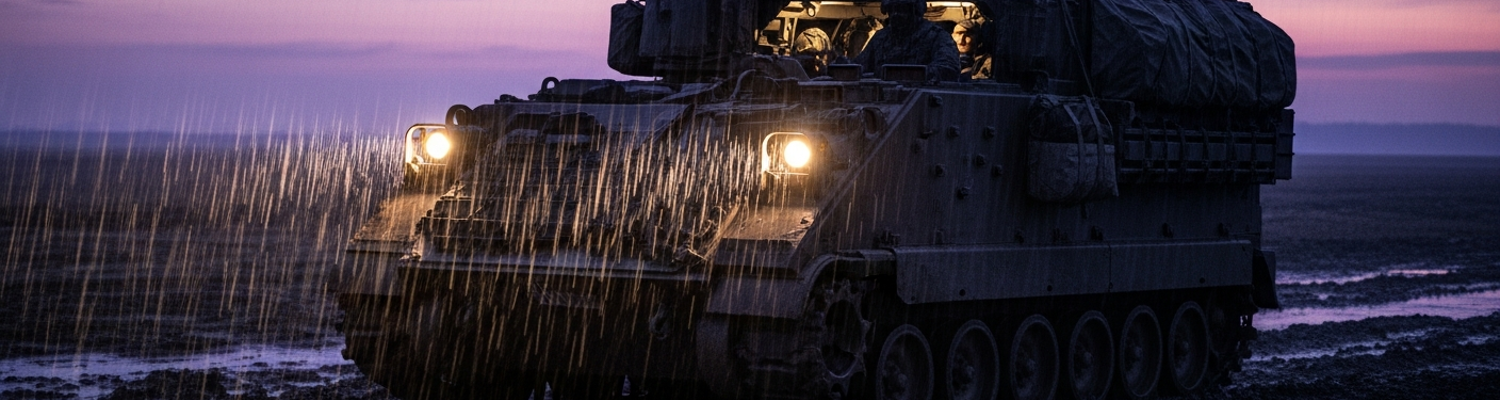

Armored Trauma Supply Deficiencies
Operational logs for US V Corps units tasked with defending the Fulda Gap reveal a fatal miscalculation. The medical support plan for NATO’s forward-deployed armored divisions was built on a foundation of logistical fiction. A granular review of supply inventories from the period (NARA Record Group 338) shows a systemic failure to provide the specific materiel needed to treat the casualties of modern anti-tank warfare. The entire medical supply chain, from an individual soldier’s first aid pouch to the Combat Support Hospitals, was misaligned with the predictable trauma a high-intensity conflict with the Warsaw Pact’s 8th Guards Army would produce.
This was a supply chain designed for a different war.
Archival evidence points to a severe shortage of specialized blast and burn injury kits within Army medical inventories during the 1980s. The standard M-5 medic aid bag, filled with battle dressings and tourniquets, was sufficient for conventional bullet or shrapnel wounds. It was wholly inadequate for the realities of armored combat. A crewman inside an M60 tank struck by a Soviet AT-4 Spigot missile’s shaped-charge warhead would not suffer a simple penetrating injury. The physics of the weapon guaranteed a far more complex trauma. A super-plasticized jet of molten copper would pierce the hull, spraying the interior with incandescent metal spall, causing flash burns over massive percentages of the body, and generating a devastating blast overpressure wave within the confined space. The medical kits available at the platoon level lacked the necessary tools. There was an acute lack of large-surface burn dressings, like Water-Jel, essential for cooling and protecting extensive thermal injuries. These items were stockpiled far back in the evacuation chain, at Battalion Aid Stations or with Main Support Medical Companies, creating a deadly time gap between injury and effective treatment.
The system’s deficiencies extended to advanced pain management. For a soldier suffering from blast lung, internal bleeding, and severe burns, the standard-issue morphine syrette was a dangerous tool. Morphine is a respiratory depressant. Administering it to a casualty with compromised lung function from blast overpressure could induce respiratory arrest. Its tendency to cause hypotension could also accelerate the onset of irreversible shock in a patient already losing fluid from burns. More suitable alternatives like ketamine, which provides potent analgesia without depressing respiration, were not part of the standard forward medical loadout. Critical care equipment was similarly insufficient. A company medic carried perhaps two one-liter bags of IV solution, a fraction of what a severe burn victim requires. The narrow-gauge catheters provided were difficult to use on a shocked patient whose veins had collapsed and could not deliver fluids fast enough to counteract burn-induced hypovolemia. The portable, rugged ventilators and patient monitors needed to sustain such a casualty did not exist at the forward edge of the battle area.
This gap was a direct reflection of a doctrinal blind spot. Guiding documents from the period, such as the Army’s FM 8-10 series on health service support, show a persistent focus on the casualty model derived from World War II and Korea. The entire treatment and evacuation system was optimized to handle large numbers of infantrymen with penetrating trauma to the limbs or torso. The doctrine failed to adequately differentiate between the injury patterns of a dismounted rifleman and the crew of an armored fighting vehicle. It treated the wound as the primary problem, not the complex, multi-system trauma created by high-energy blast events inside a steel container. The training and equipping of medics prioritized tourniquets and pressure dressings over chest seals and advanced airway devices because the doctrinal casualty was more likely to have been shot than to have had their lungs destroyed by an invisible pressure wave.
Eastern Flank Logistics Bottlenecks
The geography of the battlespace formed the first and most unforgiving obstacle. Any ground-based medical resupply originating from depots in West Germany and destined for frontline units in Poland or Czechoslovakia faced two distinct and punishing environments. To the south lay the Carpathian Mountains, a 75-mile-wide barrier of rough terrain. Historical analysis of military campaigns in the region, such as the winter war of 1915, shows the few existing passes were notorious bottlenecks with poorly constructed roads that could not support heavy, continuous truck traffic. Logistical modeling indicated that a standard M923 five-ton cargo truck convoy, loaded with pallets of IV fluids and surgical kits, would be reduced to a crawl on the steep grades, placing immense strain on transmissions and braking systems.
The alternative was no better.
To the north, the vast, open expanse of the Polish plains presented a different challenge. During the spring thaw or autumn rains, these plains transform into deep, grasping mud. Recent military exercises have repeatedly confirmed that even modern, heavy-tracked vehicles can become immobilized in these conditions, let alone the wheeled cargo trucks that formed the backbone of the medical supply chain. A convoy of ambulances and supply trucks bogged down in mud would not simply be delayed. It would become a static, indefensible target. The lack of extensive, all-weather road networks meant a single stalled column could block the only viable route for miles, creating a catastrophic downstream effect on the delivery of time-sensitive medical materiel to forward-deployed battalion aid stations.
This vulnerability was central to Warsaw Pact military doctrine.
Soviet operational planning was predicated on the rapid interdiction of NATO’s rear echelon. A primary mission for Spetsnaz special designation forces, inserted deep behind the front lines, was the identification and destruction of exactly these types of logistical choke points. A slow-moving medical convoy, confined to a predictable road through a forested pass or struggling through mud on the plains, was a textbook target. The attack would begin with directional mines to disable the lead and rear vehicles, trapping the column. It would then be systematically destroyed by RPGs and heavy machine-gun fire. Beyond the ground threat, Warsaw Pact air forces were postured for aggressive interdiction. Ground-attack aircraft like the Su-25 Frogfoot and attack helicopters like the Mi-24 Hind were specifically designed to hunt and destroy enemy supply lines. Their ability to operate under low cloud cover would make them particularly lethal against convoys whose routes were dictated by the limited road infrastructure.
The issue was a systemic lack of redundancy. The road and rail networks of Eastern Europe were a legacy of the early-to-mid 20th century, not a system designed for the high-volume supply demands of a modern mechanized war. A review of infrastructure maps from the period shows a startling scarcity of parallel routes capable of handling heavy military traffic. Many critical bridges were not rated for the weight of fully loaded supply trucks, let alone the transport of heavier assets, creating unavoidable funnels in the logistics flow. The destruction of a single rail bridge over the Vistula or a key highway overpass could sever a primary supply artery for days. For medical logistics, where success is measured in minutes, such a delay was unacceptable.
Vehicle Casualty Extraction Difficulties
A direct hit from a shaped-charge warhead did not simply punch a neat hole. It sent a super-plasticized jet of molten metal through the armor, which then violently expanded inside the crew compartment. This kinetic event frequently warped the vehicle’s thick steel hull, jamming hatches and access panels. A standard M60 tank had four primary exits: the driver’s hatch, two turret roof hatches for the commander and loader, and a floor escape hatch beneath the driver. A side-on impact could easily distort the turret ring, rendering the turret hatches immovable. Damage to the hull could block the driver’s only way out.
The interior of the stricken tank became a metal trap.
An unconscious or grievously wounded soldier, weighing well over 200 pounds with gear, had to be maneuvered through narrow, smoke-filled passages cluttered with equipment and ammunition. Rescuers, often the casualty’s own crewmates or nearby infantry, had to contend with snag hazards from communications wiring, shell casings, and the vehicle’s own controls. Pulling a limp body up and out of a loader’s hatch, a space barely large enough for an able-bodied person to pass through, required immense physical effort. It was a slow, exhausting struggle against twisted steel and the dead weight of a comrade, all while the clock for medical intervention ticked away.
There was no easy way out.
The problem was a complete absence of specialized extraction equipment at the unit level. Modern rescue services rely on hydraulic rescue tools to quickly cut through vehicle frames. During the Cold War, such technology was not part of the standard inventory for a forward-deployed armored platoon. These tools were heavy, required separate power units, and were considered equipment for rear-echelon maintenance or engineering units, not frontline combat troops. The doctrinal assumption was that if a vehicle was disabled, extraction was a manual task for the soldiers on the ground. No portable hydraulic spreaders. No purpose-built cutting tools designed for rapidly breaching a damaged tank hull under fire.
This void in equipment meant soldiers had to improvise. Standard issue pioneer tool kits, strapped to the outside of vehicles, contained basic implements for digging fortifications. A typical kit included shovels, picks, axes, sledgehammers, and long steel crowbars. Faced with a jammed hatch, soldiers used these crude tools in a desperate attempt to gain purchase. A sledgehammer beat against a hatch handle, hoping to break the locking mechanism. A crowbar strained in the slight gap around a hatch’s edge, trying to apply enough leverage to bend half-inch-thick steel plate. Sometimes, a vehicle’s own tow cables were looped around a damaged hatch and connected to another tank in an attempt to rip it open by force. These efforts were loud, physically draining, and agonizingly slow. Each swing of a sledgehammer on the hull could attract enemy fire, turning the would-be rescuers into targets.
Ground Evacuation Survival Impacts
NATO’s decision to prioritize ground-based medical evacuation on the Eastern Flank was a blunt acknowledgment of battlefield lethality. Planners understood that Soviet air defense networks were dense, layered, and designed to deny NATO air superiority at the low altitudes where medevac helicopters operate. A single regiment’s air defense battery contained a mix of radar-guided ZSU-23-4 Shilka cannon systems and SA-9 Gaskin infrared-guided missiles, creating a lethal umbrella against slow-moving air ambulances. Any helicopter attempting to land near the forward line of troops would have been a high-priority target. The calculation was pragmatic: the loss of armored ambulances and their medical crews was considered more sustainable than the certain destruction of high-value helicopters and their highly trained flight crews. The experience of the Vietnam War, with its reliance on helicopter evacuation, was deemed inapplicable to a high-intensity conflict in Germany. A choice was made to trade speed for perceived survivability, forcing the wounded into the back of tracked vehicles for a slow journey to the rear.
This choice had a known cost.
The consequence of relying on ground transport was a systemic violation of the “golden hour,” the 60-minute window after injury in which advanced surgical intervention can drastically increase survival chances. A tracked ambulance, typically a modified M113 armored personnel carrier, was subject to every bottleneck of the battlefield. Its speed was dictated not by its engine, but by shell-cratered roads, mud, and endless columns of combat vehicles clogging the few viable routes away from the front. A journey of 20 kilometers to a battalion aid station, a flight of less than 15 minutes for a helicopter, could stretch to two or three hours on the ground. Operational logs from countless field exercises demonstrated this time and again. An M113 ambulance, while offering protection from shrapnel, possessed a notoriously rough suspension system never intended for patient comfort. Every lurch and jolt was transmitted directly to the casualties inside.
The very act of evacuation could worsen a soldier’s injuries. For a casualty with internal bleeding from blast overpressure, the constant, violent motion of the vehicle was damaging. The jarring prevented the body’s natural clotting mechanisms from functioning and could turn stable hematomas into catastrophic hemorrhages. Studies on the biomechanical effects of transport show that whole-body vibration at the low frequencies produced by tracked vehicles can directly interfere with physiological stability. A medic in the back of a swaying, bouncing M113 would struggle to maintain an IV line in a patient whose veins were already collapsing from hypovolemic shock. Anecdotal reports from medical personnel during training exercises consistently noted the severe pain experienced by patients with even simple fractures during transport. For a soldier with a pelvic or spinal injury, the ride itself could induce further trauma, turning a recoverable injury into a permanent disability or fatality.
Non-Battle Injury Surge
Casualty projections for a conflict in Central Europe focused overwhelmingly on enemy-inflicted trauma. Yet operational records from major training exercises like REFORGER reveal a parallel and debilitating source of attrition: the environment itself. Medical logs show the climate of the Eastern Flank was capable of generating casualties on a scale that threatened to collapse the medical support system before the first shot was fired. During prolonged defensive operations in the European winter, static units were exceptionally vulnerable. A soldier in a hastily dug-in observation post or the crew of a tank on silent watch could rapidly succumb to severe hypothermia. U.S. Army data from the 1980s indicates that hospitalizations from cold weather injuries were a persistent problem. The physiological progression is insidious; sustained exposure leads from shivering to impaired judgment, confusion, and life-threatening drops in core body temperature. Frostbite was an even more common threat, particularly to the extremities. Hands and feet, when left damp and cold for extended periods, would suffer tissue death, rendering a soldier non-functional. These were mission-ending injuries that required immediate evacuation.
The summer months offered no respite.
Unexpected heatwaves across the North German Plain created a mirror-image threat. Archival analysis shows that the interior of an M60-series tank, with its powerful engine generating heat and limited ventilation, could reach temperatures exceeding 120 degrees Fahrenheit. The situation was drastically worsened by the requirement to operate in full Mission Oriented Protective Posture (MOPP) gear. The impermeable suits, designed to protect against chemical agents, prevent evaporative cooling. Under these conditions, a soldier’s core temperature can rise to lethal levels, leading to heat exhaustion and then heatstroke, a full-blown medical emergency characterized by organ failure. The standard water ration of two one-quart canteens was insufficient to prevent dehydration under such exertion, placing a massive logistical burden on water purification and distribution units.
The convergence of these environmental threats with projected combat casualties created a triage nightmare. A Battalion Aid Station (BAS), the first link in the surgical chain, was designed with the primary assumption that it would be treating penetrating trauma, blast injuries, and burns. Its personnel and materiel were geared toward hemorrhage control and stabilizing combat wounds. The simultaneous arrival of large numbers of non-battle casualties completely disrupted this model. A medic team performing life-saving interventions on a casualty with shrapnel wounds would be confronted with another ambulance carrying a soldier suffering from advanced heatstroke. This patient required immediate, aggressive, total-body cooling, a procedure for which the BAS had neither the specialized equipment like ice sheet kits nor the personnel to spare. At the same time, a third vehicle might arrive with multiple soldiers suffering from severe, limb-threatening frostbite, an injury requiring slow, careful rewarming and extensive pain management. This forced medical officers into impossible decisions, weighing a guaranteed combat fatality against a potentially preventable environmental one.
Frontline Medical Facility Strain
A maneuver battalion’s aid station was a point of transit, not a destination. Doctrinal manuals from the 1980s show these Role 1 facilities were built for mobility, not capacity. A standard medical platoon organic to a heavy battalion in V Corps might consist of one or two physicians, a physician assistant, and a few dozen combat medics. The physical footprint was minimal, often just a collection of tents or a commandeered building located one to three kilometers from the fighting. This structure was predicated on an idealized flow of casualties who would be stabilized and evacuated to higher echelons of care within minutes.
It was a system built on a best-case scenario.
The first wave of casualties from a single engagement between opposing armored companies would have shattered this model. The physical space of the BAS could accommodate perhaps a dozen litters before becoming completely gridlocked. Combat models projecting casualty rates of 30 percent or higher in the opening minutes of a battle meant that a single US company could generate over a dozen complex trauma cases almost instantly. The arrival of this number of critically wounded soldiers would have immediately exhausted the station’s personnel. The handful of medical officers would be forced into a desperate triage, sorting the wounded into categories of immediate, delayed, and expectant. The last group were those deemed too injured to save with the limited resources available.
An aid station was equipped for advanced trauma life support, not surgery. A close review of doctrinal publications and equipment lists reveals a facility equipped to manage airways, control external hemorrhage, and start intravenous lines. It had no operating tables. No surgical-grade lighting. No sterilization equipment for complex procedures. Diagnostic capabilities were primitive, limited almost entirely to a physician’s physical examination. There were no portable X-ray machines, no ultrasound devices for detecting internal bleeding, and no field laboratories to analyze blood. A medic at the BAS could only suspect internal injuries based on the mechanism of injury; they had no tools to confirm it. This forced them to treat patients as black boxes, providing supportive care while being unable to address the underlying lethal injury.
The entire medical evacuation chain was calibrated for rapid patient throughput, an assumption that collapsed in the face of slow, hazardous ground evacuation. Planners allocated supplies and personnel to a BAS based on the expectation that a patient would be stabilized and moved out in under an hour. When evacuation times stretched from minutes to multiple hours, these frontline facilities became holding pens for the critically injured. This had catastrophic consequences. A single patient with extensive burns or internal bleeding could monopolize the attention of the station’s only physician and several medics for hours. This one patient could consume dozens of liters of IV fluid and entire allotments of dressings, resources intended to stabilize a platoon’s worth of casualties. As holding time increased, the physical space filled with litters, blocking access to supplies. The accumulation of blood and discarded packaging in a confined space created a significant risk of infection. The most devastating effect was on triage. As new casualties arrived to find no free personnel and dwindling supplies, medical officers were forced into a continuous, brutal re-triage of patients already under their care, deciding who would continue to receive resources and who would be reclassified as expectant.