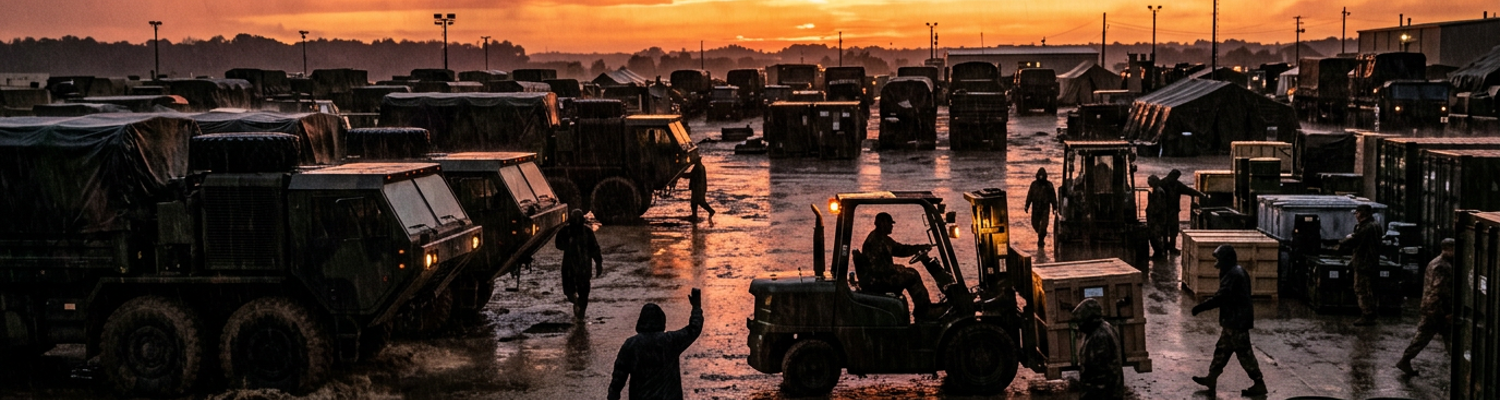

Operation Nickel Grass Munitions Surges at Pine Bluff
Diesel exhaust churned through the damp air inside Pine Bluff Arsenal as the initial loading plan collapsed under conflicting emergency taskings from Washington. The sudden outbreak of the Yom Kippur War in October 1973 had triggered Operation Nickel Grass, dumping massive munitions quotas onto the Arkansas installation with almost no warning. Civilian workers and soldiers struggled to keep their footing on slick concrete while dispatchers shouted over idling truck engines, trying to redirect flatbeds that jammed the narrow access roads between the storage rows. Urgent teleprinter orders demanded immediate overseas shipments of screening smoke canisters and white phosphorus projectiles, but wet cargo straps snapped under tension and waterlogged paper manifests tore apart in the downpour. Supply personnel shoved hand-scrawled loading orders into the hands of soaked forklift drivers, forcing depot crews to abandon standard safety intervals and divert every operational machine directly toward the earthen storage igloos.
Bunker doors swung open on rusted hinges, releasing pockets of stagnant river bottom humidity that smelled heavily of sulfur and damp clay. Inside these unventilated concrete structures, technical inspection teams wearing heavy rubber protective masks and gloves pulled crates of white phosphorus shells and colored screening smoke munitions from the walls. High humidity and seasonal temperature changes had softened the wooden shipping boxes, forcing inspectors to examine every casing for cracked paint, corroded fuze wells, or leaking seals before clearing them for flight. Civilian contractor crews and military personnel worked round-the-clock under bare lightbulbs strung along conduit pipes, sweat soaking their work clothes as they stacked chemical projectiles and banded them to heavy wooden pallets. Inspectors rejected damaged containers on the spot, but the relentless shipping schedule forced crews to clean, test, and palletize hundreds of acceptable rounds every hour. Winch operators hauled the approved pallets out into the continuous rain and loaded them directly onto flatbed trailers waiting on the gravel apron.
Tractor-trailers hauled the loaded ammunition skids out through the depot gates in tight convoys, heading directly for Military Airlift Command staging points designated to receive the ordnance. Depot dispatchers maintained constant telephone contact with flight coordinators at regional bases such as Little Rock Air Force Base to time truck arrivals with incoming aircraft. Giant Air Force C-141 Starlifters and C-5 Galaxies sat on flight lines with their cargo doors open, waiting for the smoke munitions and phosphorus rounds to replenish overseas combat units. Highway escorts cleared the tractor-trailers through civilian checkpoints without delay, ignoring normal peacetime weight inspections to keep transport aircraft from idling empty on the tarmac. Flight coordinators and depot clerks worked together to adjust weight distributions on their cargo sheets, allowing ground crews to roll the pallets off the flatbed beds and straight into the aircraft cargo bays. Air Force loadmasters chained the final munitions skids securely to floor tracks and locked the rear ramps, clearing the cargo transports to take off across the Atlantic Ocean while the empty supply trucks turned back toward the arsenal.
Forklift drivers cut their engines as the final transport trucks cleared the gate, leaving the depot floor at Pine Bluff in sudden quiet at dawn. Rainwater dripped steadily from leaky seams in the corrugated metal roof, pattering onto empty pallets and pooling in deep wheel ruts carved into the Arkansas mud. The immediate emergency of the airlift had passed, but the physical strain of seventy-two hours of continuous hauling showed in broken wooden dunnage, discarded protective gloves, and oil slicks across the concrete floor. Weary supply sergeants and soaked contractor crews peeled off their rubber masks to breathe the cool morning air, facing piles of mismatched paperwork and missing equipment tags instead of celebration. Depot supervisors stacked the wet inventory tally sheets on a metal desk, kicked aside a pile of shredded canvas straps, and ordered the exhausted morning shift to clear the loading bays.
Biological Demilitarization Mandates Under NSDM 35
Shovels scraped thick mud from the paved staging lanes where technical crews had spent the previous two years executing National Security Decision Memorandum 35. That executive directive forced the arsenal to demilitarize its biological inventory, shutting down offensive programs by targeting both lethal human pathogens and anticrop agents. Arsenal commanders diverted veteran logistics soldiers and chemical technicians away from conventional munitions lines to operate enclosed disposal systems capable of neutralizing volatile stockpiles. Warehouse teams unsealed bunker rows that held refrigerated vats and airtight shipping drums, verifying inventory serial numbers against master manifests before moving the material into disposal staging. Civilian forklift drivers moved the containers through double-check stations where security guards logged each drum, ensuring that no active material left the containment perimeter without three separate signatures.
Paper manifests carrying those signatures authorized technician crews to complete destruction operations by May 1972, targeting the remaining stockpiles of botulinum toxin and antipersonnel pathogens. Civilian technicians inside specialized disposal facilities blended large batches of concentrated botulinum toxin into pressurized treatment tanks to eliminate the lethal neurotoxin. Parallel processing lines handled millions of pounds of dried anticrop agents, including fungal plant pathogens designed to destroy wheat and rice crops across enemy territory. Operators wore full-body rubber suits and positive-pressure respirators while hooking high-pressure lines to the storage drums, listening for pressure drops that could indicate a broken seal or a leaking hose connection. Shift leaders kept stopwatch logs on every neutralization cycle, watching needle gauges on control panels to confirm that chemical contact times met the demilitarization standards before opening the discharge valves.
Valves on the discharge pipes released the treated slurry directly into surplus disposal systems that combined chemical deactivation with continuous heat sterilization under strict confinement protocols. Technicians pumped caustic soda and sodium hypochlorite into the neutralization vessels, churning the chemical mixtures at high temperatures to break down biological structures. The resulting liquids then flowed into heavy industrial autoclaves and continuous thermal processing units, where superheated steam baked the residue under sealed vacuum pressure until biological tests confirmed zero survivability. Exhaust air from every reaction vessel and processing room passed through banks of high-efficiency particulate air filters and electric incinerators to prevent microscopic spores from escaping into the damp Arkansas air. Technicians collected sterile sample jars from sampling ports, inoculated nutrient broths to verify complete kill rates, and pumped the cleared liquid into holding lagoons while dry mineral ash was buried in designated arsenal trenches.
Trenches filled with treated soil and inert residue marked the physical completion of the biological mission, leaving depot personnel to organize thousands of compliance records. Quality control inspectors gathered discarded temperature charts, autoclave pressure printouts, and sterilization logs to build the permanent demilitarization record for Washington. The sudden surge of the Middle East crisis in October had hit right as depot managers were certifying those final biological disposal sheets, forcing the same tired workforce to shift overnight from bio-agent neutralization to high-explosive and chemical smoke staging. Supply sergeants shoved the biological compliance binders into locked wall safes, grabbed fresh work orders, and sent the clean-up crews back out to the muddy loading ramps to prepare the next convoy of phosphorus munitions.
Arsenal Facility Transfers to Toxicological Research Centers
Phosphorus crates stacked along the muddy ramps gave depot crews no relief from the parallel chore of handing over contamination-prone laboratory buildings to the newly established National Center for Toxicological Research. Civilian scientists and administrative inspectors arrived at the northern perimeter gates with clipboards while military personnel still washed sulfur dust from their uniforms. Supply sergeants had to pull maintenance men off the ammunition docks to unlock the heavy steel doors of the former biological research complex and guide civilian toxicologists through rows of silent testing chambers. Decades of classified pathogen work had left the walls, ventilation ducts, and drainage sumps under suspicion of chemical and biological residue, requiring every surface to be swabbed and documented. Depot technicians swabbed concrete floors, interior pipes, and stainless steel benches with sterile gauze pads, sealing each sample into glass vials for laboratory evaluation.
Sample vials moved directly into testing ovens and culture incubators to provide the strict environmental verification required to surrender the former biological production spaces to the Food and Drug Administration. Federal health officials refused to sign facility transfer deeds or accept custody of the production halls until negative culture reports verified the complete absence of active spores and toxic compounds. Exhausted depot crews had to scrub down industrial fermentation vats, steam-clean overhead pipe racks, and flush wastewater sumps with neutralizing hypochlorite solutions for weeks on end. Technicians climbed through narrow air plenums in rubber suits and respirators, replacing charcoal filters and running high-heat decontamination cycles through the central air systems until air monitors showed zero biological activity. Civilian inspectors checked every maintenance record against the culture test results, rejecting rooms if even a speck of unverified dust remained on high ledge surfaces. Arsenal officers initialed transfer forms for each cleared room, handing building keys to federal health directors only after laboratory biologists signed off on the environmental clearance sheets.
Building keys handed over to civilian managers triggered an immediate scramble to erect physical boundary partitions between the new civilian research facilities and the remaining active military chemical zones. Engineers drove heavy post-hole diggers into the red Arkansas clay, setting tall steel posts and stretching ten-foot chain-link fencing along the newly drawn dividing line. Active chemical munition bunkers, white phosphorus storage magazines, and toxic agent handling lanes remained under direct military guard, strictly separated from the public health labs. Contractor crews hung rolls of barbed tape and installed double-locking security gates across every connecting access road to halt unauthorized foot and vehicle traffic between the two installations. Guard shanties went up at the new partition checkpoints, where military police officers demanded distinct civilian credentials from scientists and military passes from depot drivers. Civilian toxicologists parked their personal vehicles in designated outer lots while green Army forklifts and flatbeds hauled chemical munitions along the military side of the wire.
Munitions crates on those military flatbeds had to bypass newly reconfigured perimeter roads, turning routine depot runs into slow navigation drills around civilian construction zones. Depot dispatchers recalculated haul routes so that trucks carrying toxic chemical rounds never crossed into the administrative space ceded to the research center. Supply sergeants assigned to the active arsenal sectors posted fresh warning placards along the dividing fence, marking the exact points where civilian jurisdiction ended and military safety protocols began. Maintenance crews worked long shifts repairing steam pipelines and high-voltage electrical lines that ran between the central power plant and both sides of the severed compound. Soldiers and contractor laborers gathered up their muddy tools, secured the perimeter gate locks, and returned to the depot supply bays to log the fuel and material expended on the divided installation.
Persistent Ton-Container Chemical Munitions Stockpiles
Logbooks tracking those fuel expenditures had barely hit the metal desks before shift supervisors pointed the supply details toward the long lines of bulk chemical storage sheds bordering the Arkansas River bottom. Heavy steel ton-containers sat stacked by the thousands across those damp rows, holding retained bulk inventories of distilled mustard agent HD, while volatile sarin nerve agent GB and persistent VX were stored in rockets and landmines. Each cylindrical container held roughly sixteen hundred to two thousand pounds of liquid agent, stacked two high inside aging open-sided shelters and enclosed magazines that took the full brunt of the river bottom climate. Washington directives had dismantled the biological weapons lines, but the chemical stockpiles remained fully active, locking the depot workforce into constant logistical vigilance over tons of lethal neurotoxins and blister agents. Wet river air rolled off the channel each morning, condensing onto the cool steel bodies of the ton-containers and settling into the joints of their lifting lugs and discharge valves. Forklift operators maneuvering along the tight concrete alleys between the steel racks had to inch forward slowly, watching their counterweights to avoid clipping the high-pressure steel shells.
Steel shells sat exposed under aging corrugated roofs that deteriorated rapidly along the Arkansas River bottom. Relentless humidity combined with acidic swamp air to corrode the galvanized roof decking, turning protective coatings into powdery white zinc oxide and flaking brown scale. Rain poured through widened screw holes and separated metal seams, drenching the nested containers below with water that pooled in the steel cradles. Wooden support dunnage warped and rotted in the persistent damp, causing entire stacks of one-ton cylinders to shift out of alignment on the slick concrete foundations. Maintenance crews spent half their workdays patching roof panels with tar paper and replacing collapsed timbers, struggling to keep the volatile containers dry before corrosion weakened the steel walls. Depot supervisors routinely filed emergency work requests for replacement siding, but budget cutbacks and red tape delayed basic repairs while the river damp kept gnawing at the structure.
Inspectors entered the deteriorating sheds every morning at dawn to conduct mandatory leak detection sweeps and vapor testing across every row of ton-containers. Technicians pulled heavy butyl rubber protective masks tight against their faces, sweating heavily inside the airtight rubber seals as Arkansas humidity climbed past eighty percent. The cumbersome masks restricted peripheral vision and forced inspectors to draw shallow breaths through charcoal canister filters while climbing between the stacked containers. Sweep teams carried hand-pumped chemical vapor detection kits and portable bubbler tubes, holding sampling nozzles next to the valve stems, fusible plugs, and welded joints of each ton-container. Discolored test paper or a trace reading on an enzymatic ticket meant shutting down the bay immediately to locate escaping mustard vapor or persistent VX droplets. Inspectors placed yellow warning tape around any ton-container showing valve weeping, logging the serial number on clipboard manifests before calling for emergency sealing clamps and secondary containment hoods.
Workers hauled heavy steel capping kits into the tagged storage bays to seal the weeping container valves before toxic vapor escaped into the Arkansas River basin. Riggers wrestled iron clamp frames over the cylindrical container bells, tightening lead-gasketed compression bolts with long torque wrenches to choke off escaping agent. Team members kept their butyl rubber masks sealed tight while wiping down the container fittings with bleach slurry and decontaminating solution DS2. Overhead hoists lifted the leaking one-ton vessels off their rotting wooden racks, transferring the heavy cylinders onto transport dollies bound for isolated overpack stations. Supply personnel logged each movement on carbon-copy transfer sheets, noting agent type, lot numbers, and net chemical weight for the depot safety division. Forklift drivers secured the chained loads onto low-slung trailers, leaving the warehouse floor clean of chemical runoff before the next morning shift began its inspection rounds.
Federal Contractor Compliance Audits and EEO-1 Mandates
Inspectors preparing for the morning vapor sweeps found the storage bays interrupted not by toxic chemical spills, but by federal investigators conducting joint Department of Defense and Equal Employment Opportunity Commission contract compliance reviews. Federal auditors set up folding tables directly inside the surveillance division offices, spreading out thick folders to interrogate contractor managers while chemical neutralizers and river mud still coated the depot floors. Executive Order 11246 strictly required commercial defense facility operators to prove that their hiring, promotion, and wage practices conformed to federal equal employment regulations. Government teams demanded fully certified Standard Form 100 Employer Information Reports, the mandatory EEO-1 submissions designed to break down total employment figures into specific racial and gender classifications. Civilian contractors running the arsenal chemical munitions storage lines scrambled to assemble personnel rosters, while depot commanders protested that cross-examining technicians in the middle of emergency surveillance duties disrupted base operations. Compliance officers refused to grant administrative waivers, insisting that noncompliance with Executive Order 11246 would trigger contract cancellations regardless of how fast combat munitions were moving toward overseas airlift points.
Supply sergeants watched the depot administrative offices choke on metal filing cabinets and mimeograph forms as the audit mandates clashed directly with round-the-clock chemical storage operations. Administrative friction quickly paralyzed the operational chemical storage and surveillance divisions, pulling experienced foremen off toxic agent monitoring lines to verify job descriptions and payroll registers. Technicians who had spent the previous shift patching corroded ton-containers along the river bottom had to sit at wooden desks, filling out background cards and answering questions about recruitment procedures instead of checking agent pressure gauges. Standard Form 100 required contractors to break down every labor position into nine distinct employment categories, forcing storage division clerks to account for forklift operators, chemical decontaminators, and maintenance mechanics under separate compliance headers. Discrepancies between civilian contractor job titles and military assignment logs forced line leaders to draft lengthy explanatory addendums while uninspected chemical containers sat waiting in the humid river air. Civilian personnel directors spent long shifts arguing over depot telephones with regional headquarters in Dallas and Atlanta, trying to track down missing contractor demographic files before statutory deadlines expired.
Auditors cross-checked every contractor payroll ledger against security gate badge logs, searching for race and sex classification discrepancies among the blue-collar munitions and maintenance crews. Joint Department of Defense and Equal Employment Opportunity Commission teams questioned line supervisors in private rooms, demanding to know why minority representation lagged in skilled chemical maintenance slots despite aggressive local recruiting. Chemical surveillance officers pushed back, warning the inspectors that pulling certified riggers and mask-qualified handlers off active storage pads left unstable nerve agent and mustard stockpiles without adequate monitoring. Investigators showed little interest in local storage hazards, remaining focused on statistical workforce parity and threatening to withhold contractor progress payments until every line on Standard Form 100 matched payroll receipts. Depot dispatchers had to pull extra soldiers off inventory details to photocopy thousands of hiring applications, apprentice records, and shift schedules on hot mimeograph machines. Exhausted supply sergeants shoved the completed compliance folders into heavy canvas mailbags, locked the brass padlocks, and hauled the documentation stacks out to the administrative courier vans waiting at the arsenal headquarters dock.
Union Seniority Systems and Chemical Security Clearances
Vans rumbled away from the headquarters dock with the audit records, leaving contractor managers to enforce federal fair employment mandates directly against the depot civilian union seniority system. Plant executives attempted to implement affirmative action directives by reassigning qualified minority laborers into higher-paying toxic chemical handling slots and mechanized warehouse positions. Union shop stewards immediately resisted the transfers with stacks of formal grievance forms, citing entrenched collective bargaining contracts that awarded crane, forklift, and surveillance jobs strictly by plant longevity. Senior warehousemen who had handled conventional ordnance for decades claimed first rights to the higher hourly wages on the chemical decontamination lines, rejecting any federal bypass of their negotiated seniority ladder. Junior laborers reassigned under the federal compliance orders found their names crossed off shift boards as union officials threatened formal arbitration and wildcat work stoppages against depot contractor firms. Company supervisors argued with union representatives over carbon-copied contract clauses inside drafty dispatch offices, paralyzing morning labor assignments while chemical handling lines lost half their scheduled manpower.
Army security officers compounded the labor dispute by enforcing strict Chemical Personnel Reliability Program clearance standards against every reassigned civilian worker. Department of Defense regulations demanded total psychological stability, spotless police records, and rigorous physical exams before any civilian laborer could enter storage igloos holding mustard or nerve agents. Depot physicians and military security screeners subjected newly transferred minority applicants to exhaustive medical checks and background investigations that dragged on for weeks. Senior civilian forklift operators who had won job bids through the union seniority system also found themselves disqualified by minor health issues, prescription medications, or past off-duty alcohol arrests on local police logs. Contractor managers could not backfill the empty slots on the chemical surveillance lines because unvetted workers were legally barred from approaching toxic agent bulk containers. Disqualified veteran handlers and uncertified new hires sat together on wooden benches in the civilian personnel office, waiting for medical appeals boards to review their sealed health files.
Forklift operators remaining on the active payroll cut their engines at the security gate boundary lines, refusing to move toxic munitions pallets without certified credentials and union-sanctioned work tickets. Operational delays spread across the bulk storage sheds as chemical-handling contractor crews tried to navigate the contradictory directives pouring in from federal compliance officers and local union leadership. Civilian foremen refused to order unvetted forklift drivers into the chemical vapor hazard areas for fear of massive government safety fines, while union stewards ordered cleared drivers to turn off their machines whenever uncertified personnel were assigned to their loading teams. Crates of chemical smoke rounds and persistent agent ton-containers remained stranded on the wet concrete ramps under the river bottom humidity while dispatchers sorted through conflicting sets of paperwork. Contractor supervisors redrew shift rosters by hand on grease boards, only to erase them when security guards turned back drivers lacking the required red stamp on their personnel badges. Supply sergeants ended up drafting emergency military details to tie down exposed cargo tarps, stepping around deadlined forklifts in the mud while civilian crews waited for administrative rulings in the rain.