
FORGING DETERRENCE: STRATEGIC AIR COMMAND'S ASCENT
The Strategic Air Command (SAC), activated on March 21, 1946, began as an organization with a global mission that far exceeded its immediate grasp. The National Security Act of 1947 created an independent United States Air Force, and SAC became its long-range striking arm. Tasked with offensive operations in the nascent atomic age, it initially possessed a scattered force of World War II-era B-29 Superfortress bombers, aircraft ill-suited for the immense distances required to strike the burgeoning Soviet adversary. The command’s headquarters moved to Offutt Air Force Base in Nebraska in 1948, a location chosen for its relative safety deep within the American heartland. That same year, General Curtis LeMay assumed command. LeMay discovered an organization lacking discipline, readiness, and capability. He famously staged a mock bombing run on Dayton, Ohio, where every participating aircraft failed to execute the mission correctly, with many missing the target entirely. Appalled, he immediately instituted a brutal, uncompromising regime of training and professionalization. His philosophy demanded constant readiness through competition between crews, forging SAC into the hardened instrument of national policy it was designed to be.
THE CONVAIR INTERCONTINENTAL BOMBER
The first physical embodiment of SAC's intercontinental mission was the Convair B-36 Peacemaker. A true behemoth, its design originated from a 1941 requirement for a bomber capable of striking Europe from bases in North America if Britain fell to Germany. The XB-36 prototype first flew on August 8, 1946. Its scale was immense, with a wingspan of 230 feet and a tail standing nearly 47 feet tall. Propulsion was a unique and complex hybrid system, giving rise to the crew slogan "six turning, four burning." Six massive Pratt & Whitney R-4360 Wasp Major radial piston engines, mounted in a pusher configuration, provided the primary thrust for long-range cruise. Four General Electric J47 turbojets, housed in paired pods on the outer wings, provided extra power for takeoff and high-altitude dashes over the target. This combination gave later models of the B-36 a ferry range approaching 10,000 miles, allowing it to reach targets deep inside the Soviet Union from bases in the United States. It could operate at a service ceiling above 40,000 feet, initially thought to be safe from Soviet fighters, and carry a maximum bomb load of 87,200 pounds. This payload capacity was essential for the heavy, first-generation atomic weapons. This aircraft represented the core of the "atomic blitz" doctrine, a strategy centered on a massive, overwhelming nuclear strike to cripple an enemy's will and ability to wage war. The B-36, however, had significant operational limitations. Its cruising speed was slow, making it a vulnerable target for the new Soviet MiG-15 jet fighters that appeared during the Korean War. Its complex engine configuration was a maintenance nightmare, and the extensive use of magnesium in its construction meant engine fires were notoriously difficult to extinguish. Crews endured missions lasting over 40 hours, moving between compartments through an 85-foot pressurized tunnel. The aircraft was a demanding platform, but for a short period, it was the only American weapon system capable of holding the Soviet homeland at risk.
TRANSITION TO THE JET-POWERED SPEAR
The clear vulnerability of the slow-moving B-36 accelerated SAC’s transition to an all-jet force. The first step was the revolutionary Boeing B-47 Stratojet. First flown in December 1947 and entering service in 1951, the B-47 was a major leap forward. It incorporated a 35-degree swept-wing design based on captured German aerodynamic data, a feature essential for high subsonic speed. Powered by six General Electric J47 turbojets, it could cruise at speeds over 600 mph and operate at altitudes above 40,000 feet. This performance rendered most contemporary fighters obsolete. The B-47 force introduced new tactics centered on high-altitude, high-speed penetration of enemy airspace. The aircraft presented engineering challenges, including its thin, flexible wings, a tandem bicycle landing gear that required a special crosswind crabbing technique, and the need for a braking parachute on landing. The B-47 was a medium-range bomber, unable to strike the USSR from the continental U.S. and return. Its deployment necessitated a network of forward bases in Europe, North Africa, and the Pacific, extending America’s geopolitical footprint through the "Reflex Action" concept, which saw bomber wings rotate for 90-day alert tours overseas.
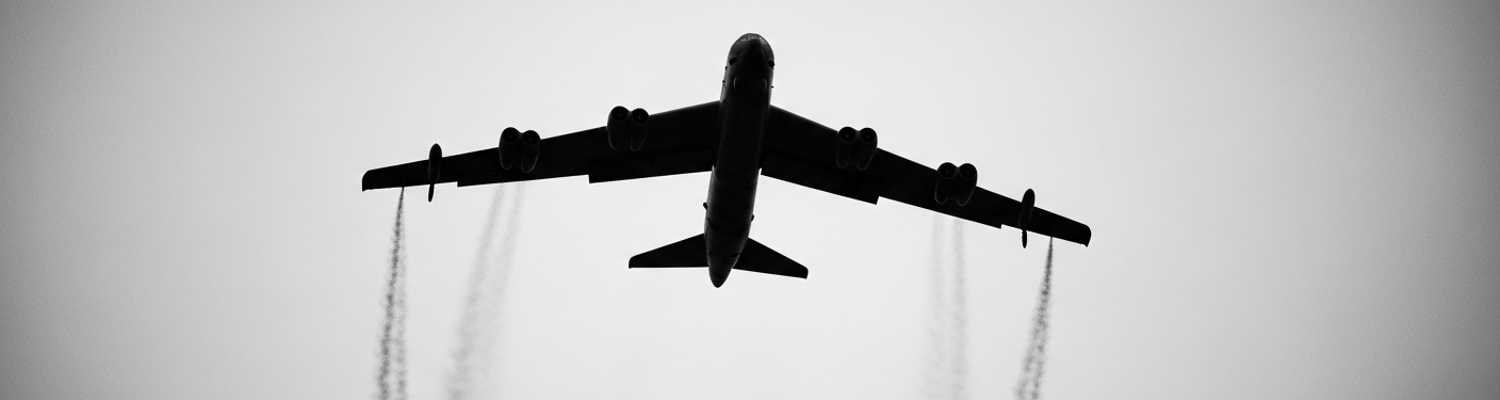
The solution to the B-47's range limitations arrived with the Boeing B-52 Stratofortress. The B-52's design itself was a product of rapid innovation. In October 1948, a Boeing team led by engineer George Schairer, presented with new USAF requirements, redesigned their initial straight-wing proposal into the now-iconic eight-engine, swept-wing bomber over a single weekend in a Dayton hotel room. With its first flight in April 1952 and entry into service in 1955, the B-52 combined the intercontinental range of the B-36 with the speed and altitude of a jet. Powered by eight Pratt & Whitney J57 turbojet engines, the B-52 could carry a 70,000-pound payload and had an unrefueled combat range of around 8,800 miles. It solidified SAC’s ability to execute its deterrence mission from secure bases within the United States. As Soviet surface-to-air missile technology like the SA-2 Guideline improved, the B-52’s mission profile evolved from high-altitude penetration to perilous low-level flight, a tactical shift that stressed the airframes but demonstrated the platform's incredible adaptability.
AN UNBLINKING COMMAND STRUCTURE
A credible deterrent required more than powerful aircraft; it demanded a command and control (C2) system that could survive a first strike and guarantee retaliation. Under General Thomas Power, who succeeded LeMay in 1957, SAC refined its alert posture to a state of constant, hair-trigger readiness. This led to the implementation of continuous airborne alert missions. Operation Chrome Dome, initiated in 1961, kept a dozen B-52s armed with thermonuclear weapons airborne 24 hours a day. These aircraft flew predetermined routes to points just outside Soviet airspace, ready to proceed to their targets on command. The operation guaranteed that a portion of SAC’s strike force would survive a surprise attack on its bases, but it came with immense risk, highlighted by "Broken Arrow" incidents like the 1966 B-52 crash near Palomares, Spain, and the 1968 crash at Thule Air Base, Greenland.
To ensure command continuity, SAC established an airborne command post. The Operation Looking Glass mission began on February 3, 1961. Using modified KC-135 Stratotanker aircraft designated EC-135Cs, SAC maintained a command post in the air at all times for over 29 consecutive years. The name "Looking Glass" signified that the aircraft mirrored the capabilities of SAC’s hardened underground command center, "The Hole," at Offutt. Aboard each flight was a general officer and a battle staff capable of assuming control of all U.S. nuclear forces. The EC-135 was equipped with the Airborne Launch Control System, allowing it to directly launch the nation’s land-based Minuteman intercontinental ballistic missiles if ground launch centers were destroyed.
This evolution in C2 capabilities supported a critical shift in strategic doctrine. The Eisenhower administration’s policy of "massive retaliation" was increasingly seen as an inflexible, all-or-nothing approach. The Kennedy administration introduced the doctrine of "flexible response," which called for a range of military options. SAC’s robust and survivable C2 network, combined with its diverse force of bombers and newly integrated ballistic missiles, provided the tools to implement this more nuanced strategy.
LEGACY OF DETERRENCE AND MODERN STRATEGY
The challenges SAC faced in creating a survivable command network find a direct parallel in modern military cyber defense. The primary threat to SAC’s C2 was a physical, decapitating nuclear strike. The objective of Looking Glass was to ensure command functions could continue even if terrestrial nodes were destroyed. Today, the threat to command networks is a non-kinetic cyberattack, GPS jamming, or an anti-satellite weapon disabling communications. The goal, however, remains identical: guarantee the integrity and continuity of command authority. The airborne redundancy of the Cold War has evolved into the distributed, hardened, and encrypted networks that form the backbone of modern C4ISR systems.
The longevity of the B-52 offers profound lessons for platform acquisition. Originally designed as a high-altitude bomber, the B-52 is projected to serve until the 2050s, a century of service. This endurance is a product of its robust and adaptable airframe. It has evolved from a high-altitude bomber to a low-level penetrator, and now to a standoff weapons platform carrying munitions like the AGM-86 Air-Launched Cruise Missile and the AGM-158 JASSM. Current modernization, including the Commercial Engine Replacement Program, will keep it viable for decades. The B-52's success demonstrates that a lasting strategic asset is one with an adaptable design, capable of incorporating technologies to meet threats its original designers never envisioned. This principle directly informs the modular, open-architecture philosophy of future programs like the B-21 Raider, ensuring they can adapt rather than become obsolete.