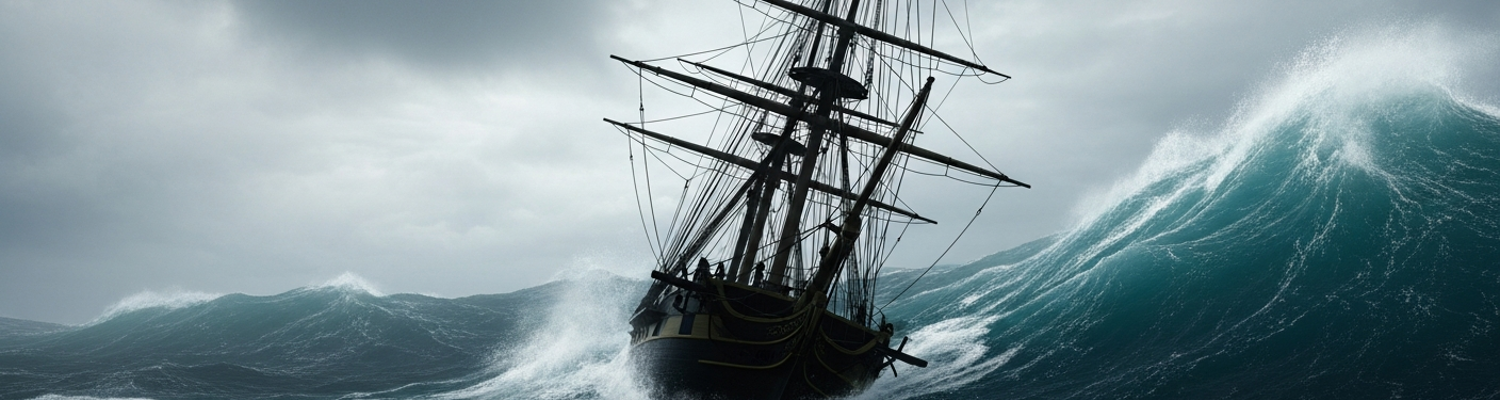

The orders given to Captain James Biddle in 1817 reflected a new, expansionist American agenda. He was to take a single vessel, sail it around the treacherous Cape Horn, and formally reclaim the Oregon Country for the United States. This diplomatic maneuver was time-sensitive, a geopolitical chess move against British interests in the Pacific Northwest following the War of 1812. The instrument chosen for this undertaking was not a powerful ship-of-the-line or a heavy frigate, but the USS Ontario, a vessel whose design embodied a series of calculated risks.
A review of its specifications reveals the tactical philosophy behind its classification as a 16-gun sloop-of-war. This designation placed it outside the formal rating system used for larger warships, defining it as a vessel built for speed and independent action rather than fleet engagements. Its primary armament consisted of eighteen 32-pounder carronades, supplemented by two 18-pounder long guns. The carronades were vicious short-range weapons, capable of delivering a devastating weight of metal that could shatter an opponent’s hull. Their lighter weight and smaller powder charges allowed a sloop to carry a heavier broadside than its size would normally permit. This came at a price. The carronade’s limited range made a sloop like the Ontario vulnerable to frigates armed with long guns, which could stand off and batter the smaller ship into submission. The Ontario’s design, therefore, was a trade-off. It sacrificed long-range hitting power for the ability to chase down merchantmen, escape more powerful foes, and operate effectively in coastal waters. With a crew of 150 and a hull displacing just 509 tons, it was a compact tool for the projection of power, but one that required a commander to pick his fights carefully.
The ship was a product of wartime necessity, laid down and launched in Baltimore in 1813. Its construction was overseen by the shipbuilder Thomas Kemp at his Fells Point shipyard, a hub of American shipbuilding known for producing fast privateers. Kemp was a master of the Baltimore Clipper style, a design defined by sharp, raked hulls that granted vessels exceptional speed. The Ontario was built from these same plans, a direct descendant of the schooners that had successfully harassed British shipping throughout the war. It was one of six new sloops-of-war authorized by Congress on March 3, 1813, based on designs by naval architect William Doughty. Archival records show that its first commander, Master Commandant Robert T. Spence, struggled to find a full complement of sailors. This delay ultimately resulted in the Ontario being trapped in the Chesapeake Bay by the British blockade for the remainder of the war. It entered service not with a glorious battle, but in a state of enforced inactivity.
This vessel was a physical symbol of America’s nascent blue-water naval capability. The War of 1812, fought largely over maritime rights, had forced a strategic shift away from a small, coastal defense force toward a professional navy capable of global operations. Post-war, the Navy’s mission became the protection of American commercial shipping across the globe, with squadrons dispatched to the Mediterranean, the Caribbean, and the Pacific. The Ontario’s first major missions embodied this new doctrine. Its deployment to the Mediterranean in 1815 was part of Commodore Stephen Decatur’s squadron, which decisively ended the piracy of the Barbary states. This was followed by its pioneering 1817 mission to the Pacific under Captain Biddle. In a single voyage, the Ontario rounded Cape Horn, secured the release of captured American merchant ships in Valparaíso, and formally claimed the territory around the Columbia River for the United States. It became the first U.S. naval vessel to visit the coasts of what would become Oregon, California, and Washington. These actions were a clear declaration that the United States intended to operate and defend its interests far from its own shores.
The War of 1812 delivered a clarifying lesson to American leadership. A coastal defense force was wholly insufficient. The Royal Navy’s tight blockade had brought the U.S. government to the edge of financial ruin, crippling commerce and exposing the young nation’s economic vulnerability. While the celebrated victories of heavy frigates like the USS Constitution provided a morale boost, the operational picture was one of impotence as the majority of the American fleet remained trapped in port. In response, a complete strategic reversal took place. Examining the historical record reveals a decisive pivot away from the Jeffersonian ideal of a small gunboat navy. On April 29, 1816, Congress passed the Act for the Gradual Increase of the Navy. This legislation fundamentally remade American sea power. It appropriated one million dollars per year for eight years and authorized the construction of nine ships-of-the-line, vessels rated for 74 guns or more, and twelve 44-gun heavy frigates. This was not a plan for harbor defense; it was the blueprint for a blue-water, deep-ocean fleet capable of challenging European navies and projecting force far from American shores. The intent was to ensure that no foreign power could ever again hold American commerce hostage.
This new hardware demanded a new global mission.
The first test of this doctrine came almost immediately. In 1815, President James Madison secured Congressional authorization on March 3rd to act against the Dey of Algiers, whose corsairs had resumed preying on American merchantmen. A ten-ship squadron under Commodore Stephen Decatur, with the USS Guerriere as his flagship and including the Ontario, was dispatched to the Mediterranean. This was a punitive expedition. Just off Cape Gata, Spain, Decatur’s squadron intercepted and captured the Algerian flagship Mashouda on June 17, 1815, killing the Algerian naval commander, Raïs Hamidou. Two days later, they captured another brig, the Estedio. By the end of June, Decatur’s fleet was blockading the port of Algiers itself, and on July 3rd, the Dey signed a treaty aboard the Guerriere that ended all future tribute payments and returned all American captives. This swift action, a contrast to the drawn-out First Barbary War, was a direct result of the new naval policy. It led to the formal establishment of permanent overseas naval squadrons, including the Mediterranean Squadron, followed by the West India, Pacific, and Brazil Squadrons. This institutionalized a persistent American military presence across the globe to protect its expanding commercial interests.
Naval power was now an instrument of territorial expansion.
The 1817 orders issued to Captain James Biddle for the USS Ontario's voyage to the Pacific embodied this expansionist agenda. His primary objective was to sail to the mouth of the Columbia River and formally reclaim the Oregon Country for the United States, a claim contested by Great Britain following their capture of Fort Astoria during the War of 1812. Archival evidence shows the Ontario arrived at Cape Disappointment on August 19, 1818. Biddle led a landing party ashore in Baker Bay, where they raised the American flag, turned a sod of earth, and nailed a lead plate to a tree, asserting American sovereignty over the territory. This was a unilateral act, a physical staking of a claim thousands of miles from the nation’s capital. The presence of a commissioned U.S. warship was the instrument of enforcement. When the British sloop HMS Blossom arrived months later to conduct a formal handover of the post, they found the American flag already flying. Biddle’s actions, conducted without firing a shot, demonstrated a new reality: the United States Navy would now be used to not only protect its citizens and commerce but to actively assert and expand its territorial boundaries.
The selection of Captain James Biddle to command the USS Ontario for its 1817 Pacific mission was a deliberate choice. It placed a proven naval officer in charge of a politically sensitive operation. Biddle was a veteran of two wars, having been captured and imprisoned for nineteen months during the First Barbary War and later earning distinction in the War of 1812 for his command of the sloop USS Hornet in its victory over HMS Penguin. His orders for the Ontario expedition were multifaceted. The public directive was to sail to the Pacific and show the flag, protecting American commercial interests, particularly the whaling fleet. A review of government records, however, reveals a second, secret set of instructions. Biddle was to proceed to the mouth of the Columbia River and re-assert American sovereignty over the territory surrounding Fort Astoria, which had been sold to the British North West Company during the war and renamed Fort George. This was a direct expression of the Monroe administration’s expansionist policy, using a naval vessel as an instrument of territorial claim. For this task, Biddle was given a single 509-ton sloop of war and a crew of 150 men.
A single ship was to execute a continental claim.
The expedition commenced on October 4, 1817, as the USS Ontario departed New York Harbor. The first leg of the voyage involved a stop at Rio de Janeiro to deliver diplomatic dispatches before turning south to face the most notorious maritime obstacle on the planet: Cape Horn. For a small vessel like the Ontario, designed as a coastal interceptor and not a blue-water ship-of-the-line, the passage was a severe test of both its physical structure and its crew’s endurance. Ship’s logs from this period document the conditions of the transit, with the sloop battling relentless westerly gales, freezing temperatures, and mountainous seas for weeks on end. The ship’s Baltimore-built hull, designed for speed, was subjected to immense stress as it rounded the continent. Biddle’s leadership during this phase was critical, managing the exhaustion of his crew while navigating the treacherous waters that had claimed countless other vessels.
Survival was the first objective.
Emerging from the Strait of Magellan in early 1818, the Ontario made for Valparaíso, Chile, arriving in the midst of the Chilean War of Independence. Here, Biddle’s mission shifted from exploration to diplomacy. The port was under a Spanish royalist blockade, and several American merchant ships had been seized. Acting as both a naval commander and a diplomat, Biddle entered into direct negotiations with local authorities to secure the release of the captured American vessels and their crews. A review of the Ontario’s journals shows these negotiations were tense, with Biddle leveraging the presence of his warship to give weight to American demands for neutral trading rights. After successfully freeing the ships, he sailed north to Lima, Peru, to continue his defense of American shipping interests before finally turning the Ontario’s bow toward his primary objective in the Pacific Northwest.
The Ontario arrived off Cape Disappointment at the mouth of the Columbia River on August 19, 1818. Biddle, deeming the river’s bar too hazardous to cross with his ship, anchored offshore and led a party of men into Baker Bay. There, on the north side of the river, they performed a formal ceremony of possession. An American flag was raised, a sod of earth was turned, and a lead plate was nailed to a tree, claiming the territory for the United States. Shortly after, he repeated the ceremony on the south bank near Fort George. This was a preemptive move. The official American commissioner for the handover, John B. Prevost, was not present, having been delayed in South America. When the British sloop HMS Blossom arrived in October with Prevost aboard to formally restore the post, its officers found Biddle’s claim already made and the American flag flying.
The true, legally binding reclamation of the Columbia River basin would not be conducted by the warship that staked the initial claim. A full forty-eight days after Captain Biddle’s preemptive ceremony, the formal transfer of authority took place under far different circumstances. The American agent, John B. Prevost, arrived not on an American man-of-war, but as a passenger aboard the British sloop HMS Blossom, which dropped anchor in the Columbia River in early October 1818. The USS Ontario was already gone, having departed weeks earlier to continue its mission along the Pacific coast. Prevost stepped ashore into a situation defined by diplomatic protocol rather than military initiative. On the morning of October 6th, he met with James Keith, the chief factor of the North West Company, and Captain Frederick Hickey of the Blossom. An examination of the diplomatic record shows the transfer was mandated by Article I of the Treaty of Ghent, which required the restoration of all territories and places taken by either side during the War of 1812. The American argument rested on the fact that while the Pacific Fur Company had sold the fort under duress, the subsequent actions of Captain William Black of HMS Racoon in 1813, who performed a formal capture ceremony, classified the post as a spoil of war, making it subject to the treaty’s terms. The setting for this transaction was a post significantly altered from the original American stockade. North West Company records indicate they had expanded the footprint to 190 by 210 feet and armed it with a formidable array of cannon and swivels.
The Union Jack was lowered from the flagpole.
In its place, a small honor guard of British sailors and North West Company men hoisted the flag of the United States. The specific banner that rose over the fort was the 20-star flag, an ensign that had only been official for six months, reflecting the recent admission of Illinois into the Union. The raising of this flag was a carefully observed procedure, witnessed by the British officers, the assembled company employees, many of them French-Canadian and Hawaiian laborers, and the watchful eyes of local Chinook and Clatsop leaders. For them, this was the second time in five years they had seen one foreign banner replace another over the fort. The physical act was simple, the pulling of a rope on a wooden pole, but it represented the formal reversion of ownership, a tangible symbol that the United States was re-establishing its claim on the Pacific coast.
With the flag raised, Prevost unrolled a formal, handwritten document of acceptance. He read its contents aloud, his voice carrying over the grounds of the expanded fort. The proclamation’s text cited the authority granted to him by the U.S. government and referenced the specific treaty articles compelling the action. He declared the settlement and country restored to the United States. Following the proclamation, instruments of transfer were signed by Prevost, Captain Hickey, and James Keith. These documents formally conveyed the physical assets of Fort George back into American possession. The ceremony was a legal maneuver, designed to create an undeniable record of compliance with the treaty. Despite the transfer of sovereignty, no American personnel remained to occupy the post; the North West Company was permitted to continue its fur trading operations without interruption.
This entire ceremony of possession was performed on land that was not vacant. The American legal theory of the claim rested on the Doctrine of Discovery, a principle of international law, created by and for European colonial powers, that legitimized the seizure of lands not occupied by other Christian peoples. This framework willfully ignored the existence of the established, complex societies that had controlled the region for millennia. The mouth of the Columbia was the heart of the Chinookan peoples’ territory, with the Chinook proper occupying the northern bank and the Clatsop the southern. These were not scattered bands of nomads; they were sophisticated, hierarchical societies organized around autonomous villages, with a deep history in the region. Their economy was built on the immense bounty of the Columbia River, and they managed a vast trade network that extended up the river and along the Pacific coast. They had been trading with European and American ships for more than three decades by the time the Ontario arrived. From the perspective of the Chinook and Clatsop leaders who likely observed Biddle’s landing party, the act of turning soil and nailing a metal plate to a tree would have been a bizarre ritual. It represented a fundamental clash of worldviews: the American assumption that land could be claimed through symbolic acts versus the Indigenous reality of ownership through generations of occupation, use, and sacred connection. The Ontario’s ceremony did not conquer or displace the Chinookans that day, but it laid the legalistic and philosophical groundwork for the dispossession that would follow as American settlers, emboldened by such claims, began to arrive in the coming decades.
The Ontario’s mission was as much a message to other colonial empires as it was a claim on the land itself. The primary audience for Biddle’s preemptive flag-raising was Great Britain. The Treaty of Ghent, which ended the War of 1812, stipulated that all captured territory must be returned. While Fort Astoria had been sold to the British North West Company, a subsequent formal 'capture' by a Royal Navy warship made its status subject to the treaty. Biddle’s actions in August, months before the arrival of the British sloop HMS Blossom with the American commissioner J.B. Prevost for the official handover, ensured that the British would be ceding the post back under an American flag that was already flying. This was a calculated assertion of dominance. Beyond the British, the claim challenged the ambitions of the other two European powers with interests in the region. Spain maintained claims to the entire Pacific coastline based on 16th-century declarations, though these were weakening and would be formally ceded to the U.S. the following year. More immediately, the Russian Empire was actively expanding its fur-trading posts down the coast from Alaska, an advance the United States viewed with growing concern. The voyage of the USS Ontario was a clear signal that the United States intended to be a Pacific power and would enforce its doctrine of continental expansion.
This assertion was the leading edge of a catastrophic disruption to traditional lifeways. The maritime fur trade had already introduced new wealth and European goods, which the Chinook skillfully incorporated into their existing economic and social structures, using the new opportunities to enhance their prestige. However, the permanent claim staked by the Ontario signaled a shift from a relationship based on trade, where they held significant leverage, to one of impending colonization. The American and British presence, now solidified and backed by naval power, intensified competition and began to systematically dismantle the Chinookan role as middlemen. The most devastating impact, however, came not from guns or policy but from biology. The consistent contact brought by an increasing number of ships like the Ontario created vectors for diseases to which the indigenous population had no immunity. While a massive smallpox epidemic had already swept the region decades earlier, the period following 1818 saw recurring outbreaks of new diseases. Within a decade of the Ontario’s visit, a virulent epidemic, likely malaria, tore through the lower Columbia. This single outbreak, lasting from 1830 to 1833, is estimated to have killed up to 90 percent of the indigenous population in the area, a demographic collapse of almost unimaginable speed and scale.
A review of official records from Biddle’s mission or the subsequent diplomatic transfer shows a singular focus on the geopolitical contest with Great Britain. The operational success was measured by the raising of a flag and the securing of a territorial claim against a European rival. The indigenous inhabitants of that territory were largely invisible in the strategic calculus. Their complex society, their economic power, and their very existence were treated as part of the landscape rather than as a sovereign presence to be negotiated with. This perspective set a destructive precedent for the decades of westward expansion that followed. The Doctrine of Discovery provided the justification for claiming lands inhabited by non-Christians, effectively erasing indigenous sovereignty from the American legal and political consciousness. The demographic collapse caused by disease was later used by arriving American settlers as proof that the land was empty and available for the taking, a self-fulfilling prophecy initiated by the very first waves of contact. The USS Ontario did not fire its cannons on the Chinook, but its mission was an integral part of a larger systemic assault that would, within a single generation, lead to the near-total destruction of the people who had controlled the mouth of the Columbia River for centuries.
A close review of the USS Ontario’s specifications reveals the severe physical constraints placed on early 19th-century American power projection. The vessel was a 509-ton sloop-of-war, designed not for sustained blue-water operations but for speed and coastal action. For its mission to the Pacific, this single, small warship with its crew of 150 was entirely alone. It operated thousands of miles from any friendly port, meaning any significant combat damage, critical mast failure during the passage around Cape Horn, or an outbreak of disease would have ended the mission completely. These limitations were not theoretical. Upon arriving at the mouth of the Columbia River on August 19, 1818, Captain Biddle made a critical decision based on the tangible limits of his ship. He judged the notoriously violent Columbia Bar, a treacherous convergence of river current and ocean swell, too dangerous to risk crossing. Instead of sailing up to Fort George, he anchored offshore and took a landing party in smaller boats. The nation’s instrument of sovereign assertion was held at bay by a geographic feature.
The ship’s physical presence was the sole basis of its authority. This authority was, by its very nature, temporary. The moment the Ontario departed the Oregon coast to sail for Spanish California, the direct projection of American military power vanished with it. An analysis of the timeline shows the ephemeral quality of this control. Biddle performed his flag-raising ceremony in August and then left. The official American commissioner, J.B. Prevost, did not arrive until October, and he did so as a passenger aboard a British warship, HMS Blossom. After the formal handover ceremony, no American troops or officials were left to occupy the fort. The United States flag flew over the post, but the men running it remained employees of the British-owned North West Company. Naval power in this era was a pulse, not a presence. It could deliver a message or secure a diplomatic victory, but it could not occupy and hold territory without a land-based force to follow. The Ontario’s mission was a textbook example of this transient capability; it staked a claim and then sailed away, leaving the claim to be enforced by treaty and diplomacy rather than by military occupation.
This created an illusion of control. The act of planting a flag and nailing a lead plate to a tree at Baker Bay was a symbolic gesture that asserted ownership over a vast region, yet in practice, it controlled nothing beyond the few square feet the sailors stood on. On paper, in Washington D.C., the United States had extended its sovereignty to the Pacific. On the ground, the true power brokers remained exactly who they were the day before the Ontario’s arrival. The region’s dominant economic and military force was the North West Company, with its organized network of trading posts and personnel. The established political authority belonged to the Chinook and Clatsop peoples, who managed the regional trade networks and had controlled the territory for centuries. Biddle’s ceremony was a legal performance for an audience of rival colonial powers, primarily Great Britain, Spain, and Russia. It succeeded in establishing a political fact that would be recognized in European and American diplomatic circles, but it was a fact that had no immediate power to displace the existing commercial and Indigenous structures that governed life along the Columbia River. The warship created a claim, but it could not by itself turn that claim into reality.