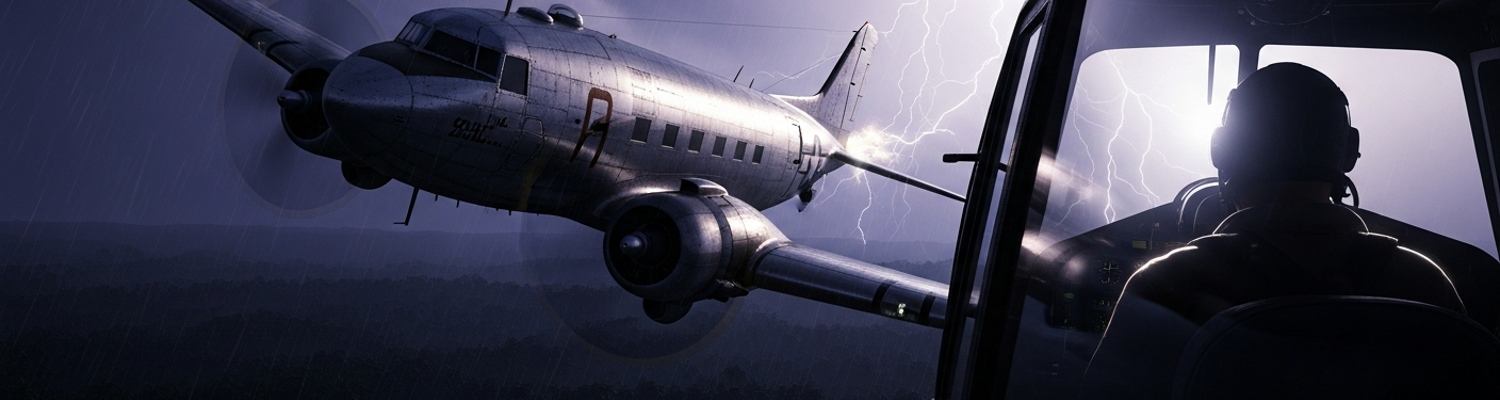

For the transport crews of the U.S. Fifth Air Force, the routine was a known grind. Flying overloaded, unarmed C-47 Skytrains from bases like Port Moresby or Dobodura was the artery feeding the Australian and American infantry fighting in the New Guinea jungle. Navigation through the treacherous Owen Stanley mountains depended almost entirely on radio beacons. Then the enemy found a new way to sever that artery. A close review of operational logs from the period shows the sudden onset of a threat that had no physical form. On a standard flight, a pilot’s headset would fill with a modulated wave of noise. Reports from the 54th Troop Carrier Wing described a piercing “howler” that made voice communication impossible. At the same time, the needle on the AN/ARN-7 radio compass, the primary instrument for homing in on navigation beacons, would begin to swing erratically or freeze. The initial reaction in the cockpit was always the same. A frantic check of the C-47’s own electrical and radio systems, particularly the SCR-274-N command set. Pilots and radio operators searched for equipment failure, a frequent problem in the harsh tropical environment. The truth only became clear as multiple aircraft across a wide front reported the exact same phenomena at the exact same time. It was a coordinated, electronic assault.
This electronic offensive struck the most vulnerable and operationally necessary artery of the Allied campaign in New Guinea: the constant aerial resupply of frontline troops. The Douglas C-47 Skytrain was the backbone of this effort, ferrying ammunition, K-rations, medical personnel, and artillery to forward airstrips carved from the jungle, such as the major Allied base at Nadzab. These missions, flown by the 54th Troop Carrier Wing and its subordinate groups, allowed Allied ground forces to counter the mobility of the lighter-traveling Japanese army. Without the C-47s, divisions like the U.S. 32nd Infantry would be cut off and starved of materiel. The flight paths were already perilous, demanding navigation through narrow mountain passes where visibility could drop to zero in moments. In these conditions, radio navigation was essential for survival. Archival evidence shows that pilots depended on the low-frequency radio range network and homing beacons to find their way through the clouds. The Japanese jamming was specifically targeted to disrupt these frequencies. With their radio compasses rendered useless, pilots were forced onto dead reckoning, a profoundly inaccurate and stressful method of navigation over the monotonous, unmapped jungle canopy below.
Command and control began to fray. The jamming campaign created a pervasive sense of isolation for the aircrews. A formation of a dozen C-47s could become a dozen individual aircraft, each flying blind and unable to communicate with its flight leader or home base. This degradation of command links was most acute during large-scale airborne operations, such as the massive paratroop drop that secured the Nadzab airfield, a complex undertaking that demanded precise timing and coordination between transports. The introduction of widespread jamming threatened to turn such organized efforts into scattered, ineffective drops. Post-action reports increasingly noted missions aborted due to navigational failure. Worse, supply drops went disastrously astray, sometimes delivering desperately needed materiel directly into the hands of Japanese ground units. The mental strain of flying for hours, lost in a disorienting soup of jungle and static, unable to get a fix on their position or confirm their course, pushed many to the breaking point. The fuel gauge became a relentless countdown timer, with every minute spent searching for a drop zone increasing the odds of not making it back to base.
For the C-47 crews, the most immediate effect was the neutralization of their primary navigation instrument, the AN/ARN-7 radio compass. Operational logs detail how pilots flying through the dense cloud cover blanketing the Owen Stanley Range would suddenly see the needle on their I-81 or I-82 indicators swing wildly. The low-frequency radio beacons they relied on to home in on forward airstrips like Nadzab were overwhelmed by a powerful, modulated carrier wave. Traditional radio navigation was now completely unreliable. With their electronic eyes blinded, pilots were thrown back onto the crude science of dead reckoning. This was a terrifying prospect over a triple-canopy jungle that offered few distinguishable landmarks. The unforgiving terrain, with its sudden downdrafts and violent storms, had already claimed aircraft like the C-47 Flying Dutchman under normal conditions; losing navigational aids multiplied that danger exponentially. The pressure was constant. Every minute spent searching for a break in the clouds or a recognizable river bend was a minute closer to fuel exhaustion, turning the cockpit into a pressure cooker of anxiety and strained calculation.
Simultaneously, the jamming tore apart the command-and-control fabric holding transport formations together. The standard SCR-274-N command set, the primary radio for inter-aircraft communication, was rendered useless. Instead of the procedural voice of the flight leader, headsets filled with piercing howls and grinding static. A coordinated flight of a dozen transports from the 54th Troop Carrier Wing could devolve into twelve isolated, blind aircraft in a matter of seconds. Flight leaders were unable to issue course corrections, warn of impending weather, or coordinate defensive maneuvers. This breakdown was particularly hazardous during complex, large-scale airborne assaults. The successful paratroop drop on Nadzab in September 1943, which involved the 503rd Parachute Infantry Regiment, demanded a formation integrity that jamming threatened to shatter completely. If a single aircraft developed engine trouble or was hit by ground fire, it was now completely alone. The inability to radio for assistance or even report a position meant that a crew in distress simply vanished into the noise.
The jamming plunged aircrews into an unnerving operational silence. This was not a peaceful quiet, but a loud, aggressive void filled by the enemy’s electronic presence. The familiar chatter between aircraft, the steady tone of a navigation beacon, and the link to the home base were all replaced by a hostile signal. This electronic isolation amplified every other stressor of combat flight. The drone of the C-47’s two Pratt & Whitney engines was a constant reminder of the thousands of mechanical parts that could fail. The static in the headset was a direct signal from an unseen enemy who knew where they were. For hours on end, crews were trapped in a state of heightened alert, unable to receive information or confirm their status. Post-mission reports from this period show a marked increase in aborted sorties and accounts of extreme psychological distress among pilots and navigators. The radio, once an instrument of safety, had been weaponized.
A close review of operational logs from the Fifth Air Force reveals a quantifiable degradation of airlift capability directly corresponding with the emergence of Japanese electronic warfare. Mission reports from units like the 54th Troop Carrier Wing began to document an alarming spike in aircraft classified as ‘lost’. This designation was not solely for confirmed shoot-downs or crash sites. It became a catch-all for C-47 Skytrains that lifted off from rear bases like Port Moresby, flew toward the jagged peaks of the Owen Stanley Range, and simply vanished. For hours, they would exist only as a name on a flight schedule. The crews, blinded by the jamming that rendered their AN/ARN-7 radio compasses useless and deafened by the static overwhelming their command radios, were forced to rely on dead reckoning over terrain that offered no reliable landmarks. A single miscalculation of wind speed or a slight deviation in heading could send an aircraft dozens of miles off course, deep into an unmapped valley system. With the fuel gauge dictating a point of no return, many of these ‘lost’ aircraft were never seen again, their disappearance attributed to the already high attrition rate from weather and mechanical failure.
The same operational records that show a rise in lost aircraft also detail a correlated and highly disruptive surge in unscheduled diversions. An aircraft declared missing would suddenly appear hours later, its engines running on fumes, at an auxiliary airstrip sometimes hundreds of miles from its intended drop zone. Pilots, completely disoriented by the electronic interference and unable to raise their home base, made the command decision to land at the first viable airfield they could find. While this saved the crew and airframe, it injected chaos into the high-tempo airlift schedule. A C-47 loaded with 75mm howitzer ammunition for troops in the Markham Valley might land at a coastal strip supporting a completely different operation. The cargo was now in the wrong place, the crew was out of position, and the aircraft itself was removed from the operational roster until it could be refueled and rerouted. Each diversion represented a mission failure and multiplied the logistical strain on an already overstretched system.
A direct link was established by Allied radio intelligence units tasked with monitoring the enemy’s electronic activity. Groups like the U.S. Army’s Signal Intelligence Service began the painstaking work of intercepting the Japanese jamming signals, performing traffic analysis, and using direction-finding equipment to triangulate their points of origin. By cross-referencing pilot reports of severe interference with their own surveillance data (contained in documents like NARA Record Group 457), they began to chart the enemy’s electronic order of battle. The analysis revealed that the jamming was not a blanket of random noise but a targeted offensive. Powerful transmitters were concentrated to create ‘hot spots’ of electronic disruption along the most heavily trafficked air corridors, particularly the hazardous entry and exit points of mountain passes and the final approach paths to major bases. Intelligence officers could literally draw circles on operational maps showing where a C-47 was most likely to lose its navigation, and these zones directly matched the locations where crews were reporting the most profound disorientation and where most aircraft went missing.
The jamming campaign forced a systemic regression in air navigation techniques. With their radio compasses useless, C-47 crews of the 54th Troop Carrier Wing were thrust back to the perilous art of dead reckoning. Over the uniform expanse of the New Guinea jungle, this was a gamble. Dead reckoning required the navigator to calculate the aircraft’s position by plotting its course, speed, and time elapsed from a known starting point. The method was profoundly susceptible to error. A slight miscalculation of wind velocity over the Owen Stanley Range or an undetected navigational drift could send a transport plane dozens of miles off its intended flight path. Archival logs show pilots from units like the 317th and 433rd Troop Carrier Groups grappling with this new reality, flying for hours with no external confirmation of their position. The burden of this uncertainty was severe. The constant drone of the C-47’s two Pratt & Whitney R-1830 Twin Wasp radial engines became an unnerving countdown timer, with every minute of navigational uncertainty bringing the aircraft closer to fuel exhaustion. The fear was not just of getting lost, but of surviving a crash only to be stranded in a jungle so dense that rescue was nearly impossible.
To counteract the navigational blindness, a tactical shift was mandated. Crews were ordered to abandon instrument flight in the clouds and descend to low altitudes to maintain visual contact with the ground. This decision traded one set of lethal risks for another. Instead of flying over the mountain ranges, C-47s were now forced to thread their way through treacherous passes and narrow valleys, often in marginal weather. Flying at treetop level exposed the slow, unarmed transports to a new spectrum of threats. Archival analyses of mission reports from this period show a marked increase in encounters with Japanese ground fire. Even light machine guns and rifle fire, previously ineffective at higher altitudes, could now puncture fuel tanks or disable an engine. The risk of ambush from established Japanese anti-aircraft positions, which intelligence had previously mapped for avoidance at altitude, became a constant danger. The physical demands on the pilots were punishing. Low-level flight in the tropical heat and mountainous terrain meant battling violent turbulence and unpredictable downdrafts that could slam an aircraft toward the jungle canopy with little warning. The crash of the C-47 “Gremlin Special” in the Baliem Valley in May 1945, though a sightseeing flight, was a stark reminder of how quickly a flight could end in disaster in the island's interior.
The cumulative effect of these stressors created a corrosive form of mental exhaustion unique to the airlift crews. The mental strain of navigating by dead reckoning was now compounded by the intense physical exertion of low-level flying and the hypervigilance required to scan for both ground fire and terrain obstacles. A review of Fifth Air Force medical records indicates a significant rise in cases of what was then termed “operational exhaustion” among transport crews during this period. Symptoms included weight loss, insomnia, and severe anxiety. This was not the explosive stress of a single bombing run but a grinding, long-duration pressure that eroded a crew’s effectiveness over a series of missions. The isolation caused by the radio jamming meant that a crew struggling with a failing engine or wounded pilot was completely on its own, their calls for help absorbed by enemy static. The psychological breaking point for many was the realization that their survival depended entirely on their own strained calculations and reflexes, with no possibility of outside support. This sustained, high-stakes environment led to a documented increase in aborted sorties and medical discharges for psychiatric reasons, directly impacting the operational capacity of the New Guinea airlift.
A close review of Fifth Air Force medical records from the Southwest Pacific Area reveals a distinct pattern. As Japanese electronic warfare intensified, so too did the rate of what were then called combat fatigue diagnoses among the crews of the Southwest Pacific Air Transport Command. This was not the acute stress of a single high-risk bombing run, but a slower, corrosive pressure that built over hundreds of flight hours. The rise in cases was particularly notable among the C-47 crews of the 54th Troop Carrier Wing and its constituent groups. Flight surgeons and medical officers began to document a sharp increase in aircrews presenting with symptoms that went far beyond simple exhaustion. Official records from this period are difficult to parse, as “operational exhaustion” was an evolving diagnosis, but the operational evidence is clear. The constant strain of navigating blind, the isolation imposed by radio silence, and the ever-present threat of fuel starvation over an unforgiving jungle created a unique psychological crucible. The number of men removed from flight status for what was termed “anxiety state” began to directly affect the availability of experienced pilots and navigators when they were most needed.
The condition that afflicted these transport crews was characterized by a specific set of symptoms, primarily chronic anxiety and what was then colloquially called “shattered nerves.” Unlike infantrymen who might experience periods of intense combat followed by time in the rear, the transport crews' battle was a continuous, grinding affair. A pilot might fly three harrowing, near-disastrous missions in a single week, each one compounding the psychological load of the last. Medical reports describe men suffering from uncontrollable tremors, persistent insomnia, and a hypersensitivity to noise. A dropped wrench on the flight line could provoke a startling physical reaction. For these men, the drone of their C-47’s Pratt & Whitney engines was no longer a sound of power but a constant, nerve-grating reminder of their isolation and vulnerability. The chronic anxiety manifested as an inability to relax even when on the ground, a constant state of hypervigilance that exhausted the body and eroded morale. Many of the men most severely affected were veteran pilots with hundreds of hours of combat flying time who had simply reached their physiological and psychological limit.
The command structure of the Fifth Air Force was forced to confront a problem with no easy solution. Initially, there was a tendency to view such breakdowns as a pre-existing weakness in an individual’s character. The sheer number of cases emerging from otherwise reliable, veteran aircrews of the 54th Troop Carrier Wing made this position untenable. Flight surgeons, working in primitive conditions at forward airfields like Nadzab, advocated for a medical approach. The primary treatment was rest. Crews showing signs of severe fatigue were grounded, sometimes for a few days, sometimes for weeks. For the most severe cases, men were evacuated to rear-area hospitals in Australia. This, however, created a secondary crisis. Every experienced crew pulled from the line was a direct hit to the airlift capability that sustained the entire Allied campaign. With a limited pool of trained replacements, commanders were caught between the need to preserve the health of their men and the relentless operational demand for more flights, more tonnage, and more risk.
The Japanese electronic offensive induced a profound and pervasive sense of helplessness among the airlift crews of the Fifth Air Force. This was not the familiar fear of anti-aircraft fire or enemy fighters, but a disorienting, invisible assault that turned a pilot’s own cockpit into a source of torment. A review of operational logs from units like the 54th Troop Carrier Wing shows how the unpredictable nature of the jamming amplified this feeling. On a flight over the Owen Stanley Range, a C-47 pilot’s AN/ARN-7 radio compass would function perfectly one moment, its needle pointing reassuringly toward a friendly beacon. The next, it would be seized by an unseen force, the needle swinging wildly, the steady homing tone in the headset replaced by a grinding static. This unpredictability was a key component of the psychological attack. It denied crews the ability to anticipate and mentally prepare for the failure of their equipment, creating a constant, low-grade anxiety on every flight. The enemy was inside the aircraft’s most necessary systems, able to blind and deafen the crew at will.
This constant electronic interference systematically destroyed the crews’ trust in their technology and the command structures that sent them into harm's way. The AN/ARN-7 radio compass and the SCR-274-N command set were designed as lifelines. The jamming inverted their function, transforming them into conduits for enemy aggression. A pilot could no longer implicitly trust the bearing on his primary navigation indicator; it could be a ghost signal leading him fatally off course into an unmapped valley. This technological betrayal fostered a deep-seated suspicion of the very instruments meant to guide them home. This erosion of confidence extended to the command hierarchy. From the perspective of the cockpit, flying deaf and blind, it felt as though leadership was either unaware of the severity of the threat or considered the crews of the unarmed transports to be expendable. While radio intelligence units worked to counter the threat, for the pilots of the 54th Troop Carrier Wing, each mission where their radios were overwhelmed felt like confirmation that their warnings were unheeded and their survival was not a high-level priority.
The sustained pressure of this invisible warfare pushed many experienced aircrews to their breaking points. The toll of flying for hours, completely isolated and uncertain of one’s position, was a grinding, corrosive form of stress. A review of Fifth Air Force medical records from the period shows a notable increase in “operational exhaustion” diagnoses among transport crews. Symptoms included uncontrollable tremors, chronic insomnia, and a hypersensitivity to noise that lingered long after a mission was over. For many veteran pilots, the breaking point was not a single dramatic event, but the cumulative weight of mission after mission spent wrestling with jammed instruments, the constant drone of the engines a countdown to fuel exhaustion. The realization that a mechanical failure or a wounded crewman could not even be reported, that they could simply vanish into the static without a trace, was a uniquely corrosive fear. This attrition of the human element represented a significant operational victory for the Japanese, inflicting casualties and degrading airlift capacity without firing a single shot.