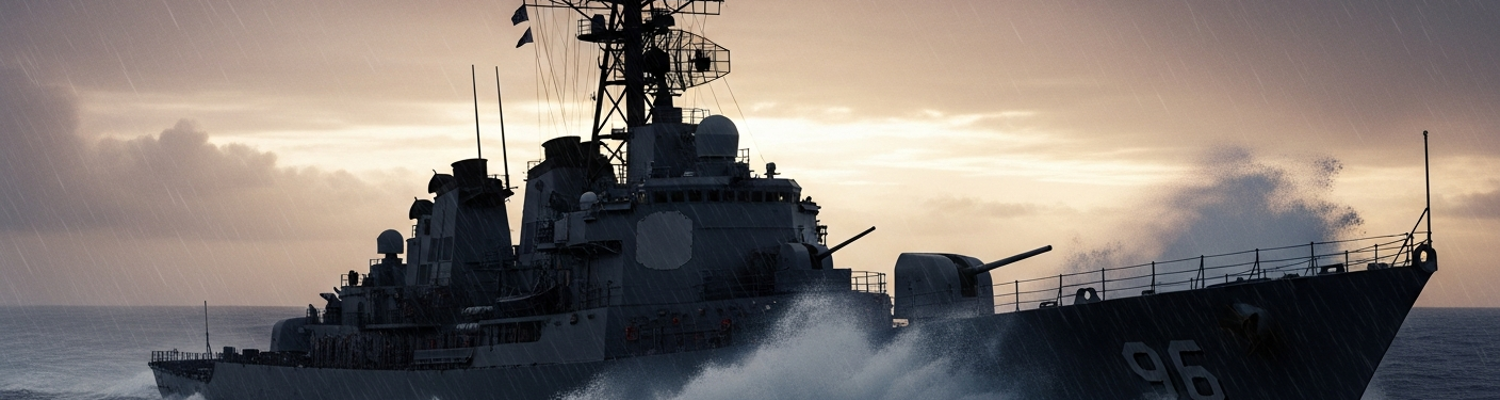

The Unscheduled Directive
A secure teletype message, transmitted at 04:30 ZULU on 18 October 1973, reached the radio room of the USS Macdonough (DLG-39). The order rerouted the Farragut-class guided-missile destroyer leader from its standard patrol in the Eastern Atlantic. Its new instructions originated from the Naval Security Group Command (NAVSECGRU), the Navy’s signals intelligence authority. The Macdonough was now tasked with a high-priority electronic intelligence collection mission.
The ship’s location was 35°15’N, 15°30’W.
Declassified operational summaries show the directive specifically tasked the ship's electronic warfare team to intercept, analyze, and record emissions from Soviet naval assets. The Yom Kippur War had triggered a surge of Soviet naval power toward the Mediterranean to shadow the U.S. Sixth Fleet. Atlantic Fleet intelligence required a detailed electronic order of battle. The specialists manning the ship's AN/WLR-1 and AN/WLR-3 receiver suites were now on the front line of a clandestine intelligence conflict. Their primary targets were the search and fire-control radars of Soviet warships, including the "Don Kay" navigation radars on destroyers and the powerful "Head Net-C" air-search radars on Kresta-class cruisers.
The tasking placed immediate strain on the ship's systems. The Farragut-class destroyers, products of 1950s design, had been in service for over a decade. Maintenance logs from this period reveal a constant struggle to keep the sensitive ELINT gear operational. The AN/ULQ-6B jammer, a key component of the ship's electronic countermeasures suite, was notoriously temperamental, its high-voltage power supplies prone to failure. Normal maintenance schedules, which called for regular downtime to calibrate receivers and inspect waveguide plumbing, were frequently ignored. The ship’s EW technicians performed repairs at sea, often cannibalizing parts from redundant systems to keep the primary collection suites online.
This operational pressure was symptomatic of a systemic issue within the Atlantic Fleet’s intelligence apparatus. Naval intelligence leadership, under pressure to justify budgets, had instituted a quota system for ELINT collection. Programmatic initiatives from fleet headquarters established benchmarks for the volume of recorded intercepts. These quotas often failed to account for the operational realities of a deployed warship, the condition of its equipment, or transit times between patrol areas. The captain of the Macdonough was caught between his operational commander, who required the ship ready for anti-submarine and anti-air warfare, and the intelligence community, which demanded his undivided attention on signal collection. Every hour the AN/WLR-1 suite was powered up was an hour of wear on vacuum tubes, power converters, and antennas. The small team of Cryptologic Technicians (CTs) worked grueling watch schedules in cramped, windowless electronic warfare spaces, hunting for faint signals in a sea of electromagnetic noise. Their success was measured in the sheer volume of magnetic tapes filled with raw data, shipped to shore-based facilities for analysis.
Deferred Maintenance, Accepted Risk
An examination of the Macdonough’s maintenance history leading up to October 1973 reveals a command structure that prioritized accelerated deployment over established engineering and material readiness standards. The ship had been briefly decommissioned for overhaul on April 6, 1973, and was recommissioned on May 4, 1974; the crisis deployment occurred within this administrative window that bracketed major systems work. This was not an oversight.
Archived Naval Sea Systems Command (NAVSEA) maintenance reports from 1972-1973 show that multiple Engineering Change Proposals and casualty reports submitted by the ship’s own officers were systematically deferred. Reports detailed persistent voltage irregularities in the power supplies for the AN/WLR-1 receiver suite, a system that required stable power for its sensitive vacuum tube-based tuners. The logs also repeatedly flagged the AN/ULQ-6B jammer's waveguide plumbing for excessive signal loss, a condition that severely limited its effective power output. These documented deficiencies were not addressed during the compressed refit period before the October mission. The operational directive from NAVSECGRU forced the ship to sea with known and uncorrected faults in its primary mission equipment.
A pre-deployment survey report from late 1972 explicitly condemned the existing ELINT suite as inadequate for a high-threat environment. This survey was conducted in anticipation of installing an early test version of the AN/SLQ-32 system, which was conceived to replace the aging WLR-1 series. The engineers’ report noted that the AN/WLR-1’s manual tuning process was too slow to reliably intercept the frequency-agile radars of modern Soviet warships. It documented that the AN/ULQ-6B jammer was not only obsolete but that its power converters were failing, operating well outside of specified tolerances and posing a risk of burnout. The recommendation was blunt: the ship required a complete replacement of its EW suite before any deployment to a contested theater. Faced with the urgent demands of the Yom Kippur War and a lack of available platforms, Atlantic Fleet command chose to override the engineering assessment.
This disregard for material readiness extended to the ship’s ability to communicate. The same pre-deployment assessments flagged deficiencies in the ship’s communications suite. Technical reports filed by the ship’s Electronics Materiel Officer detailed significant electromagnetic interference between the high-frequency radio transmitters and the sensitive ELINT receivers. Transmitting on primary fleet tactical voice circuits would cause the AN/WLR-1’s panoramic display to saturate with false signals, rendering it useless for intelligence collection. The documented fix was a 700 man-hour job requiring the installation of new, heavily shielded coaxial cabling and RF filters between the radio room and the electronic warfare spaces. The ship was given only a brief window in port. The work was deferred.
This decision created a debilitating operational compromise. The ship’s cryptologic team could listen for enemy emissions or the radio crew could communicate with command, but they could not do both effectively at the same time. The ship sailed with this known defect. A review of operational logs indicates the 18 October deployment directive was issued with a formal waiver from NAVSEA, explicitly acknowledging the degraded material condition of the Macdonough’s ELINT and communications hardware.
Prototype Under Fire
While the Macdonough sailed with its known deficiencies, a handful of other vessels, primarily Leahy-class guided-missile leaders, were at sea carrying early prototype versions of the AN/SLQ-32. The development of the AN/SLQ-32 was authorized by the Chief of Naval Operations in 1972 to counter the growing anti-ship cruise missile threat. The Yom Kippur War created an urgent demand for any advanced ELINT capability, and these test systems were pressed into frontline service. Almost immediately, reports from ships like the USS Leahy, operating in the Mediterranean, began to detail catastrophic hardware failures.
The AN/SLQ-32 was a generational leap, moving from analog, vacuum-tube architecture to digital, microprocessor-based signal processing. These early solid-state processors generated a thermal load for which designers had not adequately planned. Crammed into the tight, poorly ventilated electronic warfare spaces of 1960s-era cruisers, the processors began to overheat. Engineering casualty reports describe core processor temperatures regularly exceeding specified limits. Technicians performed unauthorized modifications, leaving equipment racks open and rigging box fans to blow ambient air directly onto the circuit boards.
This chronic overheating was a catalyst for a more insidious problem. Saltwater corrosion.
The ad-hoc cooling measures drew a constant flow of humid, salt-laden air directly over the SLQ-32’s unprotected internals. Unlike the robust, heavily coated components of older systems, the prototype’s multi-layer circuit boards and high-density pin connectors were exceptionally vulnerable. Analysis of returned hardware from this deployment window showed crystalline salt deposits forming on processor heat sinks, reducing their thermal efficiency and worsening the overheating cycle. More damaging was the effect on electrical pathways. Technicians reported visible green and white blooms of copper and aluminum oxide forming around processor sockets and backplane connectors. This corrosion introduced micro-arcing and intermittent electrical shorts, creating a cascade of unpredictable faults.
For the Cryptologic Technicians operating the AN/SLQ-32 console, the hardware degradation manifested as a tactical problem. The system’s primary function was to automatically detect, classify, and display potential threats. As the processors overheated and the connectors corroded, the system’s internal logic began to collapse. It generated thousands of false positives, flooding the panoramic digital display with phantom threats. Soviet fishing trawlers were tagged as missile cruisers; friendly aircraft were identified as incoming anti-ship missiles. The automated warnings became so numerous and unreliable that they were tactically useless. Operators were faced with an impenetrable barrier of false data that rendered the advanced system operationally blind. Shipboard commanders made a difficult choice. Archival evidence shows that operators on the Leahy and other SLQ-32-equipped ships were ordered to bypass the main processor entirely. They were instructed to route the raw antenna feed to auxiliary analog displays, using the multi-million-dollar prototype as a simple receiver. They reverted to the painstaking, manual signal analysis methods of the very systems the SLQ-32 was designed to replace.
The Failing Workhorse
A review of cryptologic maintenance logs from Atlantic Fleet destroyers during the 1973 crisis exposes a hardware vulnerability in their primary collection tool. The operational backbone of their signals intelligence effort was the R-1051/URR receiver, a hybrid system pairing a solid-state chassis with two vacuum tubes in its radio frequency (RF) amplifier front end. Introduced in the mid-1960s, its core design was showing its age. The receiver’s architecture was a complex assembly of motor-driven turrets and chain-driven mechanical switches for frequency selection. A technical assessment of the receiver’s schematics highlights its primary weaknesses: thermal instability in the vacuum tube stages and persistent faults in the mechanical tuning assemblies. The two tubes, prized for their ability to handle strong signals without overloading, generated significant heat that affected the frequency stability of surrounding components. Maintenance reports from the period repeatedly flag issues with failing capacitors and troublesome power supply rectifiers.
These hardware deficiencies were the direct cause of frequent and debilitating gaps in intelligence collection. The primary mission was the interception of fleeting, low-power transmissions from Soviet submarines, particularly the short burst communications used to report their status or receive targeting data. Capturing these signals required a receiver that was both highly sensitive and exceptionally stable. The R-1051 was neither. Archival logs describe a maddening operational sequence: a technician would spend hours manually searching a specific frequency band. When a faint signal finally appeared, the thermal drift in the R-1051’s vacuum tube front-end could cause the receiver to lose its precise tuning at the critical moment, blurring or losing the signal entirely. A specific failure mode involved capacitors within the receiver’s synthesizer and intermediate frequency (IF) stages, which were known to fail without warning, causing a sudden loss of sensitivity. An intercept could vanish mid-collection, leaving an incomplete data fragment useless for analysis. The result was a shattered intelligence picture.
The impact of these systemic failures was laid bare during Exercise Silent Arrow in late November 1973. The exercise was a test of the Atlantic Fleet’s anti-submarine warfare (ASW) capabilities, with the USS Macdonough tasked to provide passive ELINT cueing for patrol aircraft. The goal was for the Macdonough’s cryptologic team to detect, identify, and track a US fast-attack submarine acting as a Soviet Victor-class surrogate based solely on its simulated communications and electronic emissions. An examination of the exercise’s after-action report reveals a mission failure directly attributable to the R-1051 receivers. On the second day of the exercise, as the target submarine began its simulated high-value transmissions, both primary R-1051 units in the ship’s electronic warfare space suffered cascading failures. One unit experienced a complete burnout of a power supply rectifier bridge. The other suffered a severe frequency drift that made it impossible to lock onto the target’s signal. For nearly six hours, the Macdonough was effectively deaf. The "enemy" submarine completed its entire simulated patrol route and executed a mock torpedo attack on a friendly oiler without being detected by the primary ELINT platform. The final report bluntly stated that the R-1051 system was materially unsuitable for modern submarine reconnaissance, a conclusion documented in engineering assessments for over a year.
The Bureaucratic Blindfold
The combination of unreliable shipboard equipment and a multi-layered reporting structure delivered dangerously inaccurate assessments to fleet commanders. On 2 November 1973, a critical 7F-series power supply rectifier failed in one of the USS Macdonough’s primary R-1051 receivers. Shipboard technicians could not effect repairs with onboard spares. A high-precedence Casualty Report, or CASREP, was drafted and transmitted. From the ship, it was routed to its Destroyer Squadron commander, who forwarded it to the Atlantic Fleet’s logistics command. Because the casualty involved a primary intelligence collection system, the message was also routed for informational purposes to NAVSECGRU, adding another layer of review. Archival analysis of these message chains shows the technical specifics were quickly lost. At each command echelon, the CASREP was reviewed by officers who, while competent in operational planning, lacked the specific technical knowledge to understand the severe tactical implication of the failure. The request for a single electronic component was bundled with thousands of other routine requisitions.
For ten days, the Macdonough operated with a significant degradation in its primary mission capability. The request for the rectifier, a part essential for stable receiver operation, was categorized and prioritized by a logistics system that evaluated it based on cost and stock number, not its direct impact on a high-stakes intelligence mission.
This bureaucratic inertia directly fueled a breakdown in command and control. With one of its primary receivers operating intermittently and the other prone to thermal drift, the Macdonough’s cryptologic team was forced to make judgment calls based on incomplete information. On 9 November 1973, the ship’s operational log records the interception of a complex radar signal near the Azores. Due to the R-1051’s degraded state, the technicians could not achieve a stable lock to analyze the signal’s specific parameters. The shipboard team made a provisional identification of the emitter as the "Head Net-C" air-search radar associated with Soviet Kresta-class missile cruisers. The report was immediately flashed to the Fleet Intelligence Center in Norfolk. For twelve hours, the Atlantic Fleet’s operational picture showed a high-threat Soviet surface combatant operating in a key submarine transit lane. Carrier battle groups were alerted. P-3 Orion patrol aircraft were diverted to search the area.
No cruiser existed. Later analysis from other sources, including satellite imagery and intercepts from other platforms, determined the source was a radar echo from a distant Spanish freighter, its signal distorted by atmospheric conditions. The false report, a direct consequence of the Macdonough’s failing equipment, eroded the fleet commander’s confidence in the ELINT reporting system and caused a significant diversion of high-value assets.
Sanitized Reality
The most damaging effect of the multi-layered bureaucracy was its inability to transmit accurate operational assessments to higher commands. The unfiltered reality of the situation on the ships was systematically sanitized as it moved up the chain of command. The after-action report for Exercise Silent Arrow, which detailed the catastrophic failure of the Macdonough’s receivers, was a case in point.
The ship’s captain submitted a blunt assessment stating the equipment was materially unsuitable for the mission.
When this report reached the desk of the Destroyer Squadron commander, its language was softened. The squadron, competing with others for budget and prestige, had an institutional interest in downplaying the failures of its assigned units. By the time a summary of the exercise reached the desk of the Commander, Naval Surface Force Atlantic, the Macdonough’s specific, catastrophic failure had been aggregated and diluted into a single bullet point about "intermittent challenges with legacy receiver suites across multiple platforms." The sharp-edged warning from the front line was gone, replaced by a vague, manageable-sounding administrative summary.
This filtering process ensured that senior leadership at the Pentagon and within NAVSECGRU were operating with a dangerously skewed perception of their actual capabilities. They read reports of mission success, while the technicians on the deck plates were fighting a losing battle with failing equipment. The documented failure of the R-1051 during Silent Arrow, when sanitized and presented to procurement committees, ironically became a justification for accelerating funding for the AN/SLQ-32 program. The logic was simple: the old system was broken, so the new system must be rushed into service. This occurred despite the equally alarming, if less widely circulated, field reports of the SLQ-32 prototypes overheating and corroding in the Mediterranean. The bureaucracy, by its very nature, filtered out two distinct sets of bad news and produced a single, flawed solution. The lessons from the corroded channels of 1973 were not about a single piece of hardware, but about a system that was incapable of learning from its own mistakes.