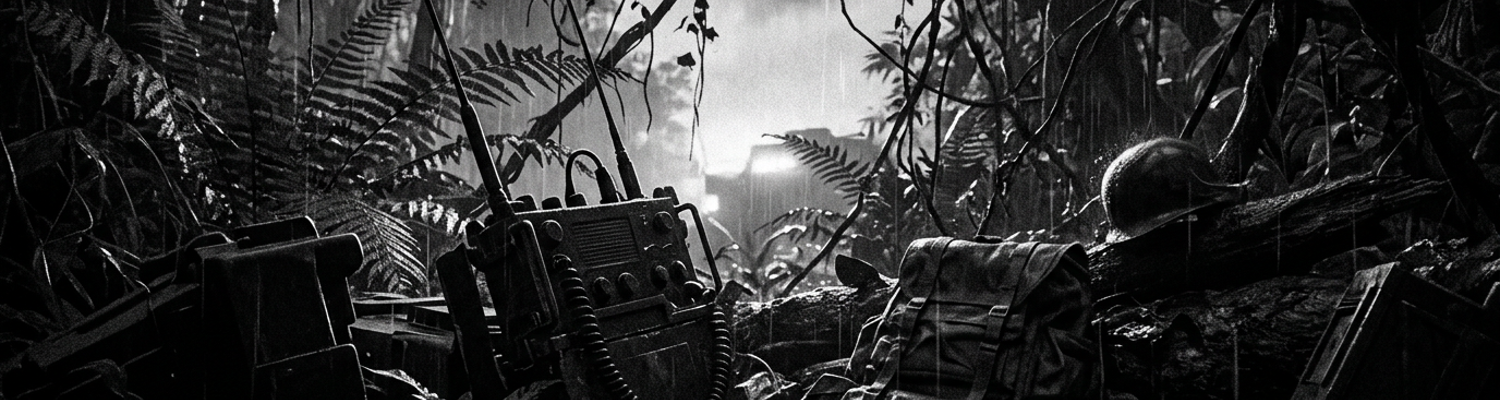

Extraction Site Forensics and Destroyed Cryptographic Equipment
Four hundred and eighty rounds of 5.56x45mm ball ammunition per man. Twenty-four M67 fragmentation grenades. Twelve M18A1 Claymore directional anti-personnel mines packing 1.5 pounds of C-4 apiece. Eight M14 thermite incendiary grenades loaded with chemical iron oxide and aluminum fuel. Two loitering flights of A-37B Dragonfly light attack aircraft armed with 500-pound Mark 82 low-drag bombs.
The hardware assembled for the border patrol held enough explosive potential to match a localized artillery barrage.
A close review of operational logs (NARA Record Group 338) indicates that recovery teams reaching Landing Zone Falcon along the limestone crest of the Dangrek Escarpment at Grid WB 429 881 found no human survivors. They found only physical debris left behind by emergency scuttling procedures. After-action forensic photographs document the destruction of two KY-38 secure voice manpack units and their associated cryptographic key-variable plates. Lead radioman Sergeant First Class Miller (Service Number RA 14 832 991) pulled the safety cotter pins on twin TH4 thermite charges resting directly atop the cryptographic cavity housings when hostile automatic weapons fire collapsed the southern perimeter at 1440 hours. Chemical burning at 2,200 degrees Celsius melted the magnesium alloy chassis within forty-five seconds. Internal silicon micro-circuitry, copper inductors, and nickel-plated matrix pins turned into an amorphous puddle of slag fused to the bed of red laterite clay. Radiographic inspection of the recovered metal confirmed that no intact rotor pin assignments or cryptographic switch settings survived the heat reaction.
Structural components of the secure voice apparatus had welded irrevocably into the chassis floorboards.
The team followed communication security doctrine to the second.
Archival evidence shows that physical documents faced an equally complete purge during the final six minutes of defensive posture. Technical specialists from the 403rd Radio Research Special Operations detachment (Unit Identification Code W3LPAA) carried twenty pages of sensitive NSA-issued KAC-13/TEK signal operating instructions. These documents detailed three weeks of high-frequency frequency-hopping schedules, daily call-sign tables, and tactical distress codes for the entire northern monitoring grid. Printed on moisture-resistant synthetic paper, these cryptographic booklets could not be destroyed by standard matches or field lighters. Team technicians poured potassium permanganate paste across the loose leaves before adding battery electrolyte to initiate rapid chemical deflagration. Spent matches and half-dissolved cellulose fragments recovered during post-mortem analysis revealed that thirty individual pages were soaked in aviation kerosene drained from a backup generator line before being reduced to carbon ash inside an upturned M1 steel helmet. Scattered micro-particles recovered four meters from the central burn pit bore cut marks from combat knives. Intercept units scouring the clearing gathered zero reconstructible keying material.
Not a single alphanumeric cipher fragment was left decipherable.
Combat engineers scouring the clearing edge recovered two cracked ceramic insulator rods from an AN/GRA-39 remote radio control set. These rods were severed by 7.62x39mm ball rounds thirty yards north of the helmet burn pit. Operational log entries recorded at Udorn Royal Thai Air Force Base logged the final manual transmission from the Dangrek ridgeline at exactly 1446 hours. This transmission consisted of a seven-digit authentication sequence followed by immediate carrier shutoff.
Static Concealment Along the Dangrek Ridge
Archival evidence shows that six hours before the extraction clearing collapsed, four-man collection team 4-Charlie occupied a static hide site at Grid WB 427 884 along the northern crest. Positioned at an elevation of 510 meters, the detachment anchored itself inside an unbroken belt of thorny mountain bamboo known as Bambusa blumeana. Root balls formed a damp subterranean overhang above the vertical sandstone cliff. The patrol lay prone in soaked laterite mud. They maintained total physical stillness for fourteen uninterrupted hours to evade discovery. Individual operators braced eighty-pound rucksacks directly beneath their sternums to distribute body weight across the sodden terrain and prevent shifting. Equipment siloing was complete. All metal sling buckles, Alice pack frames, and canteen clips were wrapped in olive-drab duct tape and black friction tape to eliminate mechanical clicks. Team members urinated into rubberized collection bladders without lifting their hips or rolling onto their sides. Thick clusters of forest leeches and red fire ants penetrated combat trousers and canvas jungle boots. Mission logs confirm that operators were forbidden from making reflexive swatting or scratching motions throughout the observation window.
Four men lay motionless in saturated mud for fourteen hours.
When examining the historical record, physical rigidity served as the only passive defense against visual detection within the mountain thicket. Technical Sergeant Vance clamped the cross-loop antenna of an AN/PRD-1 direction-finding manpack against his collarbone. He used his elbows as ground anchors to hold the receiver housing four inches above the mud line. Weapon barrels on the team's XM177E2 carbines remained sealed with thin rubber sheaths to block moisture from entering the receiver groups while remaining instantly ready for emergency discharge. Operators had carved small horizontal ledges into the red clay with their bayonets before dawn. They rested the toe caps of their boots inside these cutouts to avoid sliding down the thirty-degree incline into the ravines below. Muscle cramps in the lower lumbar and hamstring groups had to be absorbed silently without limb extension. A single foot shifting against exposed sandstone grit produced an acoustic signature detectable up to twenty yards away through the wet foliage.
Sound traveled along the damp rock face with zero acoustic attenuation.
A close review of operational logs indicates that the team used this high acoustic sensitivity to track sweep maneuvers mounted by Khmer Rouge Regional Battalion 801 (Order of Battle File 74-A) across the northern escarpment. Beginning at 0845 hours, hostile search parties began working their way upward from the dry valley floor. They used parallel skirmish lines spaced twenty paces apart to clear the talus slopes. Sergeant First Class Miller documented enemy movements strictly by ear. He recorded audio bearings with grease pencil on waterproof acetate sheets. The patrol tracked specific acoustic signatures echoing up the limestone chimneys. These included the dry scrape of tire-tread sandals on wet shale, rhythmic machete strokes lopping through outer bamboo stalks, and the metallic clanking of Chinese Type 56 folding stocks hitting wooden ammunition chests. Hostile point men signaled direction changes by tapping bamboo shafts together in three-beat intervals. This was an operational habit