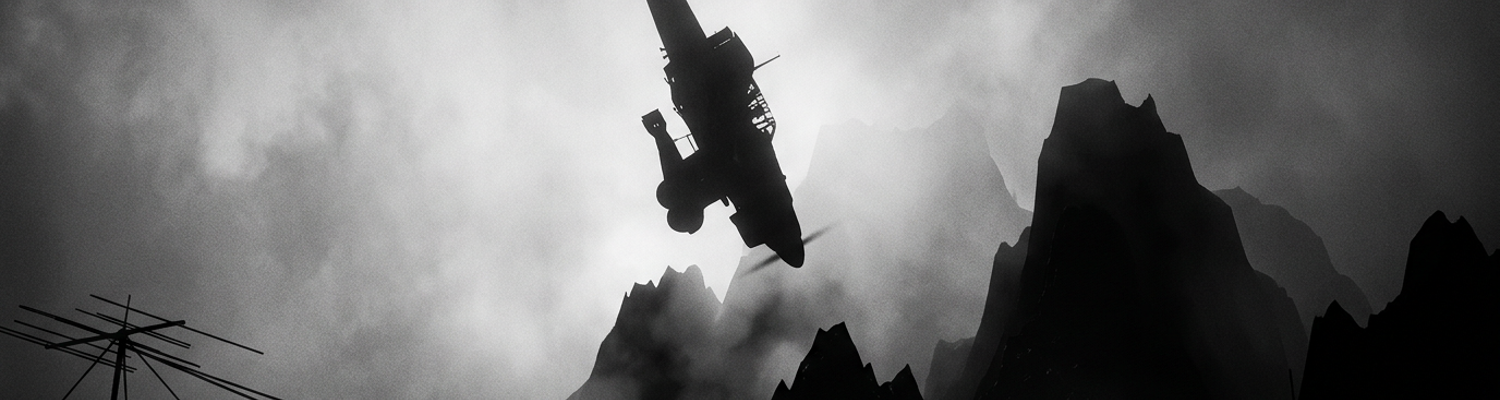

Carnage on Hill 1205 Limestone Ridges
High inside the port wing root of an attacking North American A-36 Apache dive-bomber, an internal hydraulic bypass valve suffered a sudden loss of pressure. The actuator system dropped from one thousand pounds per square inch down to ambient zero. Cold-thickened fluid sprayed past a shrunken neoprene gasket. The dive-brake deployment mechanism jammed halfway through its travel stroke.
In the cockpit, the pilot fought severe control resistance. Brass gears inside the elevator trim control box bound against frost-hardened grease. They stripped their teeth under sudden manual torque. The aircraft yawed violently out of its designated fifty-degree dive angle directly over the crest of Mount Sammucro.
The Texas soldiers had less than four seconds to find cover.
Archival evidence shows that elements of Company A and Company B, 1st Battalion, 143rd Infantry Regiment occupied shallow defensive pits scraped into the solid rock spine. Standard five-hundred-pound AN-M64 general-purpose bombs slammed directly into the company perimeter along the narrow saddle. Troopers had spent thirty-six continuous hours chipping six-inch trenches into the unyielding surface with entrenching tools. Their torsos remained fully exposed to horizontal blast shockwaves. Each bomb carried two hundred sixty-two pounds of high explosive compound. The munitions detonated directly against the open parapets. Several forward defensive positions vanished in simultaneous sheets of yellow flame. The heavy machine gun squads of Company D positioned to defend the northern approach were destroyed instantly. Men clinging to the limestone were hurled into the air by overpressure waves exceeding several thousand pounds per square inch. Soldiers inside adjacent foxholes suffered severe concussion and ruptured eardrums.
Sub-zero mountain air filled with burning cordite and pulverized rock.
When examining the historical record of United States Army Air Forces tactical strikes, the physical craters left behind on Hill 1205 departed radically from typical soft-soil detonations. Solid limestone cannot absorb explosive kinetic energy through soil displacement. The AN-M64 bombs could not dig deep defensive basins. They created broad, saucer-shaped scars barely two feet deep and twelve feet across. Jagged halos of calcined white rock rimmed the impact zones. Steel casings forged from high-tensile carbon steel sheared into thousands of sharp-edged fragments. These pieces traveled at speeds exceeding three thousand feet per second. Unimpeded by crater walls, the metal shards skimmed parallel to the frozen grade. Secondary fragmentation comprised thousands of high-velocity stone chips generated by shattered bedrock. This dual-layer fragmentation envelope sheared off signal wire. It severed radio aerials on BC-654 sets. Canvas equipment was shredded across a radius of seventy-five yards around each impact locus.
Incoming artillery from German positions at San Pietro Infine struck the summit immediately after the bombing run.
A close review of operational logs indicates that spotters from the German 15th Panzergrenadier Division recognized the disruption instantly. They directed 81-millimeter mortar barrages onto the friendly fire site. Litter squads from the 111th Medical Battalion faced a sheer descent across frozen crags angled at forty-five degrees to transport dozens of critically wounded infantrymen. Ice-coated rock faces prevented the use of wheeled transport. Four bearers per canvas stretcher were required to negotiate single-file goat trails exposed to continuous enemy shrapnel. Medics administered morphine syrettes that froze inside their wool field jackets. They struggled to apply tourniquets to mangled limbs as descending litter teams slipped on frost-covered scree. The evacuation route dropped twelve hundred feet down the southeastern slope toward an aid station established in the ruins of Ceppagna. Every casualty transport turned into a four-hour struggle through German interdiction fires.
Winter Line Strategy and the San Pietro Defile
Lieutenant General Mark W. Clark directed the United States Fifth Army into the jagged mountain choke points of the German Bernhardt Line during the first week of December 1943.
Archival evidence shows that Clark committed Major General Geoffrey Keyes and his II Corps to a direct frontal assault against the Reinhard positions guarding the Mignano Gap. Field Marshal Albert Kesselring had ordered the German Tenth Army to hold these fortified massifs at all costs to delay the Allied drive toward Rome. XIV Panzer Corps troops anchored their defensive perimeter inside reinforced concrete shelters. Log pillboxes roofed with railway ties and deep limestone caves proved impervious to standard 105-millimeter howitzer rounds. Continuous autumn downpours saturated the river basins. The primary supply corridors turned into knee-deep mud that swallowed wheeled transport. Combat engineers of the 111th Engineer Combat Battalion laid thousands of heavy timber logs to construct corduroy roads under intermittent artillery fire. Beneath the surface slime, German pioneers planted thousands of S-mine antipersonnel devices and Schu-mine 42 wooden boxes. These completely evaded Allied SCR-625 metallic mine detectors. The 753rd Tank Battalion attempted to advance along the elevated embankment of Highway 6. They lost multiple M4 Sherman tanks to dug-in 75-millimeter anti-tank guns before reaching their deployment lines.
Highway 6 was an open kill zone.
A close review of operational logs indicates that Mount Sammucro dictated every tactical movement through the San Pietro defile. Rising to an elevation of 1,205 meters, this massive limestone spine dominated the eastern entry corridor to the Liri Valley. Allied mechanized formations had to pass through this exact route. German artillery spotters from the 15th Panzergrenadier Division occupied forward observation perches along the crags of Hill 1205. They secured sweeping lines of sight across the entire Allied assembly sector. Motorized supply columns moving past Ceppagna or along the Mignano railway drew prompt counter-battery fire from heavy 170-millimeter kanone batteries positioned miles to the rear. At the southwestern base of the mountain, the village of San Pietro Infine formed an interlocking redoubt of stone houses. These structures were converted into machine gun bunkers with deep cellars reinforced by iron beams. These base positions were zeroed directly into the defile below. Units attempting to cross the open valley faced direct enfilading machine gun streams and registered 81-millimeter mortar concentrations. All of this was orchestrated from the high limestone heights above.
Taking the summit required a vertical ascent under total blackout.
When examining the historical record, Major General Fred L. Walker recognized that his 36th Infantry Division could not take San Pietro Infine without first wresting control of Mount Sammucro. Walker ordered the 1st Battalion, 143rd Infantry Regiment, commanded by Lieutenant Colonel David M. Frazior, to scale the steep southeastern escarpment during the night of December 7. The divisional commander omitted an opening artillery bombardment to preserve tactical surprise. Infantrymen climbed three thousand feet of jagged, frozen limestone. They hauled water cans, heavy ammunition boxes, and SCR-300 radios up goat paths that collapsed beneath their combat boots. Frazior and his men assaulted the crest at dawn on December 8. They bayoneted German sentries and dug into the limestone scree of Hill 1205 with handheld entrenching spades. Counterattacks followed within hours. Elements of the 71st Panzergrenadier Regiment launched repeated daylight thrusts backed by six-barrel Nebelwerfer rocket batteries. Walker coordinated secondary attacks with the 142nd Infantry Regiment against the lower ridges. The forward rifle companies on Hill 1205 found themselves pinned under continuous blast waves and sub-zero night temperatures.
Mule trains delivering rations and plasma along the southern ravines were obliterated by German mortar fire.
Improvised Air Liaison Parties on Exposed Crags
Archival evidence shows that Fifth Army and XII Air Support Command had established no standardized mountain tactical air control doctrine prior to the December offensive.
Major General Geoffrey Keyes assigned improvised Air Liaison Parties composed of infantry officers and enlisted radiomen drawn directly from 36th Infantry Division headquarters. He paired them with lone air force officers who possessed no specialized alpine experience. These teams ascended the vertical limestone contours of Mount Sammucro without cold-weather high-altitude clothing or mountaineering equipment. Instead of insulated parkas, crampons, or cold-weather packs, the liaison parties climbed in standard-issue wool serge trousers, canvas leggings, and M-1941 field jackets with thin flannel linings. Smooth rubber-composition soles on their service shoes slipped constantly across iced rock surfaces along the narrow crest of Hill 1205. Entrenching tools failed to penetrate the solid limestone bedrock. This prevented the controllers from digging protected foxholes or parapets against artillery splinters. Wind gusts exceeding forty miles per hour pushed ambient temperatures well below zero degrees Fahrenheit. Severe hypothermia incapacitated the observers within three hours of their arrival on the ridge.
Manual dexterity vanished under the freezing winds.
A close review of operational logs indicates that the technological breakdown centered on the portable SCR-284 radio sets dragged up the escarpment. Field teams relied on the BC-654 receiver-transmitter unit. This hardware was powered by six-volt BB-54 lead-acid wet cell accumulator batteries and PE-104 vibrator power units. Sub-freezing temperatures caused the dilute sulfuric acid electrolyte inside the glass battery jars to freeze and stratify. This collapsed the specific gravity and caused terminal voltage to drop from six volts down to 1.8 volts under load. Without adequate voltage, the transmitter tubes failed to generate radio-frequency output. Internal moisture condensed and froze across the quartz crystal sockets and tuning coil turns. Radiomen attempted to supply operational power using the manual GN-45 hand-crank generator. Operating the dual foot-pedals and twin hand cranks required two soldiers to stand fully upright on narrow, forty-five-degree scree slopes exposed to German machine gun nests on Hill 950. Ice glazed the internal carbon commutator brushes of the generator. This cut circuit continuity and shorted out the secondary power windings.
Electrochemical failure paralyzed the entire signaling array.
When examining the historical record, the breakdown of ground-to-air coordination stemmed from an absolute frequency disparity between ground elements and the incoming fighter-bombers. Ground liaison detachments operated the SCR-284 across high-frequency bands between 3,800 and 5,800 kilocycles. The A-36 Apache dive-bombers of the 86th Fighter-Bomber Group carried VHF SCR-522 transceivers tuned exclusively between 100 and 156 megacycles. Direct voice communication between front-line spotters on the rocks and the pilots diving toward Hill 1205 was technically impossible. Air support requests moved through an elaborate manual relay network. Observers used HF voice or telegraph keys to signal the 36th Division command post near Ceppagna. The post relayed messages by telephone wire to II Corps headquarters at Mignano. The corps then routed coordinates to XII Air Support Command at Presenzano. Incoming German counter-battery shellfire consistently severed the vulnerable overland telephone cables running through the Mignano Gap. This created message backlogs that exceeded forty minutes. Pilots over Mount Sammucro operated from outdated paper map coordinates drawn prior to morning takeoff. They flew through low overcast clouds without knowing that friendly infantry had already occupied the objective.
The dive-bombers crossed the initial point on pre-planned headings with their onboard radios tuned to empty frequencies.
Wet Identification Panels and Pyrotechnic Obscuration
Archival evidence shows that riflemen of the 143rd Infantry Regiment attempted to mark their forward trace using standard AP-50 fluorescent recognition panels issued for ground-to-air coordination.
Soldiers unrolled strips of synthetic acetate fabric dyed in high-visibility fluorescent orange and cerise across the jagged rock crest of Hill 1205. Cold drizzle turned to driving sleet at dawn on December 8. The precipitation soaked the porous cloth and caused the water-soluble fluorescent pigments to break down chemically under near-freezing saturation. Instead of reflecting daylight with high-contrast visibility across several miles, the wet panels collapsed into dark, waterlogged rags clinging flat against gray limestone. Gale-force mountain winds gusting along the exposed ridgeline snapped copper grommets from their anchor cords. The fabric tumbled across the scree into shell holes filled with liquefied mud. Men from Company B weighted remaining panels with loose rocks. Passing infantry boots trampled wet clay and shattered shale across the surface. This turned the cerise markers into dull gray smears that matched the surrounding mountainside.
The bright warning cloth became invisible against the wet stone.
A close review of operational logs indicates that friendly ordnance compounded the optical suppression minutes before the air strike arrived. At 0830 hours, twelve 155-millimeter M1 howitzers of the 133rd Field Artillery Battalion commenced an intense preparatory bombardment against German positions dug into the reverse slopes of Hill 1205 and the San Pietro approaches. The heavy guns expended hundreds of forty-three-pound M107 high-explosive charges alongside base-ejecting smoke canisters designed to screen Allied infantry movements across open talus. A thermal inversion layer hung across the narrow valley. It trapped thousands of pounds of pulverized limestone, cordite gases, and thick white phosphorus smoke against the upper ridgelines. Westerly crosswinds channeled through the San Pietro defile drove this concentrated particulate cloud directly across the American defensive line. The smoke blanketed the shallow pits occupied by the 1st Battalion and formed a horizontal smoke ceiling thirty feet above the crest. Sleet combined with the suspended carbon soot to create an opaque gray emulsion. This completely sealed off the ground markers from overhead observation.
Sulfur smoke smothered the peak.
When examining the historical record, meteorological instability across the Apennine spine prevented incoming pilots from compensating for ground-level obscuration. Flight formations of the 86th Fighter-Bomber Group departed Pomigliano Airfield under broken cloud conditions. They found the summit of Mount Sammucro enveloped in dense stratocumulus banks and drifting alpine mist. Cloud bases hovered between eight hundred and one thousand meters. The razor-backed spine of Hill 1205 was draped in shifting fog pockets that dropped localized horizontal visibility below two hundred yards. Pilots executing fifty-degree dive-bombing profiles entered their attack dives through narrow fissures in the cloud ceiling at speeds exceeding three hundred fifty miles per hour. Windshield defrosters on the Allison V-1710 engines struggled against external temperature drops. This coated cockpit perspex panels in internal condensation and external rime ice during the high-speed descent. Aviators possessed fewer than four seconds after breaking through the mist to identify targets, fix aim points, and pickle ordnance before initiating pull-up procedures.
Target recognition dissolved into gray fog.
Flight leaders spotted flashes through the drifting smoke layer and identified the summit ridge as an active German strongpoint. They mistook the concussions of incoming German mortar shells for hostile anti-aircraft batteries firing from the crest. Lacking direct radio contact with forward infantry observers, the four-ship flight rolled in on magnetic headings assigned three hours earlier at the airfield briefing tent. Release pins pulled free from bomb shackles at an altitude of twelve hundred feet. Four five-hundred-pound general-purpose bombs fell straight into the smoke-shrouded limestone trenches of Company A.
27th Bombardment Group Flight Profiles and Target Inversion
Archival evidence shows that Twelfth Air Force tasked the 27th Bombardment Group with close-support interdiction across the Reinhard Line. They launched three squadrons of North American A-36 Apaches from the crushed-tufa airstrip at Gaudo near Paestum.
Each airframe was powered by an Allison V-1710-87 liquid-cooled V-12 engine rated at 1,325 horsepower. This engine plant was engineered strictly for low-altitude operation due to its single-stage, single-speed supercharger. Ground crews bolted two five-hundred-pound AN-M64 demolition bombs to underwing bomb racks. This pushed the gross takeoff weight of the dive-bombers past ten thousand pounds. Mechanics in the dispersal pens fought leaking ethylene-glycol coolant lines and fouled spark plugs caused by low-grade 100-octane fuel batches distributed to Italian staging bases in late November. Flight leaders from the 522nd and 524th Bombardment Squadrons received target folders detailing German supply bottlenecks along the San Pietro defile. These paper packets lacked updated battle maps showing the midnight advances of the 36th Division. Flying north over the Gulf of Salerno and turning inland toward the Mignano Gap, pilots maintained manifold pressures near forty-two inches of mercury. They nursed temperamental cooling systems through dense thermal layers while climbing toward their assigned initial points.
The low-altitude power curve left pilots no margin for error once committed to an attack run.
A close review of operational logs indicates that the strike package encountered a fractured cloud deck hanging between nine thousand and three thousand feet over the summit of Mount Sammucro. Standard A-36 attack doctrine dictated a fifty-degree glide bombing run. The heavy overcast forced flight commanders to initiate steep seventy-degree dive attacks through narrow rifts in the broken stratocumulus ceiling. Aviators rolled inverted at eight thousand feet. They pulled through the vertical to acquire targets obscured by turbulent cloud edges and drifting alpine precipitation. Hydraulically actuated, cast-aluminum dive brakes slotted into the upper and lower wing surfaces deployed against extreme slipstream resistance. The brakes whined loudly as high-pressure airflow buffeted the wing spars. Despite the drag vanes, gravity pulled the loaded airframes downward at velocities accelerating past three hundred ninety miles per hour. Heavy control column buffeting made fine rudder adjustments impossible as pilots plunged straight toward the jagged mountain mass. Cockpit windscreens fogged instantly when hot engine exhaust met sub-freezing outside air temperatures. This blinded the pilots during the first two thousand feet of their descent.
Centrifugal force drained blood from the pilots as they fought the stick.
When examining the historical record, this extreme dive angle produced catastrophic target misidentification through topographical compression. Plunging out of the cloud base at four hundred feet per second, aviators suffered target inversion. They confused the sharp crest of Hill 1205 with the German reverse-slope bunker complexes situated six hundred yards deeper into the San Pietro ravine. The razorback contour of the friendly ridge visually flattened against the darker valley floor. This masked the narrow saddle where Company A of the 143rd Infantry Regiment lay dug into open limestone scrapes. Pilots hunting for reinforced log pillboxes and anti-tank revetments fixed their optical gunsights on the fresh dirt parapets and rock mounds thrown up by the Texas infantrymen. Smoke from earlier American artillery fire drifted directly across the friendly foxholes. This gave the exact visual signature of active German gun positions returning fire. Ground details blurred into gray streaks across the perspex canopy. Flight leaders pickled their ordnance at twelve hundred feet above the terrain. They released eight five-hundred-pound bombs directly into the center of the American forward defensive perimeter before hauling back on the elevator controls.
Shattered Landlines and Failed Wave-Off Signals
Archival evidence shows that the blast wave from the initial bomb cluster completely sheared the tactical telephone grid linking Hill 1205 to the rear echelon.
Forward observers and company commanders relied on battery-powered EE-8-A field telephones connected by two-strand W-110-B twisted field wire. This wire was laid loosely over bare limestone outcrops down the southeastern ridge. Sharp casing fragments traveling at supersonic speeds severed these copper-and-steel conductors in dozens of exposed locations within fifty yards of the command post of Company A. High-velocity stone splinters sliced clean through the rubberized friction-tape insulation. Displaced limestone boulders rolled onto lower cable segments. They crushed the core conductors against sharp bedrock shelves. Signal corps linemen from the 143rd Infantry communications platoon could not exit their foxholes to trace the breaks with test sets. German 81-millimeter mortar shells continued to pound the exposed slope. Lieutenant Colonel David M. Frazior maintained his 1st Battalion command post in a stone shelter twelve hundred feet below near the village of Ceppagna. He was stripped of all real-time voice contact with his forward rifle companies within seconds of the first bomb detonation.
Field telephone circuits died simultaneously across the entire company sector.
A close review of operational logs indicates that surviving officers on the ridge were unable to signal the air formation with emergency pyrotechnic wave-off munitions. Division doctrine dictated the firing of ground-to-air pyrotechnic markers to halt fratricidal strikes. Platoons were instructed to launch AN-M8 pyrotechnic pistols or ten-gauge M2 projectors loaded with amber star clusters and colored smoke cartridges. Sleet and freezing drizzle had saturated the canvas equipment bags of the platoon leaders. Water soaked directly into the compressed paper hulls of the signal rounds. Moisture warped the cardboard casings, causing them to swell until they jammed inside the steel breech chambers of the hand-held projectors. Platoon sergeants attempting to activate M18 colored smoke grenades pulled the safety pins only to have the cold-corroded striker springs fail to detonate the primer caps. Those few canisters that did ignite produced sluggish, low-temperature chemical burns. These were instantly extinguished by forty-mile-per-hour wind gusts sweeping across the exposed crest.
Not a single colored star shell reached the cloud deck.
When examining the historical record, the trailing elements of the 27th Bombardment Group treated this absence of ground signals as confirmation of an active German position. Two trailing North American A-36 Apaches of the 522nd Bombardment Squadron descended through the same narrow fissure in the stratocumulus deck at three-minute intervals behind the flight leaders. These pilots operated under visual attack orders directing them to hit points of target disruption. Both aviators fixed their optical sights directly upon the rising plumes of white limestone dust and black high-explosive soot created by the first wave. Entering sixty-degree dives at eight thousand feet, the pilots watched the smoke billow over the saddle without identifying the prone Texas infantrymen pinned among the shattered rocks below. Shackles on the underwing bomb racks tripped at one thousand feet above the mountain grade. Four more five-hundred-pound AN-M64 general-purpose bombs fell down the exact descent trajectory of the previous pass. The secondary ordnance detonated squarely across the Company B aid perimeter and the primary litter collection point. This destroyed two additional machine gun squads and killed nineteen wounded soldiers who lay awaiting stretcher transport along the reverse slope.
Flight leaders banked south toward Salerno at 0914 hours with all weapon stations empty.
Fifth Army Air-Ground Coordination Deficiencies
Archival evidence shows that Fifth Army air-ground doctrine in December 1943 rested on the procedural framework of Field Manual 31-35.
Drafted in April 1942, this operational manual mandated that close air support function through pre-planned, rigid scheduling rather than frontline tactical intervention. Tactical air support command centers required ground formations to submit support requests twelve to twenty-four hours before bomb release. Under these protocols, strikes targeted static rear installations, road junctions, and rail heads plotted on grid coordinates long before dawn. Frontline infantry commanders possessed no authority to redirect aircraft once pilots received morning briefings at staging bases. The manual treated tactical aircraft as airborne artillery batteries. It denied forward observers any direct mechanism to adjust delivery or alter assigned bomb coordinates when combat conditions shifted. When elements of the 143rd Infantry Regiment seized the crest of Hill 1205 during the night, no operational channel existed to cancel strikes that had been scheduled while German defenders still occupied the ridge.
Doctrinal protocol kept the original coordinates active on paper.
A close review of operational logs indicates that air support coordination collapsed inside an indirect message relay system spanning four separate command echelons. Emergency cancellation requests from the 36th Division had to travel through battalion switchboards to reach the main division command post at Ceppagna. Radio operators at Ceppagna hand-encoded coordinate updates and transmitted them via telegraph or telephone lines to the II Corps Air Support Party stationed at Mignano. Corps staff officers reviewed each clearance request, marked paper tracking boards, and sent teletype dispatches down landlines to XII Air Support Command headquarters at Presenzano. German 150-millimeter artillery fire regularly severed the unarmored W-110 field telephone wires traversing the Mignano Gap. Signal teams were forced to trace breaks across exposed rocky ground. Message transmission across this four-tier administrative pipeline routinely took between ninety minutes and two hours. Urgent wave-off requests drafted at 0815 hours sat in dispatch trays at corps headquarters while the A-36 Apaches were already rolling into their attack dives over Mount Sammucro.
Relay delays outlasted the flight time between airfield takeoff and bomb impact.
When examining the historical record, this administrative delay coincided with an absolute radio frequency divide separating ground units from tactical bombers. Frontline infantry platoons and battalion forward observers carried battery-powered SCR-300 frequency-modulated radios operating between 40.0 and 48.0 megacycles. They also carried SCR-284 sets tuned to high-frequency amplitude modulation bands between 3.8 and 5.8 megacycles. Combat aircraft flown by the 27th and 86th Fighter-Bomber Groups carried Western Electric SCR-522 transceivers. Operating across four preset crystal-controlled very high frequency channels between 100 and 156 megacycles, these airborne transceivers connected solely to other aircraft and rear-area fighter-control direction centers. No ground combat team on the slopes of Hill 1205 possessed an SCR-522 set, a compatible vehicular mount, or any radio capable of transmitting above 50 megacycles. Forward observers on the frozen crags watched the dive-bombers deploy their wing brakes without any technical equipment to transmit an abort code into the headsets of the pilots.
The dive-bombers entered their bomb runs with their radio transceivers tuned exclusively to four pre-set tactical air frequencies that no soldier on Mount Sammucro could reach.
Evolution of Forward Air Control Doctrine
Archival evidence shows that Twelfth Air Force convened formal post-incident boards of inquiry in Caserta throughout late December 1943 to investigate the recurring fratricide across the Bernhardt Line.
Major General John K. Cannon assumed command of Twelfth Air Force on December 21. He reviewed ballistic telemetry, pilot debrief logs from the 27th Bombardment Group, and ground casualty lists from the 36th Infantry Division on Mount Sammucro. Staff investigators led by Brigadier General Gordon P. Saville concluded that the foundational close-support doctrine of Field Manual 31-35 had collapsed under Apennine mountain warfare conditions. The inquiry found that grid coordinate disparities between army topographic sheets and aerial charts produced target plot deviations of up to eight hundred yards in jagged relief. Relaying tactical strike requests across four separate telephone switchboards routinely consumed seventy-five minutes. This rendered planned aim points obsolete before aircraft cleared their departure airfields at Gaudo and Pomigliano. The board also established that the technical divide between infantry SCR-300 radios and fighter-bomber SCR-522 VHF transceivers meant that pilots dived blind onto friendly coordinates. No ground-level abort signal could reach their headsets.
Paper flight schedules had killed American soldiers on Hill 1205.
A close review of operational logs indicates that the Mediterranean Allied Tactical Air Force responded to these findings by adapting British Desert Air Force visual control experiments into an American system designated Rover Joe. Entering frontline trials during the First Battle of Monte Cassino in February 1944, Rover Joe detachments paired experienced fighter-bomber pilots with communications personnel. These teams were mounted inside armored M3A1 scout cars and modified Dodge three-quarter-ton command trucks. Operating from elevated observation perches on terrain like Mount Trocchio overlooking the Rapido River, these forward air controllers maintained direct line-of-sight over German defensive lines. Each Rover Joe vehicle carried vehicular SCR-522 VHF transceivers composed of BC-624 receivers and BC-625 transmitters. This allowed controllers to speak directly to pilots on tactical flight channels. The system was backed by heavy SCR-399 high-frequency sets linked to rear air headquarters. Rover Joe controllers surveyed the valley through twenty-power target spotter telescopes. They visually tracked German positions before talking incoming P-40 Warhawks and P-47 Thunderbolts onto targets using clock bearings and prominent geographic markers. Aviators approaching the combat zone no longer flew rigid, pre-briefed bomb plots. They checked in with Rover controllers while circling at designated contact points ten miles behind the battle line.
Voice control had replaced pre-planned coordinates.
When examining the historical record, Fifth Army and XII Tactical Air Command simultaneously established rigid bomb line verification protocols to prevent close-support aircraft from releasing ordnance within friendly sectors. Air-ground directives enforced in March 1944 established a mandatory Bomb Safety Line plotted on standardized 1:50,000 scale topographic maps updated twice daily at 0400 and 1600 hours. Ground artillery battalions were integrated into the clearance cycle. They fired 105-millimeter base-ejection smoke shells filled with red or orange chlorosulfonic acid to mark the friendly forward line of troops precisely two minutes before aircraft reached their initial dive point. Incoming flight leaders faced a mandatory two-way radio challenge-and-response protocol over their SCR-522 sets. This required pilots to confirm visual identification of the colored smoke line before arming bomb shackles. Air controllers held absolute veto authority over approaching strikes. They ordered immediate wave-offs if an aviator failed to verify target markers or if mountain wind shear blew artillery marking smoke back over friendly rifle pits. Missions that could not achieve positive visual correlation were diverted to secondary rail targets north of Rome.
Strikes within one thousand yards of front-line units required written sign-off from the corps artillery officer.