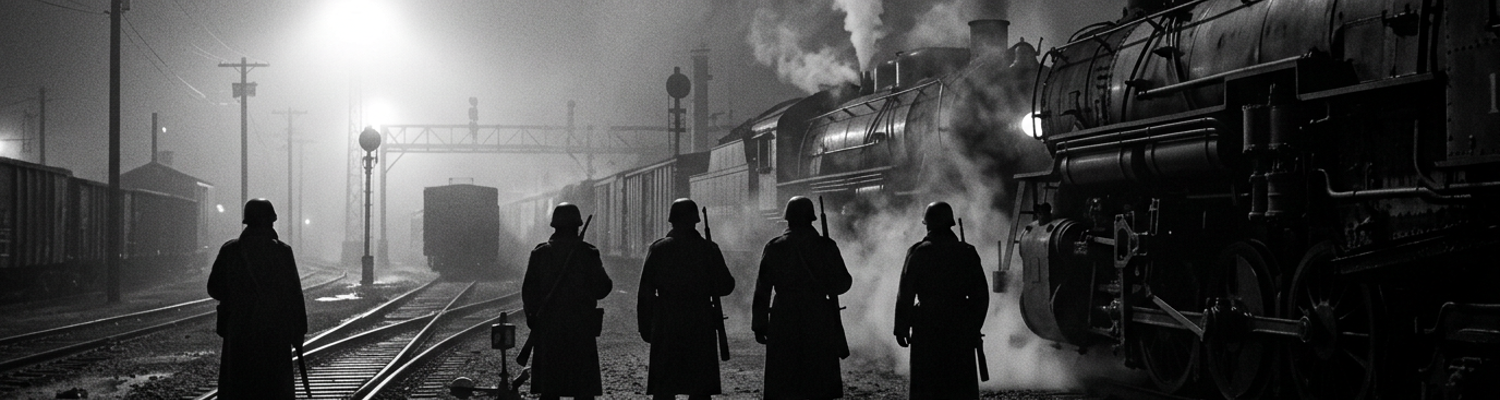

Strategic Rail Corridors and Port Embarkation Logistics
Securing twelve miles of double-tracked coastal grade against sabotage was an absolute impossibility for two understrength engineer companies.
Archival evidence shows that on the afternoon of December 7, 1941, staff officers at Western Defense Command headquarters in the Presidio unrolled topographic rail maps of the San Francisco peninsula. They confronted an immediate geographic bottleneck. Western Defense Command identified the Southern Pacific Railroad Bayshore Cutoff as the sole direct rail artery into the San Francisco Port of Embarkation. Every carload of artillery ammunition routing directly into Fort Mason had to pass through this specific corridor. Completed in 1907 across Franciscan chert formations and unstable bay mud, the double-track line bypassed the steep interior grades of the old San Miguel branch.
That winding interior detour had already degraded into an inadequate secondary route incapable of handling standard wartime axle loads.
Rail car floats crossing the bay from the Oakland terminals offered no workable substitute during bad weather. Staff planners calculated a grim equation. If enemy saboteurs disabled the Bayshore tracks, cargo transfers into deep-water transports would completely halt at the docks.
A single pair of steel rails supported the outbound Pacific supply chain.
A close review of operational logs (NARA Record Group 338) indicates that combat engineers mobilized immediately following Pearl Harbor to secure the five mainline tunnels between San Francisco and San Bruno. Dispatch orders routed detachments from the Presidio and Fort Scott into the industrial rail cuts before midnight on December 7. Tunnel 1 pierced Potrero Hill for 1,811 feet. Tunnel 2 cut through Visitacion Point. Tunnel 3 bored through the rock of Sierra Point. Tunnel 4 sat south of Candlestick Cove. Tunnel 5 cut 1,117 feet through the base of San Bruno Mountain. Engineers established perimeter pickets at every portal. They stacked wet sandbags against concrete headwalls to construct defensive firing positions. Men carried M1903 Springfield rifles, trench shotguns, and live fragmentation grenades. They stood guard directly on the rock ballast as civilian steam locomotives pumped sulfurous coal smoke into the unventilated bores. Standing orders instructed sentries to shoot any unidentified individual approaching the track beds who failed to halt on first challenge.
Physical track mechanics broke down rapidly under the sudden surge of military tonnage.
Southern Pacific maintenance crews reported cracked joint bars and crushed wooden cross-ties near the southern approach to Tunnel 4. Poor drainage along the bay marsh softened the roadbed under heavy flatcars loaded with M3 Stuart light tanks. Sentry units lacked basic foul-weather gear, shelter halves, and field telephone wire. Squad leaders had to rely on trackside call boxes belonging to railroad dispatchers. Handheld kerosene lanterns supplied the only illumination during citywide blackouts. Electrical current to tunnel signals failed repeatedly during coastal air raid warnings. Guard squads stood forty-eight-hour shifts without hot food. They heated canned field rations over kerosene lanterns placed inside shallow concrete refuge niches recessed into the tunnel walls.
By the morning of December 9, nineteen separate freight trains sat dead on the sidings south of San Bruno awaiting armed track clearance.
Fortification of the Visitacion Classification Yard
Archival evidence shows that at 0400 hours on December 8, 1941, the 18th Engineer Regiment received orders from Western Defense Command to establish defensive perimeters around the Visitacion classification yard.
Sprawling across two hundred acres of reclaimed tidal mud at the southern edge of San Francisco, the yard contained thirty-eight parallel tracks holding thousands of tons of volatile war materiel. Flatcars and boxcars arriving from eastern depots sat packed with crated Wright R-1820 radial engines. Other cars held crated water-cooled machine guns and thousands of wooden crates holding 155mm high-explosive artillery shells routed for coastal batteries. Combat engineers drove timber stakes into the cinders and strung double-apron barbed wire along the outer track boundaries from the roundhouse to the Visitacion Point bluffs.
Squads set up sandbag redoubts at trackside switches.
They mounted M1917A1 water-cooled .30-caliber machine guns on heavy tripods to cover the yard throats. Slit trenches were dug directly into the crushed rock ballast and saturated salt-marsh fill. Brackish water seeped into the revetments at high tide. The water pooled around the boots of riflemen armed with M1903 Springfields.
Ballast water fouled the weapon mechanisms before noon.
When examining the historical record of the perimeter defenses, physical infrastructure failures began almost instantly across the marshland foundation. The weight of stacked sandbag revetments and steel rail ties sank the soft ground near the northern lead tracks. This forced mechanical switch rods out of alignment. Switchmen trying to throw hand-operated ground throw levers found the points jammed by loose aggregate displaced by entrenching work. Engineer commanders refused to permit civilian track maintenance gangs into the inner classification tracks without armed military escorts. This stranded repair crews outside the wire. Inside the perimeter, open flatcars packed with wooden crates of 75mm field artillery ammunition sat exposed beneath freezing rain and heavy ocean fog. Sentry details patrolling the car aisles carried fixed bayonets and fragmentation grenades. They were stationed at fifty-foot intervals with explicit authority to shoot anyone attempting to breach the perimeter fences.
Zero civilian workers entered the yard unescorted.
A close review of operational logs indicates that switching operations collapsed within hours. Military checkpoints demanded manual cargo manifests for every rolling freight car entering the yard. Southern Pacific dispatchers normally relied on gravity switching from the classification hump. They rolled disconnected cars freely into sorting tracks at speeds exceeding ten miles per hour. That automated sorting rhythm ended when armed sentries from the 6th Coast Artillery took control of the lead tracks. Every cut of cars had to halt completely at the yard gate. An officer inspected paper waybills against metal seal numbers stamped on boxcar doors. If a seal number showed scratches, sentries barred the car from moving down the ladder track. Guards used bolt cutters to sever seals on sealed boxcars. They climbed inside with flashlights and crawled across crated war materiel to inspect crate stencils by hand.
Hump sorting operations dropped from eighty cars an hour to four.
Civilian 0-6-0 steam switch engines sat idle on lead tracks with boilers under full steam. They burned through soft coal reserves while awaiting manifest clearances. Because locomotives could not clear the primary arrival tracks, inbound supply trains halted along the main line as far south as Redwood City. Steam pressure dropped in waiting locomotives. This caused mechanical feed-water pumps to freeze in the damp bay air. Track crews ran short of clean water for locomotive tenders. By December 10, over six hundred railcars stood stationary between Tunnel 2 and the southern yard throat.
California State Guard Deputization and Track Patrols
Archival evidence shows that on the night of December 8, 1941, the California State Adjutant General activated the 2nd Infantry Battalion of the California State Guard under emergency executive decrees from Sacramento.
Western Defense Command requested eight hundred men to relieve exhausted federal troops guarding the coastal perimeter. County sheriffs in San Francisco and San Mateo hastily swore in store clerks, shipyard machinists, and retired Spanish-American War veterans at the San Francisco Civic Auditorium. Officers pinned stamped brass badges onto civilian lapels and dispatched company-sized elements south along Third Street toward the Bayshore Cutoff. Company E established a command post in an abandoned passenger depot near the north portal of Tunnel 1. Patrol details fanned out along the ballasted grade in teams of two. They stepped across slippery redwood ties in pitch-black conditions. Their immediate orders required them to clear the track perimeter and patrol the interior bores of all five tunnels through the night.
State authorities handed loaded weapons to men who had never walked an active rail corridor.
When examining the historical record of track movements, sentries entering the damp rock cuts encountered near-zero visibility and heavy airborne contaminants. Tunnel 2 and Tunnel 3 lacked mechanical ventilation fans. This trapped sulfurous locomotive exhaust against the arched concrete ceilings for hours after trains passed. Guard details advanced through the dark bores using unshielded flashlights that threw weak, yellow beams against soot-blackened walls. Thick smoke from heavy consolidation engines blinded the sentries. It produced coughing fits and disorientation that forced men to drop flat onto the oily ties. Because telephone cables had not been strung through the tunnels, interior sentries possessed no direct communication with trackside dispatchers. Roving squads had to press their ears directly against cold rail steel to listen for vibrations indicating an approaching train.
Locomotive headlamps provided the only warning inside the blind curves.
A close review of operational logs indicates that the ordnance distributed to these volunteers came from obsolete state armory stockpiles. Supply sergeants issued surplus M1917 Enfield and Krag-Jorgensen bolt-action rifles that had rested in open wooden crates since 1919. Thick, hardened cosmoline packed the receiver wells. This caused extractors to slip over cartridge rims and jammed firing pins during wet coastal air alerts. Men lacked regulation winter uniforms. Sentries stood watches along the Sierra Point shoreline dressed in civilian wool overcoats, light work jackets, and thin leather street shoes that quickly soaked through in the forty-degree rain. Wet sea fog off San Francisco Bay saturated cotton trousers within an hour of deployment. Medical logs from the San Mateo County field station recorded thirty cases of severe exposure and foot rot among State Guard pickets between December 9 and December 12.
The volunteers possessed zero training in railroad right-of-way regulations.
Civilian volunteers regularly misjudged the lateral clearance profiles of wide industrial rolling stock. Southern Pacific standard operating procedures required workers to stand clear by at least six feet when trains passed. State Guard riflemen frequently attempted to flatten themselves against tunnel walls where clearances narrowed to twenty-eight inches. Refuge niches built into the concrete walls every one hundred feet were repeatedly found blocked by discarded equipment crates and sandbags. On December 11, an unscheduled northbound freight hauling steel plate struck a sentry rifle barrel at the southern entrance of Tunnel 4. The impact sheared the wooden stock and threw the guard into the drainage ditch. Southern Pacific dispatchers reported three emergency stops within forty-eight hours after frightened guards aimed loaded rifles into locomotive cabs. They mistook slow-moving maintenance handcars for saboteurs.
Intelligence Failures and Sentry Friendly Fire Incidents
Archival evidence shows that by 2000 hours on December 9, 1941, intelligence officers at Western Defense Command headquarters in the Presidio began circulating unverified alarm bulletins down to trackside detachments.
The G-2 intelligence section logged repeated reports claiming Imperial Japanese Navy submarines were disembarking teams of saboteurs in rubber rafts along the San Mateo coastline between Point San Pedro and Sharp Park. Field officers distributed these raw summaries directly to green State Guard pickets without filtering out civilian rumors. Telephone alerts warned guard details that enemy commandos carried explosive cutting charges intended to demolish the concrete portals of Tunnel 3 and blow the rail bed near Sierra Point into San Francisco Bay. Patrol commanders reacted by ordering sentries to assume combat readiness and treat any unexplained movement along the right-of-way as hostile. Men stood in darkness on forty-degree nights. They stared down the ballasted tracks as coastal fog blew across the rails. Sentries mistook utility poles, windblown garbage, and stray coastal livestock for armed landing parties.
Panic dissolved trigger discipline within hours.
When examining the historical record of these nighttime sectors, enclosed tunnel geometry turned this tactical jitteriness into an active hazard for American personnel. At 0140 hours on December 10, a two-man roving patrol from Company E entered the southern bore of the 2,165-foot Tunnel 3 without checking in with the fixed portal watch. Thick coal smoke from a southbound freight hung low against the concrete lining. This cut visibility to three paces and muffled footsteps. As the relief patrol advanced over the ballast, the stationary picket near the northern portal saw two figures silhouetted against a faint reflection on the steel rails. The sentry fired three rapid rounds from an M1903 Springfield rifle without issuing a verbal challenge. The .30-06 copper-jacketed bullets glanced off the curved concrete archway and splintered against the granite rock face. This showered both men with sharp stone fragments and jacket shards. Believing themselves under fire from saboteurs, the patrol returned fire with an M1917 Enfield. They sent four high-velocity rounds down the bore that ricocheted through the narrow passage before striking an electrical signal battery box mounted to the wall.
Sparks and bullet fragments tore through the track circuits.
A close review of operational logs indicates that these uncontrolled discharges triggered sudden, unauthorized shutdowns across the entire cutoff route. Five minutes after the firing in Tunnel 3, the crew of an inbound Southern Pacific freight train carrying crated .50-caliber machine gun barrels rounded the curve into the southern approach. The locomotive engineer saw muzzle flashes reflecting off the damp ceiling and heard high-velocity rounds cracking past the steel cab window. He immediately threw the Westinghouse automatic brake valve into the emergency position. This dumped seventy pounds of trainline air pressure in an instant. The sudden deceleration caused thirty-eight heavy boxcars to bunch violently. The force sheared the draft gear on a center flatcar and threw two wheel sets off the rails near the Tunnel 3 portal. Sentry commanders refused to let railroad repair crews approach the derailment until company officers could search the tunnel on foot with bayonets fixed. Northbound military trains backed up behind the disabled freight for seven miles. Flatcars loaded with aircraft engines and crated field artillery sat stationary on the main tracks until daylight.
Forty-two carloads of Pacific-bound ammunition sat stranded until noon.
Material Shortages and Tunnel Shoring Deficits
By December 11, defensive works along the twelve-mile rail grade ground to an absolute halt for lack of raw construction material.
Archival evidence shows that field officers from the 18th Engineer Regiment submitted priority requisitions to the San Francisco General Depot at Fort Mason for ten thousand yards of standard four-point tactical barbed wire, three thousand replacement rail ties, and two hundred structural timber bents. Depot staff filled less than eight percent of that request. Supply warehouses across the Bay Area had already emptied their inventory to string perimeter wire along the ocean beaches between Fort Funston and the Presidio. Inside the rail cuts, combat engineers had only forty-two spools of rusted cattle fencing to secure five vulnerable tunnel portals. Squads on the ground were forced to strip salvage wire from abandoned dairy farms along the base of San Bruno Mountain to build perimeter barriers around Tunnel 5. Without standard steel screw pickets, work details drove split eucalyptus branches and discarded steel pipes directly into the rock ballast to hold the lines. Track maintenance collapsed under the same dry supply pipeline. Creosoted Douglas fir cross-ties beneath the outer curved rails at Tunnel 2 had begun to splinter under forty-ton carloads of 155mm coastal shells. Southern Pacific roadmasters held fewer than two hundred spare ties in their Bayshore maintenance sheds. Depot quartermasters refused to release civilian stock without signed federal procurement authorizations.
Track foremen spent thirty-six hours searching scrap heaps for second-hand redwood ties to keep military trains from spreading the rails.
A close review of operational logs indicates that the structural reinforcement of the five tunnel portals sparked an administrative war between Western Defense Command and commercial industrial interests. Engineer inspections warned that unreinforced concrete headwalls at Tunnel 1 in Potrero Hill and Tunnel 3 at Sierra Point would shatter inward under aerial blast overpressure. This would seal outbound rail shipments inside collapsed rock debris. Planners drew specifications for exterior timber blast shields requiring twenty thousand board feet of 12x12-inch and 14x14-inch heavy structural Douglas fir. Military logistics officers sent to secure these baulks discovered that regional commercial shipyards had locked up the entire regional timber supply. Emergency Maritime Commission contracts held superior priority ratings over domestic rail protection details. Bethlehem Shipbuilding at Potrero Point, Moore Dry Dock in Oakland, and the expanding Richmond Shipyards bought every load of structural timber arriving by barge from Oregon sawmills. Civilian shipyard agents stood on the docks with open purchase orders. They paid cash to divert timber rafts directly into slipway construction and ship scaffolding.
Army procurement warrants could not break commercial priority ratings.
When examining the historical record of December 12, a detachment from the 6th Coast Artillery attempted to commandeer two carloads of heavy timber sitting on an industrial siding near Hunters Point. The shipment consisted of eighty milled fir baulks assigned to the Hunters Point drydock expansion project. Civilian yard managers refused to surrender the bill of lading. They blocked the military trucks with heavy industrial tractors until port authorities intervened. Maritime Commission liaison officers upheld the shipyard claim. This forced the military trucks to withdraw empty. Engineer squads at Tunnel 4 had no choice but to improvise portal bulkheads out of split railroad ties, loose riprap stone, and unseasoned pine boards stripped from nearby packing warehouses. Green pine warped within forty-eight hours under heavy rain. It sagged across the portal approaches and reduced vertical clearance down to eighteen feet. Locomotive smokestacks regularly struck the drooping falsework. This knocked splintered planks across the tracks and forced armed details to haul wood scrap off the rails before clearance could resume.
The Bayshore Roundhouse Three Hundred Car Freight Logjam
Archival evidence shows that by sunrise on December 13, 1941, the mechanical operations of the Southern Pacific Bayshore Roundhouse collapsed into a total standstill.
Uncoordinated train stoppages initiated by nervous State Guard sentries along the five tunnel approaches collided directly with Western Defense Command perimeter checkpoints. When inbound freights hit emergency track halts outside Tunnel 2, locomotive engineers backed their consists toward the Visitacion yard ladder tracks. Yard switchers were already dead on the rails waiting for bill-of-lading verifications. Within ten hours, this unmanaged chain reaction produced a three-hundred-car freight logjam blocking the Bayshore Roundhouse complex and the primary locomotive servicing terminal. Tender tanks ran dry of boiler feed water while locomotives idled on the lead approaches. Yard hostlers could not align the eighty-foot mechanical turntable because uncoupled boxcars loaded with crated engine parts physically overlapped the approach split rails. Mechanical switch linkage rods bent under excessive lateral wheel loads when yard crews attempted to shove fifty-ton boxcars onto jammed storage spurs. Ten heavy consolidation steam locomotives sat trapped inside the brick engine stalls. They were unable to reach the mainline to relieve exhausted freight engines whose fires were dying on the ballasted arrival tracks.
Three hundred cars of Pacific cargo formed an unbroken wall of dead steel.
A close review of operational logs indicates that the gridlock severed the mechanical servicing schedule for the entire San Francisco terminal division. Locomotive boilers required flue washouts and ashpan servicing every twenty-four hours to prevent injector clogs from alkaline bay water. The blockage left roundhouse pit gangs unable to reach incoming engines. Hostlers dumped hot firebox cinders directly between the rails on Track 4. This scorched cross-ties and damaged track-circuit signal bonding wires. Draft gear knuckles fractured on three center refrigerator cars when an unauthorized civilian switcher attempted to pull a forty-car cut off the roundhouse approach track without releasing hand brakes that armed sentries had manually set the previous midnight. The yardmaster at Bayshore repeatedly wired regional dispatchers in San Luis Obispo and Sacramento to halt all westbound manifest trains. Military convoys continued to enter the peninsula corridor under high-priority movement orders issued by the Army Transportation Corps. Every arriving cut of rolling stock simply telescoped into the southern yard throat.
Munitions cars sat cold on the sorting ladders.
When examining the historical record, this industrial paralysis deepened while regional authorities diverted civilian attention away from the transport failure. Dozens of flatcars loaded with crated 37mm anti-aircraft ammunition, depth charges, and artillery powder canisters sat stalled on Visitacion classification sidings. Civilian vigilance leaflets were mass-distributed across Bay Area neighborhoods by civil defense authorities. Auxiliary fire wardens, volunteer messengers, and uniformed Boy Scouts carried hundreds of thousands of printed pamphlets door-to-door through the Mission District, the Richmond, Sunset, and down into northern San Mateo County. The flyers instructed civilians to report suspicious individuals near railroad infrastructure, black out residential windows with tar paper, and stockpile dry sand inside bathtubs to combat air-dropped magnesium incendiary sticks. Municipal transport trucks delivered crates of these paper bulletins across city sectors. They burned fuel while traversing overpasses directly above the frozen rail corridors. Down on the dead classification tracks, flatcars loaded with crated high-explosive ordnance designated for naval patrol squadrons sat completely immobilized under freezing drizzle. They were guarded only by two state infantrymen with unzeroed rifles.
By dusk, the pileup reached seven solid miles of fouled track south toward Millbrae.