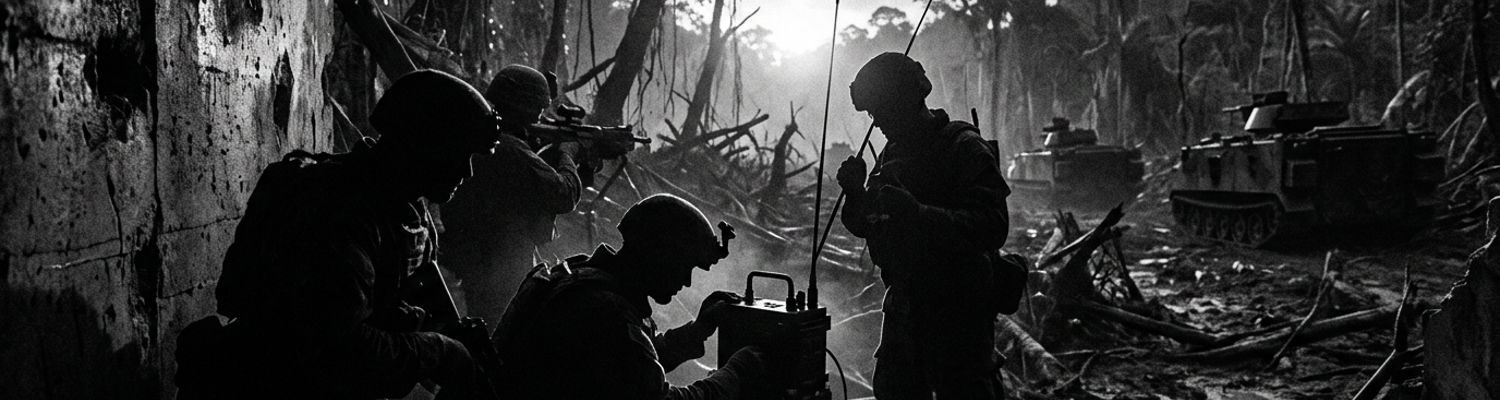

Opening Bombardment of the Command Compound
Before dawn on April 13, 1972, stillness covered the French rubber plantations enclosing the provincial capital of An Loc. Dense humidity trapped the scent of damp vegetation across the red clay fields of Binh Long Province. Archival evidence shows that American military personnel embedded with the Army of the Republic of Vietnam 5th Infantry Division listened to an abnormal quiet across the northern perimeter tree lines.
At 0530 hours, that silence ended permanently.
North Vietnamese Army gunners assigned to the 75th Artillery Regiment opened fire with an opening salvo of over seven thousand indirect fire rounds across an area measuring less than two square kilometers. High-explosive ordnance pounded the civilian quarters. Tin roofs tore apart. Defensive fighting positions of the 5th Infantry Division flattened under continuous impacts.
The entire provincial capital became a target grid under sustained saturation fire.
A close review of operational logs indicates that the subterranean Tactical Operations Center of the 3rd Regional Assistance Command absorbed direct hits almost immediately. Buried beneath layers of hand-packed soil, timber baulks, and pierced steel planking, the bunker shuddered under the kinetic impact of Soviet-supplied 130mm M-46 towed field guns (NARA Record Group 338). These weapons fired from prepared positions across the Cambodian border. Long-range 122mm BM-21 artillery rockets struck the compound alongside the heavy gun batteries. Each high-angle detonation drove shockwaves through the overhead timbers. Concrete fragments, red dust, and cordite smoke dislodged into the operational command space. Fluorescent fixtures shattered on their conduit mounts.
Staff personnel and radio operators moved across floor grating in the sudden gloom. They breathed through wet handkerchiefs. Plotting charts required protection by the narrow yellow beams of angle-head flashlights. The concussive overpressure blew out blast baffles. Deafening vibrations drowned out verbal voice commands between ARVN officers and their American advisers.
Physical isolation arrived in minutes.
When examining the historical record of the 3rd Regional Assistance Command communications logs, severe hardware destruction unfolded across the compound surface directly above the bunker. Heavy fragmentation from exploding 130mm rounds shredded the OE-254 omnidirectional antenna masts. Splintered steel sliced clean through the primary RG-8 coaxial transmission lines running down through the armored bunker entrance conduits. This direct damage instantly severed the primary VHF-FM frequencies required to link subterranean radio consoles with orbiting forward air controllers and military headquarters at Tan Son Nhut Air Base in Saigon. Outside, the fortified perimeter revetments disintegrated under direct fire. Thick sandbag barriers, timber retaining frames, and interlocking steel plates built to shield external diesel power generators and tactical vehicles turned into scattered debris fields. Shrapnel punctured the crankcases of the primary external power generators. Lubricating oil dumped across the gravel pads. The line voltage feeding the secondary bunker radio amplifiers died instantly.
American radio operators found themselves trapped underground working failing battery-powered transceivers.
They were completely unable to confirm whether the perimeter bunkers were still holding against advancing mechanized units.
Subterranean Fortifications and High-Frequency Radio Nets
Archival evidence shows that within the 5th Infantry Division command compound, subterranean shelter defense transformed into immediate structural salvage. Heavy 130mm high-explosive delayed-fuse shells continuously pulverized the upper soil mantle. The interlocking pierced steel planking disintegrated. Sandbags tore into strips. American communications technicians and ARVN signalmen worked in absolute blackness whenever emergency lantern filaments snapped from surface blast waves.
Men shoved splintered twelve-by-twelve timber stringers back into compromised ceiling spans using their shoulders as temporary jacks.
Personnel worked without entrenching picks. They dragged leaking seventy-pound dirt bags across the shaking roof surface while shrapnel scythed overhead horizontally across the compound yard. Crushed red laterite sifted downward through timber joints directly onto the plotting maps below. Deep grit coated the plotting boards. Field-expedient bracing held the center spans from caving under direct artillery strikes.
The bunker was falling apart from the top down.
When examining the historical record of Advisory Team 43, maintaining continuous radio contact across long distances required keeping temperamental high-frequency transmitters operable under catastrophic interior conditions. Radio operators manned AN/PRC-74 transceivers and AN/GRC-106 high-frequency systems wedged into earthen alcoves. They struggled to establish voice and continuous-wave telegraphy nets with the 3rd Regional Assistance Command rear headquarters at Bien Hoa. Pulverized red clay suspended in the stagnant air entered every open component. Tuning capacitors fouled. Mechanical band selectors jammed. Telegraph keys gummed up.
External generator lines were severed.
Operators drained twenty-four-volt nickel-cadmium and lead-acid wet-cell battery blocks past standard operating tolerances. Heavy chemical discharges filled the sealed bunker chambers with corrosive sulfur dioxide and acidic vapors. These fumes burned the eyes and bronchial passages of the radio teams. Technicians scrubbed lead terminals with bare bayonet tips to scrape away contact-killing corrosion. They blew dust out of heatsink fins while vomiting from the airborne chemical concentration.
Every breath scorched their lungs.
A close review of operational logs indicates that subterranean sap trenches connecting the division command bunker to auxiliary medical dugouts suffered recurring structural failures throughout the daylight bombardment. Shockwaves from delayed-fuse NVA munitions cracked the narrow earthen communication saps. Overhead clay walls sloughed inward in dense slabs. American advisors, working alongside South Vietnamese engineers, used folding M1943 entrenching tools and bare hands to claw through cave-ins before buried troops ran out of air pockets. In several instances, soldiers found themselves completely sealed inside collapsing corridors. Rescue teams tunneled blindly through loose red soil by the sound of muffled boot thuds against timber revetments.
A major cave-in choked off the northern sap leading to the tactical operations center.
Men dug continuously for two hours under relentless incoming fire to extract three trapped ARVN couriers before carbon dioxide accumulation proved fatal. Clearing parties piled extracted debris into empty ammunition crates and stacked them against the unstable sap walls as makeshift retaining bulkheads.
Entombment was an immediate danger.
Radio technicians constantly recalibrated long-wire field antennas strung out across the rubbled exterior surface to keep high-frequency frequencies open. Wire runs severed by exploding mortar fragments forced signal operators to crawl through collapsed sap openings. They spliced peeled copper strands together using friction tape. Inside, staff officers huddled over grease-pencil tactical maps laid across ammunition crates. They tracked reports received through screeching headset static.
Every direct hit sent another sheet of red clay raining down on the radio benches.
High-voltage circuits shorted. Technicians dried out connections with cigarette lighters.
Soviet Armor Infiltration and Antiaircraft Deployments
When examining the historical record of the 5th Infantry Division north of the provincial airfield, the ground assault commenced the moment the artillery preparation lifted at 0630 hours. Soviet-manufactured T-54 main battle tanks from the 203rd Armored Regiment rolled south down the axis of National Route 13. They ground through the outer concertina wire barriers guarding the northern perimeter. Equipped with 520-horsepower V-54-32 water-cooled diesel engines, the thirty-six-ton tracked vehicles crushed timber bunkers and slit trenches occupied by the ARVN 8th Infantry Regiment.
South Vietnamese soldiers engaged the sloped front glacis plates of the armored vehicles using American-supplied M72 light antitank weapons.
Archival evidence shows that sixty-six-millimeter rockets regularly bounced off the hundred-millimeter thick cast steel armor without detonating. Piezoelectric crystal fuses failed to initiate shaped charges due to shallow forty-five-degree impact angles. Inside the advancing hulls, North Vietnamese drivers engaged planetary steering gears to pivot across defensive trenches. They crushed field telephone wires and severed buried command cables beneath their metallic track pads. Tank commanders utilized hundred-millimeter D-10T rifled guns to fire direct-fire high-explosive fragmentation shells straight into the firing slits of ARVN machine-gun positions. Concrete strongpoints neutralized at ranges under fifty meters.
Steel tracks flattened the northern trench network.
A close review of operational logs indicates that the armored assault groups moved in combined-arms echelons protected by tracked ZSU-57-2 antiaircraft guns and towed twin-barrel 23mm systems. Deployed in defilade along the edges of rubber tree lines near coordinates XT 782894, these mobile antiaircraft batteries established a heavy flak zone directly over the mechanized advance. Dual fifty-seven-millimeter automatic cannons mounted on modified T-54 hulls fired clip-fed fragmentation rounds at cyclic rates exceeding two hundred rounds per minute. They targeted any low-flying forward air controller attempting to visually identify armor targets. Orbiting Air Force O-1 Bird Dog and OV-10 Bronco crews had to pull up immediately to avoid automatic cannon fire tracking their flight paths. Fragmentation patterns from exploding 23mm HE-incendiary shells saturated airspace between five hundred and two thousand feet. The aluminum skins of low-flying observation platforms shredded.
Forward air controllers could not maintain the low visual observation orbits required to guide dive-bombing tactical aircraft down through heavy plantation smoke.
Attack aircraft seeking to deliver standard napalm canisters and Mk 82 general-purpose bombs were denied clearance below four thousand feet. Perimeter ground units remained exposed to direct vehicle cannon fire.
Flight corridors below three thousand feet turned into lethal engagement zones.
Archival evidence shows that North Vietnamese infantry cadres embedded with the armor columns introduced the 9K32 Strela-2 surface-to-air missile across the An Loc perimeter. Known by the NATO designation SA-7 Grail, the man-portable, shoulder-fired launcher used an uncooled lead-sulfide seeker head sensitive to the infrared thermal emissions of aircraft exhaust nozzles. NVA gunners operated from concealed positions behind rubber tree stumps. They acquired low-altitude aircraft within seconds. They launched twenty-one-pound solid-fuel rockets that accelerated to Mach 1.5. A-37 Dragonfly light attack jets and South Vietnamese Air Force A-1 Skyraiders attempting standard close-in visual bombing runs found themselves targeted the moment they pulled up from weapon delivery dives.
The infrared seekers tracked exhaust temperatures directly to engine exhaust ducts.
Detonating 1.15-kilogram fragmentation warheads severed flight control cables and forced strike pilots to jettison unguided ordnance off-target. American tactical air control parties inside the besieged command bunker had to issue immediate orders prohibiting all strike aircraft from descending below ten thousand feet unless flares or ECM pods were active. High-altitude drops drastically degraded the accuracy of unguided five-hundred-pound bomb clusters. Blast damage scattered across civilian residential blocks rather than destroying advancing armored treads on the perimeter wire.
Seventh Air Force command logs recorded sixty-two Strela launches over the city perimeter within seventy-two hours.
Danger-Close Air Support and Doctrinal Margins
Archival evidence shows that by 1000 hours on April 13, Advisory Team 43 and airborne forward air controllers discarded standard tactical procedures to prevent the total collapse of the northern perimeter. United States Air Force close air support regulations strictly mandated a minimum five-hundred-meter safety standoff buffer between friendly defensive perimeters and the designated impact points of five-hundred-pound high-explosive ordnance. That doctrinal distance evaporated when North Vietnamese infantry cadres and T-54 tanks penetrated the outer defensive wire of the ARVN 8th Infantry Regiment near coordinate XT 781886. Hostile forces occupied fighting positions less than one hundred meters from the division tactical operations center.
Textbook standoff distances became obsolete.
Bunker advisors inside the subterranean complex established direct radio channels with orbiting forward air controllers flying OV-10 Broncos. They instructed them to drop ordnance along the inner defensive works. Every targeted point of impact fell well inside the safety danger envelope. Blast overpressures threatened to cave in the overhead log stringers of friendly bunkers. Ground commanders accepted the risk of fratricide rather than allow enemy sappers to throw satchel charges down entry ramps.
Standard safety margins vanished when hostile armor crossed the outer revetments.
A close review of operational logs indicates that South Vietnamese Air Force A-37 Dragonfly light attack aircraft executed extreme close-in delivery profiles to neutralize these mechanized advances (USAF Tactical Air Command File 72-A). Operating from Bien Hoa Air Base, twin-engine A-37B jets assigned to the 3rd Air Division entered steep dive-bombing runs over the contested northern sector. Pilots pitched down from an altitude of five thousand feet at angles exceeding forty-five degrees to maintain visual contact through heavy antiaircraft fire. Aircraft released unguided Mk 82 five-hundred-pound low-drag general-purpose bombs at twelve hundred feet. They pulled out of weapon trajectories within fifty meters of friendly defensive trenches.
Iron casings detonated with instantaneous mechanical nose fuses.
The explosions sheared through timber fortifications and lifted sheets of red laterite clay skyward. Concussive shockwaves ruptured the eardrums of ARVN riflemen huddled below ground level. Serrated fragmentation patterns scythed outward across the defensive berms. North Vietnamese infantry stripped off the rear engine decks of disabled T-54 hulls. Friendly trench walls peppered with burning steel shards.
Friendly infantry pressed their faces into the dirt floor to escape the surface fragmentation.
When examining the historical record of tactical air control parties, target acquisition became nearly impossible due to suspended laterite dust, black smoke from burning rubber trees, and smoldering vehicle diesel fuel. Orbiting aircrews looking down through the haze could not distinguish friendly defensive saps from enemy assault positions. Ground teams improvised visual signaling techniques after primary radio tracking degraded. Bunker personnel climbed up to exposed trench steps to ignite M18 colored smoke grenades. Surface blast winds from nearby artillery detonations scattered the violet and yellow smoke markers across empty ground.
Advisers turned to handheld glass survival mirrors.
They angled reflected sunlight through narrow observation embrasures directly toward the cockpits of orbiting forward air controllers to establish azimuth bearings. As daylight failed and dust clouds blocked the sun, ground units fired emergency pencil flares and launched hand-held Mk 24 illumination flares horizontally across the roadbed of Route 13. Burning magnesium illuminated the metallic profiles of advancing Soviet tanks. Diving A-37 pilots received distinct visual reference points required to pickle their ordnance directly onto the road.
Hot iron shrapnel from an evening strike sheared through the auxiliary antenna mast at 1842 hours.
Paveway Laser-Guided Bombs and Night Interdiction
Archival evidence shows that on April 15, Seventh Air Force introduced the KMU-342 Paveway I laser-guided bomb system to smash North Vietnamese armor entrenched within reinforced earthen revetments along Route 13. McDonnell Douglas F-4D Phantom II crews from the 8th Tactical Fighter Wing flew inbound from Ubon Royal Thai Air Force Base. They carried two-thousand-pound GBU-10 heavy ordnance on underwing pylons. Weapon system officers acquired camouflaged T-54 hulls using early AN/AVQ-10 Pave Knife laser designator pods mounted on fuselage stations. High-intensity infrared laser beams painted the cast steel turrets from an altitude of twelve thousand feet.
Below the cloud deck, aerodynamic computer-control groups mounted on the nose of each bomb detected reflected energy pulses through quadrant photodiode seeker arrays.
Cold-gas actuators drove the annular tail fins in rapid binary deflections. The falling trajectory continuously adjusted toward the laser energy reflection. Heavy steel casings punched straight through protective earthen berms. Five hundred pounds of Tritonal explosive detonated within engine compartments. Secondary ammunition explosions ripped turrets entirely off their hull rings.
Direct laser illumination cracked hulls that had resisted light antitank rockets for three days.
When examining the historical record of night defense operations, AC-130E Spectre gunships from the 16th Special Operations Squadron established sustained interdiction orbits directly over the northern city approaches. Aircrews operated in heavy circular pylon turns at eight thousand feet. They scanned the rubber plantation canopy with AN/AAD-7 forward-looking infrared sensors and low-light television cameras. Weapon operators detected vehicle engine heat signatures and active ignition distributors through the tree canopy. Defending North Vietnamese units responded with continuous salvos of radar-directed 37mm and 57mm antiaircraft shells. Black fragmentation clouds burst alongside the gunship hulls.
Spectre crews returned fire using an integrated armament suite.
This consisted of two 20mm M61 Vulcan rotary cannons, a 40mm Bofors L/60 automatic gun, and a modified 105mm M102 howitzer fitted to the port fuselage. High-explosive 105mm rounds dropped straight down onto assembly trenches. Staging areas within seventy meters of South Vietnamese perimeter outposts ruptured.
Gunship navigators tracked hostile muzzle flashes to suppress advancing infantry before assault waves reached the inner perimeter wire.
A close review of operational logs indicates that subterranean tactical air control parties directed every precision drop through catastrophic hardware failures inside the division bunker. Advisory Team 43 communications specialists operated inside a pitch-black electronics alcove flooded with sulfuric fumes from overcharged lead-acid batteries. The primary external Onan five-kilowatt diesel generator had seized after shell fragments punctured its coolant radiator. Line voltage to the AN/VRC-46 console transceivers cut entirely. Technicians worked by hand-held angle flashlights.
They hot-wired backup twenty-four-volt vehicle batteries directly into the power pins of portable AN/PRC-77 field radios.
Crushed coaxial antenna cables running up the bunker chimney suffered severe line impedance. Transmitter output reduced down to fractional-watt transmissions. Radio operators wedged carbon microphones under their rubber gas-mask seals. They spoke through screaming static to transmit eight-digit UTM coordinates and target elevation data to orbiting air controllers.
Battery acid dripped from split plastic cases across the radio bench as the final strike cleared at 0417 hours.
Administrative Bureaucracy and Headquarters Mandates
Archival evidence shows that ninety kilometers south of the besieged trenches of Binh Long Province, the military bureaucracy inside the Military Assistance Command, Vietnam headquarters complex at Tan Son Nhut Air Base operated under a completely detached administrative rhythm. Within the air-conditioned interior of Pentagon East, staff officers assigned to the J-3 Operations and J-2 Intelligence directorates fed punch cards into IBM System/360 mainframes. They processed the Easter Offensive through statistical metrics. Daily operational summaries, sortie allocation charts, ammunition expenditure spreadsheets, and computerized Hamlet Evaluation System scorecards took operational precedence over tactical voice traffic radiating from the 3rd Regional Assistance Command.
Emergency operational-readiness cables arrived reporting localized defensive collapses or incoming artillery barrages exceeding eight thousand rounds.
Saigon desk personnel routinely delayed distribution to demand proper administrative formatting. Cryptographic teletype channels on the worldwide Automatic Digital Network became clogged with routine peacetime summaries. Ammunition replenishment tallies and emergency air support manifests destined for the An Loc command bunker stalled.
Paperwork routinely superseded incoming tactical traffic.
A close review of operational logs indicates that during the height of the April encirclement, rear-echelon commands focused heavily on enforcing compliance with newly issued administrative guidelines from the Defense Race Relations Institute. Established under Department of Defense Directive 1322.11 following domestic racial unrest, the institute operated out of Patrick Air Force Base in Florida. It mandated standardized race relations training programs across all global operational theaters. Headquarters administrators at Tan Son Nhut and Bien Hoa forwarded these policy directives downward into tactical zones without adjusting for frontline combat status. Staff memorandums demanded that Advisory Team 43 appoint qualified equal opportunity representatives, certify advisory detachment rosters, and submit documentation confirming completed classroom instructional hours.
Field clerks inside rear headquarters drew up formal compliance packets.
Combat advisers dodging 130mm artillery fragmentation in Binh Long Province had to account for delinquent racial awareness seminars.
The bureaucratic apparatus in Saigon continued tracking civil-service educational metrics while artillery collapsed the northern trench lines.
When examining the historical record of MACV personnel branches, staff officers actively drafted and transmitted formal administrative inquiries regarding affirmative action quotas and equal opportunity audits directly into the besieged pocket. Routed over secure tactical teletype circuits, these administrative cables demanded immediate personnel audits categorizing American advisory personnel by race, rank, and military occupational specialty. Communications specialists inside the ruined 5th ARVN Division Tactical Operations Center operated by angle-head flashlights while chemical smoke choked the electronics alcoves. They pulled formal high-priority cables requesting written explanations for delinquent affirmative action surveys.
Advisory Team 43 officers were instructed to complete personnel evaluation audits and schedule equal opportunity advisory councils.
Subterranean timber stringers fractured under continuous high-explosive shell detonations. Personnel officers in Saigon insisted that demographic ledgers for the second quarter be finalized and transmitted before the end of the administrative cycle on April 30.
The final administrative audit inquiry arrived over the cryptographic teleprinter at 1410 hours while Soviet-built tanks engaged the inner wire forty meters from the bunker entrance.
Strategic Information Delays and Command Isolation
Distance created an administrative vacuum.
Archival evidence shows that front-line flash messages from Advisory Team 43 required hours to traverse the chain of command to Saigon. Tactical radio calls sent over AN/PRC-74 high-frequency radios traveled first to the 3rd Regional Assistance Command tactical operations center at Bien Hoa. There, radio personnel hand-transcribed garbled voice transmissions onto standard DD Form 173 message forms before passing the paper slips to cryptographic technicians operating KW-7 Orestes encryption units. Automated Digital Network teleprinters forwarded the encrypted tapes to the MACV Operations Center at Tan Son Nhut Air Base.
Duty officers inside the windowless basement of Pentagon East systematically held urgent flash cables until morning briefing packets were assembled for J-3 staff reviews.
By the time General Creighton Abrams viewed plotting maps indicating that North Vietnamese sappers were contesting the northern sector of National Route 13, the tactical positions depicted on the grease-pencil overlays had been abandoned or overrun five hours prior.
Paperwork moved at the speed of peacetime clerks.
A close review of operational logs indicates that MACV supply planners relied on theoretical formulas that disregarded the total isolation of the subterranean bunker network. Staff officers in the J-4 Logistics Directorate calculated daily resupply quotas using Field Manual 101-10 supply consumption tables. They generated computer printouts that projected ninety metric tons of dry rations, small-arms ammunition, and vehicle lubricants delivered daily to the An Loc airstrip. These models assumed the 3,000-foot dirt runway at coordinate XT 778875 was still operational. They envisioned forklifts and two-and-a-half-ton cargo trucks unloading pallets into divisional supply points.
In the actual enclave, continuous 122mm rocket impacts had turned the landing strip into an impassable field of craters.
The zone was swept by interlocking fire from Soviet 12.7mm and 23mm antiaircraft emplacements. When the Air Force attempted standard low-altitude parachute drops from seven hundred feet, heavy ground fire ripped through the fuselages of C-130 Hercules transports. Cargo planes had to jettison bundles outside the wire or abort entirely. Ground troops trapped under constant artillery bombardment could not leave their foxholes to retrieve the drifting pallets. Eighty percent of delivered supplies fell directly into North Vietnamese positions.
Computers in Saigon registered successful delivery tonnage while soldiers starved in the mud.
When examining the historical record of MACV tactical directives, strategic orders issued from Tan Son Nhut demanded operational movements that contradicted the immediate survival requirements of the perimeter defenders. Senior planners insisted that the ARVN 5th Infantry Division execute aggressive counterattacks to secure outer rubber plantation sectors and link up with the ARVN 21st Division struggling northward along Highway 13. Saigon commanders viewed the siege as an opportunity to fix enemy main-force regiments for destruction by B-52 Arc Light strikes. They ordered Vietnamese infantry out of their fortified subterranean dugouts into open fields blanketed by 130mm fragmentation rounds.
Inside the division command post, Brigadier General Le Van Hung and his American advisers lacked basic medical materials to keep wounded riflemen alive.
They ran completely out of sterile saline, blood expanders, and surgical dressings. Field commanders repeatedly ignored headquarters directives to mount broad clearing operations. Every requested tactical airstrike diverted to suppress enemy armor fifty meters from their own bunker parapets. Tactical survival dictated holding static earthen scrapes. Headquarters officers miles away in soundproofed briefing rooms continued to formulate complex multi-regimental offensive maneuvers.
On April 16, Saigon headquarters ordered a company-sized reconnaissance patrol north toward Loc Ninh, hours after the designated unit had been reduced to eleven surviving riflemen.
Tactical Aftermath and Combined Arms Integration
Archival evidence shows that the survival of the An Loc perimeter demonstrated that massed conventional armor formations could be systematically broken by concentrated air assets when ground defenses fixed the vehicles in place. North Vietnamese Army doctrine had committed the 203rd and 202nd Armored Regiments to push through South Vietnamese defenses in classic Soviet-style armored advances. Without organic infantry screens to suppress tank hunter-killer teams or clear rubbled roads, T-54 and PT-76 tanks became canalized along the narrow avenues of National Route 13 and the ruined residential blocks surrounding the provincial marketplace.
Mechanized elements stalled before anti-tank ditch networks and wire obstacles.
Seventh Air Force planners directed waves of B-52 Stratofortresses from U-Tapao Royal Thai Navy Airfield and Andersen Air Force Base to drop five-hundred-pound bombs along approach corridors XT 775892 and XT 801865. Experimental UH-1B helicopter gunships belonging to the 1st Aviation Brigade engaged the armored vehicles with XM26 launchers firing BGM-71 TOW wire-guided missiles. Twenty-four tanks disabled with direct hits to engine decks and turret rings. South Vietnamese A-1 Skyraiders and American F-4 Phantoms saturated secondary tree lines with CBU-55 fuel-air explosive munitions. Atmospheric oxygen consumed in blast zones suffocated armored crews inside closed hatches.
Armor doctrine collapsed under unremitting aerial bombardment.
A close review of operational logs indicates that the operational coordination developed between subterranean tactical air control parties and layered strike aircraft established precedents for multi-tiered close air support. Advisory Team 43 operated from a suffocating concrete bunker lacking primary electrical power. They relied on battery-fed AN/PRC-25 and AN/VRC-46 transceivers to route strike calls through orbiting forward air controllers in OV-10 Broncos and O-1 Bird Dogs. Airborne controllers stacked attack packages vertically within a narrow three-nautical-mile radius over the city, managing altitudes between one thousand and thirty thousand feet.
Flight leads synchronized low-level South Vietnamese A-37 runs with mid-level Air Force F-4 dive-bomb profiles and high-altitude B-52 strikes spaced less than fifteen minutes apart.
Subterranean controllers calculated weapon impact delays and blast radii using hand-drawn acetate overlays laid over grease-stained 1:50,000 scale map sheets. They manually deconflicted flight paths through screaming radio interference. Forward-looking infrared sensors aboard night-flying AC-130 gunships acquired thermal blooms from enemy tank ignitions. Coordinates passed down to the bunker before vectoring attack jets into drop runs that missed the friendly perimeter wire by less than forty meters.
Targeting procedures evolved inside a collapsed subterranean cell.
When examining the historical record of MACV headquarters, the siege exposed a profound structural divide separating the administrative apparatus in Saigon from the improvised frontline combat conditions. Staff sections inside the air-conditioned offices of Pentagon East continued issuing high-priority teletype demands for equal opportunity audits, racial awareness instructional compliance, and rigid supply manifests. Ground advisers in Binh Long Province stripped electrical copper from destroyed telephone poles to rebuild functional antennas. Rear-echelon planners calculated resupply drops according to theoretical cargo formulas that presumed functional ground infrastructure. Computer manifests assigned pallets to an airstrip blocked by artillery craters and swept by 23mm antiaircraft fire.
Combat advisers disregarded official field manuals entirely.
They taught South Vietnamese infantry to salvage cargo parachutes for bandages and adapt captured Soviet 82mm mortar rounds for American-made M29 tubes. Personnel clerks at Tan Son Nhut filed formal deficiency notices regarding overdue quarterly administrative surveys. Subterranean teams used vehicle jumper cables attached to dead twenty-four-volt batteries to call in air support against advancing infantry.
On June 18, 1972, the siege ended after twenty thousand tons of aerial ordnance had flattened every standing structure across the two-square-kilometer town site.